The More Things Change …

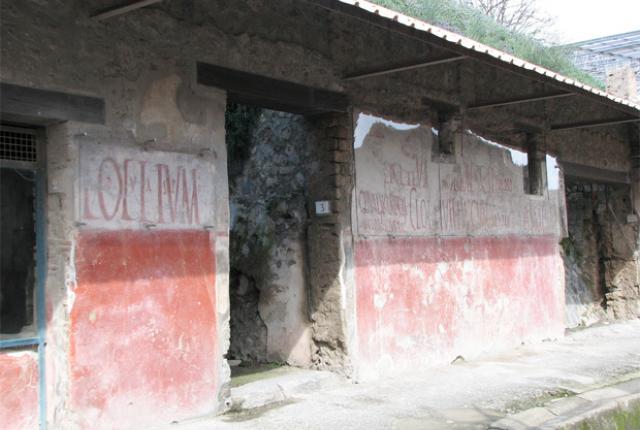
Roman Graffiti from Pompeii

The following is a reprint from January 28, 2013.

Let us say we were seated across the table from an ancient Roman and, say, a Viking. Aside from the obvious language problem, would there be enough commonality to allow for a spirited discussion? I think there would be, primarily because I have read enough Roman and Viking (I should say Icelandic and Norse) literature to vouch for the fact that, when all is said and done, we are not all that different from one another.

Let me take as a case in point graffiti that has been discovered from the ruins of Pompeii and Herculaneum. You can probably find the equivalent in any nightclub’s restroom wall:

  • Philiros spado – “Philiros is a eunuch”
  • Apollinaris, medicus Titi Imperatoris hic cacavit bene – “Apollinaris, physician to the Emperor Titud, had a good crap here”
  • Oppi, emboliari, fur, furuncle – “Oppius, you’re a clown, a thief, and a cheap crook”
  • Miximus in lecto. Faetor, peccavimus, hospes. Si dices: quare? Nulla matella fuit –
    This one was found in an inn: “We have wet the bed. I admit we were wrong, my host, but if you ask why, it is because there was no chamber pot.”
  • Virgula Tertio su: Indecens esVirgula to Tertius: You are a nasty boy.“
  • Suspirium puellam Celadus thraex – “Celadus makes the girls moan”

Now I have not seen the graffiti of Ancient Rome, but I saw the viking graffiti in the tomb at Maes Howe in the Orkneys. Built over 5,000 years ago, Maes Howe was frequently visited by Viking raiders in the hopes that some buried treasure could be found there. They found none, but left such observations as the following in their Futharc runes:

  • “Thorni fucked. Helgi carved.”
  • “Ingigerth is the most beautiful of all women” next to a picture of a slobbering dog.
  • “These runes were carved by the man most skilled in runes in the Western Ocean.”

You can find more about the Pompeiian graffiti by clicking here. The runes at Maes Howe are explained here.

The more things change, the more they remain the same.

Giving Life to a Period in History

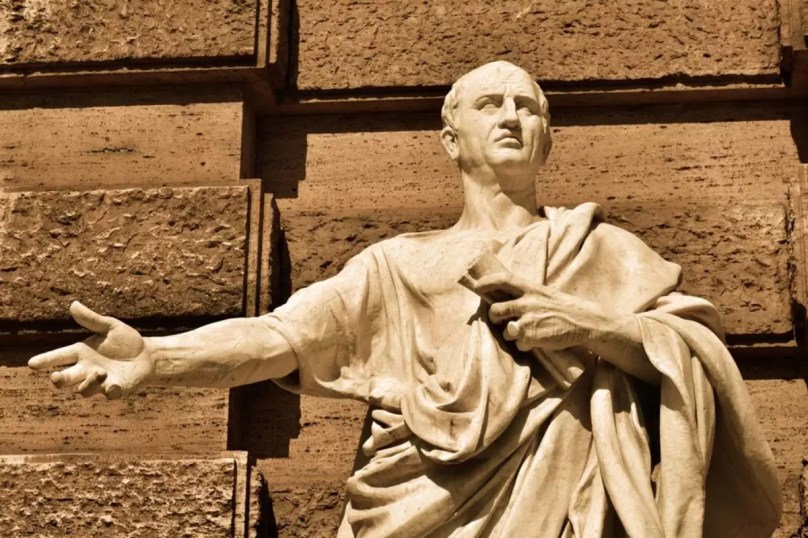
Roman Senator Marcus Tullius Cicero (100-43 BCE)

How many letters and journals have come down to us from Ancient Egypt or Classical Greece or Biblical Palestine? None. Consequently, our view of their respective civilizations is an incomplete one. For the last years of the Roman Republic, however, we have a voluminous orator, letter writer, and philosopher who was very much at the center of the action.

Marcus Tullius Cicero was one of the most powerful members of the Roman Senate. From him, we have political orations, speeches for the prosecution or defense of murder trials, essays on the gods and growing old (among other subjects), and letters to friends and political associates. In particular, his letters to his friend Atticus give us a picture of his times such as we do not have from any other ancient civilization.

What is more, his works are eminently readable today. In fact, his oration attacking Mark Antony was so effective that the Roman general promptly sent out an assassin to shut him up permanently.

I have just finished viewing the HBO/BBC co-produced mini-series called Rome (2005-2007) which covered the last days of the Roman Republic. The twenty-two episodes include incidents in the life of Julius Caesar, Augustus Caesar, Mark Antony, Pompey the Great, Brutus, Cassius, Cleopatra, and Cicero.

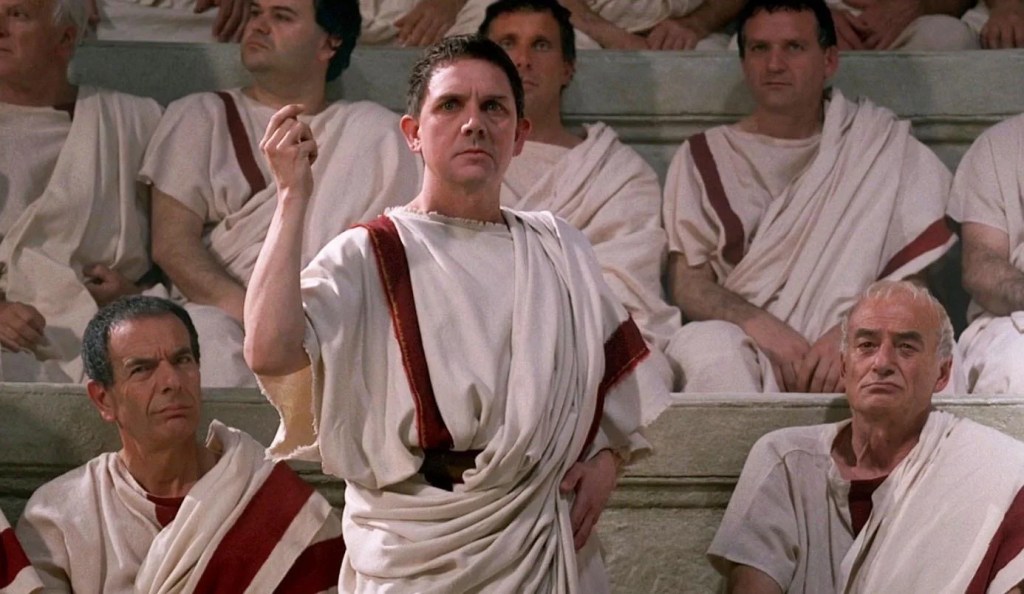
David Bamber as Cicero in the HBO/BBC Mini-Series Rome

Both the mini-series and Cicero’s own writings portray the senator as a deeply divided individual. He was a follower of Gnaeus Pompey and was with him when he lost to Julius Caesar at Pharsalus. Then he sided with Brutus, Cassius, and the other slayers of Julius Caesar and was with them at the Battle of Philippi. That did not sit well with Antony and Octavian (later renamed Augustus), who agreed to his demise.

Even more than two thousand years later, we can see clearly that Cicero was a follower of the old, traditional senate and of Cato the Younger, who committed suicide after Philippi. In 63 BCE, he led the overthrow of the conspiracy of Lucius Sergius Catiline, having several of the participants executed without trial. Ever after, he was disappointed that the people did not express sufficient gratitude. It was clearly a case of, “Yes, but what have you done for us lately?”

I strongly urge you to read some of the excellent Penguin translations of Cicero’s work and, if you have time, view the Rome mini-series, which is still available on HBO.

A Brief Tenure

Statue of Julius Caesar as a God

I have just finished reading Adrian Keith Goldsworthy’s biography, Caesar: Life of a Colossus. While not pertaining directly to the subject of his biography, Goldsworthy includes an amusing anecdote about a consul who dies on his last day in office and the consul-for-a-day who succeeds him:

When Fabius Maximus went to watch a play and was announced as consul, the audience is said to have yelled out, “He is no consul!” He died on the morning of his last day in office. Caesar received the news while presiding over a meeting of the Tribal Assembly, which was going to elect quaestors for the next year. Instead, he had the people reconvene as the Comitia Centuriata and vote for a new consul. Just after midday another of his legates from Gaul was chosen, Caius Caninius Rebilus, whose spell as consul therefore lasted no more than a few hours. A few days later Cicero joked that ‘in the consulship of Caninius nobody ate lunch. However, nothing bad occurred while he was consul—for his vigilance was so incredible that throughout his entire consulship he never went to sleep.’ At the time he is supposed to have urged everyone to rush and congratulate Caninius before his office expired.

Our Nero

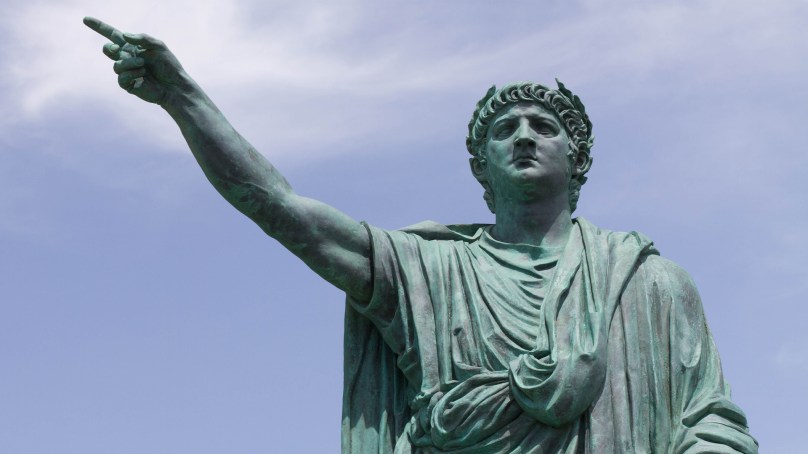
Roman Emperor Nero (AD 37-68)

Much as I dislike writing about politics, I have recently noticed some strange resemblances between the current occupant of the White House and the Roman Emperor Nero:

Actors. Nero appeared before the Roman public as a poet, musician, and charioteer; while our president was famed as the actor in a reality TV show called “The Apprentice.”

Wrecking. Nero purportedly burned down a large part of Rome so he could build a gigantic palace for himself called the domus aureus, “The Golden House.” Our president is destroying the institutions of government that he feels do not benefit billionaires like himself.

Praetorian Guard. Nero was murdered by his own Praetorian Guard. Our president, on the other hand, is developing his own Praetorian Guard called ICE. To date, they have not murdered him.

Low-Class Supporters. The provision of “bread and circuses” to the Roman masses made Nero popular among lower class denizens of Rome. Whereas the persecution of various minorities is popular among the red-hatted MAGA supporters of our president.

So far, our current president has not directly ordered any of his family murdered, but if I were Melania, Donald Junior, or Eric, I would not sleep well of nights.

Philosophy for Whom?

The Emperor Marcus Aurelius (121-180 AD)

Ever since I was a high school student, I pictured myself as studying philosophy and thereby improving my life. Very early on, I learned that most philosophers were too abstruse for the likes of me. I ran up against the likes of Kant, Heidegger, Sartre, Wittgenstein, and Hegel—and found myself considerably less smart than I thought. (However, I liked Sartre’s fiction and plays).

Recently I found myself drawn to the philosophers of ancient Greece and Rome. Now it seems that philosophy is several removes from everyday life. Read A. J. Ayer and Wittgenstein, and you’ll have no idea how to live your life. But read the ancient Stoics, and you can indeed feel better about your life.

Particularly interesting are the following Roman philosophers:

  • Lucius Annaeus Seneca (4 BC to 65 AD) practically ran the Roman Empire while he helped to educate the young Nero. Unfortunately, his pupil did not turn out well; and Nero ordered his tutor to commit suicide. Read in particular his Letters of a Stoic.
  • Epictetus (50-135 AD) was a former slave who wrote a very readable treatise entitled The Enchiridion.
  • Marcus Aurelius (121-180 AD) was the last of the benevolent Antonine emperors. (As great a philosopher as the father was, his son Commodus was one of the worst emperors.) The Meditations are a highly readable journal of Marcus Aurelius’s thoughts while ruling a large part of the known world.

The amazing thing about the works of these Stoic philosophers is that they are relevant and highly readable today. Much more so than most of the present day philosophers.

The Good Emperor

Marcus Aurelius Antoninus (AD 121-180)

When Edward Gibbon came to write The Decline and Fall of the Roman Empire, he began with what he regarded as a golden age in the affairs of men, namely, the reign of the five “good” Antonine emperors. These were Nerva (AD 96-98), Trajan (AD 98-117), Hadrian (AD 117-138), Antoninus Pius (AD 138-161), and Marcus Aurelius (AD 161-180).

Among all the Roman emperors, it was only Marcus Aurelius who, in his Meditations, published a work of Stoic philosophy that is read to this day. It was he who wrote:

When you first rise in the morning tell yourself: I will encounter busybodies, ingrates, egomaniacs, liars, the jealous and cranks. They are all stricken with these afflictions because they don’t know the difference between good and evil. Because I have understood the beauty of good and the ugliness of evil, I know that these wrong-doers are still akin to me . . . and that none can do me harm, or implicate me in ugliness—nor can I be angry at my relatives or hate them. For we are made for cooperation.

Today was the last day at the Getty Villa in Pacific Palisades for a 3½-pound gold head of the emperor to be on display, so I felt I just had to see it. So I drove out to the Villa with my 90-year-old neighbor Luis to see it and check out the permanent collections as well.

It was well worth seeing, even though I developed a bad case of museum legs which tired me out after five hours. I visit the museum two or three times a year, and i love it more each time. And now I feel I should re-read the Meditations. I mean, how many world leaders ever wrote a major work of philosophy that still has worth in today’s world?

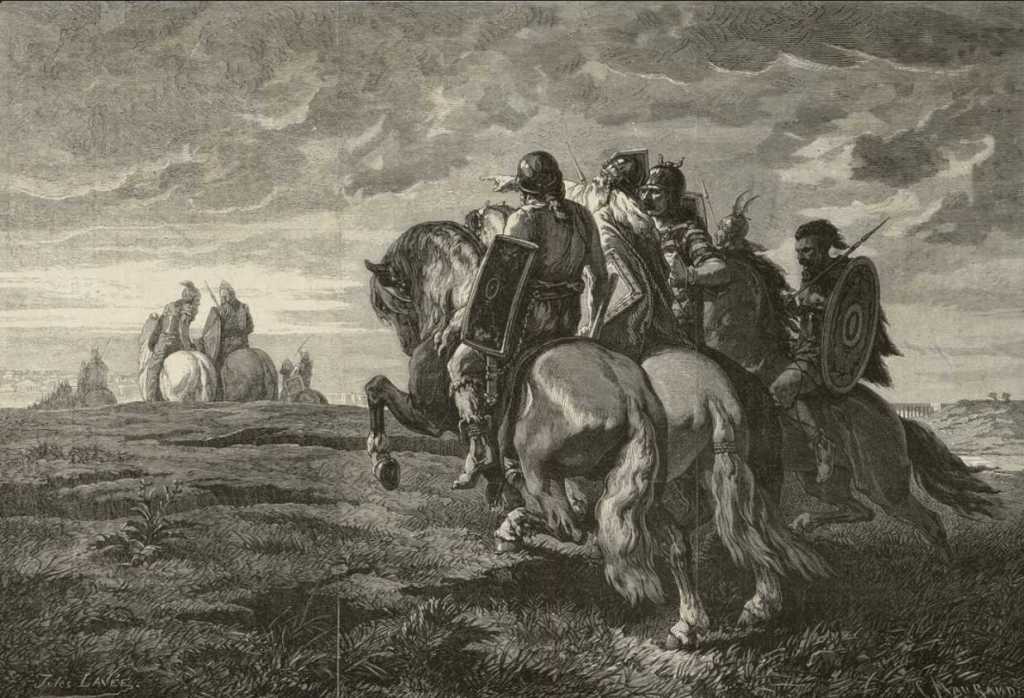
The Barbarians Are Coming! The Barbarians Are Coming!

There are two ways of looking at the Barbarian Invasions of the Roman Empire. For the first, we have Orientius, said to be a cleric from Gascony, in his Commonitorium:

Look at how death has swept through the entire world,
at how many peoples have been affected by the madness of war.
What use are thick forests or high and inaccessible mountains,
what use the raging torrents with violent whirlpools,
carefully located fortresses, cities protected by their walls,
positions defended by the sea, the squalor of hiding places,
the darkness of caves and the hovels among the rocks;
nothing has been of use in avoiding the barbarians hunting in a pack….
In the villages and the villas, in the fields and at the crossroads,
in all the hamlets, on the roads and in every other place,
death, suffering, massacres, fire-raising, and mourning:
the whole of Gaul was burning in a single blaze.

Then there is the view of Greek poet Constantine Cavafy in his wonderful poem:

Waiting for the Barbarians

What are we waiting for, assembled in the forum?

The barbarians are due here today.

Why isn’t anything going on in the senate?
Why are the senators sitting there without legislating?

Because the barbarians are coming today.
What’s the point of senators making laws now?
Once the barbarians are here, they’ll do the legislating.

Why did our emperor get up so early,
and why is he sitting enthroned at the city’s main gate,
in state, wearing the crown?

Because the barbarians are coming today
and the emperor’s waiting to receive their leader.
He’s even got a scroll to give him,
loaded with titles, with imposing names.

Why have our two consuls and praetors come out today
wearing their embroidered, their scarlet togas?
Why have they put on bracelets with so many amethysts,
rings sparkling with magnificent emeralds?
Why are they carrying elegant canes
beautifully worked in silver and gold?

Because the barbarians are coming today
and things like that dazzle the barbarians.

Why don’t our distinguished orators turn up as usual
to make their speeches, say what they have to say?

Because the barbarians are coming today
and they’re bored by rhetoric and public speaking.

Why this sudden bewilderment, this confusion?
(How serious people’s faces have become.)
Why are the streets and squares emptying so rapidly,
everyone going home lost in thought?

Because night has fallen and the barbarians haven’t come.
And some of our men just in from the border say
there are no barbarians any longer.

Now what’s going to happen to us without barbarians?
Those people were a kind of solution.

Now which attitude do we take if Donald Trump and his incel hoards should regain the Presidency of the United States?


Et Tu, Brute?!

The Assassination of Julius Caesar by Mariano Rossi (1731-1807)

I have just finished reading an interesting book that sheds light on how rhetoric influenced the way people acted in ancient Rome. J. E. Lendon’s That Tyrant Persuasion: How Rhetoric Shaped the Roman World shows that public speechifying was the dominant mass medium of the time and affected the laws and, in many respects, the way people acted.

Lendon used as his prime example the conspiracy to assassinate Julius Caesar by Brutus, Cassius, and their associates. In Chapter Four, he discusses eight reasons why the whole conspiracy had been a shambles:

  • Decimus Brutus had armed gladiators near the Senate House of Pompey. Why did they not kill Caesar?
  • Why did all the conspirators in the Senate House want to stab Caesar themselves, producing a confused melee?
  • Why did the conspirators do nothing about Mark Antony and Marcus Lepidus, or any other followers of Caesar, not even arrest them for kid-glove treatment if the fastidious Brutus insisted? It was especially leaving Antony alive that Cicero later regarded as “childish.”
  • Why did Brutus think that after the assassination he would be able to address the Senate? Why did he not expect the senators, most of them loyalists of Caesar, to be terrified of the deed?
  • Why were the conspirators apparently surprised by the panic their deed caused in the city?
  • Why did the conspirators go up the Capitoline Hill?
  • Why did the conspirators spend March 16 giving speeches in the Forum?
  • Why, other than descending to give speeches, did the conspirators apparently have no plans for what to do after they ascended the Capitoline Hill, given that the reactions of Lepidus, Antony, their troops, and Caesar’s veterans could have been predicted?

In his book, Lendon deals with each of these questions in great detail. As I read his book, I suddenly saw that public speaking in ancient Rome was the equivalent of our social media, and that the conspirators who, at Donald Trump’s urging, marched on the Capitol on January 6, 2021 were being misled in much the same way that Brutus and his co-conspirators were by the conventions of ancient rhetoric.

Is the Emperor Happy?

Solidus of the Emperor Petronius Maximus (Mar-May455)

I am greatly enjoying the second volume of The Barbarian Invasions of the Roman Empire, written by Thomas Hodgkin (1798-1866). This is the volume that tells of the Huns and the Vandals. More and more, I am fascinated by classic 19th century British and American historians.

The following excerpt is from Apollinaris Sidonius, a fifth century Roman poet, diplomat, and bishop. He is writing about the emperor that followed Valentinian III, who was assassinated for his part in the murder of Aetius, the last great Roman general, who defeated Attila and the Huns at Chalons in CE 451.

I received your letter … dedicated to the praises of your patron the emperor Petronius Maximus. I think, however, that either affection or a determination to support a foregone conclusion has carried you away from the strict truth when you call him most happy because he passed through the highest offices of the state and died an emperor. I can never agree with the opinion that those men should be called happy who cling to the steep and slippery summits of the state. For words cannot describe how many miseries are hourly endured in the lives of men who, like [the Roman dictator] Sulla, claim to be called Felix [fortunate] because they have clambered over the limits of law and right assigned to the rest of their fellow citizens. They think that supreme power must be supreme happiness, and do not perceive that they have, by the very act of grasping dominion, sold themselves to the most wearisome of all servitudes; for, as kings lord it over their fellow men, so the anxiety to retain power lords it over kings.

Lucretius on the Nature of Things

Titus Lucretius Carus (1st Century BC)

It’s not easy to read The Nature of Things by Lucretius. Not only does he attempt to summarize the philosophy of Epicurus and the science knowledge of his day (40-55 BC), but he did in in rhymed couplets, which in this edition are translated as heptameter (“fourteeners”).

Not to worry: If you press on, you will get the gist of what Lucretius writes, and you will encounter some great passages such as this one on the role of the gods in life:

If you possess a firm grasp of these tenets, you will see
That Nature, rid of harsh taskmasters, all at once is free,
And everything she does, does on her own, so that gods play
No part. For by the holy hearts of gods, who while away
Their tranquil immortality in peace!—who can hold sway
Over the measureless universe? Who is there who can keep
Hold of the reins that curb the power of the fathomless deep?
Who can juggle all the heavens? And with celestial flame
Warm worlds to fruitfulness? And be all places at the same
Time for all eternity, to cast a shadow under
Dark banks of clouds, or quake a clear sky with the clap of thunder?
What god would send down lightning to rend his own shrines asunder?
Or withdraw to rage in desert wastes, and there let those bolts fly
That often slay the innocent and pass the guilty by?

It is a far different world than hours. Instead of the Periodical Table of the Elements, Lucretius had earth, wind, air, and fire. You can see him bending in obscure directions to explain such phenomena as magnetism, thunder, earthquakes, and plagues. Yet one could not help but admire the ingenuity of an astute observer who had no notion of Newtonian Physics, let alone Quantum Physics, yet tried his hardest to explain what he saw.