Serendipity: An Eye-Witness to Vesuvius AD 79

The Vesuvius Eruption as Imagined by an Artist

I have just finished reading the complete letters of Pliny the Younger (AD 61-113). They were interesting on three counts. First of all, I was impressed by Pliny’s honesty and sense of civic responsibility. Secondly, toward the end of his life, he was governor of Bithynia and Pontus, where he died in AD 113. Finally he writes as a first hand witness of the eruption o Vesuvius in AD 79. He and his uncle Pliny the Elder were across the bay as it happened. The uncle crossed the bay to investigate, and died in the process. Here is his nephew’s account in a letter he wrote to the historian Cornelius Taci

Your request that I would send you an account of my uncle’s death, in order to transmit a more exact relation of it to posterity, deserves my acknowledgments; for, if this accident shall be celebrated by your pen, the glory of it, I am well assured, will be rendered forever illustrious. And notwithstanding he perished by a misfortune, which, as it involved at the same time a most beautiful country in ruins, and destroyed so many populous cities, seems to promise him an everlasting remembrance; notwithstanding he has himself composed many and lasting works; yet I am persuaded, the mentioning of him in your immortal writings, will greatly contribute to render his name immortal. Happy I esteem those to be to whom by provision of the gods has been granted the ability either to do such actions as are worthy of being related or to relate them in a manner worthy of being read; but peculiarly happy are they who are blessed with both these uncommon talents: in the number of which my uncle, as his own writings and your history will evidently prove, may justly be ranked. It is with extreme willingness, therefore, that I execute your commands; and should indeed have claimed the task if you had not enjoined it. He was at that time with the fleet under his command at Misenum. On the 24th of August, about one in the afternoon, my mother desired him to observe a cloud which appeared of a very unusual size and shape. He had just taken a turn in the sun and, after bathing himself in cold water, and making a light luncheon, gone back to his books: he immediately arose and went out upon a rising ground from whence he might get a better sight of this very uncommon appearance. A cloud, from which mountain was uncertain, at this distance (but it was found afterwards to come from Mount Vesuvius), was ascending, the appearance of which I cannot give you a more exact description of than by likening it to that of a pine tree, for it shot up to a great height in the form of a very tall trunk, which spread itself out at the top into a sort of branches; occasioned, I imagine, either by a sudden gust of air that impelled it, the force of which decreased as it advanced upwards, or the cloud itself being pressed back again by its own weight, expanded in the manner I have mentioned; it appeared sometimes bright and sometimes dark and spotted, according as it was either more or less impregnated with earth and cinders. This phenomenon seemed to a man of such learning and research as my uncle extraordinary and worth further looking into. He ordered a light vessel to be got ready, and gave me leave, if I liked, to accompany him. I said I had rather go on with my work; and it so happened, he had himself given me something to write out. As he was coming out of the house, he received a note from Rectina, the wife of Bassus, who was in the utmost alarm at the imminent danger which threatened her; for her villa lying at the foot of Mount Vesuvius, there was no way of escape but by sea; she earnestly entreated him therefore to come to her assistance. He accordingly changed his first intention, and what he had begun from a philosophical, he now carries out in a noble and generous spirit. He ordered the galleys to be put to sea, and went himself on board with an intention of assisting not only Rectina, but the several other towns which lay thickly strewn along that beautiful coast. Hastening then to the place from whence others fled with the utmost terror, he steered his course direct to the point of danger, and with so much calmness and presence of mind as to be able to make and dictate his observations upon the motion and all the phenomena of that dreadful scene. He was now so close to the mountain that the cinders, which grew thicker and hotter the nearer he approached, fell into the ships, together with pumice-stones, and black pieces of burning rock: they were in danger too not only of being aground by the sudden retreat of the sea, but also from the vast fragments which rolled down from the mountain, and obstructed all the shore. Here he stopped to consider whether he should turn back again; to which the pilot advising him, “Fortune,” said he, “favours the brave; steer to where Pomponianus is.” Pomponianus was then at Stabiae, separated by a bay, which the sea, after several insensible windings, forms with the shore. He had already sent his baggage on board; for though he was not at that time in actual danger, yet being within sight of it, and indeed extremely near, if it should in the least increase, he was determined to put to sea as soon as the wind, which was blowing dead in-shore, should go down. It was favourable, however, for carrying my uncle to Pomponianus, whom he found in the greatest consternation: he embraced him tenderly, encouraging and urging him to keep up his spirits, and, the more effectually to soothe his fears by seeming unconcerned himself, ordered a bath to be got ready, and then, after having bathed, sat down to supper with great cheerfulness, or at least (what is just as heroic) with every appearance of it. Meanwhile broad flames shone out in several places from Mount Vesuvius, which the darkness of the night contributed to render still brighter and clearer. But my uncle, in order to soothe the apprehensions of his friend, assured him it was only the burning of the villages, which the country people had abandoned to the flames: after this he retired to rest, and it is most certain he was so little disquieted as to fall into a sound sleep: for his breathing, which, on account of his corpulence, was rather heavy and sonorous, was heard by the attendants outside. The court which led to his apartment being now almost filled with stones and ashes, if he had continued there any time longer, it would have been impossible for him to have made his way out. So he was awoke and got up, and went to Pomponianus and the rest of his company, who were feeling too anxious to think of going to bed. They consulted together whether it would be most prudent to trust to the houses, which now rocked from side to side with frequent and violent concussions as though shaken from their very foundations; or fly to the open fields, where the calcined stones and cinders, though light indeed, yet fell in large showers, and threatened destruction. In this choice of dangers they resolved for the fields: a resolution which, while the rest of the company were hurried into by their fears, my uncle embraced upon cool and deliberate consideration. They went out then, having pillows tied upon their heads with napkins; and this was their whole defence against the storm of stones that fell round them. It was now day everywhere else, but there a deeper darkness prevailed than in the thickest night; which however was in some degree alleviated by torches and other lights of various kinds. They thought proper to go farther down upon the shore to see if they might safely put out to sea, but found the waves still running extremely high, and boisterous. There my uncle, laying himself down upon a sail cloth, which was spread for him, called twice for some cold water, which he drank, when immediately the flames, preceded by a strong whiff of sulphur, dispersed the rest of the party, and obliged him to rise. He raised himself up with the assistance of two of his servants, and instantly fell down dead; suffocated, as I conjecture, by some gross and noxious vapour, having always had a weak throat, which was often inflamed. As soon as it was light again, which was not till the third day after this melancholy accident, his body was found entire, and without any marks of violence upon it, in the dress in which he fell, and looking more like a man asleep than dead. During all this time my mother and I, who were at Misenum—but this has no connection with your history, and you did not desire any particulars besides those of my uncle’s death; so I will end here, only adding that I have faithfully related to you what I was either an eye-witness of myself or received immediately after the accident happened, and before there was time to vary the truth. You will pick out of this narrative whatever is most important: for a letter is one thing, a history another; it is one thing writing to a friend, another thing writing to the public.
Optimates and Populares

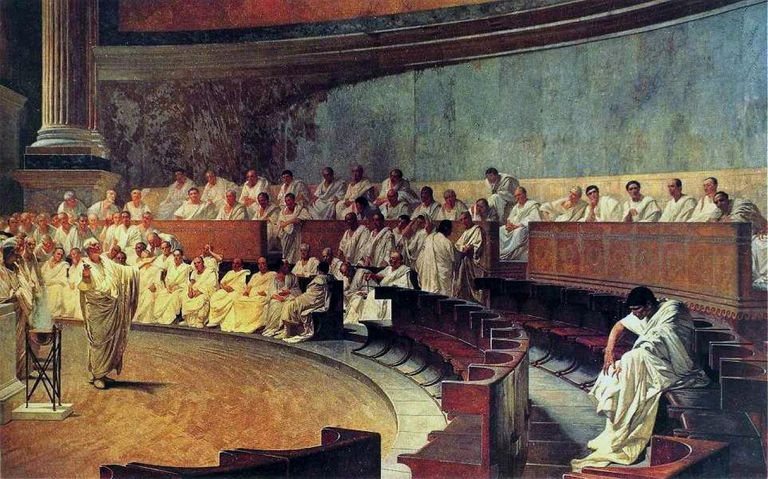
The Roman Senate with Cicero Accusing Catiline (Seated by Himself at Right)

Over the last couple of days, I have been reading Mary Beard’s SPQR: A History of Ancient Rome. We think of the Roman Republic in very decorous terms, with all those dignified men in togas. We don’t see many representations of Roman plebeians, who were not permitted to wear the toga—let alone the thousands of slaves living in the city.

It was actually a far from decorous time, with over a hundred years of violent conflict between the optimates (wealthy upper classes) and the populares (common people). This century included the Brothers Gracchi, who were murdered; the brutal dictator Sulla; the victorious general Marius; and ended with the war between Julius Caesar and Pompey the Great. In many ways, it was reminiscent of our own times—a time when we are envisioning the end of our own Republic from the repeated assaults of the Dictator Trump.

Among the optimates, there were the senate, the consuls, the priesthood, all the Republican offices (Quaestor, Praetor, Aedile, etc.), as well as the class of equites, or knights. For most of its existence, these are the people who ruled the Republic. The populares, or plebeians, were everyone else (always excepting the slaves, who had no one to speak for them). The optimates did everything in their power to aggrandize their power at the expense of the populares. In fact, one of the reasons Julius Caesar was assassinated in the Senate in 44 BC was his policy of sharing power with the populares. The men who stabbed him were all Senators.

I am tempted to equate the optimates with Republicans, and the populares with Democrats. In fact, the situation was complicated by the inhabitants of the various provinces of the Republic—and these provinces began right outside the Rome city limits.


Serendipity: Fury Cursing the House of Atreus

The Progeny of Tantalus, Atreus, and Thyestes Is Cursed by the Gods

I have been reading the tragedies of Seneca, where I came upon this speech by the Fury that curses the progeny of Tantalus, which includes Atreus, Thyestes, Agamemnon, and Aegisthus. This occurs in the tragedy Thyestes. I cannot help relating it to the House of Trumpf in Washington.

Haughty brothers will lose their kingdoms, then be recalled from exile to rule again. The destiny of their house will swing violently back and forth between short-lived kings; the powerful will become humble, the humble powerful. Fortune will carry the kingship on a constant wave of uncertainty. When god restores to their country those exiled because of their crimes, they will return only to commit more. Everyone else will hate them as much as they hate each other. In their anger they will consider nothing off limits: brother will fear brother, father son, son father. Children will suffer wicked deaths but be born out of even greater wickedness. A hostile wife will plot against her husband. But in this wicked house adultery will be the most trivial of crimes. Righteousness, Faith, Law—all will perish. Wars will be carried across the seas; every land will be irrigated by bloodshed. Lust will exult victoriously over the mighty leaders of nations. Not even heaven will be exempt from your wickedness! Why do stars still shine in heaven’s vault? Why do their flames still feel obliged to offer their splendour to the world? No! Let there be deep night! Let day retreat from the sky! Embroil your household! Summon Hatred, Slaughter, Death! Fill the whole house with your contagion, fill it with the essence of Tantalus.

Just to refresh your memory, Tantalus was a son of Jupiter. He killed his son Pelops and attempted to feed him to the gods. “For this he was punished with eternal thirst and hunger while residing in a pool of water and surrounded by trees with low-hanging fruits, which would recede and retreat whenever he tried to drink or eat them—the origin of our word ‘tantalize.‘” (From the Penguin edition of Seneca’s Phaedra and Other Plays.)

Why were Seneca’s tragedies so dark? He was the Emperor Nero’s adviser, which drove him to commit suicide by taking hemlock.


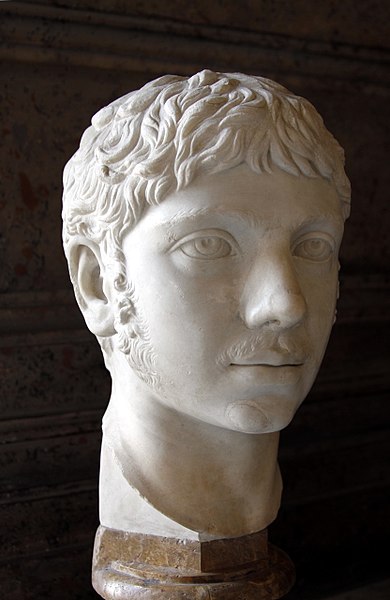
Elagabalus

Elagabalus (AD 203-222)

It is generally accepted that the worst of the Roman emperors was Elagabalus, also known as Heliogabalus, who reigned from 218 to 222, when he was assassinated by the Praetorian Guard at the tender age of eighteen. My thoughts tend to turn in his direction when I consider the current occupant of the White House and various other Trumpf properties. Read what Edward Gibbon has to say about him in The Decline and Fall of the Roman Empire:

A rational voluptuary adheres with invariable respect to the temperate dictates of nature, and improves the gratifications of sense by social intercourse, endearing connections, and the soft coloring of taste and the imagination. But Elagabalus, (I speak of the emperor of that name,) corrupted by his youth, his country, and his fortune, abandoned himself to the grossest pleasures with ungoverned fury [Italics mine], and soon found disgust and satiety in the midst of his enjoyments. The inflammatory powers of art were summoned to his aid: the confused multitude of women, of wines, and of dishes, and the studied variety of attitude and sauces, served to revive his languid appetites. New terms and new inventions in these sciences, the only ones cultivated and patronized by the monarch, signalized his reign, and transmitted his infamy to succeeding times. A capricious prodigality supplied the want of taste and elegance; and whilst Elagabalus lavished away the treasures of his people in the wildest extravagance, his own voice and that of his flatterers applauded a spirit of magnificence unknown to the tameness of his predecessors. To confound the order of seasons and climates, to sport with the passions and prejudices of his subjects, and to subvert every law of nature and decency, were in the number of his most delicious amusements. A long train of concubines, and a rapid succession of wives, among whom was a vestal virgin, ravished by force from her sacred asylum, were insufficient to satisfy the impotence of his passions. The master of the Roman world affected to copy the dress and manners of the female sex, preferred the distaff to the sceptre, and dishonored the principal dignities of the empire by distributing them among his numerous lovers; one of whom was publicly invested with the title and authority of the emperor’s, or, as he more properly styled himself, of the empress’s husband.

Perhaps what this country needs is a Praetorian Guard detachment.


Stymie the Pollsters!

It Would Be Nice If This Election Unified Us, But....

It Would Be Nice If This Election Unified Us, But….

We’ve all had it up to here with the damnable Presidential Election of 2016. I think it’s time to throw some monkey wrenches, particularly at the work of political pollsters. When they call you in the evening (it’s always in the evening), politely but firmly decline to state your preferences or, in fact, to answer any questions at all. Just tell them it’s in violation of your religion.

Let’s face it, more than half the polls are abominations, but even the ones that aren’t deserve to be stymied at every turn. Until the candidates themselves lose all faith in the polls, the horrendous campaign meat grinder will continue to burn money and patience until we are so disgusted as to consider renouncing our citizenship.

Whether its Cheeto-Brain or the Great Stone Spouse who wins, no one will be particularly happy. We are in a period that resembles the Roman Empire after the Antonine “good” emperors, when Rome had one ruler after another mercifully assassinated by the Praetorian Guard, until the reign of the truly dreadful Elagabalus from AD 218 to 222 .

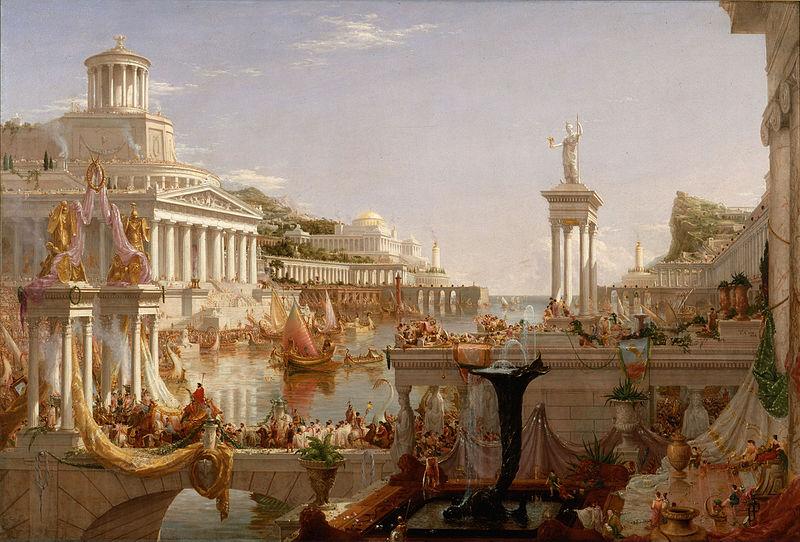
The Fall of Rome

Cole Thomas’s “The Course of Empire”

Cole Thomas’s “The Course of Empire”

That’s the title of this poem by W. H. Auden, dedicated to his friend Cyril Connolly:

The piers are pummelled by the waves;
In a lonely field the rain
Lashes an abandoned train;
Outlaws fill the mountain caves.

Fantastic grow the evening gowns;
Agents of the Fisc pursue
Absconding tax-defaulters through
The sewers of provincial towns.

Private rites of magic send
The temple prostitutes to sleep;
All the literati keep
An imaginary friend.

Cerebrotonic Cato may
Extol the Ancient Disciplines,
But the muscle-bound Marines
Mutiny for food and pay.

Caesar’s double-bed is warm
As an unimportant clerk
Writes I DO NOT LIKE MY WORK
On a pink official form.

Unendowed with wealth or pity,
Little birds with scarlet legs,
Sitting on their speckled eggs,
Eye each flu-infected city.

Altogether elsewhere, vast
Herds of reindeer move across
Miles and miles of golden moss,
Silently and very fast.

The Fisc refers to Britain’s tax agency, also known as The Inland Revenue.


Lions and Bulls, Oh My!

A Frequent Theme in Roman Mosaic Art?

A Frequent Theme in Roman Mosaic Art?

At our visit to the Getty Villa on Wednesday, I was surprised to see so many works depicting lions eating other large, powerful beasts. There was a special exhibit entitled “Roman Mosaics Across the Empire.” (Follow the link and you will see a lion biting into a surprisingly nonchalant horse.) The image that caught my eye, however, was the one above, in which a lion is chasing what looks like a Brahma bull.

Roman mosaics can be stunningly beautiful. I remember a show at the Los Angeles County Museum of Art years ago which included various objects retrieved from the ruins at Pompeii and Herculaneum. The mosaics in this exhibit, taken from the Naples Museum of Archaeology, were particularly beautiful—probably because the Romans during that period were more advanced in their art than those of the later Empire, from which most of the works in this special exhibit were drawn.

There were numerous lions, particularly in funerary monuments. Although I do not recall reading anything about lions during Roman times, I am surprised that they appear prominently in so many mosaics and pieces of statuary.

A Pot To Piss In

Greek Reveler Draining His Lizard

Just because they wore togas and spoke Classical Greek, that doesn’t mean that the ancient Greeks were all that high and mighty. One of the more amusing exhibits at the Getty Villa that Martine and I saw yesterday afternoon illustrated a different and more down to earth use for an amphora.

A bibulous reveler is shown urinating into the amphora (or, more technically, a chous) held up by his slave boy while continuing to declaim his sodden oration.

The closer one gets to the ancient Greeks and Romans, the more we see people very much like ourselves. The conditions of their lives were radically different, but they were recognizably human in he same way we are. Read the letters of Cicero or Pliny the Younger and you will enter a whole new world peopled with recognizable characters.


Flea-Bitten Empire

With the Legions Came Another Invader ....

With the Legions Came Other Invaders ….

According to an article in The Guardian, we tend to give a lot of credit to the Romans for cleanliness and hygiene. What is not commonly associated with them are “lice, fleas, bed bugs, bacterial infections from contamination with human feces, and 25ft-long tapeworms, a misery spread across the empire by the Roman passion for fermented fish sauce.”

But what about all those Roman baths? Well, how often was the water changed? Or did the bathers regale themselves in a bacteriological soup until the bucket brigade of slaves renewed the water? Unchanged water “left the bathers swimming in a warm soup of bacteria and the eggs of parasites such as roundworm and whipworm.” Then, too, many simply bathed themselves in olive oil, which was cleaned off with a strigil, an kind of scraper with a curved blade used to scrape sweat and dirt from the skin in a hot-air bath or after exercise.

Roman Baths

Roman Baths

And what about those tapeworms? Here the culprit was the Romans’ use of a fermented raw fish sauce called garum. According to Piers Mitchell, from whose article in The Journal of Parasitology this information is derived: “Wrapped around the Romans’ intestines …, the parasites could remove nutrients from food before it could be digested, which could cause severe or even fatal anaemia. Evidence from some Roman sites in Italy revealed that up to 80% of the child skeletons had evidence of severe anaemia.”

Another common source of ill health was the use of human feces to fertilize vegetable gardens. If the human wastes were allowed to compost for a year or more, there would be no danger from bacteriological infections; but there is no proof that the Romans knew of this.

Archaeologists found that the Romans with their baths were no freer from infection and worms and such like than the supposedly more primitive Vikings.

Sic transit gloria Imperii!

The Modesty of the Ancients

An Unedited Face from 2,300 Years Ago

An Unedited Face from 2,300 Years Ago

Going to a great art museum always makes me think. Although my two most recent posts regarding my visit to the Getty Center on Saturday are (partly) repeats, there is one thing that hit me between the eyes: In the exhibit entitled “Power and Pathos: Bronze Sculpture of the Hellenistic World ,” I saw that in the ancient world, verisimilitude took precedence over vanity. In the bust of Seuthes III (above), a Thracian monarch, for example, we have a face that does not attempt to prettify its subject. If the face on the statue was not considered to be recognizable to viewers, it was a failure. Unlike today, there was no equivalent to “Photoshopping.”

The same goes for Roman coins. Consider the following examples:

The Emperor Nero

The Emperor Nero

With that massive bull neck, the Emperor Nero was no beauty, yet all representations of him from his day do not hesitate to show his bad features, of which there were many.

The same goes for the Emperor Nerva:

The Emperor Nerva with Massive Schnozz

The Emperor Nerva with Massive Schnozz

Now here is a case of a look that a good plastic surgeon could do something about with a rhinoplasty. Nerva reminds me of that exchange in W.C. Fields’s The Bank Dick (1940):

Boy in Bank: Mommy, doesn’t that man have a funny nose?
Mother in Bank: You mustn’t make fun of the gentleman, Clifford. You’d like to have a nose like that full of nickels, wouldn’t you?