Glimmers

The Archangel Raphael in the Style of the Cuzco School of Painting

Currently, I am reading Olga Tokarczuk’s House of Day, House of Night, an early (1988) novel by the 2018 winner of the Nobel Prize in Literature. I came across the following passage and thought I would like to share it with you:

Quite out of the blue a bizarre and compelling idea came into my head today: that we have ended up as human beings through forgetfulness, through lack of attention, and that in reality we are creatures participating in a vast, cosmic battle that has probably been going on since time immemorial, and which, for all we know, may never end. All we see of it are glimmers, in blood-red moons, in fires and gales, in frozen leaves that fall in October, in the jittery flight of a butterfly, in the irregular pulse of time that can lengthen a night into infinity or come to a violent stop each day at noon. I am actually an angel or demon sent into the turmoil of one life on a sort of mission, which is either carrying itself out without my help, or else I have totally forgotten about it. This forgetfulness is part of the war—it’s the other side’s weapon, and they have attacked me with it so that I’m wounded, invalided out of the game for a while. As a result, I don’t know how powerful or weak I am—I don’t know anything about myself because I can’t remember anything, and that’s why I don’t try to look for either weakness or power in myself. It’s an extraordinary feeling—to imagine that somewhere deep inside, you are someone completely different from the person you always thought you were. But it didn’t make me feel anxious, just relieved, finally free of a kind of weariness that used to permeate my life.

Saints and Angels

The Archangel Michael Vanquishing Satan

I suppose I was always something of an unbeliever. Even when I was twelve years old and had to choose a confirmation name at St. Henry, instead of picking Michael or Joseph like all my classmates, I selected Alexander. When asked who was St. Alexander by my friends, I said it referred to Alexander VI, the notorious Borgia pope who was possibly the worst of the so called bad popes.

This evening, I was reading an amusing review of a book by Eliot Weinberger entitled Angels and Saints. Among the angels described are:

  • Nadiel, the angel of migration
  • Memuneh, the dispenser of dreams
  • Maktiel, who rules over trees
  • Taliahad, the angel of water
  • Hanum, the angel of Monday

The saints could be even more outrageous. Anne Enright’s review in the New York Review of Books includes the following tidbit:

Many of the beatified were early Christian martyrs who were hard to kill, and the details of their deaths receive more space than the manner of their lives. (I will never find again those two Roman martyrs who died by being turned upside down while milk and mustard were put up their noses, nor check through the multiple volumes [of Butler’s The Lives of the Saints] to see if I dreamed this, which surely I did not.)

One saint to whom I regularly pray is …

Genesius of Arles
(France, d. 303 or 308)
A decapitated martyr, his body was buried in France but his head was transported “in the hands of angels” to Spain, where he is invoked as a protection against dandruff.

To this day, I wish I still had my collection of holy pictures of saints, which the pious Dominican sisters of St. Henry handed out to good students. (I was sometimes good.)

With Saints and Angels in Long Beach

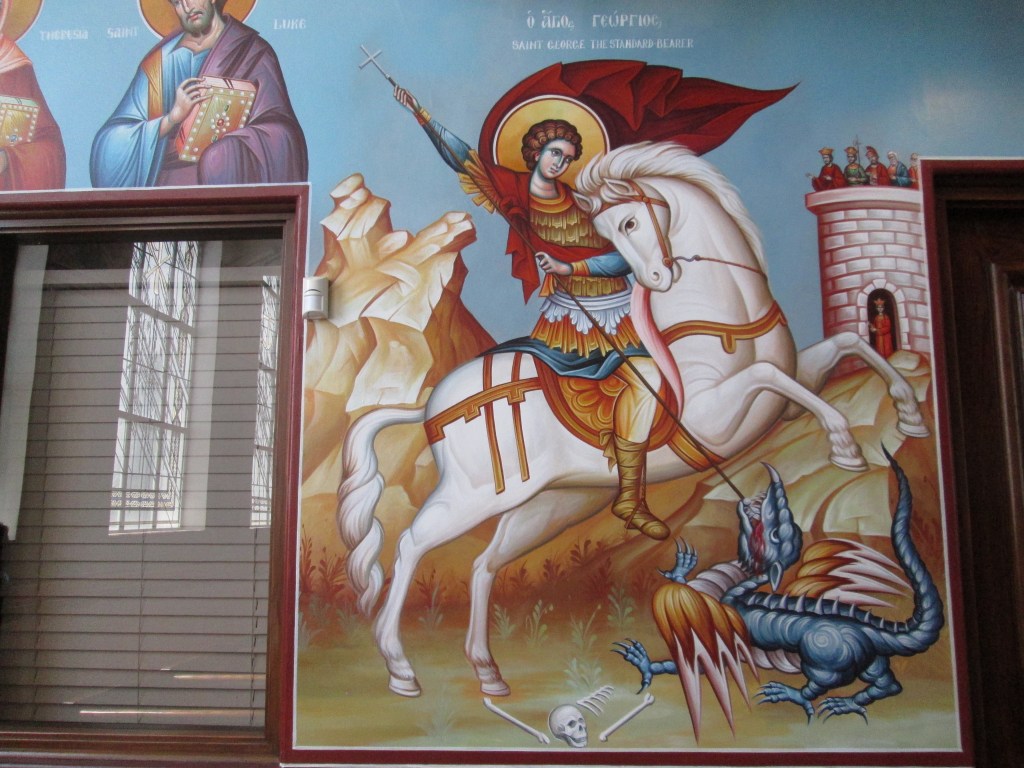
Saint George Slaying the Dragon

With the continuing heat dome over Southern California, Martine and I took a chance and went to the Long Beach Greek Festival at the Assumption of the Blessed Virgin Church. Although it was as hot as Hades, I’m glad we went. The food was good, there were tons of tasty Greek pastries, and the church itself was outstanding.

The church was not as wealthy as Saint Sophia in downtown L.A. or Saint Nicholas in Northridge, but it was beautifully painted with what seemed to be hundreds of saints and angels. And, unlike many Greek Orthodox churches, most of them were identified in both Greek and English.

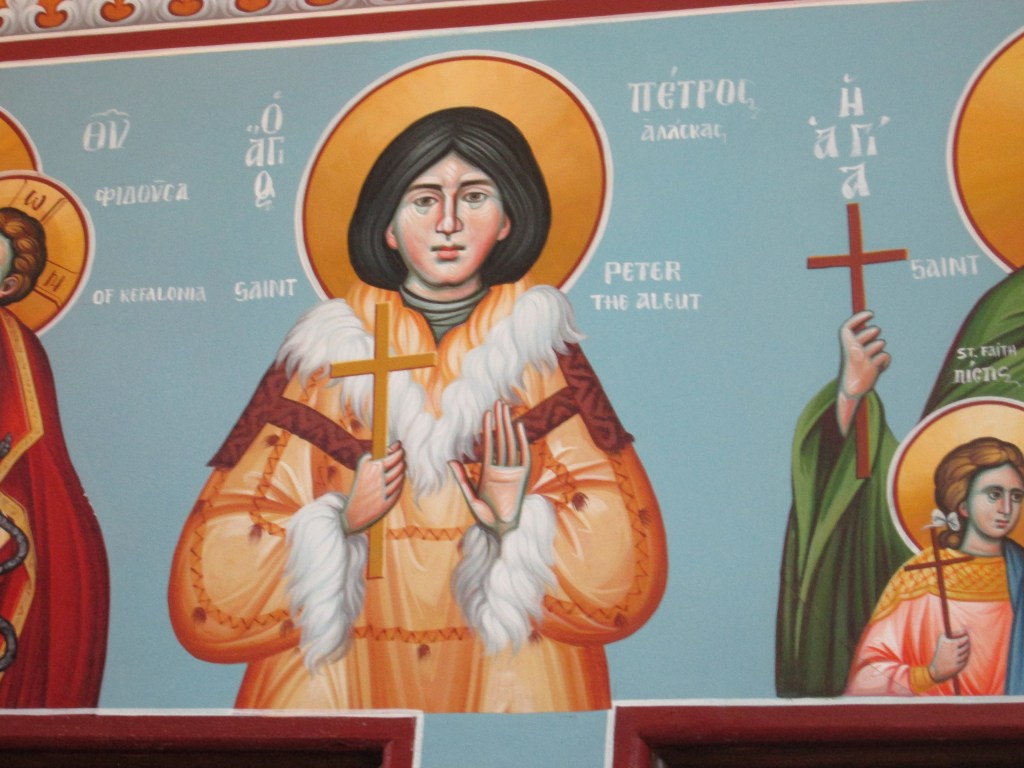
There were a few surprises, the most prominent one being an Eskimo—actually an Aleut—called Saint Peter the Aleut:

Saint Peter the Aleut, aka Cungagnaq

For an Aleut to be a Greek Orthodox martyr requires a leap of faith. And for Cungagnaq, it came in 1815 when the Spanish, who were uneasy about the Russian occupation of Alaska, captured him near San Francisco and had him put to death at the instigation of some Catholic priests who were upset that he was a heretic. Read about it on Wikipedia.

Just about every square inch of the Assumption of the Blessed Virgin church was covered with images of Christ, Mary, and the saints and angels. The effect was quite stunning. Martine and I spent an hour studying the sacred images.

I might be an indifferent lapsed Catholic, but the simplicity and sincerity of the church held my respect and even awe.

“On Angels”

Cuzco School Detail of an Angel

I love this poem by Polish poet Czeslaw Milosz (1911-2004). Sometimes I think that those who have lived much of their lives under Communism understand best our need for angels.

On Angels
All was taken away from you: white dresses,
wings, even existence.
Yet I believe you,
messengers.

There, where the world is turned inside out,
a heavy fabric embroidered with stars and beasts,
you stroll, inspecting the trustworthy seams.

Short is your stay here:
now and then at a matinal hour, if the sky is clear,
in a melody repeated by a bird,
or in the smell of apples at close of day
when the light makes the orchards magic.

They say somebody has invented you
but to me this does not sound convincing
for the humans invented themselves as well.

The voice — no doubt it is a valid proof,
as it can belong only to radiant creatures,
weightless and winged (after all, why not?),
girdled with the lightning.

I have heard that voice many a time when asleep
and, what is strange, I understood more or less
an order or an appeal in an unearthly tongue:

Day draw near
another one
do what you can.

I love the message conveyed by the angel: “do what you can.”

Christian Archeology

Interior of the Palace of the Archbishop, Lima, Peru

What shocked me more than anything during my 2014 visit to Peru was that the archeology of Spanish Catholicism in Peru was fully as interesting as the archeology of the Incas and other pre-Columbian peoples. The pictures here all come from my visit to the Palace of the Archbishop next to the Cathedral in Lima on November 9, 2014. I was guided through the Palace by a very cute young Peruvian nun who kept addressing me as “Gentleman.”

As I visited the Palace and the various churches and convents, I thought to myself that the Christian religion in Peru had passed its peak. What remained was partially syncretic, but in any case visually stunning.

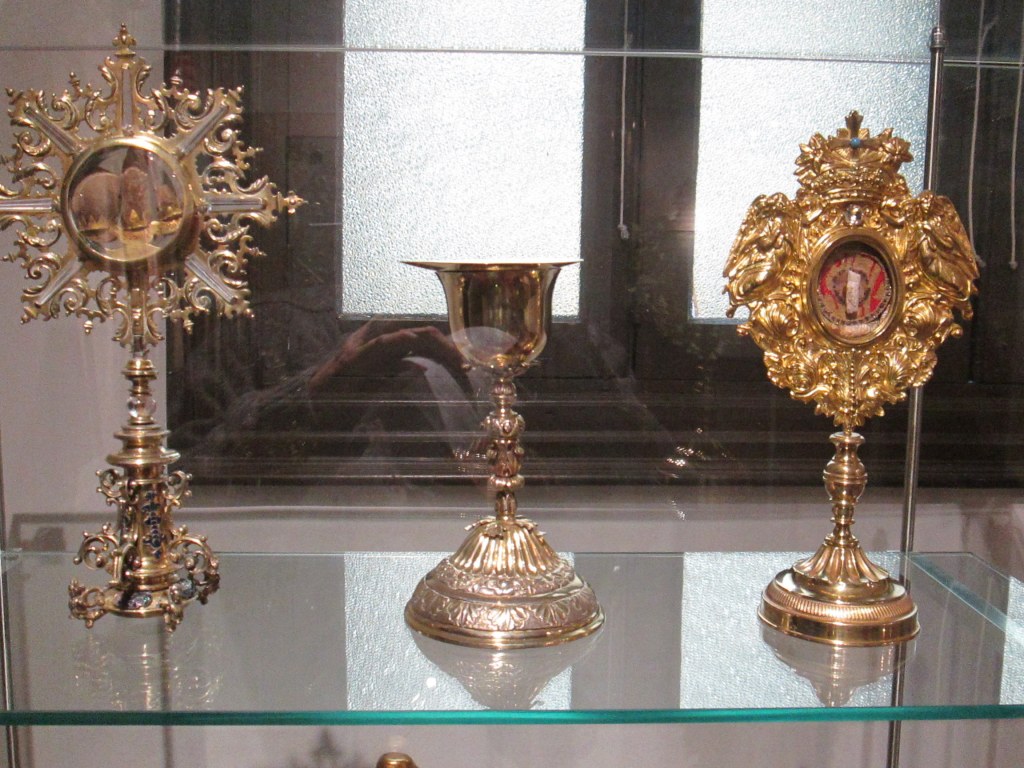
Chalice Flanked by Two Monstrances

I have often thought that it was not the King of Spain who benefited from the wealth of gold and silver transshipped from South America, as much as Holy Mother the Church. The churches and monasteries in the historic center of Lima are glistening with gold, silver, and precious stones. At the Monastery of Santo Domingo are the remains of three 17th century Limeño saints: Rose of Lima, Martín de Porres, and Juan Macías—all of whom were affiliated with the Dominican Order.

Brought up as a Roman Catholic, I found myself spending a lot more time in the churches than at the Inca ruins. They were usually beautiful and peaceful, even if I wound up attending Mass a number of times. In fact, I felt myself more a Catholic in Peru than I do in Los Angeles.

Statue of the Blessed Virgin

Whatever their original colors, it seems as if the paintings and statues of Christ, the Virgin, and the saints are predominantly reddish brown. This is particularly true of the Cusco School of Painting which predominated at the time. At some point soon, I will repeat a past post on the iconography of archangels shown in Peruvian paintings of the Cusco School.

Among the Ruins of Christianity

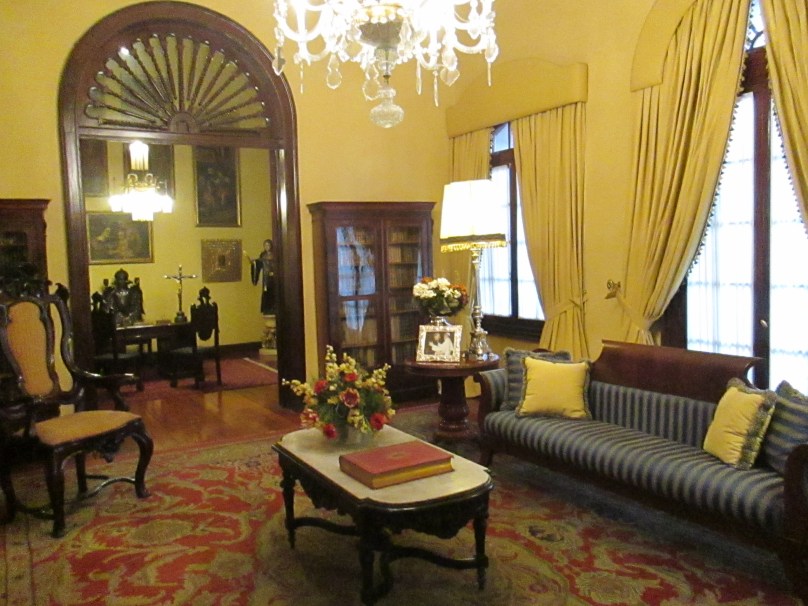
A Room in the Archbishop’s Palace in Lima, Peru

I started my travels in 1975 with an interest in ancient civilizations. Then, I found myself also visiting the ruins of a much more recent civilization—our own. It reached its apogee in Peru. I was definitely interested in the Inca, but I found the remnants of Christianity in Peru to be even more interesting. Lima in particular was a treasure house of ecclesiastical art, not only in the cathedral and the main churches, but also in the archbishop’s palace, which is just as interesting.

For some reason, I was particularly interested in the depiction of angels in the New World. These were not the hermaphroditic or epicene angels of the mother country, but images of masculine strength that obviously owed something to the images of supernatural beings among the Incas.

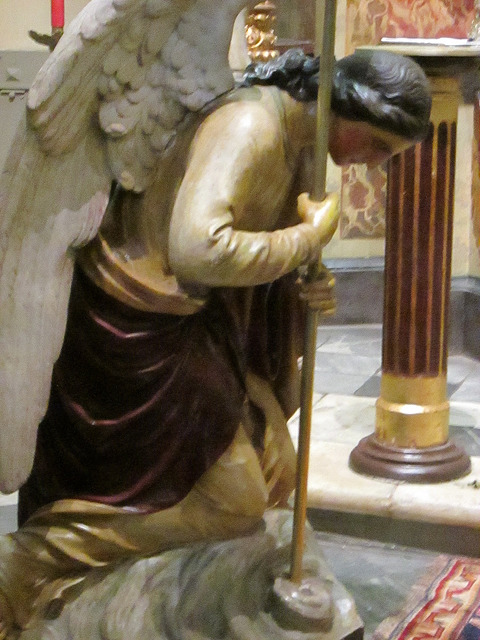
Image of Angel in Lima’s Cathedral

The angel in the above picture appears to be driving a spear into some unformed material, like clay. There is a look of determination on the angel’s face as well as a feeling of strength. Most of the statuary and art in the churches were actually done by Peruvians, and not transshipped from Europe.

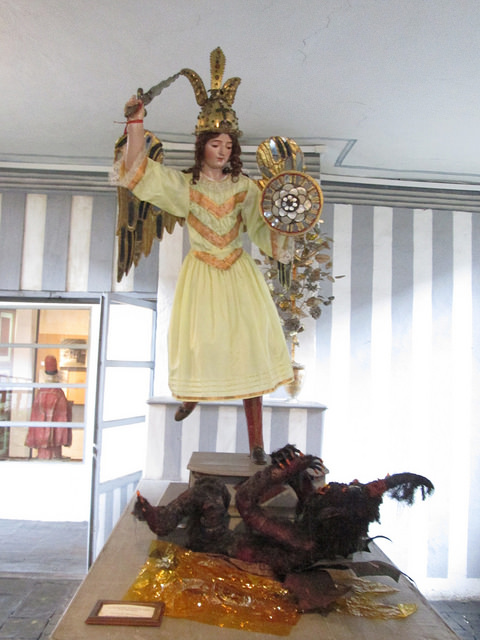
Statue of Angel in the Museo de Las Conceptas in Cuenca, Ecuador

I saw the above statue in the Museo de Las Conceptas in a former convent in Cuenca. He is another one of those militant angels of South America, and one who is in the middle of overcoming a demon. Cuenca has two religious museums. One is the former cathedral on the main square, and the other is in the former convent.

If you find yourself visiting Latin America, you will find some interesting bits of our own history as it has been adapted and modified by the converted natives. Perhaps the most extreme example of this is among the highland Mayans of Chiapas. I don’t have any pictures for you, because I was warned against even taking my camera to Chamula. Some European tourists were killed by the Chamulas by taking photos in the church. My brother and I did see the church. There were statues of Christ, the Virgin, and various saints, but they were covered with stalks of corn. In place of pews, there was a large open space, where the Chamulas lie face down on the floor with arms outstretched, surrounded by lit candles.

As you can see, going to church is a part of my visits to Latin America.


Dürer’s Melancholia I

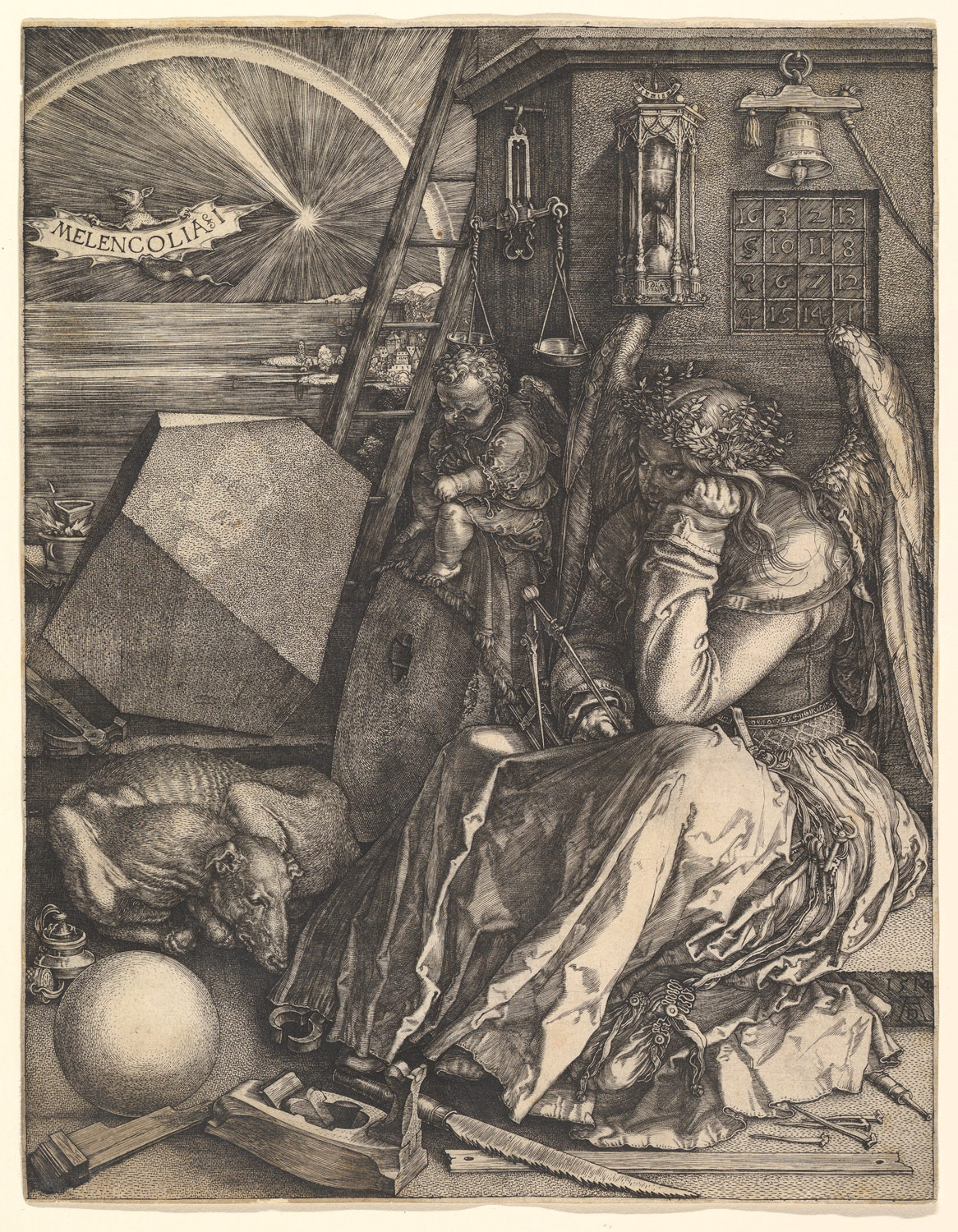
Albrecht Dürer’s Engraving “Melancholia I”

I have written before of my admiration for Albrecht Dürer (1471-1528), probably Germany’s greatest artist. Now I am even more certain of my admiration, since I discovered that he is of Hungarian descent—his father was a goldsmith named Albrecht Ajtósi.

Slowly poring through Will Durant’s The Reformation: A History of European Civilization from Wyclif to Calvin 1300-1564, I hunted up Dürer’s engraving after reading what the author had to say about it:

Finally the engraving that Dürer entitled Melancholia I reveals an angel seated amid the chaos of an unfinished building, with a medley of tools and scientific instruments at her feet; a purse and keys attached to her girdle as emblems of wealth and power; her head resting pensively on one hand, her eyes gazing half in wonder, half in terror, about her. Is she asking to what end all this labor, this building and demolition and building, this pursuit of wealth and power and the mirage called truth, this glory of science and Babel of intellect vainly fighting inevitable death? Can it be that Dürer, at the very outset of the modern age, understood the problem faced by triumphant science, of progressive means abused by unchanging ends?

It is by far the greatest work of art on the theme of being stumped. I find it interesting that the angel is female, no doubt wondering what men have come up with this time.


Archangels of the Andes

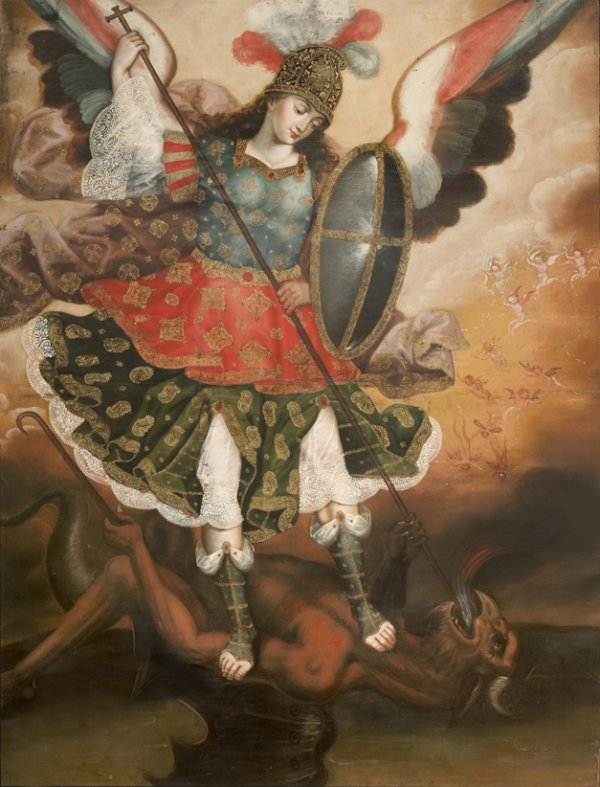
The Archangel Michael Vanquishing Satan

The Archangel Michael Vanquishing Satan

They are young, elegant, and handsome. Their wings are bi-colored, like the wings of mature condors. Yet they are all powerful and conquer their enemies with surpassing ease. They are the archangels depicted in paintings of the Cusco School of Art.

One has to imagine what it was like to be an Inca facing a compact phalanx of Spanish conquistadores mounted on horseback. At Cajamarca, many thousands were slaughtered by Pizarro and his hundred or so men. They barely even used their muskets, which were pretty useless in hand-to-hand combat in any case. No, it was Spanish steel and the strangeness of seeing warriors on horseback. Were they a single creature, man and horse? The Incas tried to kill the horses and display their corpses, thinking that now they would win with ease.

It was not to be so. The Incas were ultimately conquered, even though it took the better part of a century to complete the conquest. To the defeated, it didn’t look as if their gods were of much help to them. There must be something to this Christianity!

You can see it in the native painters’ depiction of angels, such as the one above. Michael defeats the demon without breaking a sweat or staining his doublet. He might just as easily be crocheting a doily or cleaning his nails. All throughout Peru, I saw hundreds of these archangels in the churches and archiepiscopal palaces, all with the same characteristics. The artists are usually indigenous Quechuans who painted multiple images of the same religious figures for distribution to churches all around the country.

When the Incans saw these angels, did they think of how easily they themselves were bested by the Spanish?