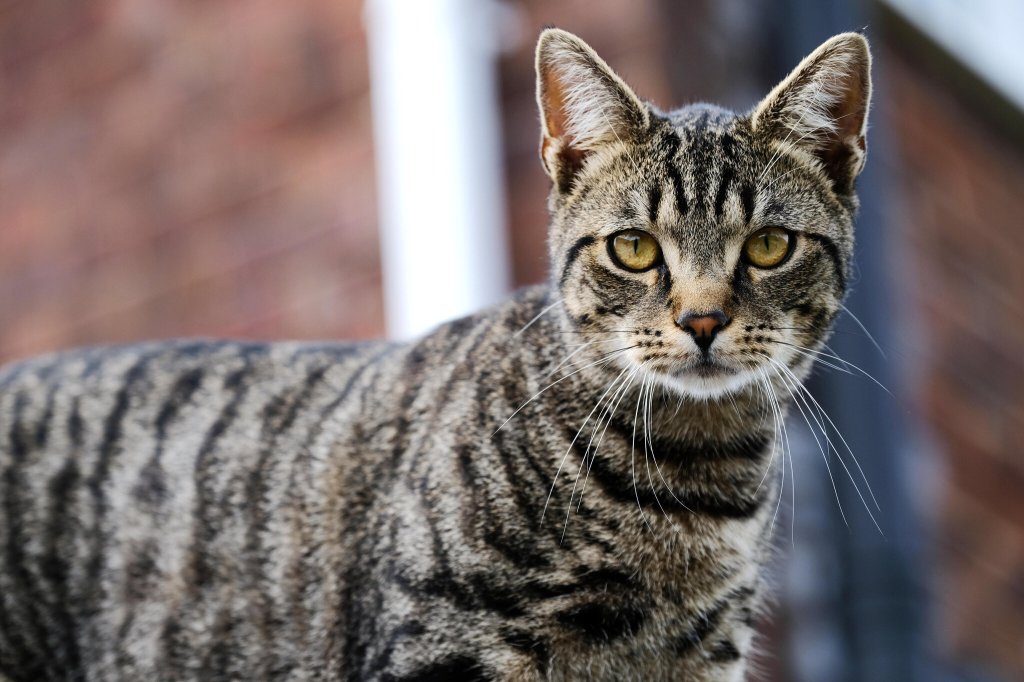
The Argentinian poet Jorge Luis Borges could not play with a cat without thinking of those other cats he saw at the Buenos Aires Zoo too large and too ferocious for play.
To a Cat
Mirrors are not more silent nor the creeping dawn more secretive; in the moonlight, you are that panther we catch sight of from afar. By the inexplicable workings of a divine law, we look for you in vain; More remote, even, than the Ganges or the setting sun, yours is the solitude, yours the secret. Your haunch allows the lingering caress of my hand. You have accepted, since that long forgotten past, the love of the distrustful hand. You belong to another time. You are lord of a place bounded like a dream.
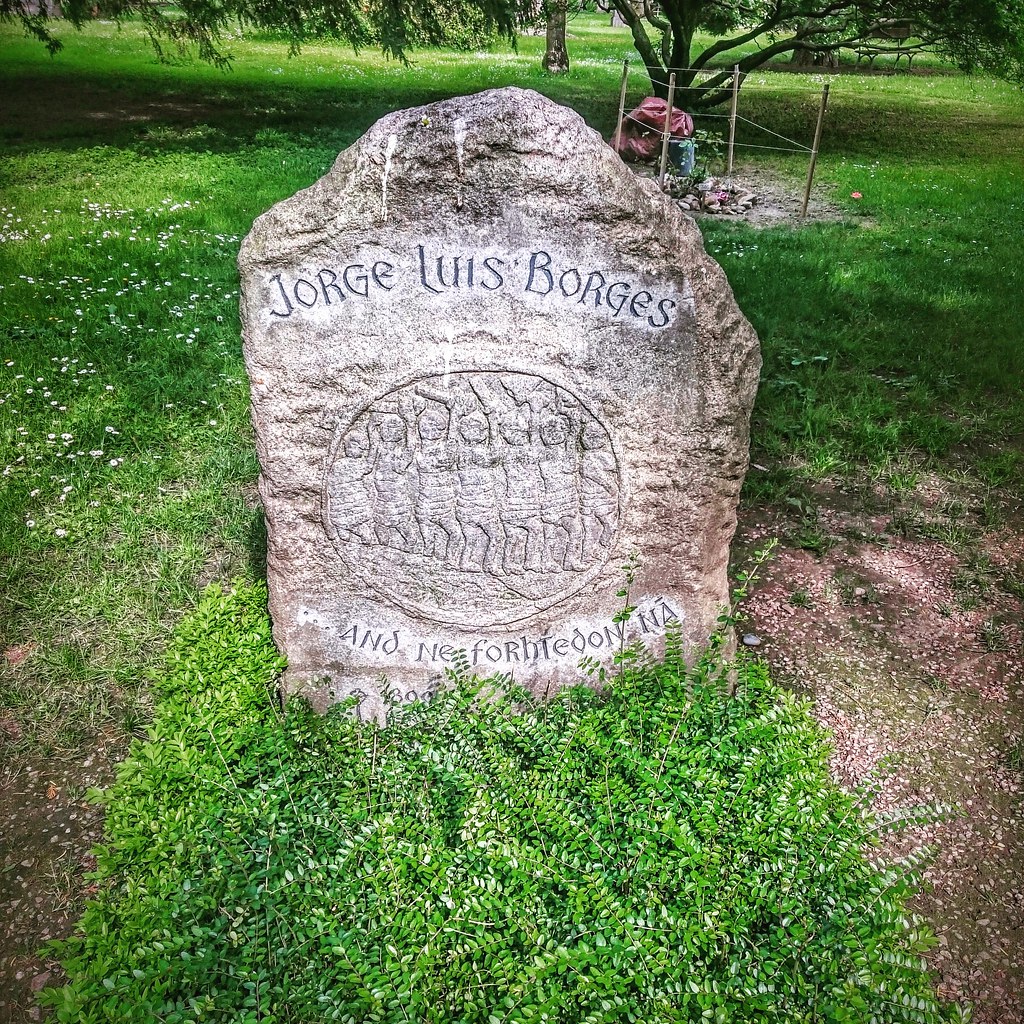
The Tomb of Jorge Luis Borges (1899-1986) in Geneva Switzerland
The title of this post is in Anglo-Saxon from the gravestone of Jorge Luis Borges. It comes from The Battle of Maldon. Translated, it means “Be not afraid.” Toward the end of his life, Borges learned Anglo-Saxon and even studied Old Norse, which is the language of Iceland.
Here is an early poem by Borges (from Fervor de Buenos Aires, 1923) on the subject of death. The translation is by W. S. Merwin.
Remorse for Any Death
Free of memory and hope,
unlimited, abstract, almost future,
the dead body is not somebody: It is death.
Like the God of the mystics,
whom they insist has no attributes,
the dead person is no one everywhere,
is nothing but the loss and absence of the world.
We rob it of everything,
we do not leave it one color, one syllable:
Here is the yard which its eyes no longer take up,
there is the sidewalk where it waylaid its hope.
It might even be thinking
what we are thinking.
We have divided among us, like thieves,
the treasure of nights and days.
At this time when we are supposedly making up New Year’s resolutions, I am reminded of this poem by Jorge Luis Borges, the great Argentinian poet who died not long after his poem “Instants” was written.
Instants
If I could live again my life,
In the next - I'll try,
- to make more mistakes,
I won't try to be so perfect,
I'll be more relaxed,
I'll be more full - than I am now,
In fact, I'll take fewer things seriously,
I'll be less hygenic,
I'll take more risks,
I'll take more trips,
I'll watch more sunsets,
I'll climb more mountains,
I'll swim more rivers,
I'll go to more places - I've never been,
I'll eat more ice creams and less (lime) beans,
I'll have more real problems - and less imaginary ones,
I was one of those people who live
prudent and prolific lives -
each minute of his life,
Of course that I had moments of joy - but,
if I could go back I'll try to have only good moments,

If you don't know - that's what life is made of,
Don't lose the now!

I was one of those who never goes anywhere
without a thermometer,
without a hot-water bottle,
and without an umbrella and without a parachute,

If I could live again - I will travel light,
If I could live again - I'll try to work bare feet
at the beginning of spring till
the end of autumn,
I'll ride more carts,
I'll watch more sunrises and play with more children,
If I have the life to live - but now I am 85,
- and I know that I am dying . . .
In his collection Seven Nights (1984), Jorge Luis Borges wrote:
I have two nightmares that often become confused with each other. I have the nightmare of the labyrinth, which comes, in part, from a steel engraving I saw in a French book when I was a child. In this engraving were the Seven Wonders of the World, among them the labyrinth of Crete. I believed when I was a child (or I now believe I believed) that if one had a magnifying glass powerful enough, one could look through he cracks and see the Minotaur in the terrible center of the labyrinth. My other nightmare is that of a mirror. The two are not distinct, as it takes only two facing mirrors to construct a labyrinth. I always dream of labyrinths or of mirrors. In the dream of the mirror another vision appears, another terror of my nights, and that is the idea of the mask. Masks have always scared me. No doubt I felt in my childhood that someone who was wearing a mask was hiding something horrible. These are my most terrible nightmares: I see myself reflected in a mirror, but the reflection is wearing a mask. I am afraid to pull the mask off, afraid to see my real face.
Though he lost the use of his eyes in the 1950s, Jorge Luis Borges was appointed to head the National Library of Argentina. He was the second blind librarian there, the first being Paul Groussac. Borges works on the theme of his blindness and Groussac’s in the following poem:
Poem of the Gifts
No one should read self-pity or reproach
into this statement of the majesty
of God, who with such splendid irony
granted me books and blindness at one touch.

Care of this city of books he handed over
to sightless eyes, which now can do no more
than read in libraries of dream the poor
and senseless paragraphs that dawns deliver

to wishful scrutiny. In vain the day
squanders on these same eyes its infinite tomes,
as distant as the inaccessible volumes
that perished once in Alexandria.

From hunger and from thirst (in the Greek story),
a king lies dying among gardens and fountains.
Aimlessly, endlessly, I trace the confines,
high and profound, of this blind library.

Cultures of East and West, the entire atlas,
encyclopedias, centuries, dynasties,
symbols, the cosmos, and cosmogonies
are offered from the walls, all to no purpose.

In shadow, with a tentative stick, I try
the hollow twilight, slow and imprecise—
I, who had always thought of Paradise
in form and image as a library.

Something, which certainly is not defined
by the word fate, arranges all these things;
another man was given, on other evenings
now gone, these many books. He too was blind.

Wandering through the gradual galleries,
I often feel with vague and holy dread
I am that other dead one, who attempted
the same uncertain steps on similar days.

Which of the two is setting down this poem—
a single sightless self, a plural I?
What can it matter, then, the name that names me,
given our curse is common and the same?

Groussac or Borges, now I look upon
this dear world losing shape, fading away
into a pale uncertain ashy-gray
that feels like sleep, or else oblivion.
Here is one of my favorite poems by the Argentinian Jorge Luis Borges (1899-1986). Above is a view of a street in the San Telmo neighborhood of Buenos Aires.
Limits
Of all the streets that blur in to the sunset,
There must be one (which, I am not sure)
That I by now have walked for the last time
Without guessing it, the pawn of that Someone

Who fixes in advance omnipotent laws,
Sets up a secret and unwavering scale
for all the shadows, dreams, and forms
Woven into the texture of this life.

If there is a limit to all things and a measure
And a last time and nothing more and forgetfulness,
Who will tell us to whom in this house
We without knowing it have said farewell?

Through the dawning window night withdraws
And among the stacked books which throw
Irregular shadows on the dim table,
There must be one which I will never read.

There is in the South more than one worn gate,
With its cement urns and planted cactus,
Which is already forbidden to my entry,
Inaccessible, as in a lithograph.

There is a door you have closed forever
And some mirror is expecting you in vain;
To you the crossroads seem wide open,
Yet watching you, four-faced, is a Janus.

There is among all your memories one
Which has now been lost beyond recall.
You will not be seen going down to that fountain
Neither by white sun nor by yellow moon.

You will never recapture what the Persian
Said in his language woven with birds and roses,
When, in the sunset, before the light disperses,
You wish to give words to unforgettable things.

And the steadily flowing Rhone and the lake,
All that vast yesterday over which today I bend?
They will be as lost as Carthage,
Scourged by the Romans with fire and salt.

At dawn I seem to hear the turbulent
Murmur of crowds milling and fading away;
They are all I have been loved by, forgotten by;
Space, time, and Borges now are leaving me.
A Painting by the Younger Sister of Jorge Luis Borges
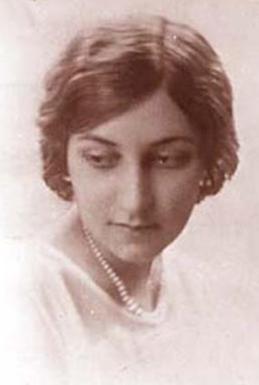
I was reading a radio interview by Osvaldo Ferrari with the late Jorge Luis Borges, when the subject came up of the writer’s sister, Leonor Fanny “Norah” Borges Acevedp (1901-1998):
FERRARI: As for your relationship with painting, Borges, we mustn’t forget that you’re the brother of a painter.
BORGES: Of a great painter, I think, eh? Although I don’t know if the word ‘great’ adds anything to the word ‘painter.’ Brother of a painter, let’s say. Now, as she explores subjects like angels, gardens, angels who are musicians in gardens …
FERRARI: Like the painting of the Annunciation, for example, which has the city of Adrogué in the background, which is in your house.
BORGES: Yes, which she wanted to destroy.
FERRARI: How dreadful.
BORGES: No, it’s because she thinks that she was still very clumsy, that she couldn’t paint when she made it. Well, what I know is that she sketches the plan of each painting and then she paints it. That is, the people who’ve described it as a naive painting are completely wrong. But art critics, of course, their profession is to get things wrong, I’d say … or all critics.
Woman Playing a Guitar, Painted by Norah Borges
Before one raising the issue of the blind writer as an art critic, let me say that Borges lost his vision in the mid 1950s, so he is talking of painters from his memories of thirty or more years ago. There is also a book I have of Borges’s film criticism, which also dates from before the onset of his blindness.
Because Borges and his writings have been so influential in my life, I am deeply interested in works produced by his family. For instance, Borges’s mother, Leonor Acevedo, collaborated with her son on a number of translations from the English.
Norah Borges
The work of Norah Borges is known and exhibited in South America.
A Somewhat Less Cosmic Tiger Than the One Created by Borges
Jorge Luis Borges wrote a number of spectacular poems based on tigers he had viewed at the Buenos Aires Zoo. Leave it to his friend, poet Silvina Ocampo, to provide an altogether different picture. Appropriately, the title is:
A Tiger Speaks
I who move like water
sinuously
like water I know
shameful secrets.
I heard that there are dog cemeteries,
with earnest inscriptions
commemorating human friendship,
and that there are horses so stupid
they kneel before their masters,
oxen who are slaves to farmworkers,
cats who are ornaments for ladies,
like a hat or a fan,
bears who dance to the sound of a tambourine
from a man or a dwarf woman,
monkeys who flatter their owners,
elephants whom the public degrades,
abject seals who gargle
to entertain the children,
cows who let themselves be dragged along, mistreated,
who give their milk to anybody,
trained sheep
who donate their wool
to make clothing or mattresses,
snakes who caress
the head and neck of madmen.

We never managed to agree
about man’s true nature,
some fools think
perhaps in gratitude
for those who deified us
in other times
that man is a god,
but I and certain of my friends and enemies
think that he is edible.
The edible man
is always shy and trembling,
without claws and hair or with very little hair;
the man-god distributes food
with his hands, so I’ve been told,
he has a whip in his tongue and in his eyes.
In olden days, when he took up his position in the arena,
or in the desert, he wore a halo
or carried a magic wand,
he had a long mane
like a lion’s, which tangles in the teeth.
All this disturbs me:
sometimes I dream
of a rug whose coat
resembles mine, and I cry
stretched out on my own skin.
It’s strange. Inconceivable.
But there are stranger things:
Don't birds exist
who pass the time singing,
ridiculous doves, and an infinite series of fish
and beetles I’m unaware of
but which bother me?
Isn't there a poet who thinks about me constantly,
who believes that in my skin are signs revealing
man’s destiny drawn by God
in a poem?
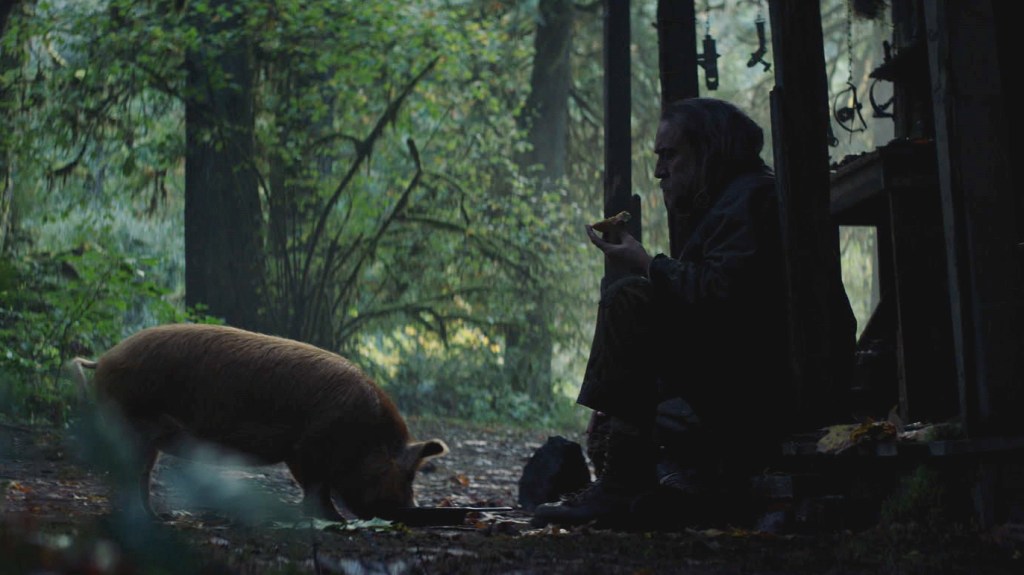
Today, for the first time in over a year, I went to the movies. My brother Dan had recommended I see Michael Sarnovski’s film Pig (2021) starring Nicolas Cage. So I took the bus to Pico and Westwood to see the film at the Landmark Theatres there—seeing as how I hate to spend a lot of money on parking.
The film was a winner. Cage is made to look like a grizzled old homeless person, which is all part of Sarnovski’s attempt to make us underestimate the character. When Cage’s truffle-hunting pig is stolen, he heads to the city (Portland, Oregon) to find it and bring it back. There we learn that he is the formerly famous chef Robin Feld who was once a legend in the city’s restaurant world.
This is a film for people who are into food, as my brother certainly is. The film reminds me of Marie NDiaye’s novel The Cheffe, which has a similar foodie emphasis. And because of Robin Feld’s prodigious memory of every meal he ever prepared, I will add that you should check out Jorge Luis Borges’s story “Funes the Memorious.”
Great movies and stories always lead you to interesting places. And I think Pig fits into this category.
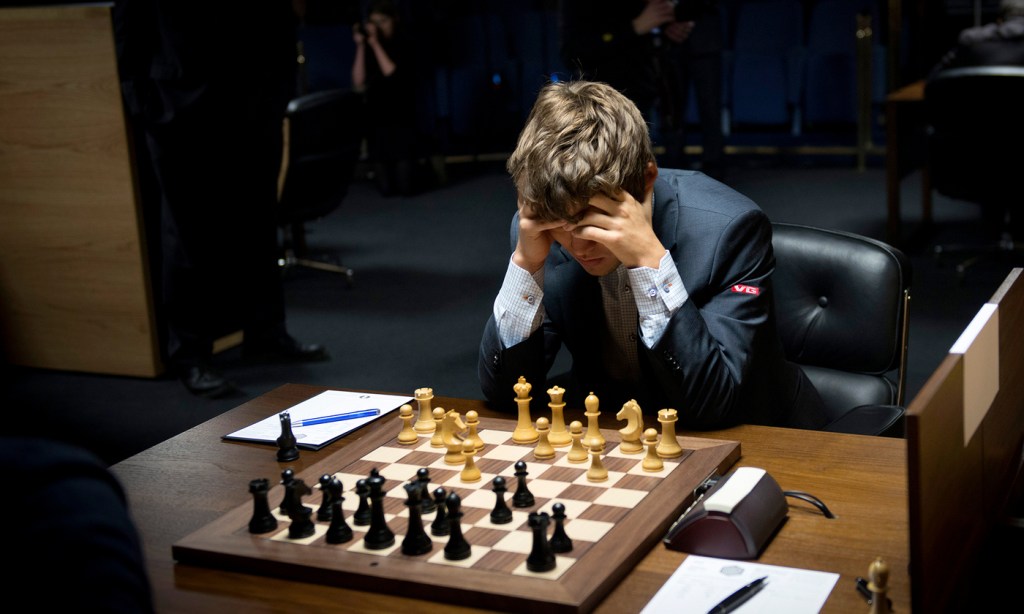
Argentinian poet Jorge Luis Borges (1899-1986) wrote two sonnets entitles “Chess.” This is the second one:
Faint-hearted king, sly bishop, ruthless queen,
straightforward castle, and deceitful pawn—
over the checkered black and white terrain
they seek out and begin their armed campaign.

They do not know it is the player’s hand
that dominates and guides their destiny.
They do not know an adamantine fate
controls their will and lays the battle plan.

The player too is captive of caprice
(the words are Omar’s) on another ground
where black nights alternate with whiter days.

God moves the player, he in turn the piece.
But what god beyond God begins the round
of dust and time and sleep and agonies?
From Jorge Luis Borges, The Sonnets (London: Penguin, 2010).






 Tarnmoor
You must be logged in to post a comment.