Modest Divinities

Shinto Shrine

Shinto Shrine

Jorge Luis Borges spent the last thirty to forty of his years in blindness, but like Tiresias and Milton, he saw more than most of us. The following poem is called “Shinto.”

Shinto

When misfortune confronts us
in an instant we are saved
by the humblest actions
of memory or attention:
the taste of fruit, the taste of water,
that face returned to us in dream,
the first jasmine flowers of November,
the infinite yearning of the compass,
a book we thought forever lost,
the pulsing of a hexameter,
the little key that opens a house,
the smell of sandalwood or library,
the ancient name of a street,
the colourations of a map,
an unforeseen etymology,
the smoothness of a filed fingernail,
the date that we were searching for,
counting the twelve dark bell-strokes,
a sudden physical pain.

Eight million the deities of Shinto
who travel the earth, secretly.
Those modest divinities touch us,
touch us, and pass on by.


One Word Makes a Difference

Argentinian Writer Jorges Luis Borges (1899-1986)

Argentinian Writer Jorge Luis Borges (1899-1986)

There is a wonderful novel by José Saramago called The History of the Siege of Lisbon (1989) in which a historian introduces a single word—“not”—to indicate that Crusaders failed to help lift the Portuguese king lift the siege of the city of Lisbon from the attacking Moors. The other day, I saw an article in the I Love Chile News in which the word “not” was inadvertently omitted, changing the whole sense of the passage.

In an interview with Maria Kodama, Borges’s widow, the I Love Chile News said that the Nobel Prize Committee actually wanted Borges to accept an honor from dictator Augusto Pinochet. It is generally thought that the Committee refused to give the Nobel Prize for Literature to Borges because he was hobnobbing with rightist dictator. Following is the text of the story as it was printed:

According to an interview with the Spanish newspaper El País, before traveling to Chile in 1976 to receive an honorary award of the Faculty of Philosophy and Humanities of the University of Chile, the author received a call from Stockholm.

He was awarded the Nobel Prize and they warned him that he should [here’s where the “not” belongs] go forward with his visit to the South American country.

According to Kodama, Borges told the Nobel Foundation member: “Look, gentleman: I am grateful for your kindness, but after what you just told me my duty is to go to Chile. There are two things that a man can not allow: bribe or be bribed. Thank you very much, good morning.”

Historical Background

Borges arrived in Chile in mid-September, in the same days in which the socialistic ex-chancellor Orlando Letelier was murdered in Washington.

A few months earlier, Borges had already received the Order of Bernardo O’Higgins from the Chilean embassy in Buenos Aires. It was the highest honor you could receive from the military dictatorship as a foreigner at the time.

In his acceptance speech in Santiago, Borges paid tribute to the repression by saying that “in this era of anarchy in here, between the mountains and the sea, there is a strong country. (The Argentine poet Leopoldo) Lugones preached strong homeland when he spoke of the time of the sword. I declare to prefer the sword, the clear sword, to the furtive dynamite,” he said, quoting a verse.

“And I say this knowing very clearly, very precisely, what I say. Well, my country is emerging from the swamp, I think, with happiness. I think we deserve to go out of the morass in which we were. We are already going through the work of swords, exactly. And here they have already emerged from the swamp. And here we are: Chile, the region, the country, which is both a long country and an honorable sword,” said Borges.

At the time Argentina was under the dictatorship of General Jorge Videla, who according to official figures killed thousands of people during the repression.

The next day, Borges also met Pinochet and said “he is an excellent person, his warmth, his goodness … I’m very satisfied … The fact that here, also in my country, and in Uruguay, the freedom and the order is saved, especially in an anarchy continent, a continent undermined by communism. I expressed my satisfaction, as an Argentine, of which we should have here nearby a country of order and peace.”

There are several things questionable about the story. I doubt that the Nobel Prize Committee would have been so overt about dangling the award in front of Borges. It may well be true that kowtowing to Pinochet cost Borges his Nobel, but Ms. Kodama has been known to embroider the facts on occasion.

“The Absence of Life”

The Beast in the Jungle?

The Beast in the Jungle?

In his An Introduction to American Literature, Jorge-Luis Borges wrote of Henry James, “Despite the scruples and delicate complexities of James his work suffers from a major defect: the absence of life.” Borges got Henry James wrong, just as he got William Faulkner wrong. I can understand, because I thought the same about James—up until the time I actually started reading him.

Granted he can appear to be insufferably bland and insufferably gentlemanly. At the same time, he knew what he was about; and he had a moral sense that was more finely wrought than almost all other writers. In his story “Maud-Evelyn,” he writes about a middle-aged couple called the Dedricks:

“Whom do they know?”

“No one but me. There are people in London like that.”

“Why know no one but you?”

“No—I mean no one at all.  There are extraordinary people in London, and awfully nice. You haven’t an idea. You people don’t know every one. They lead their lives—they go their way. One finds—what do you call it?—refinement, books, cleverness, don’t you know, and music, and pictures, and religion, and an excellent table—all sorts of pleasant things. You only come across them by chance; but it’s all perpetually going on.”

Sounds rather boring, doesn’t it?—until, that is, you find out what the Dedricks are up to with their dear-departed daughter. With James, it’s all too easy to get stuck on this surface frou-frou.

Henry James

Henry James

If you read James’s best story, “The Beast in the Jungle,” you will have the pleasure of seeing James write about himself under the name of John Marcher. Our Mr. Marcher feels that he is being reserved for an unknown and dire fate. His woman friend May Bartram puts it this way: “You said you had from your earliest time, as the deepest thing within you, the sense of being kept for something rare and strange, possibly prodigious and terrible, that was sooner or later to happen to you, that you had in your bones the foreboding and the conviction of, and that would perhaps overwhelm you.”

We spend about forty pages then trying to find out the nature of this curse. In the meantime, John Marcher does not fall in love, though he has a sort of Darby-and-Joan relationship with May Bartram. One pictures him sitting by, his shoulders hunched against the threat of what he calls “the beast in the jungle” that is waiting around some dark corner to pounce on him. In the meantime, May sickens and dies, but not before suspecting the nature of Marcher’s curse.

Eventually Marcher, too, finds out, as he watches a grieving mourner at the cemetery near May’s grave. And the nature of the beast?

The fate he had been marked for he had met with a vengeance—he had emptied the cup to the lees; he had been the man of his time, the man, to whom nothing on earth was to have happened. That was the rare stroke—that was his visitation…. The Beast had lurked indeed, and the Beast, at its hour, had sprung.

Think of Henry James as a John Marcher: He never gets married or falls in love. He exchanges social amenities with all the best people. But he uniquely knows that his very bloodlessness chills many readers to the bone.

The truth is an elusive quantity. Sometimes it comes best expressed by a writer whom one chronically underestimates because of his style of life.


Gone Forever: The Cafe Richmond

One of the World’s Great Literary Cafés

One of the World’s Great Literary Cafés

Just before Martine and I flew to Buenos Aires in 2011, one of the world’s greatest literary cafés was turned overnight into a Nike sportswear shop. Where once Jorge Luis Borges sat and wrote his stories, and where Graham Greene hung out (and commemorated) while he was writing The Honorary Consul, and where Antoine de Saint-Exupéry ate near his “charming little apartment” on Calle Florida, you can now buy shoes and other clothing items that are also available in a thousand other nearby outlets.

If I make it to Argentina later this year, I plan to photograph the damage, while urging you to boycott Nike. As far as I’m concerned, they can go and swoosh themselves into oblivion.

There is a charming article in the Argentina Independent about Calle Florida, where the Richmond was located at #468 (near the intersection with Lavalle). You can read more about the Cafe Richmond in The Guardian and The Independent.

Fortunately, Buenos Aires is a city with many great cafés; but, sometimes, when a great one closes, the ripples are felt around the world.

Gabriela Kogan has written a great little book which Martine and I used called The Authentic Bars, Cafés, and Restaurants of Buenos Aires which is available from The Little Bookroom.

Silvina Ocampo and Our Other Selves

Another Great Argentinean Writer for Your Consideration

Another Great Argentinean Writer for Your Consideration

She is incredibly well connected insofar as Argentinian literature is concerned. Her husband was Adolfo Bioy Casares, who was a frequent collaborator with Jorge Luis Borges. Her sister, Victoria Ocampo, published the literary magazine Sur, for which both Bioy Casares and Borges wrote. In her own right, Silvina Ocampo is a superb writer of short stories. (Thus Were Their Faces is an excellent collection published by New York Review Books, which I have just finished reading.) Together with Borges and Bioy Casares, she edited a book of fantasy and horror stories called The Book of Fantasy which was published in 1990.

I like the following poem because it seems to have been influenced by Borges. Or was it she influenced Borges?

In Every Direction

We go leaving ourselves in every direction,
in beds, in rooms, in fields, in seas, in cities,
and each one of those fragments
that has ceased to be us, continues being
as always us, making us
jealous and hostile.
“What will it do that I would like to do?”
we think. “Who will it see that I would like to see?”
We often receive chance news
of that creature . . .
We enter its dreams
when it dreams of us,
loving it
like those whom we love most;
we knock at its doors
with burning hands,
we think it will return in the illusion of belonging to us
mistaken as before
but it will keep being treacherous and unreachable.
As with our rivals we would kill it. We will only be able
to glimpse it in photographs. It must survive us.

New York Review Books has also published a volume of her poetry translated into English that I will probably be ordering soon. The above poem is from that edition.

“He Never Sallied from His Library”

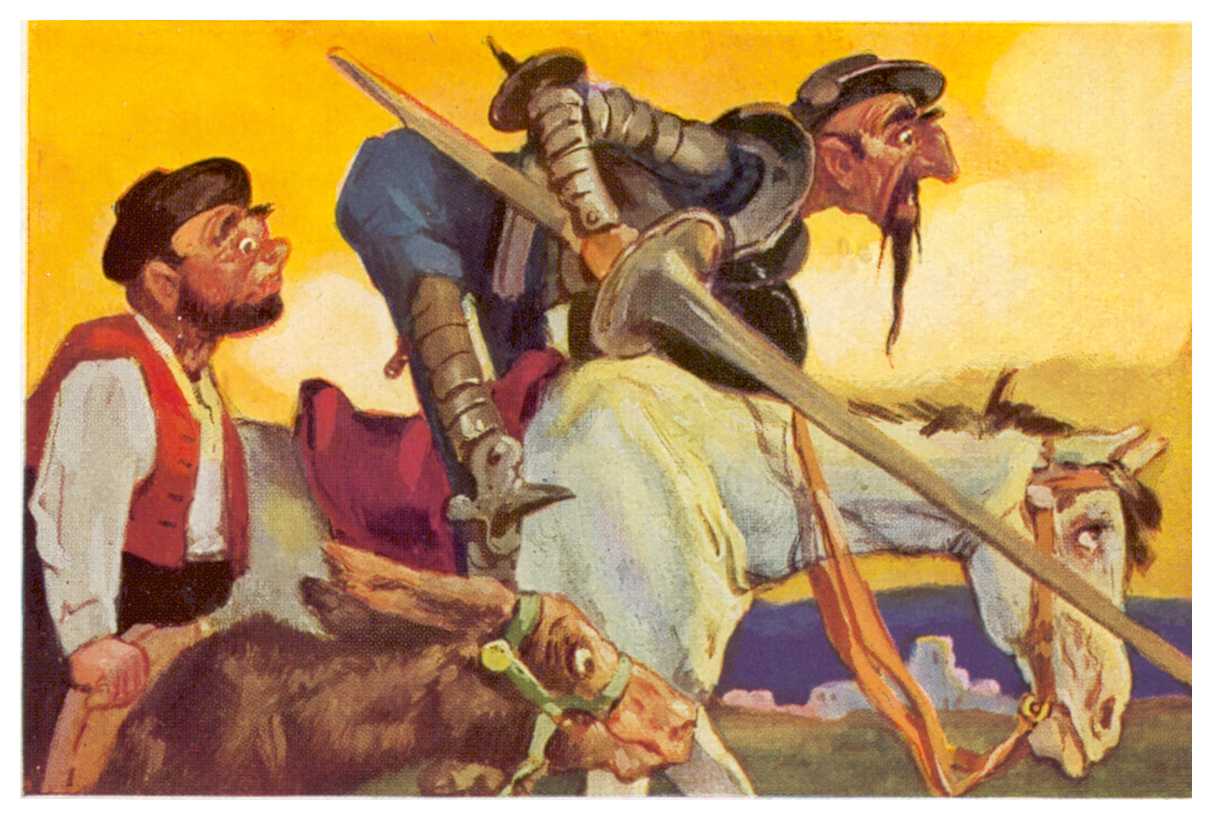
Did Quixote Imagine It All?

Did Don Quixote Imagine It All?

One reason I love this poem about the Knight of La Mancha is that its author, Jorge Luis Borges, was a bookworm like myself. Therefore, he could speculate as to whether the good Don dreamed all his adventures from the comfort of his own library.

Readers

Of that knight with the sallow, dry
Complexion and heroic bent, they guess
That, always on the verge of adventure,
He never sallied from his library.
The precise chronicle of his urges
And its tragic-comical reverses
Was dreamed by him, not by Cervantes,
It’s no more than a chronicle of dream.
Such my fate too. I know there’s something
Immortal and essential that I’ve buried
Somewhere in that library of the past
In which I read the history of the knight.
The slow leaves recall a child who gravely
Dreams vague things he cannot understand.

The translation is by A.S. Kline in this choice selection of Borges’s poetry on the Internet.

Life is different when you’re a reader. During my least favorite time of the year—tax season—I am lifted out of any temptation to depression by solving crimes with Chesterton’s Father Brown and Gaston Laroux with his mysterious Yellow Room; fighting the War of the Roses with Shakespeare’s Henry VI; becoming part of the mysterious search for Malory through a painterly landscape in Geoff Dyer’s The Search; and enjoying the world of books with Anatole France’s Sylvestre Bonnard.

After a day fighting with numbers, bits, and bytes, I vanish into my library and go tilting at my own windmills.

Slipping Off the Pedestal

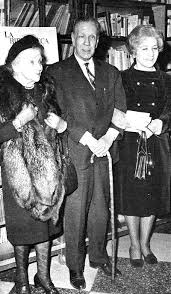
Jorge Luis Borges Flanked by His Mother and His Wife Elsa

Jorge Luis Borges Flanked by His Mother and His Wife Elsa

It was bound to happen sooner or later: After worshiping the man for over forty years, I am finally beginning to have my doubts about Jorge Luis Borges the man. But not, by any means, of Borges the poet and writer of short stories and essays. I still think he deserved the Nobel Prize for Literature on merit alone, but I begin to understand why he cheesed off the liberal-minded Nobel Prize Selection Committee.

Perhaps my favorite translator of Borges is Norman Thomas di Giovanni, whose book Georgie and Elsa: Jorge Luis Borges and His Wife, The Untold Story has just recently been published. Di Giovanni worked closely with Borges during the 1960s, shortly after he married Elsa Astete Millán, and through the divorce. What Di Giovanni discovered was that Borges was fatally naive when it came to women, politics, and social life. In fact, he was incredibly feckless in many ways. Di Giovanni writes:

[I]n later years, he travelled to Chile to receive a medal from the hands of Augusto Pinochet. This was one of the worst decisions of his life. But, he maintained, in his digging-his-heels-in mode that no one was going to tell him what he could or could not do. I imagine that it would never have occurred to Borges to question and be horrified by Pinochet’s well-oiled programme of eliminating Communists and other left-wingers. Borges was so universally condemned for his action that I think he came to realize his colossal mistake. But to justify it and himself, when I mentioned his folly to him, he said, ‘But I thought the medal was a gift of the Chilean people.’

Equally, if not more disastrous, was Borges’s marriage to Elsa. Years earlier, he had mooned over her; but, typically, someone else married her. (“Georgie” was not prime marriage material, as he lived with his mother well into his old age.) Then, one day, he met her again and—discovering that she was now widowed—took up with her again. By now, Borges was a famous literary figure; and, Elsa, being a social climber, thought that she was now about to enter the high life.

Her behavior during visits to the United States was execrable. She would steal silverware and other “souvenirs” from Borges’s friends and associates. During a visit to the Rockefellers, she insisted in photographing every room and asking about all the furnishings. It got to the point that people stopped inviting Borges lest Elsa come along. When she accidentally left a nutria coat in Cambridge after one trip, she made the return of the coat into an international incident involving U.S. and Argentinian ambassadorial and consular staffs.

Not that Borges was an ideal husband. He was an elderly blind man who happened to be impotent (which Elsa had known earlier) and incredibly old fashioned, a sort of Anglo-Argentinian who was neither all one thing or all the other. Finally, with di Giovanni’s help, Borges divorced her. He later re-married, with Maria Kodama, who now controls his esate.

Di Giovanni’s book is mandatory reading to supplement all the hagiographical biographies of the author who never quite get at the man’s character.


Tarnmoor’s ABCs: Jorge Luis Borges

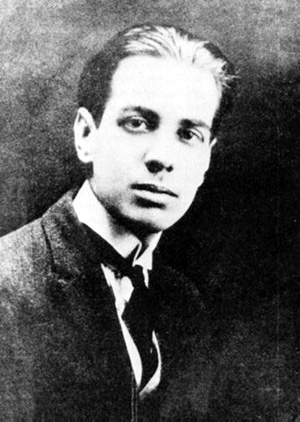
Jorge Luis Borges in 1921

Jorge Luis Borges in 1921

I was so very impressed by Czeslaw Milosz’s book Milosz’s ABC’s. There, in the form of a brief and alphabetically-ordered personal encyclopedia, was the story of the life of a Nobel Prize winning poet, of the people, places, and things that meant the most to him. Because his origins were so far away (Lithuania and Poland) and so long ago (1920s and 1930s), there were relatively few entries that resonated personally with me. Except it was sad to see so many fascinating people who, unknown today, died during the war under unknown circumstances.

My own ABCs consist of places I have loved (Iceland), things I feared (Earthquakes), writers I have admired (G. K. Chesterton and Honoré de Balzac); things associated with my past life (Cleveland and Dartmouth College), and things I love to do (Automobiles and Books). This blog entry is my own humble attempt to imitate a writer whom I have read on and off for thirty years without having sated my curiosity. Consequently, over the months to come, you will see a number of postings under the heading “Tarnmoor’s ABCs” that will attempt to do for my life what Milosz accomplished for his. To see my other entries under this category, hit the tag below marked “ABCs”.I don’t guarantee that I will use up all 26 letters of the alphabet, but I’ll do my best. Today, we’re at the letter “J,” for Jorge Luis Borges.

Ever since I first learned about Jorge Luis Borges (1899-1986), I have been hooked. By now, I have read just about everything that has been translated into English, sometimes two or three times. He has guided my reading for over forty years: Without him, I would never have discovered Iceland or the works of G. K. Chesterton. Without him, I would never have gone to Argentina twice, once in 2006 and once in 2011. His City of Buenos Aires has become one of the ineluctable geographies of my dreams.

Of his works, I recommend most highly Labyrinths, Ficciones, Other Inquisitions, and, of course, his magnificent poetry. Below, from the recent Penguin anthology entitled Poems of the Night, I have excerpted one poem entitled “Sleep” as translated by Stephen Kessler:

SLEEP

The night assigns us its magic
task. To unravel the universe,
the infinite ramifications
of effects and causes, all lost
in that bottomless vertigo, time.
Tonight the night wants you to forget
your name, your elders and your blood,
every human word and every tear,
what you would have learned from staying awake,
the illusory point of the geometricians,
the line, the plane, the cube, the pyramid,
the cylinder, the sphere, the sea, the waves,
your cheek on the pillow, the coolness
of the fresh sheets, the Caesars and Shakespeare
and the hardest thing of all, what you love.
Oddly enough, a pill can
erase the cosmos and erect chaos.

Most people who know of Borges know only that he was blind. For the last half of his life, he was a kind of Teiresias. That’s why I wanted to reproduce above a photograph of the poet in his twenties. The other thing many people know is that he was singled out by the Swedish Academy to be passed over for the Nobel Prize for Literature, primarily because one member of the selection committee disagreed with his politics. This was supposedly because he accepted an award from Chilean dictator General Augusto Pinochet Ugarte. I do not care a fig if Borges’s politics are to the right of mine: All that counts is that he has had a benign, lasting, and ever growing influence on the person I have become.

At the Admiral Benbow

N. C. Wyeth’s Blind Pew

N. C. Wyeth’s Blind Pew

It was one of the most fun novels I ever read; and it’s also not a bad poem by Jorge Luis Borges. Picture yourself at the Admiral Benbow Inn in the Southwest of England, with Jim Hawkins helping his widowed mother, when suddenly he hears the tap-tap of a cane. It is the old reprobate Blind Pew, and that is also the name of Borges’s poem:

Far from the sea and from fine war,
Which love hauled with him now that they were lost,
The blind old buccaneer was trudging
The cloddy roads of the English countryside.

Barked at by the farmhouse curs,
The butt of all the village lads,
In sickly and broken sleep he stirred
The black dust in the wayside ditches.

He knew that golden beaches far away
Kept hidden for him his own treasure,
So cursing fate’s not worth the breath;

You too on golden beaches far away
Keep for yourself an incorruptible treasure:
Hazy, many-peopled death.

Remember that the poet, too, is blind; so he has a special feeling for “the blind old buccaneer” who turns Jim Hawkins’s world upside down.

What I find most interesting is which “You” it is that Borges refers to in the first line of the fourth stanza. It cannot refer to Blind Pew, because his treasure is buried in the sands of an island in the South Pacific. It cannot be the reader of the poem, because he presumably does not desire “Hazy, many-peopled death.”

Perhaps the answer will come if we look at the same poem in the original Spanish:

Lejos del mar y la hermosa guerra,
que así el amor lo que ha perdido alaba,
el bucanero ciego fatigaba
los terrosos caminos de Inglaterra.

Ladrado por los perrors de las granjas,
pifia de los muchachos del poblado,
dormía un achacoso y agrietado
sueño en el negro polvo de las zanjas.

Sabía que en remotas playas de oro
era suyo un recóndito tesoro
y esto aliviaba su contraria suerte;

a ti también, en otras playas de oro,
te aguarda incorruptíble tu tesoro:
la vasta y vaga y necesaria muerte.

Some things start clicking into place. First of all, the poet uses the intimate form of “you,” not the formal form. It looks as if he is addressing himself. Curiously, the Spanish contains no reference indicating that these other golden beaches are “far away.” Rather, it moves directly to the poet keeping incorruptible his own treasure, that of “vast, vague, and necessary death” [my own literal translation].

Now why would Borges, blind as he is, wish for death and envy Blind Pew for his “beautiful war”? The answer is interesting, because the more of Borges you read, the more you discover that Borges is the descendant of military heroes. One of them fought in Peru at Junín to evict the Spanish. Another was Colonel Francisco Borges Lafinur (1835-1874), who died at the Battle of La Verde. The scion of these military heroes, Borges wished that he himself could have been a military hero. His stories and poems feature knife fights, hoods in the suburbs of Buenos Aires, and bravery in battle between the Unitarios and the Federales. Instead, he was born a weakling with eye troubles, like his father before him.

Xul Solar

Jorge Luis Borges’s Favorite Painter Comments on Religion

Jorge Luis Borges’s Favorite Painter Comments on Religion

His real name was Oscar Agustín Alejandro Schulz Solari, but he was better known under the name Xul Solar. Born in Buenos Aires of a Latvian father, he spent his whole life in Argentina. When I was in Buenos Aires in 2006 and 2011, I desperately wanted to visit his museum; but I just wasn’t able to do so. Before he went completely blind in the 1950s, Jorge Luis Borges—whom you may know as one of my favorite writers—befriended him and wrote about his paintings. I have always been intrigued by what I have seen of his work.

If you are interested in seeing some of his work from the 1920s through the 1960s, take a look at the website of the Museo Xul Solar, which is in Spanish but easy to navigate.

In 1949, Borges made one of his cryptic pronouncements about the work of his friend:

Versed in all disciplines, curious of all mysteries, the father of writings, of languages, of mythologies, guest of hells and heavens, “panchess-player,” author and astrologer, perfect in indulgent irony and in the generous friendship, Xul Solar is one of the most important events of our age. There are minds who profess probity, others, discriminate abundance; Xul Solar’s plentiful invention does not exclude honest rigor. His paintings are documents of the unearthly world, of the metaphysical world in which the gods take the forms of imagination, dreams. Passionate architecture, happy colors, many circumstantial details, labyrinths, homunculi and angels unforgettably define this delicate and monumental art.

The taste of our time vacillates between mere linear pleasure, emotional transcription and realism painted by a dauber’s brush. Xul Solar renews, in his ambitious but modest way, the same painting of those who do not see with their physical eyes in the sacred field of Blake, of Swedenborg, of the yogis and of bards.