Three of the 200+ Waterfalls at Iguazu National Park
I was exhilarated by the two days I spent viewing the falls at Iguazu. There were trails leading off in all directions, as the falls were in an area several kilometers long.
My only regret is that I was not able to see the falls from the Brazilian side. Although the falls were in Argentina, the best long-distance view was from the city of Foz de Iguaçu. At the time I was there, in 2015, I would have had to pay a heavy fee to cross the border into Brazil.
The Panoramic View of the Falls from Brazil
It is not always possible to see all the sights, and I was content to view the falls from the Argentinean side—close up. Particularly impressive was the most powerful of the falls, the Garganta del Diablo, or Devil’s Throat. Here is a video from YouTube:
If you ever manage to fly the 6,000 miles to Argentina, I highly recommend spending several days at the falls. On the Argentinean side, Puerto Iguazu has excellent tourist amenities.
The Jewish-Ukrainian-Brazilian Clarice Lispector (1920-1977)
If Clarice Lispector were alive today, she would be celebrating her 104th birthday. The strikingly beautiful author with the high cheekbones and wild Scythian eyes was one of the greatest women writers of the 20th century, joining such titans as Virginia Woolf, Joan Didion, Ursula LeGuin, Patricia Highsmith, and Wislawa Szymborska.
In my e-mail today was a message from New Directions Publishing, which publishes some twenty titles by Lispector in English translation. It contained a link to a video entitled “Dias de Clarice em Washington.” It is 29 minutes long in Brazilian Portuguese with English subtitles.
During the 1950s, Clarice was married to a Brazilian diplomat named Maury Gurgel Valente who was posted to the embassy in Washington. From her house in Bethesda, Maryland, she took part in diplomatic social functions and raised a family, as well as writing a number of books and short stories … until it all became too much for her, and she filed for divorce, after which she returned to Brazil.
I urge you to see this video and see what a great writer must do when she is pulled between her marriage and her art:
Yes, I am still reading Clarice Lispector’s Too Much of Life: The Complete Crônicas, which runs to almost 800 pages. Tody, I am quoting a writer that Lispector in turn quotes in her Jornal do Brasil column for September 4, 1971, namely Hélio Pellegrino:
Living—ah, that difficult delight. Living is a game, a risk. Whoever plays can win or lose. The beginning of wisdom consists in accepting that losing is also part of the game. When that happens, we gain something extremely precious: we gain the possibility of winning. If I know how to lose, then I know how to win. If I don’t know how to lose, I win nothing, and I will always go away empty-handed. The eyes of someone who doesn’t know how to lose eventually grow rusty and blind, blind with resentment. When we come to accept with true and deep humility the rules of the existential game, living becomes more than good: it becomes fascinating. To live well is to consume oneself; it is to burn the coals of time from which we are made. We are made up of time, and this means we are a passing thing, movement without respite, finitude. The quota of eternity allotted to us is embedded in time. We need to search it out with ceaseless courage so that the taste of gold may shine upon our lips. If this happens, then we are joyful and good, and our life has meaning.
A Great Writer? The Jewish-Ukrainian-Brazilian Clarice Lispector (1920-1977)
As my month of reading only women authors comes to an end, I find I have made a number of discoveries, especially Clarice Lispector, who was born Chaya Pinkhasivna Lispector in Chechelnyk, Ukrainian SSR in 1920. As a child, she emigrated with her family to the Northeast of Brazil, moving eventually to Rio de Janeiro. I am currently reading her last work before she died of ovarian cancer at the age of 57, a novelette entitled The Hour of the Star, from which the following is taken:
That girl didn’t know she was what she was, just as a dog doesn’t know it’s a dog. So she didn’t feel unhappy. The only thing she wanted was to live. She didn’t know for what, she didn’t ask questions. Maybe she thought there was a little bitty glory in living. She thought people had to be happy. So she was. Before her birth was she an idea? Before her birth was she dead? And after her birth she would die? What a thin slice of watermelon.
Also:
She thought she’d incur serious punishment and even risk dying if she took too much pleasure in life. So she protected herself from death by living less, consuming so little of her life that she’d never run out. This savings gave her a little security since you can’t fall farther than the ground.
The portraits of Lispector haunt me, with her high cheekbones. And her writing haunts me. I can see myself reading everything I can find by her.
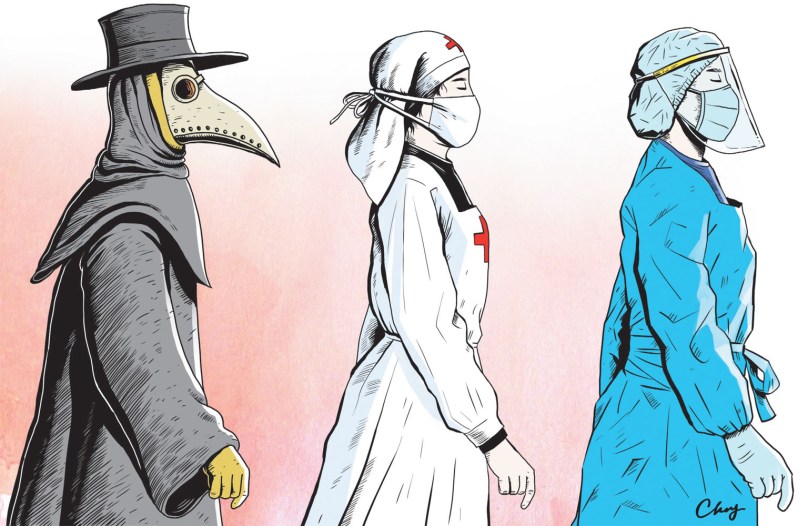
The Costumes Might Be Different, But It’s the Same Thing
The following are quoted from Gonçalo M. Tavares’s “My Plague Diary,” excerpts of which were published in the June 5, 2020 issue of the Times Literary Supplement:
For days, a violent poster campaign on the streets of the capital: if you are reading this, our condolences. You don’t want to be shut up at home, but in a coffin instead.
This poster worries more about your family than you do.
If you go out, you kill. If you go out, you die. If you go out and get sick, don’t complain. In any case, you won’t be able to complain.
If you have just gone out to visit your family, say goodbye to them.
At the entrance to the Metro: here’s hoping you don’t read me, here’s hoping you don’t die.
A lot of Brazilian prisoners are writing goodbye letters to their families. They say they’re getting sick. Coughing, fever, cries for help in a number of cells.
A picture from two weeks ago, jackals in the streets of Tel Aviv. They are hungry and they’ve lost their fear. Because they are hungry they’ve lost their fear. They need to go back to having fear or food, somebody says.
A friend from Brazil writes to me: “I wish I had a loudspeaker, like this guy in Ipanema.” They say he’s on the tenth floor, opposite the beach, and he’s set his speaker up on the balcony. And from all the way up there he was issuing warnings through his loudspeaker: Hey, lad in the blue shirt, the one on the bike, yeah, you! You’re going to get coronavirus, you know. Hey, lady in the flowery swimsuit, with your hair done and the red lipstick, yes you! You’re going to get coronavirus, you know…! She lives in Rio. She’s terrified.
Unemployment reaches 1929 Great Depression levels in the USA, and in Guatemala, women on the side of the road are holding a white flag. They wave the white flag when a car or a motorbike passes. They are unemployed, they ask anyone who stops for food.
Maria Branyas, aged 113, is now the oldest person to beat the novel coronavirus.
Dizziness, I’ve got to check this out. Too many days like this. Lying down, I’m fine, but sometimes it’s good to be on two feet. They don’t seem like days—but days in the middle of something. As if the day even when it is finished were not complete. It is always between one thing and another. These days are always the middle sibling. A need for lightness; feeding the dogs organizes my time; without their hunger I would surely be having more dizzy spells.
Two actions of resistance. You must wait or clean. How long does evil remain on a surface? Think about evil that can be eliminated by cleaning.
Doesn’t matter what you think, what matters is what you do.
Today was a day devoted to books. This morning, I took a box of 20 trade paperbacks to the Los Angeles Public Library in Mar Vista as a donation. They are about to have a large book sale in a couple of weeks, and I thought these books would probably sell. After I dropped them off, I sat in one of their comfy chairs and finished reading The Best American Travel Writing 2013, edited by Elizabeth Gilbert. Travel literature is one of my favorite book categories, accounting for much of my reading during the summer months. (As well as being an actual traveler, I am also an armchair traveler.) On my way out, a picked up a free library discard copy of Fodor’s Brazil (2016).
The reason? I am toying with the idea of flying to the State of Bahia, to Salvador and Ilheus, and reading Jorge Amado’s novels which are set there.
Next, I drove to the Westfield Culver City mall, where I ate a light vegetarian lunch at the Vietnamese restaurant in their top floor food court. Afterwards, I bought some milk chocolate clusters with walnuts, peanuts, pecans, and almonds. I spent a couple of hours looking at the Fodor Brazil guide before heading home.
Max von Sydow and Liv Ullmann Arrive on the Island in Hour of the Wolf
By the time I got back, Martine was gone for a doctor’s appointment, so I watched Ingmar Bergman’s Hour of the Wolf (1968), the closest the Swedish director ever came to a gothic horror film, starring Max von Sydow and Liv Ullmann staying on an island of vampires.
After preparing dinner, consisting of Hungarian fasirt with buttered corn on the cob. Afterwords, I started reading Valentin Kataev’s 1927 novel Embezzlers. All in all, not a bad day.
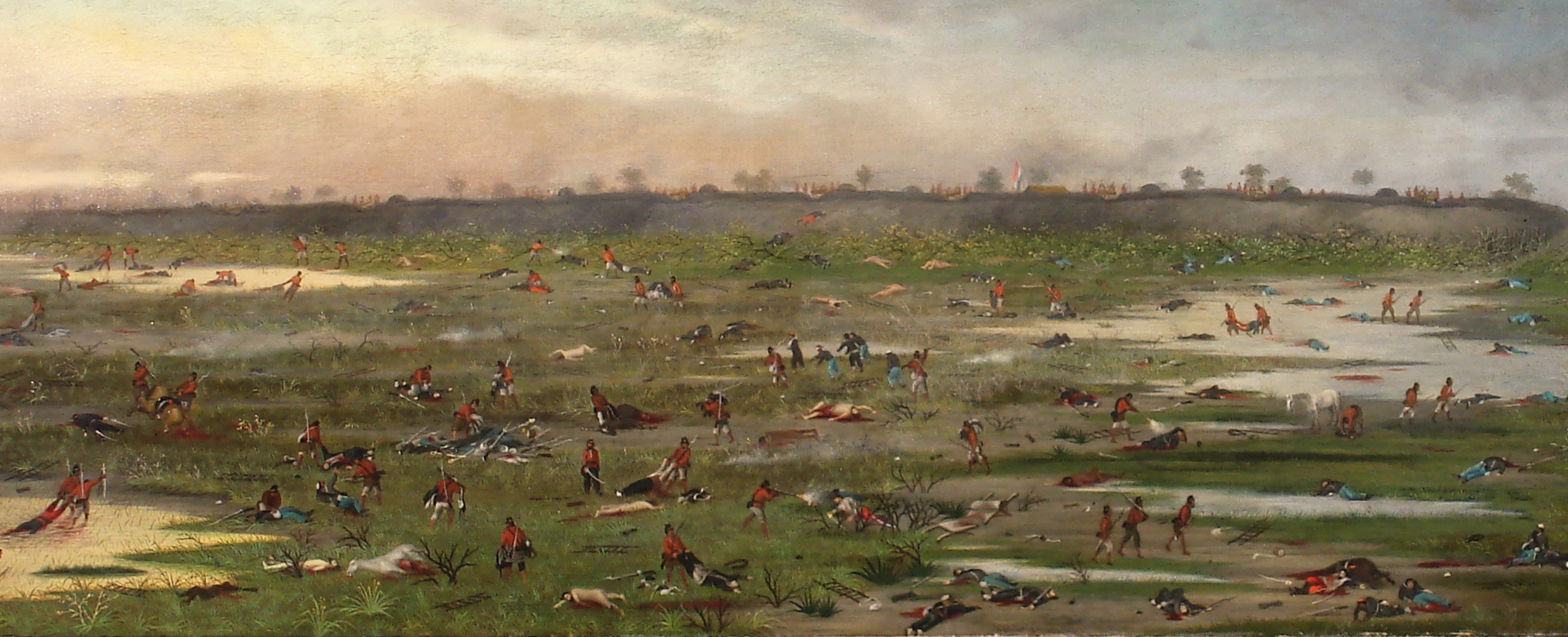
Here is a trick question for you: What was the most deadly war fought in the Western Hemisphere? What, the American Civil War? Not even close. Just as we were fighting our Civil War (which I don’t think is quite over yet), the tiny country of Paraguay decided to invade Brazil. Soon, Argentina and Uruguay joined in against Paraguay, in what is called the War of the Triple Alliance. By itself, Brazil had the resources and the manpower to crush Paraguay. But the war went on from 1865 to 1870, during which 80% of the total population of the little inland country lost their lives.
The man behind the war was dictator Francisco Solano López (shown below), better known for his obesity and rotten teeth than for his military prowess. Oddly, this was a war on which there were heavy casualties on both sides. Who knew that the starving Paraguayans fought like the devil and wouldn’t just play dead. They also had one self-trained military genius, a young railway engineer named George Thompson. He designed the Paraguayan fortifications at Curupayty to take his adopted country’s weaknesses and turn them into strengths.
The Fomentor of the War
I am re-reading one of the best travel books I have ever encountered, John Gimlette’s At the Tomb of the Inflatable Pig: Travels Through Paraguay. Here is Gimlette describing the aftermath of an abortive allied attack on the positions so skillfully designed by Thompson:
The Allies took Curupayti as a terrible blow. Argentina lost any remaining enthusiasm for the war, and the greater share of the fighting now fell to the Brazilians. Allied strength was built up to 80,000, but even the Brazilians struggled to find the numbers. Brazilian rural life was fractured by violent recruiting gangs, and eventually the plantation slaves of Bahía were drummed into the ranks on the promise of freedom and land. The cost was debilitating at £14,500,000 a year, of which £2,000,000 went on maintaining the horses of the imperial cavalry. All sides were now desperate for a conclusion.
Curupayty held out for another year. At first the Allies were paralyzed with shock, and then the ranks of both armies were liquefied by cholera. López was so terrified by the disease that he forbade anyone to mention it by name, and it was only known simply as “the Chain.” It claimed fifty men a day for six months…..
When Curupayty was finally abandoned, Thompson mounted the earthworks with one last, sullen garrison. The wary Allies shelled them for three days before mustering the courage to advance. They were in for a bitter surprise.
The last defenders of Curupayty were merely scarecrows, stuffed with straw.
I highly recommend Gimlette’s book for anyone interested in learning about events that are unknown to 99.9% of Americans. When the War of the Triple Alliance finally sputtered to an end, there were ten Paraguayan women to one man. The war continued on to levels of craziness not often seen in battle:
Meanwhile, the Allies poured fire down on to the defenders. The Paraguayans responded with all they had left, often just blowing their túrútútús—or trumpets—and infuriating the Allies with their stoicism. They dug themselves fox-holes with names like the Hotel Français, de Bordeaux and Garibaldi fed their gallows humour.
“If a Paraguayan in the midst of his comrades was blown to pieces by a shell,” wrote Thompson, “they would yell with delight, thinking it a capital joke, in which they would have been joined by the victim himself had he been capable.”
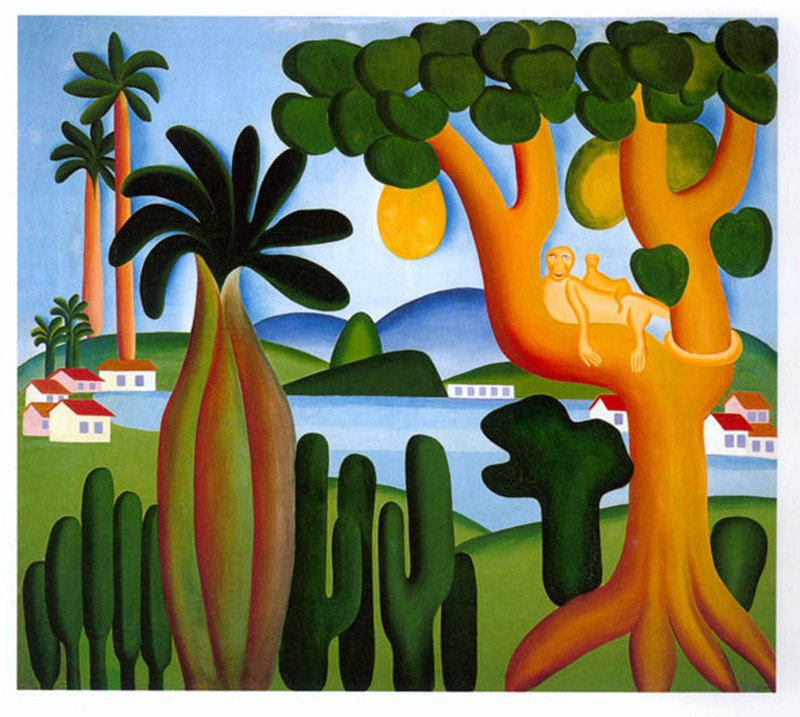
Postcard View with Brazilian Scenery by Tarsila do Amarol (1886-1973)
As you may or may not know, I am fundamentally opposed to non-representational painting. Abstract expressionism leaves me cold and even slightly hostile. I don’t even like Pablo Picasso. When I was in Paris last time, I deliberately decided not to visit the Picasso Museum even though I was in the neighborhood between Les Halles and the Bastille, where it is located.
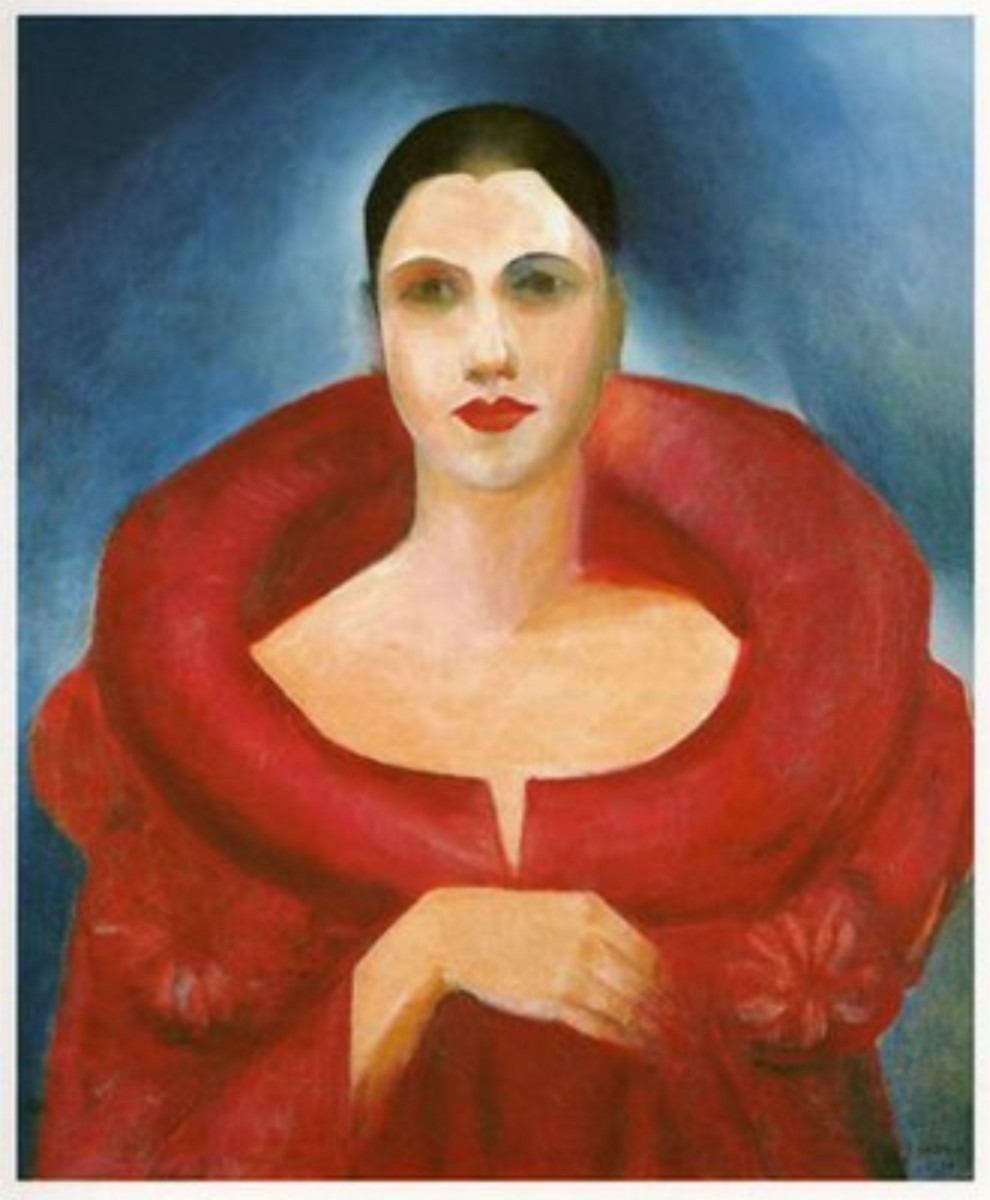
So when I heard of a Brazilian painter who has been called the Picasso of Brazil, I was less than impressed—until I saw some of her works. I was suddenly reminded of Xul Solar, the Argentinean painter whose work was much loved by Jorge Luis Borges (before he became blind, of course). Tarsila de Amaral calls herself simply Tarsila. There is a n exhibit of her works opening at the Museum of Modern Art (MOMA) in New York City.
“Brazilian Religion” (1927)
If you want to see a representative selection of her paintings, click on WikiArt’s website about her. Included there is her self-portrait (see below). Tarsila becomes one of a select group of Latin American artists of the 20th century whose work I think ranks with the best of American painting during that period, and in many cases surpasses it: Fernando Botero of Colombia; Benito Quinquela Martin and Xul Solar of Argentina; and Frida Kahlo, José Clemente Orozco, Diego Rivera, and David Alfaro Siqueiros of Mexico.
When I went to Iguazu Falls last month, it was the first time I had ever been in what I call a “monkey jungle.” There isn’t much jungle in Argentina, but the northeasterly states of Corrientes and Misiones readily qualify. Many of the trees have been cleared to make room for the Yerba Mate crop, of which most is consumed within Argentina itself (and sometimes in the United States by strange people like me).
Although I had Yerba Mate even for breakfast in the jungle—in the form of teabags, usually referred to as mate cocido—the drink which kept me going during the day was ice cold beer. In the above picture, I am enjoying a Quilmes, which is as popular down there as the various Anheuser-Busch productoids are here. You can see the edge of the pool at the Posada la Sorgente on Avenida Córdoba in Puerto Iguazu. In the late afternoon, I enjoyed having a cool one by the outdoor bar while reading my Kindle.
My overwhelming impression of the selva was that it was hot and humid, especially as it was getting ready to unleash a Biblical thunderstorm on the evening of the day the above picture was taken.
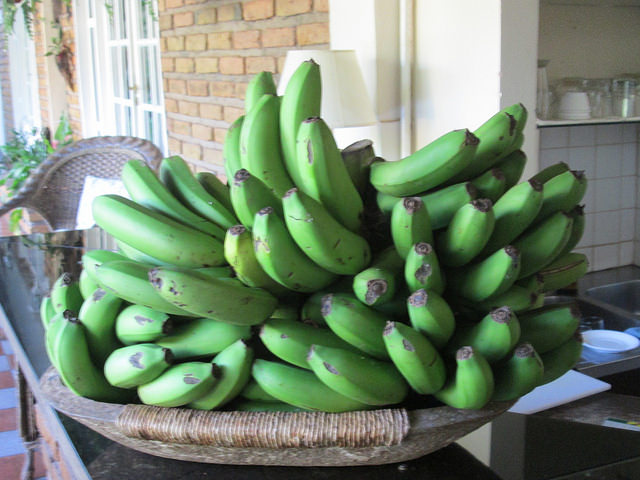
Bananas on the Bar at Posada la Sorgente
Here is another view of the bar, which had a handy basket of home-grown bananas at its edge.
I don’t know if I will ever find myself in the jungle again. For the Iguazu Falls, though, it was worth it. My greatest fear going there was the possibility of getting bitten by disease-carrying mosquitoes. Not too far north, in Brazil, the Zika fever (carried by the same Aedes aegypti mosquitoes that carry malaria, dengue, and chikungunya) is so prevalent that residents of the State of Pernambuco and surrounding areas are being urged to avoid getting pregnant. The danger? The children are in danger of being born with microcephaly.
Fortunately, not only was I not bitten: I did not even see any mosquitoes.
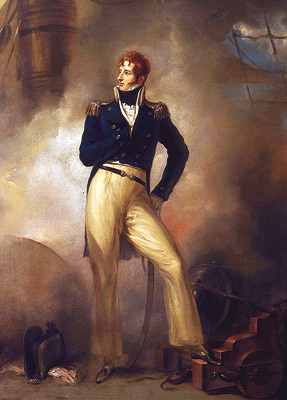
He must have been an amazing sight to his enemies, towering over six feet with red hair. Lord Thomas Cochrane, 10th Earl of Dundonald, was an impoverished Scot of noble birth who was a brilliant attacking sea captain. Because of various circumstances, mostly relating to his problems with authority, he was perhaps the most brilliant naval strategist who did not actually command a fleet. Had the Admiralty not been so venal and corrupt, he could have shortened the Napoleonic Wars by incursions against the mainland of France, forcing Napoleon back from Russia ahead of schedule. But that was not to be.
Some people are not meant to get along well with politicians. (I am one such myself, though not with one thousandth the talent of the Scotsman.) Cochrane developed a whole slew of enemies, hobnobbing as he did with Radicals as William Cobbett and Sir Francis Burdett. He even spent time at King’s Bench Prison for stock fraud—a mostly bogus charge cobbled together by his enemies with a complaisant and corrupt judge on the bench.
Stripped of his Order of the Bath and drummed out of the Navy, Cochrane accepted an offer the command the navy of the emerging Republic of Chile. He fought a number of sharp naval actions until the Spanish Pacific Fleet was driven off. Then he assisted Dom Pedro I of Brazil fight for that country’s independence from Brazil.
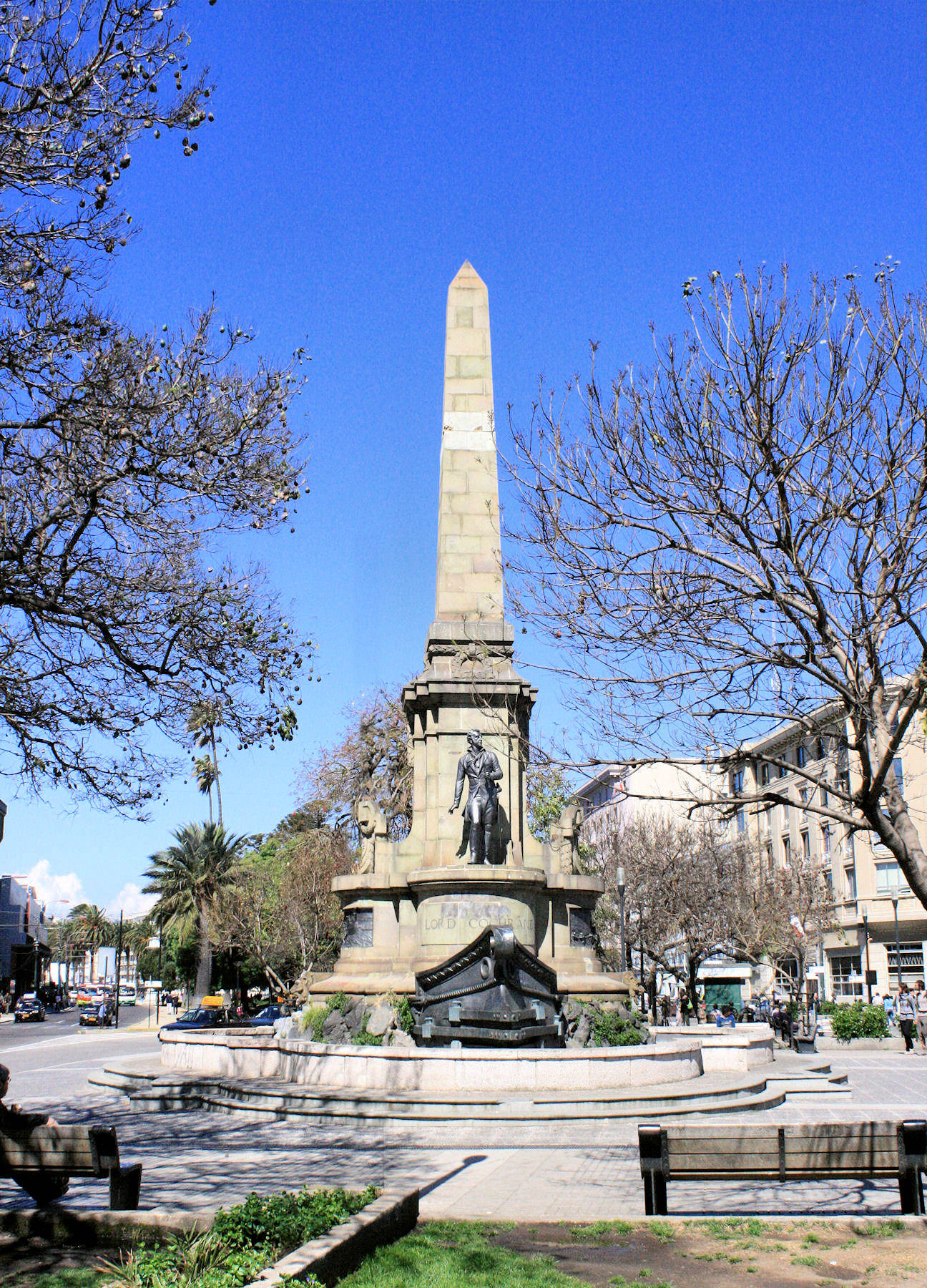
Memorial to Cochrane in Valparaiso, Chile
Finally, he ended up commanding the fleet of the Greeks who were then fighting to free themselves from the Ottomans. Here he was least effective, largely because of the rampant factionalism of the Greeks. According to Donald Thomas in his excellent biography Cochrane, “he wrote to the Chevalier Eynard of the Philhellenic Committee in Paris, describing the government of Greece as depending on ‘bands of undisciplined, ignorant, and lawless savages.’” This was a far cry from the well-trained British and Chilean sailors he had commanded.
Eventually, Greece won her independence, but only after the British, Russians, and French combined to dictate terms against the Turks.
Cochrane reminds me of General George Patton, another brilliant military leader who paid a heavy price for refusing to kiss the butts of military administrators.









 Tarnmoor
You must be logged in to post a comment.