The Man from La Boca

He Was the Painter of the Port of Buenos Aires

He Was the Painter of the Port of Buenos Aires

Benito Quinquela Martín (1890-1977) is a painter not widely known in the art world of New York, London, or Paris. In Argentina, his work is a different story altogether. Martín was known primarily for painting port scenes around La Boca, which, for most of his life, was the port of Buenos Aires. Today, La Boca is primarily known for cheap souvenir shops and dancers who assume tango positions for pesos for the tourists. Near the tour buses at Caminito, however, sits the Escuela Pedro de Mendoza, which happens to contain the Museo de Bellas Artes Benito Quinquela Martín dedicated to his work.

Boca is not the nicest part of the port city, and it is no longer the port, which has been moved east. The polluted Riachuelo, also known as the Matanza, flows past the museum and the brightly colored buildings decorated with leftover marine paints and inspired by Quinquela Martín’s port views.

Unloading Cargo at La Boca

Unloading Cargo at La Boca

Aside from the tourist ghetto around Caminito and the nearby Boca Juniors football stadium known as the Bombonera, or candy box, Boca is a rough neighborhood from which tourists do not stray far. A century ago, however, it was the port of entry for thousands of Italian, Spanish, and other European immigrants who came to South America looking for a better life. And many of them found it. During the First World War, most soldiers on both sides were fed with canned beef from Argentina and Uruguay; and silent movies like The Four Horsemen of the Apocalypse (1921) starring Rudolph Valentino showed the lives of Argentinian millionaires.

Another Port Scene from Martín

Another Port Scene from Martín

Today, Benito Quinquela Martín is considered to be one of the greatest Argentinian painters of the Twentieth Century; and his work in found in museums throughout Buenos Aires.


Cartoneros and the Tren Blanco

The Recyclers Come Out at Night ...

The Recyclers Come Out at Night …

There are always two sides to the coin. The other day, I wrote a post about Buenos Aires that perhaps gilded the lily overmuch. I have to keep reminding myself that one can easily love someone, something, or someplace that is far from perfect. Take Los Angeles, for example, from which my cousin Peggy from Cleveland fled because, as she said, she couldn’t find anyone who spoke English. (I don’t think she tried very hard.)  Many of my friends from other parts of the country do not hold Southern California in high regard, especially if they haven’t given the place a chance to work its way into their bones, the way it has with me.

So back to Buenos Aires. As with many huge cities, there is a lot of poverty lurking behind the picturesque façades. In Argentina, these usually take the form of what are sardonically called villas miserias (“misery villas”) due to the habit of calling the areas surrounding the urban core with names beginning with Villa, such as Villa Lugano, Villa Lynch, Villa Crespo, and the spectacularly awful Villa 31 (see below) adjoining the posh neighborhood of Retiro. This used to be the docks area for the Port of Buenos Aires, before they moved east.

Villa 31 with the Microcentro in the Background

Villa 31 with the Microcentro in the Background

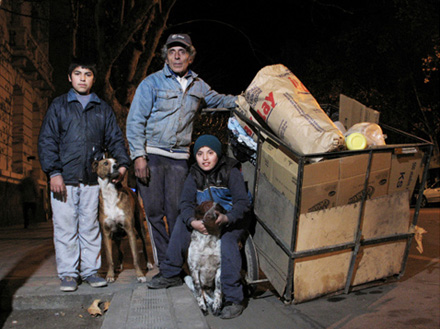
After dark, the streets of Buenos Aires fill up with cartoneros, whole families with large carts who go through the garbage for cardboard and other recyclable items for which they can earn a few pesos. After the economic crisis of 2001, the government wisely has begun to recognize them and even facilitated their scavenging by creating the tren blanco, or “white train,” to bring them from the villas miserias, where they live, to the center of the city. These trains consist of old rolling stock with the seats removed (to allow for carts to loaded) and sometimes even without lighting.

Aboard the Tren Blanco

Aboard the Tren Blanco

I have seen the cartoneros at work the few times I wondered the streets of the city at night. For the most part, they are diligent and friendly as they go about their work; but there were stories at the Posada del Sol youth hostel about backpacks and wallets that were stolen. Fortunately, I escaped being mugged.

Again, there are parts of Los Angeles about which I would say the same thing. Except here, there is a higher chance of violence and rape accompanying the mugging.

Tarnmoor’s ABCs: Xul Solar

Surreal Cities ...

Surreal Cities …

All the blog posts in this series are based on Czeslaw Milosz’s book Milosz’s ABC’s. There, in the form of a brief and alphabetically-ordered personal encyclopedia, was the story of the life of a Nobel Prize winning poet, of the people, places, and things that meant the most to him.

My own ABCs consist of places I have loved (Iceland, Patagonia, Quebec, Scotland), things I feared (Earthquakes), writers I have admired (Chesterton, Balzac, Proust, Borges, and Shakespeare); locales associated with my past life (Cleveland, Dartmouth College, and UCLA), people who have influenced me (John F. Kennedy), foods I love (Olives and Tea), and things I love to do (Automobiles and Books). This blog entry is my own humble attempt to imitate a writer whom I have read on and off for thirty years without having sated my curiosity. Consequently, over the next couple of weeks (there are now only two letters left in the alphabet: Y and Z), you will see a number of postings under the heading “Tarnmoor’s ABCs” that will attempt to do for my life what Milosz accomplished for his. To see my other entries under this category, hit the tag below marked “ABCs”. Today is X for—no, not X-Ray—but Xul Solar.

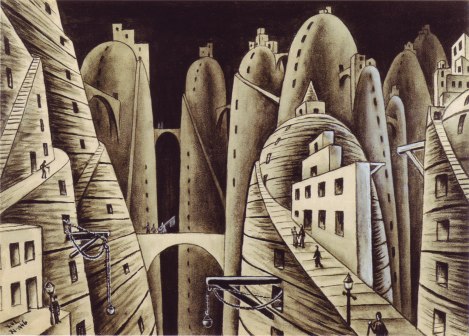
I generally do not like modern art, but I have a strange affinity for many surreal artists like Salvador Dalí, Giorgio di Chirico, and Xul Solar.

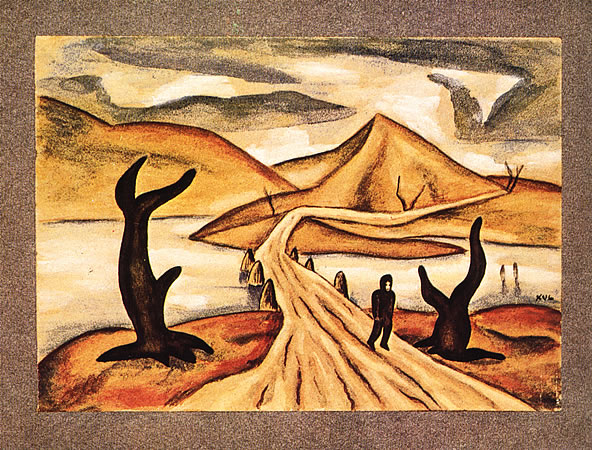
In March of last year, I already wrote a post about the Latvian-Argentinean painter, whose real name is Oscar Agustín Alejandro Schulz Solari, but since that “X” is a difficult letter to account for in any alphabetical scheme such as this one, and because I plan to visit his museum in Buenos Aires in November, I decided to write more about his work, which is filled with strange cities and desolate landscapes populated with strolling characters of a vaguely human appearance.
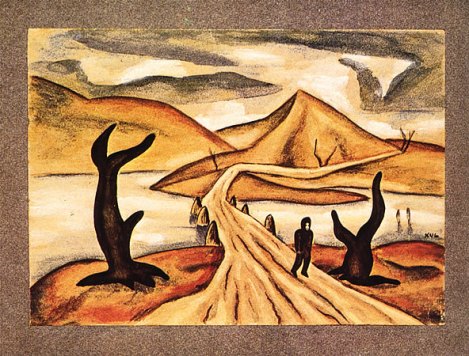
“Paisaje Bunti”

“Paisaje Bunti”

As I wrote in my previous post, it was Jorge Luis Borges who turned me on to his work. As he wrote on one occasion, “His paintings are documents of the unearthly world, of the metaphysical world in which the gods take the forms of imagination, dreams. Passionate architecture, happy colors, many circumstantial details, labyrinths, homunculi and angels unforgettably define this delicate and monumental art.” Soon after he wrote those words, Borges lost his eyesight and was unable to enjoy any paintings, save what visual fragments remained in his memory.

Below is Xul Solar’s take on a cathedral:
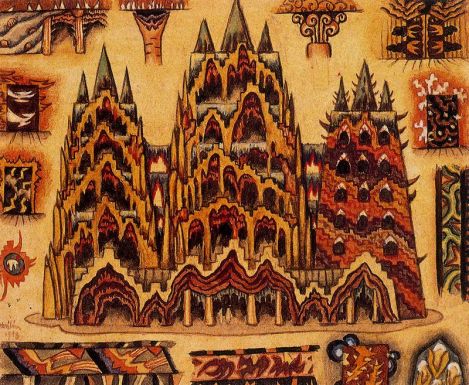
“Cathedral”

“Cathedral”

My hotel in Buenos Aires will be within walking distance of the Xul Solar Museum, which is situated at Laprida 1212, a short walk down Pueyrredón from Recoleta. You can visit the museum’s website and view a nice selection of his paintings done over some fifty years. Never mind that the text is in Spanish.


The Ytinerary: Buenos Aires

Starting at the Beginning ...

Starting at the Beginning …

This is the start of a new series of posts, all connected with my vacation plans and daydreams. The Ytinerary—combining the words “Why” and “Itinerary”—takes each step of my November trip and answers the question, “Why are you going there?”

Let’s start with Buenos Aires. My plane lands at Ezeiza, officially known as Ministro Pistarini International Airport, one of the largest in South America. Fortunately, there are a lot better reasons than mere convenience to spend time on the shores of the Plate. B.A. is a target-rich environment, full of museums, parks, and historical buildings. It has been described as very like a European city, partly because the majority of its inhabitants are of European descent, mostly Italian and Spanish. (The original natives of the Pampas were wiped out by General Julio Argentino Roca’s “Conquest of the Desert” in the 1870s.)

I have been to B.A. twice before, in 2006 and 2011. The first time, I stayed at the Posada del Sol (above) on Hipólito Yrigoyen, not far from the Plaza de Mayo and the Casa Rosada, the nation’s capitol. The second time was at the Chez Lulu in Palermo. This time, I plan to stay in Recoleta, between the two.

This time, I hope to see the city from the eyes of its greatest writer, Jorge Luis Borges. His widow runs a Borges Cultural Centre at Viamonte and San Martín. I also plan to see the Museo Xul Solar, dedicated to a surrealist painter whose work Borges loved (and about whom I will write later this week). Also, I will walk the streets of Palermo, where the poet was born long before the area became gentrified and when it was full of knife-fighters and trucho players.

I will visit some of the old cafés for which the city is famous, such as the Café Tortoni, Il Preferido, El Sanjuanino, and Los Violetas, which are well into their second century, and where Borges and his friends used to hang out. The food is great and the service exquisite.

Also, I will renew my acquaintance with TEGOBA, the English Speaking Group of Buenos Aires, which meets on Fridays for dinner at the FAME Fast Food Restaurant on Cabildo near the Congreso de Tucumán Subte stop (below).

My Friends at TEGOBA: Marta Viajero and Gonzalo Luchinetti

My Friends at TEGOBA: Marta Viajero and Gonzalo Luchinetti

As you can see, I could easily spend all three weeks of my vacation in Buenos Aires. It’s one of those cities which is endlessly fascinating.


A Visit to the Holy Land

Argentina’s Own Biblical Theme Park: Tierra Santa

Argentina’s Own Biblical Theme Park: Tierra Santa

Both times I have visited Argentina, I stopped in at Buenos Aires’s Tierra Santa, a theme park dedicated to the Bible, particularly the New Testament. It’s relatively easy to get to: Take the commuter train a mere stop or two from Retiro Station to Estación Raúl Scalabrini Ortiz and walk to the northern exit, which takes you almost a mile past a water park along the Rio de la Plata to Argentina’s occasionally tacky and very Catholic version of the Holy Land.

One can easily spend two or three hours seeing the Disneyfied exhibits of the Creation, the Last Supper, and the Sermon on the Mount. There are several Middle Eastern type restaurants, gift shops, and hundreds of full size plaster statues representing figures from the Bible. Above is the Crucifixion, atop a sun-drenched Golgotha you can climb to be in the middle of the action.

It can’t be all that bad, because according to the park’s website, Pope Francis visited it.

If you are really famished after your visit, there was a branch of Siga la Vaca (“Follow the Cow”), an all-you-can-eat parrillada right next door.

Gone Forever: The Cafe Richmond

One of the World’s Great Literary Cafés

One of the World’s Great Literary Cafés

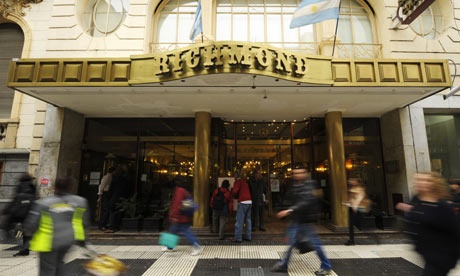
Just before Martine and I flew to Buenos Aires in 2011, one of the world’s greatest literary cafés was turned overnight into a Nike sportswear shop. Where once Jorge Luis Borges sat and wrote his stories, and where Graham Greene hung out (and commemorated) while he was writing The Honorary Consul, and where Antoine de Saint-Exupéry ate near his “charming little apartment” on Calle Florida, you can now buy shoes and other clothing items that are also available in a thousand other nearby outlets.

If I make it to Argentina later this year, I plan to photograph the damage, while urging you to boycott Nike. As far as I’m concerned, they can go and swoosh themselves into oblivion.

There is a charming article in the Argentina Independent about Calle Florida, where the Richmond was located at #468 (near the intersection with Lavalle). You can read more about the Cafe Richmond in The Guardian and The Independent.

Fortunately, Buenos Aires is a city with many great cafés; but, sometimes, when a great one closes, the ripples are felt around the world.

Gabriela Kogan has written a great little book which Martine and I used called The Authentic Bars, Cafés, and Restaurants of Buenos Aires which is available from The Little Bookroom.

Everybody Who Is Anybody

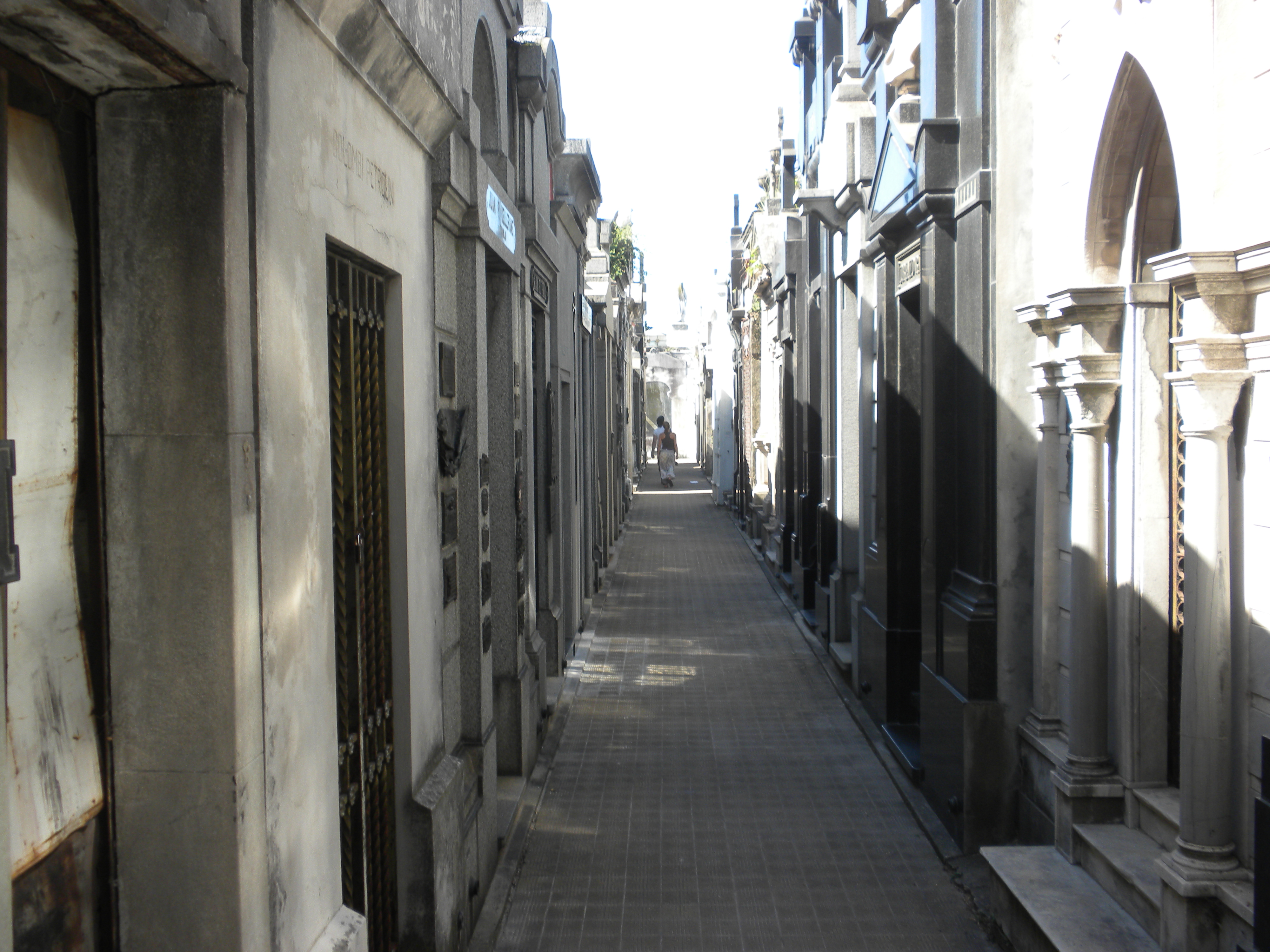
A Lane in Buenos Aires’ Recoleta Cemetery

A Lane in Buenos Aires’ Recoleta Cemetery

In the United States, there is no single cemetery where everybody who is anybody is interred. France has its Père Lachaise and Pantheon, and Argentina has La Recoleta.

There you will find the tombs of Argentina’s presidents, including Bartolomé Mitre, Carlos Pellegrini, Domingo Faustino Sarmiento, Hypólito Yrigoyen, Julio Argentino Roca, Marcelo Torcuato de Alvear, Pedro Eugenio Aramburu, and Raúl Alfonsin. Perhaps its most famous inhabitant is Evita Perón, who is buried here under her maiden name of Duarte. Not here is the only Argentinean president most people are likely to know: Juan Perón. He was buried at Chacarita Cemetery, then moved to a mausoleum some 35 miles outside of Buenos Aires.

Although Jorge Luis Borges—Argentina’s most famous writer—is buried in Europe, here you will find Silvina and Victoria Ocampo and Borges’s collaborator Adolfo Bioy Casares.

Walking through the labyrinthine passageways between the crowded crypts, one finds fabulous wealth (such as that of the Bullriches) side by side with neglected tombs with broken glass and crumbling plaster.

And yet, to pass eternity in this place has a high entrance requirement. Many of the tiny crypt spaces are more expensive than mansions in the more elegant parts of the city. These are the most exclusive fourteen acres in all of South America.

If you find yourself in Argentina, a visit to Recoleta is a must.


Back to Argentina?

Third Time’s a Charm!

Third Time’s a Charm!

As tax season pressures come to bear on me once again, I look frantically for some escape. As Martine is still unable to travel with any degree of comfort, I will travel alone for the third year in a row. And I’ve decided that I am far from finished with Argentina. When I traveled there in 2006 and 2011, it was the country of Jorge Luis Borges, of his “Funes the Memorious” and “Death and the Compass.” It still is, but new names have been added, particularly César Aira and Juan José Saer, from Coronel Pringles and Santa Fé respectively.

And there are places I have always wanted to see: San Carlos de Bariloche in the Patagonian Andes and Iguazu Falls where Argentina, Brazil, and Paraguay meet. Also I want to spend more time in Buenos Aires—a city that I love. In 2006, I stayed in the Microcentro; in 2011, Martine and I stayed in Palermo; this time, I think I’ll stay either in Recoleta (not the cemetery, pictured above) or Barrio Norte.

Because I will be traveling alone, I will probably take more long-distance buses, especially as Aerolíneas Argentinas is so dismal. To get to Argentina, by preference I will fly on LAN, probably by way of Lima, perhaps even stopping for a few days in Lima.

I wish Martine could come with me, but with her aches and pains, she would turn into a zombie from lack of sleep—which is in effect what happened during our Cabo San Lucas trip last month, which was a test of sorts.