Down to Yellow Alert

Yes! It Looks Like Calbuco Won’t Interfere with My Trip

Yes! It Looks Like Calbuco Won’t Interfere with My Trip

I have been watching Sernageomin’s Reporta de Actividad Volcánica (RAV) on a daily basis. I have seen the warnings go from a Red Alert and a 20 km danger zone to an Orange Alert and finally a Yellow Alert. Even if Calbuco doesn’t emit so much as a puff of smoke in the next six months, the Servicio Nacional de Geología y Minería will likely not lower the alert to Green if only because the three eruptions of April 22, 24, and 30 were so spectacular as to keep the agency on its toes.

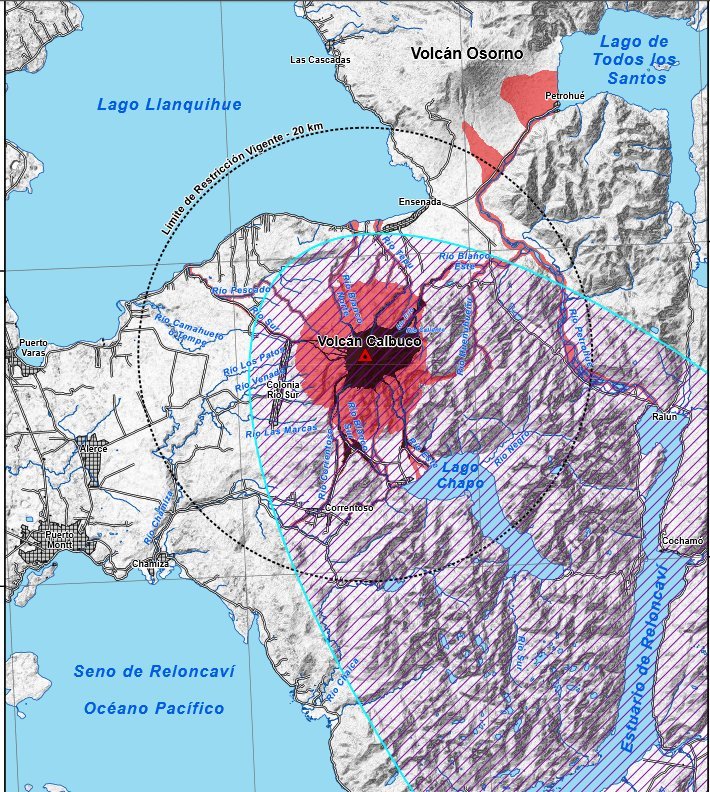
On May 9, I printed a vastly different chart showing the danger zone, the lava paths to the surrounding lakes, and the direction of wind-borne volcanic ash. My planned bus journey from Lago de Todos los Santos to Puerto Varas would have been blocked at several points by flowing lava; and both Ensenada and Petrohué had been evacuated.

As you can see from the most recent RAV chart for Calbuco (above), only parts of the Rio Frio and Rio Caliente are in any danger of pyroclastic flows; and ash is no longer coming from the caldera.

Chile is a somewhat tricky country to visit: It is not only one of the most active countries in the world due to its volcanic activity, but also due to devastating earthquakes. On May 22, 1960, Valdivia had a quake that tipped the Richter scale at 9.5. What with its associated tsunami, is is considered one of the strongest tremors in history.

So why do I want to go there? Certainly not to walk innocently into a disaster. Mountainous country is beautiful, but the taller the mountains, especially near the edge of a tectonic plate, the more Biblical are the disasters. You pay for beauty.


Hua Hum? Ho Hum!

One of the Border Crossings from Argentina into Chile That I Was Researching

One of the Border Crossings from Argentina into Chile That I Was Researching

As of yesterday, the 20 km danger zone around the Chilean volcano Calbuco has been lifted, restoring normal traffic between San Carlos Bariloche and Puerto Varas. Although the volcano is still listed as red for a potential eruption, in terms of actual danger, it has been downgraded to orange.

In a way, I am disappointed. I had been researching the other crossings over the Andes and discovered a little-known one at Paso Hua Hum near San Martin de los Andes. By way of a lake crossing, it takes me to Puerto Fuy, from which I can go to Valparaíso by way of Temuco or Valdivia. From pictures I’ve seen, it is every bit as scenic as the famous Lakes Crossing from Bariloche; and it is well off the normal tourist circuit.

This kind of research is part of the fun connected with my vacations. There is always a “problem” to be solved. For Eastern Canada, it was how to find a place to sleep close to Québec City while avoiding the traffic problems. For Iceland, it was how to see the bird cliffs at Latrabjárg in the Westfjords. For Peru, it was how to avoid coming down with acute mountain sickness. All these problems were successfully solved, which made for no small part of the satisfaction I felt from the vacation as a whole.

Volcano? What Volcano?

I’m Tired of Being Pushed Around by Natural Disasters

I’m Tired of Being Pushed Around by Natural Disasters

In 2011, it was Puyehue-Cordon Caulle that forced me to change my itinerary. This time, it’s Calbuco (see above). I guess I could just pussyfoot around until it’s time to go and switch my plans once again. This time around, I decided to bet that, by mid-November, Calbuco will be all played out. (Of course, Sernageomin still rates it as red for imminent eruption or eruption in progress.)

Consequently, today I decided to fly into Buenos Aires and, in true “open jaws” style, return via Santiago, Chile. That means I will take the lakes crossing trip from San Carlos Bariloche to Puerto Varas. If Calbuco still insists on spewing crap along my path, I will just go around it. There are other border crossings that are perhaps less convenient, but I’ll cross that bridge when I come to it.

Why am I going home by way of Chile? First of all, I’ve always wanted to visit Valparaíso. My reason for it goes back more than half a century. While a student at Dartmouth College, I saw an almost impossibly poetic documentary by Joris Ivens called … à Valparaíso (1963). If you have a half hour to spare, and don’t mind the French narration, you can see it here on YouTube.

I plan on spending several days in Valparaíso, visiting the homes of poet Pablo Neruda, climbing the endless stairs, taking the funiculars that ascend the forty-two hills of the city. Some people prefer the beach. I’ll take poetry and beauty any time!

Cabulco, Calbuco—Let’s Call the Whole Thing Off!

Okay, So I Misspelled It!

Okay, So I Misspelled It!

It appears that I have been applying alternate spellings to the name of the Chilean volcano which is threatening the itinerary for my next vacation. No sooner did I decide to cross over the Andes between Bariloche, Argentina, and Puerto Varas, Chile, than the volcano Calbuco, which hadn’t erupted for decades, decided to erupt three times.

Above is a map from Chile’s Servicio Nacional de Geología y Minería (Sernageomin) showing the zone affected by Calbuco as of yesterday. The diagonally striped red lines show the dispersion of ash. The solid black area right around the rim of the volcano shows evidence of being changed by the eruptions, and the solid red areas are considered danger zones for any future eruptions.

I plan to go by bus from Petrohué to Puerto Varas (at the left edge of the map).

My hope is that the volcanic activity abates, allowing me to sneak by without getting caught up in the mess. Keep your fingers crossed!