Ghost Town

Decaying Buildings in Ghost Town of Bodie, California

I have visited several ghost towns in California and Nevada, but by far the most impressive is Bodie in Mono County, California. Here you will find no Disney-esque reconstructions: The town is as it was in 1915, when most of its inhabitants decided to relocate elsewhere. And when they left, they left most of their goods behind, where they still are today.

And why shouldn’t they? The town sits at an altitude of 8,379 feet (2,554 meters). To reach its, one takes a washboarded gravel road thirteen miles (21 km) from the end of pavement roughly midway between Mono Lake and the town of Bridgeport. During the winter it is bitterly cold. In fact, the town’s founder, variously called William S. Bodey and Waterman S. Bodey, froze to death in an 1860 blizzard while riding to pick up supplies.

Tomb of the Founder of Bodie, in the Ghost Town’s Cemetery

Bodie was a gold mining town. At its outskirts are the ruins of a large stamping mill which is off limits to tourists because of exposed mine shafts and rusting equipment. For a while around 1880, Bodie had a population of 7,000-10,000 people and was one of the largest cities in the State of California. Over the years, the mines there produced some $34 million in gold and silver (in 1986 dollars).

But like most boom towns, Bodie went bust. Today, the Bodie Historical District is a national and California historical landmark. The state had decided to let Bodie remain as it was when it took over in 1962. No attempt will be made to prop up falling buildings, of which there are many.

Buildings Are Allowed to Collapse

When you visit Bodie, you will see a real ghost town. There are no gunfight re-enactments. In fact there are no services, no cafés, no gift shops. There is a rest room in the parking lot, but little else.
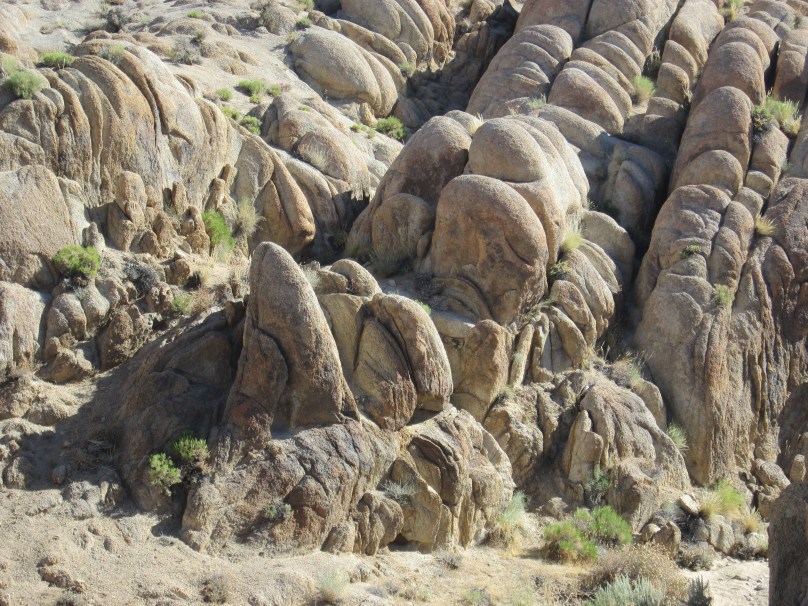
The Alabama Hills

Hundreds of Hollywood Films Were Shot in the Alabama Hills

If you take California 14 from Los Angeles through the Antelope Valley to the end, you will find yourself on U.S. 395 near China Lake and Ridgecrest. In another hour or so, you will pass the turn-off for Death Valley in Olancha and soon afterwards the little town of Lone Pine.

Just west of Lone Pine, along the road that takes you to the Whitney Portal, are the Alabama Hills, which if you have seen as many films as I have, may be surprisingly familiar to you. That is because literally hundreds of scenes in Hollywood films were shot there, Here is a short list:

  • Gladiator (2000)
  • Django Unchained (2012)
  • Tremors (1990)
  • The Great Race (1965)
  • Bad Day at Black Rock (1955)
  • How the West Was Won (1962)
  • Gunga Din (1939)
  • Around the World in 80 Days (1956)
  • The Ox Bow Incident (1942)
  • High Sierra (1941)
  • Greed (1924)
  • Ride Lonesome (1959)
  • Three Godfathers (1948)
  • Samson and Delilah (1949)

If you should find yourself driving up that lonely Eastern Sierra highway, you might want to spend an hour or two taking the Alabama Hills loop road and seeing the sights. You can find out more if you should eat breakfast or lunch at the Alabama Hills Cafe in Lone Pine, probably the best eatery for a radius of a hundred miles.

Also highly recommended is the town’s Museum of Western Film History, which memorializes the Westerns shot in the Alabama Hills area.

The Oldest Living Things?

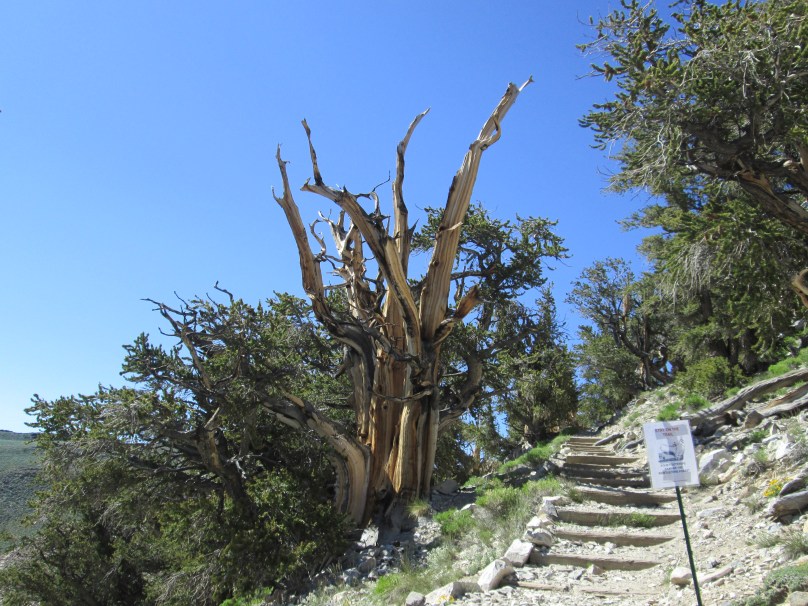
Pinus longaeva in California’s White Mountains

It has been said that the earliest living things on Earth are the Great Basin Bristlecone Pine trees in California’s Ancient Bristlecone Pine Forest within the Inyo National Forest. Martine and I visited the Schulman Grove (Altitude 10,100 feet or 3,078 meters) and its visitor center in 2019.

While there, we hiked along a trail (shown above) where there were numerous Great Basin Bristlecones (Pinus longaeva). Eventually, the altitude started to get to us; so we headed back down.

The most amazing thing we learned of at the visitor center is how scientists have been able, using the comparable annual rings of living and dead Bristlecones found in the same area, to calculate how long the species has been growing in the region. According to research conducted by C. W. Ferguson and D. A. Graybill of the Laboratory of Tree Ring Research at the University of Arizona, they were able to go back as far as 6700 B.C. This is a period of approximately 8,725 years when you add in the 2025 years of the Christian Era..

If you are a Young Earth Creationist who follows the teachings of James Ussher, Bishop of Armagh, who deduced in 1650 that the universe and everything in it was created at Noon on October 23, 4004 B.C., you are out of luck.

For more information, consult Ferguson and Graybill’s paper “Dendrochronology of Bristlecone Pine.”

El Dorado

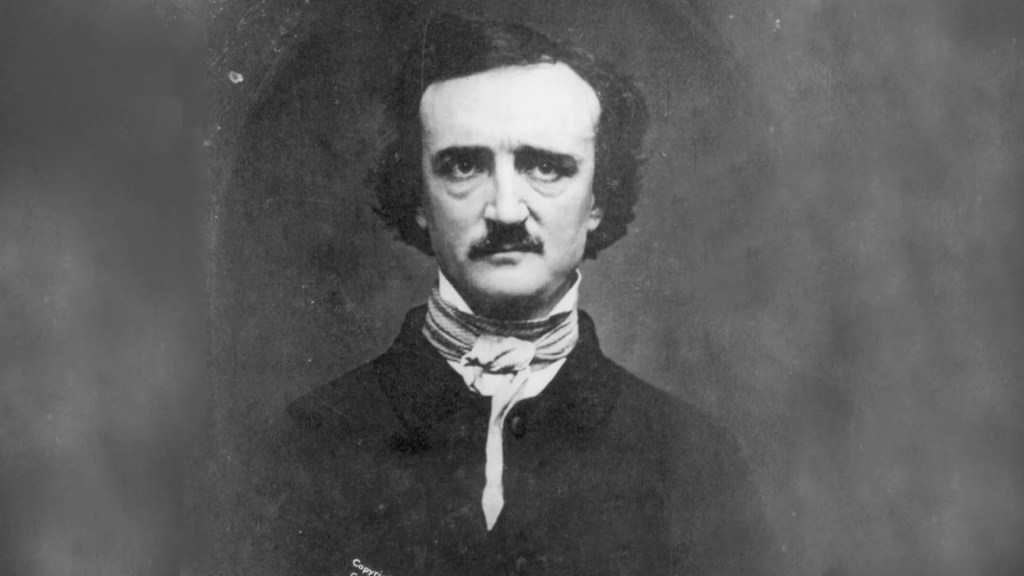
Edgar Allan Poe (1809-1849)

I am currently in the middle of the riches of Van Wyck Brooks’s The Times of Melville and Whitman (published 1947), devouring each chapter slowly, mining it for information on obscure 19th century American authors. I am even paying close attention to all the footnotes, in which I found this excerpt of a letter from Edgar Allan Poe to F. W. Thomas written on February 14, 1849. The subject was why Poe wasn’t interested in joining the Gold Rush:

Talking of gold and temptations at present held out to ‘poor-devil authors,’ did it ever strike you that all that is really valuable to a man of letters—to a poet in especial—is absolutely unpurchasable? Love, fame, the dominion of intellect, the consciousness of power, the thrilling sense of beauty, the free air of heaven, exercise of body and mind, with the physical and moral health which result—these and such as these are really all that a poet cares for—then answer me this—why should he go to California?

In fact, Poe wrote a poem on the subject:

Eldorado

Gaily bedight,
A gallant knight,
In sunshine and in shadow,
Had journeyed long,
Singing a song,
In search of Eldorado.

But he grew old—
This knight so bold—
And o’er his heart a shadow
Fell as he found
No spot of ground
That looked like Eldorado.

And, as his strength
Failed him at length,
He met a pilgrim shadow—
“Shadow,” said he,
“Where can it be—
This land of Eldorado?”

“Over the Mountains
Of the Moon,
Down the Valley of the Shadow,
Ride, boldly ride,”
The shade replied—
“If you seek for Eldorado!”

If the poem sounds vaguely familiar, it was quoted in its entirety in a Howard Hawks Western made in 1967 called, suitably enough, El Dorado. The film starred John Wayne, James Caan, and Robert Mitchum.

Anza-Borrego

Me at the Vallecito Stage Depot in 2014

A large chunk of Eastern San Diego County is occupied by the Anza-Borrego Desert State Park, the largest in California’s state park system. I used to go hiking and tent camping there with my friends.

The Vallecito Stage Depot, which is located in the general park area, was an important stop on the first official transcontinental route, serving the San Diego-San Antonio (‘Jackass’) mail line (1857-1859), the Butterfield Overland Stage Line, and the southern emigrant caravans. This was at least a full decade before the first transcontinental railroad connected the Eastern U.S. with San Francisco.

Little known outside the State of California, Anza-Borrego Desert State Park is a scenic destination with the town of Borrego Springs in the middle and near the museums and restaurants of mile-high Julian, California. To the east is the Salton Sea and desolate Imperial County.

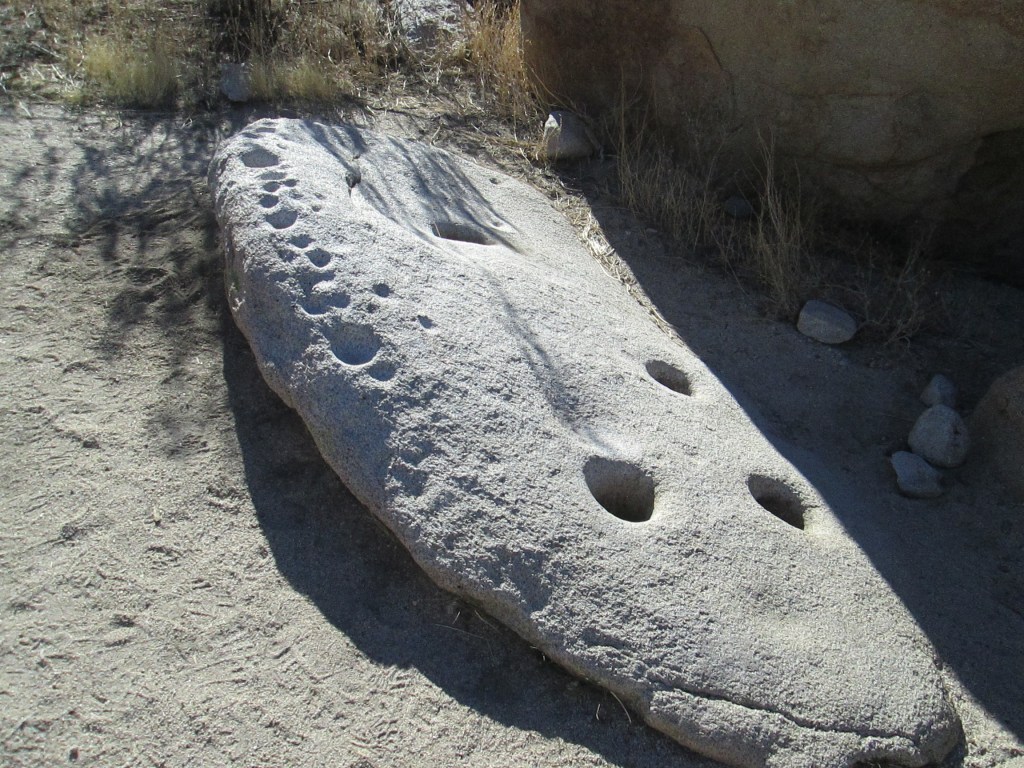
Kumeyaay Indian Morteros at Anza-Borrego

The original inhabitants of the area were the Kumeyaay Indians, who also called parts of northern Baja California home. One keeps running into evidences of their habitation of the area on the park’s many trails.

“A Certain Apprehension of Darkness”

This is not what one usually hears when talking about the settlers who crossed the continent in wagon trains to settle California. I am currently reading Joan Didion’s Where I Was From, which presents a much-needed corrective to the prevailing boosterism. This is interesting because Joan Didion’s ancestors came to California in the same wagon train that included the Donner Party. Joan’s ancestors split off and settled in Oregon at first.

To read these crossing accounts and diaries is to be struck by the regularity with which a certain apprehension of darkness enters the quest, a shadow of moral ambiguity that steadily becomes more pervasive until that moment when that traveler realizes that the worst of the Sierra [Nevada Mountains] is behind him. “The summit is crossed!” one such diary reads. “We are in California! Far away in the haze the dim outlines of the Sacramento Valley are discernible! We are on the down grade now and our famished animals may pull us through. We are in the midst of huge pines, so large as to challenge belief. Hutton is dead. Others are worse. I am better.” By this point, in every such journey, there would have been the accidents, the broken bones, the infected and even the amputated hands and feet. Sarah Royce remembered staying awake all night after a man in her party died of cholera, and hearing the wind whip his winding sheet like “some vindictive creature struggling restlessly in bonds.” There would have been the hurried burials, in graves often unmarked and sometimes deliberately obliterated. “Before leaving the Humboldt River there was one death, Miss Mary Campbell,” Nancy Hardin Cornwall’s son recalled. “She was buried right in the road and the whole train of wagons was driven over her grave to conceal it from the Indians. Miss Campbell died of mountain fever, and Mother by waiting on her caught the fever and for a long time she lingered between life and death, but at last recovered. Miss Campbell was an orphan, her mother having died at Green River.”

There would have been, darkest of all, the betrayals, the suggestions that the crossing might not after all be a noble odyssey, might instead be a mean scrambling for survival, a blind flight on the part of Josiah Royce’s “blind and stupid and homeless generation of selfish wanderers.”

The State of Jefferson

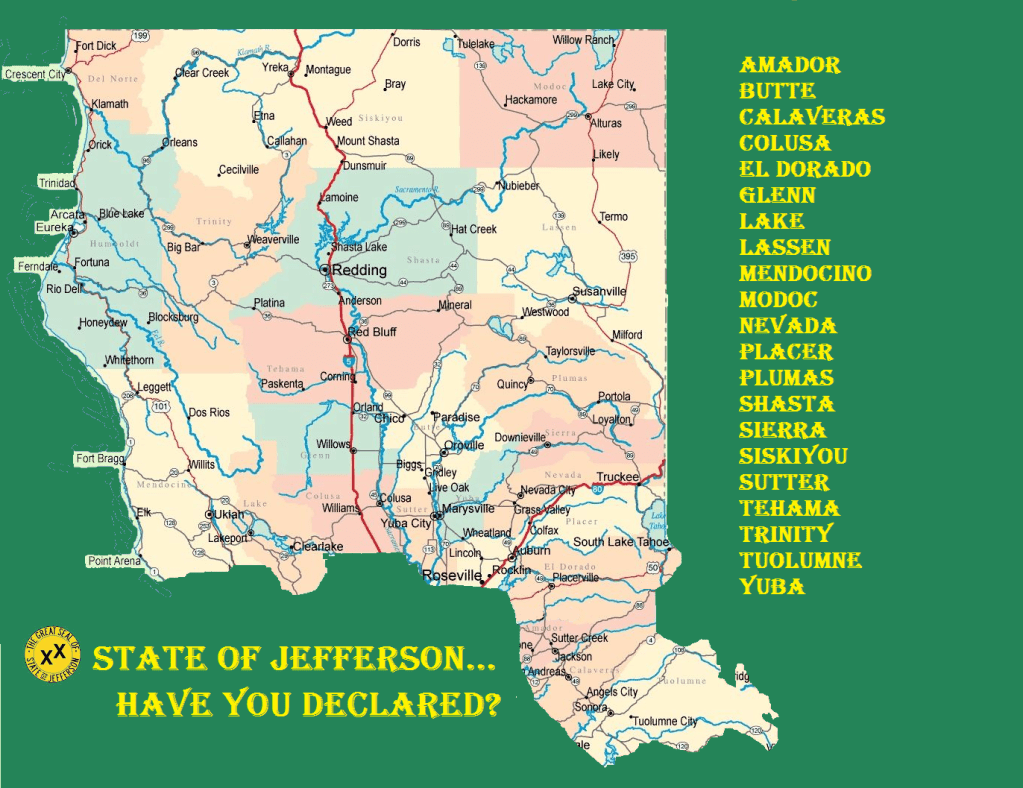
Just What We Need: Another Rural Republican State with Two Senators

Although the California gubernatorial recall election failed by an almost two-to-one margin, there are a large number of rural Californians who have MAGA tattooed over their hearts who want to secede from California so that they could get their needs met. And what are those needs? In a word, anything that would outrage us Libtards. These are areas that voted for Trump and would like to see city people washed away to sea.

I can’t see why any Democrat would vote to split the state in two, thereby giving the Republicans a majority in the Senate and two more electoral votes to ascribe to the Lardfather in the presidential election of 2024.

Do you see any major population centers in this agglomeration of rural counties? Redding? Eureka? Crescent City? Up against that you have Los Angeles, San Francisco, San Diego, Sacramento, Fresno, and maybe two dozen other cities larger than anything in the “State of Jefferson.”

I have a theory about this doomed scheme:

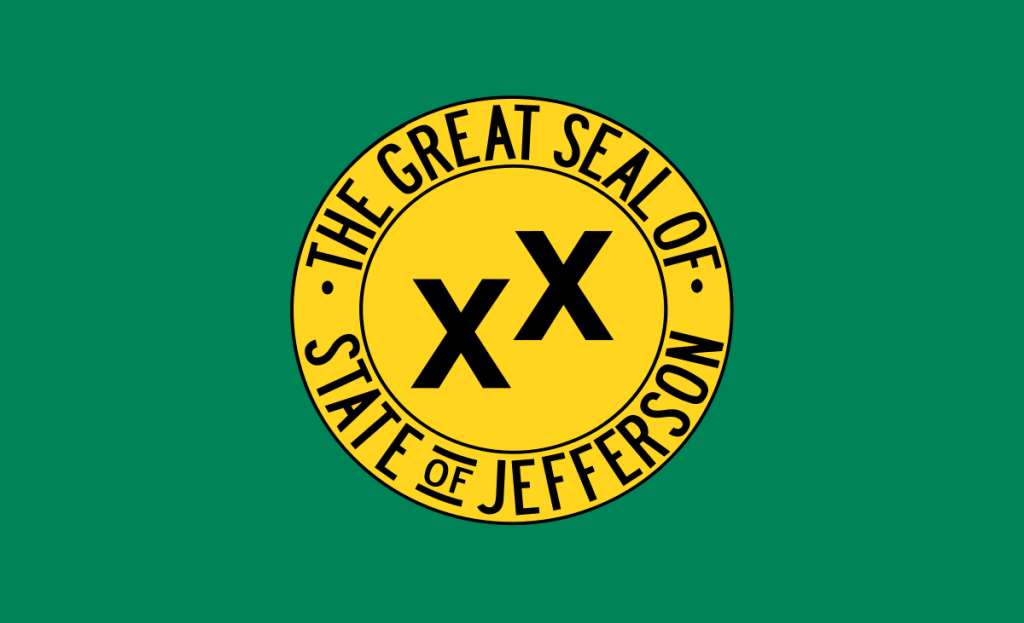
Proposed Flag of the State of Jefferson

The Great Seal of the putative State of Jefferson reminds me of a brand of Mexican Beer. Dos Equis is, to my mind, an excellent beer, but it will rot your mind if you drink too much of it:

Look Familiar?

I suppose Dos Equis (XX) beer is better than Budweiser, but I doubt that a case of cerveza is grounds for re-doing the Great State of California—even if there are a lot of disgruntled ranchers who can’t win a statewide election.

The California Recall

The Leading Republican Contender in the Attempt to Unseat Governor Newsom

Tomorrow, we will discover whether our mostly popular governor will be unseated by a Republican shock jock, or manage to hold his seat. If he is unseated, he will be replaced by someone who does not have his vote-drawing ability.

It is not a good sign that Larry Elder is complaining that he will lose as a result of an unfair election … before the votes are even tabulated! I don’t see where that makes any sense; but then, very little that the Republican Party makes any sense at all, unless one obtains power by any means necessary—fair or foul.

Recall elections are one aspect of California politics that I would like to see amended. In the race to unseat Gavin Newsom, there were a total of 46 candidates, none of whom are qualified to govern the most populous state in the Union. The field is in fact so lackluster that it must require very few signatures to qualify.

One candidate, Holly L. Baade (D) describes her contribution as “Leadership for a brighter tomorrow.” Then there is Angelyne (No Party), the Billboard Queen, famous only for advertising herself on billboards for several decades. A Green Party candidate, Dan Kapelovitz, only says, “Can you dig it?” (Answer: No.) Another, Adam Papagan (No Party) says only, “Love U.” (Love not returned.)

No Way, Angelyne!

The politicians we elect to power are by no means perfect. And yes, Gavin Newsom has made some horrible mistakes. Does that mean we have to replace him with someone who is even less qualified, less perfect for the role?

I can only hope that none of the 46 even comes close to unseating Governor Newsom when the ballots are counted.

Atacama Norte

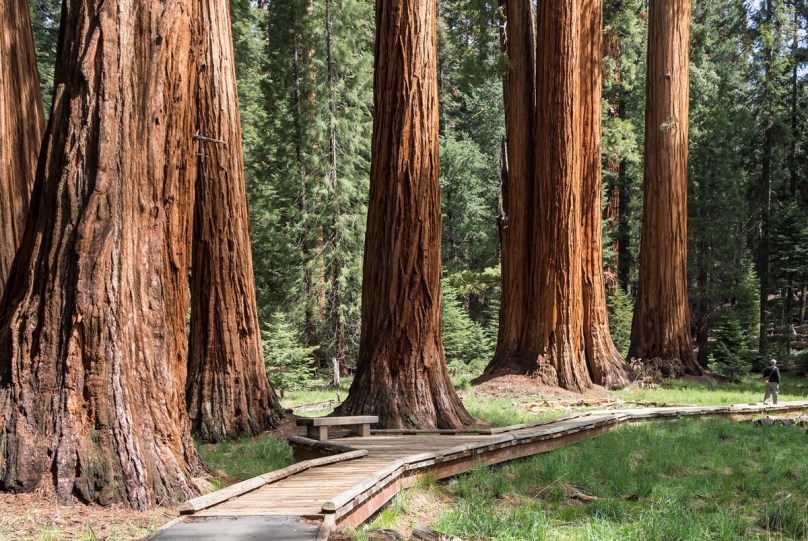
Path at Sequoia National Park

John Muir understood the forests of California better than anyone: “And into the forest I go to lose my mind and find my soul.” There are beautiful forests in California, as well as beautiful mountains and even beautiful deserts. Thanks to climate change, however, in a very few years we might still find the mountains, but in place of the forests, we will have greatly enlarged deserts.

Currently, the driest desert on earth is the Atacama, which comprises parts of northern Chile and southern Peru. It is a major event there if the rainfall runs to several millimeters! As California becomes ever drier and the wildfires ever more uncontrollable, I can foresee much of this happening in the dwindling years of my lifetime.

California has both the largest and the oldest living things on earth in its forests. The Sequoia Redwoods can run to 115.5 meters (379 feet) in height. They can—under normal circumstances—live between 1,200 and 2,200 years. In the White Mountains on the other side of the Owens Valley are the Great Basin bristlecone pines, which, unlike the redwoods, look hardly alive. Yet the oldest trees of this species are 4,800 years old, making them venerable oldsters while the Greeks were conducting the Siege of Troy described by Homer in the Iliad.

Bristlecone Pine Tree of the White Mountains

Both types of tree are hardy and have survived multiple wildfires caused by lightning strikes in the last several thousand years. But man is a relatively new factor, and many of the fires that are decimating the forests of California are the result of arson or human carelessness.

Call me a tree-hugger if you will, but there are many things in California that I have come to love. Let me close with another quote from John Muir, who is the bard of the wilds of California: “Come to the woods, for here is rest. There is no repose like that of the green deep woods. Sleep in forgetfulness of all ill.”

Sacred Mountain

Frank LaPeña’s Painting Sacred Mountain

Yesterday, Martine and I visited the Autry Museum of the American West in Griffith Park. Many of the galleries were still closed due to the Covid-19 outbreak, but what there was, was choice. I am specifically referring to the exhibit of California Indian art entitled “When I Remember I See Red: American Indian Art and Activism in California.” What impressed me the most was work from a Nontipom Wintu artist from Northern California named Frank LaPeña (1937-2019).

Artist Frank LaPeña

What draws me to American Indian art is its spirituality and brilliant imagery—both qualities notably lacking in so many academic artists. These are not works to decorate a corporate boardroom: Instead, they are works to make you feel grounded in a separate reality, one that is part of the world from which the artist comes.

Frank LaPeña’s Dream Song

In a strange coincidence, there is an accused murderer with the same name who is totally unrelated to the artist. This other Frank LaPeña was recently released from prison in Nevada where he was wrongfully incarcerated for hiring a hit man to kill the wife of a Caesars Palace in 1974.

I will try in the week ahead to highlight some more California Indian artists from the Autry show.