In the Land of the Tattooed Monkeys

Labor Day Weekend in Hollyweird

Labor Day Weekend in Hollyweird

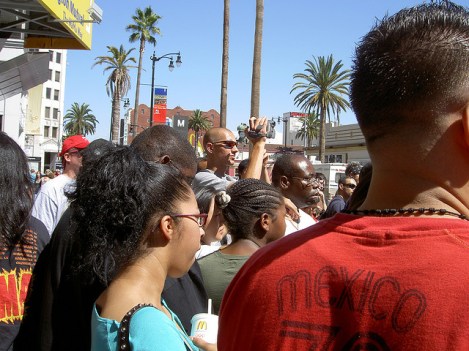
All the tourists who (1) watch too much television; (2) don’t know much about Southern California; and (3) are decorated all over with piercings and tattoos usually end up on Hollywood Boulevard. Labor Day Weekend is particularly crowded, as crowds stop and take pictures of “tweakers” dressed up as Darth Vader, Spider Man, Wonder Woman and other superheroes and superheroines. Or they take pictures of the thousands of star-shaped plaques embedded into the sidewalks honoring key entertainment figures. Or they just take pictures of each other. (The star commemorating Marilyn Monroe in front of Ripley’s “Believe-It-Or-Not” museum is always a mob scene.)

Yesterday evening, Martine and I found a short cut to get us around the crowd pressing around what was once Grauman’s Chinese Theater (and now called the TCL Chinese Theater). Out of the Loew’s Hollywood Hotel (formerly called the Hollywood Renaissance Hotel), we walked past the entrance to the Dolby Theater (formerly the Eastman Kodak Theater) to a tour bus station on Orange Avenue. That saved us at least 15 minutes on the way to Roubo’s Russian and Armenian Restaurant. Of course, all the re-branding made my head spin.

Especially on holiday weekends such as this, it is impossible to go more than a hundred feet without being solicited by tour bus operators. I always tell them that, as a long-time resident, I am better qualified to offer them a tour.

In fact, at any given time around Labor Day, about 30-40% of all vehicles on the boulevard are tour buses.

The movies at Cinecon made it all worthwhile, though it is something of a gauntlet going between the Egyptian Theater, where the films are screened, to the Loew’s Hollywood Hotel, where the dealers’s booths are set up, or to any restaurant serving halfway decent food.


More Morose Delectation

Bessie Love (1898-1986)

Bessie Love (1898-1986)

Once again it is Labor Day Weekend in the United States, and Martine and I have celebrated by seeing loads of films and seeing old friends at Cinecon 49 in Hollywood. Among the pictures we saw were:

  • The Holy Terror (1937) with Jane Withers
  • A Blonde’s Revenge (1926) with Ruth Taylor
  • The Good Bad Man (1926) with Douglas Fairbanks Sr and Bessie Love, directed by Allan Dwan
  • Transient Lady (1935) with Frances Drake
  • Their First Execution (1913) by Mack Sennett
  • Suddenly It’s Spring (1947) with Paulette Goddard and Fred MacMurray

Once again, I was impressed how beautiful many of the young actresses were almost a hundred years ago. Bessie Love in The Good Bad Man wasn’t much of an actress, but her beauty was heartbreaking.

Ruth Taylor (1905-1984)

Ruth Taylor (1905-1984)

Then there was Ruth Taylor with a small role in the Ben Turpin two-reeler A Blonde’s Revenge. It’s difficult to believe that she was the mother of Buck Henry.

Tomorrow, I’ll have to go in to work to help our computer consultant set up a new file server and seven workstations. But then, on Monday, Martine and I return to Hollywood and Cinecon for more movies.


“I Killed Seven With One Blow”

What a Valiant Little Tailor!

What a Valiant Little Tailor!

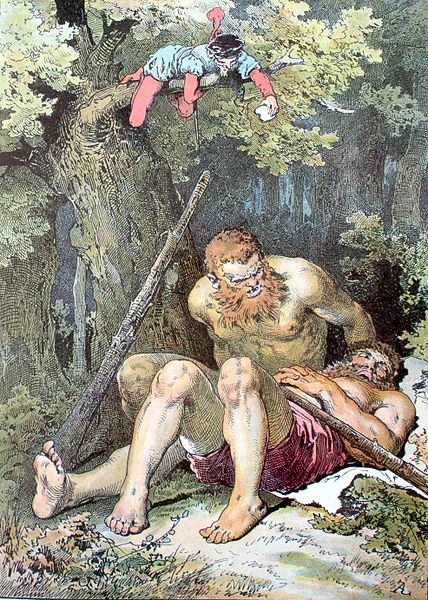
The tale comes from the Brothers Grimm: It is the story of a little tailor who kills seven flies with one blow of his swatter. Then, to make sure the world knows what a valiant little tailor he was, he makes inscribes the line “I killed seven with one blow” on his belt and goes out into the world to—what else?—make his fortune. Of course, everyone misunderstands the saying on the belt and thinks the tailor killed seven men with one blow.

I felt much the same way when I read an interview with Gore Vidal in The Paris Review in which he states “But then I’m typically American. We weren’t brought up with theater like the English or the Germans. On the other hand, I saw every movie I could in my youth. I once saw four movies in one day when I was fourteen. That was the happiest day of my life.”

What, only four? I think I have had at least ten days in my time when I have seen five or even six movies in one day. I remember two days at the University of Southern California (USC) when I saw five Westerns directed by Budd Boetticher and another when I saw not only five films by John Ford, but John Ford himself showed up. I don’t count the day I saw five films directed by Hitchcock—but only because the 35mm nitrate print of Rope (1948) exploded into flames in the projection booth.

Then there were all the days I spent at the Cinecon show in Hollywood watching early silent and sound films, one after the other, with breaks only for lunch and dinner.

For the first time in nearly a decade, I don’t think I’ll be attending the Cinecon show this time, for reasons I hinted at in a post I wrote a year ago. Of course, I could still change my mind; and Martine is interested in attending at least one day of the screenings. We’ll see.

A Prickly Individual

Alzheimer’s Disease

In 1968, I was hitchhiking on Wilshire Boulevard in West L.A., hoping to get a ride as close to the Los Feliz Theater on Vermont as possible. I forget the movie I was originally intending to see: All I know was that it was a French film.

I was picked up within a few minutes by a guy a few years older than me in a slate gray stick-shift Volvo. Just by coincidence, he was going to see a movie, too, except that his destination was a screening of Splendor in the Grass (1961) with Warren Beatty and Natalie Wood. After a few miles on the road, I decided to go with him, not having seen the Elia Kazan picture and not being averse to the luminescent eyes of Natalie Wood.

My new friend, whom I shall call Marvin, and I became movie-going buddies. We would see a film and then eat dinner, doing the bubble-gum card trading which with us passed for film criticism. Films were either “great” or “a piece of sh*t”—there was no middle ground. Inevitably, we drifted apart, as we were both pretty stubborn in our views. Marvin moved back East and ran a comic book store in Northampton, Massachusetts. And I went on to do the things I did, working in computer software and marketing and eventually accounting.

About twenty-five years ago, Marvin started coming to the film memorabilia and comics shows in Southern California. We reestablished contact. Then Martine started working for him as a helper: Marvin’s hearing was rapidly deteriorating. His hearing aid was about as efficacious as a banana. Fortunately, Martine was able to interface with the customers while passing written notes to Marvin when it required his input.

This year, Marvin came to the Cinecon show displaying alarming symptoms of Alzheimer’s Disease. He had forgotten to ship his film posters, which were the big money-maker for him, and instead just sold a few lobby cards, stills, books, and film magazines. He would keep asking me repeatedly what day of the week it was, and then promptly forget what I told him.

He knew something was happening to him. He frequently referred to his requiring a new memory chip. At the same time, he would frequently appear confused and agitated. He even misidentified Dorothy Dandridge in a still from Otto Preminger’s Porgy and Bess (1959). This is the type of mistake which, hitherto, Marvin had never made before; and other symptoms of mental slippage were beginning to appear.

Despite that, my friend was still his opinionated self and took issue with me because I read too many works of foreign literature that were translated into English (he never read anything not in English), and too much history. At the same time he was reading a John Grisham, an author deliberately not represented in my collection of mysteries.

Yesterday, when the show ended, we drove Marvin to the airport and dropped him off at the Delta Airlines terminal. I was relieved to hear from him by e-mail that he got back home safely, if tired. By return e-mail, I suggested that he see his doctor about his memory. With luck (my fingers are crossed) something could be done to reverse or ameliorate what looks like a precipitous decline.

Marvin is a prickly individual to say the least. He lives alone, though he had hopes of linking up with a woman from Northampton whom he knew. Alas, she died last year of taking several medications which didn’t agree with one another. Since then, Marvin has been more despondent than usual.

I’ve known the s.o.b. for forty-four years now, and I sincerely hope that his health improves so that we could continue our contentious friendship..

Morose Delectation

Mack Sennett Bathing Beauties

Certain stylistic differences separate us from our ancestors; but every once in a while, we can see people from eighty or a hundred years ago as if they were alive today. That was brought home to me at Cinecon today, when I saw a rare reel of Mack Sennett Bathing Beauties outtakes shot at nearby Venice Beach.

The scene was that the director had the girls run into the ocean. Evidently, the water was too cold for them, and they pleaded with the director off-screen to let them get used to the cold. Suddenly, the outlandish bathing costumes of a century ago and the stupid ringlets that the girls curled their hair into didn’t matter any more. In every other way, the scene could have been shot yesterday; and the girls were cute and rather appealing.

On Saturday morning, I saw a 1930 Fox Movietone newsreel of a stage rehearsal of a troupe of chorus girls entitled Backstage on Broadway. Again, once you looked past the inevitable blonde ringlets, the girls were incredibly beautiful, with gams that most of today’s women would kill for.

It is sad to think that virtually all of these girls are now dead. We snicker at minor details that divide their time from ours, and which place a spurious distance between us and them. No doubt their slang was outrageously different; and their everyday beliefs were probably more puritanical (though that’s hard to know for sure). In the Mack Sennett film, the bathing beauties were probably seen as brazen women, and the very large and appreciative male crowd along the Boardwalk lent credence to that that guess.

One of the poster dealers at the Cinecon show had a nude frontal body shot of the lovely Louise Brooks, whose dark bangs make her sexy even today. But, alas, she was found dead in her house from a heart attack after years of suffering from emphysema and arthritis. Mabel Normand, the most famous of Mack Sennett’s Bathing Beauties, died of tuberculosis in a sanatorium in 1930.

I suppose it’s dangerous to fall in love with ghosts. And yet the Lloyd E. Rigler Theater of the Egyptian Theater was filled with aging film fans, some of them in wheelchairs, whose eyes lit up at memories of their youth and of the women who made their lives seem worthwhile. Now they themselves are slowly vanishing into the past. New generations will take their place with dreams of tattooed and pierced young women in the outlandish costumes of Hollywood nightclubs.

Just remember: The outlandishness doesn’t count. They’re just people like us.

Silents, Golden and Not So Golden

Nancy Nash and Earle Foxe in John Ford’s Upstream (1927)

Silent movies are not for everyone. Because of the times in which most of them were produced, the results can be off-putting because of hokiness or a tendency toward melodrama. This week at Cinecon, I have seen silents that were great, some that were merely interesting, and some that were just plain bad.

The best of the lot was John Ford’s backstage drama, Upstream (1927), a film which was thought to have been lost. In 2009, however, a print was discovered by the New Zealand Film Archive. Although many scenes were spoiled by rotting of the nitrate stock, enough came through to make this one of Ford’s best silents, better even than the more famous The Iron Horse (1924).

The story was about a down at heels Shakespearean actor named Eric Brasingham (Foxe), who is courting Gertie Ryan (Nash), the partner of vaudeville knife-thrower Juan Rodriguez (Grant Withers). He gets his chance for the big time because a London theater is willing to take a chance on him because the Brasinghams are a famous acting family (even though Eric himself is a nonentity). His fellow denizens in a theatrical New York boardinghouse give him a big send-off, but he leaves Gertie in the lurch.

In London, he manages to succeed. He becomes conceited and supercilious, and omits writing to Gertie. She, tired of waiting, marries the knife-thrower. Then, suddenly, Brasingham descends on the boardinghouse as a publicity stunt and finds his reception is not what he had hoped.

Director John Ford does here what he specialized in: Characters who are well developed and interesting. Even the vaudevillian song-and-dance Callahan Brothers are unforgettable, as is the  “star boarder,” played by actual Broadway star Raymond Hitchcock. Even though the theatrical subject matter is not typical Ford—better known for his Westerns and Irish films—the director is at home regardless what he does. And certain stylistic touches link it with films as different as the Hamlet scene in My Darling Clementine (1946), in which Grant Withers is one of the Clanton boys.

More typical of the silents I saw was the excellent The Goose Woman (1925), directed by Clarence Brown and starring Louise Dresser. Graphically, it was a gorgeous film, but the melodramatic plot comes across as risible today: A famed Italian opera star has to make a choice between having a child and continuing to sing at La Scala. She has a child, and her voice goes kaput. What kind of illness is this? Was the baby delivered via the vocal chords? In any case, the singer becomes a goose woman on a farm and a full time lush, until she must make a Sophie’s Choice type of decision regarding her son, who is accused of murder.

On the Boulevard

On Hollywood Boulevard Near Grauman’s Chinese Theater

I have spent two days at the Cinecon show in Hollywood so far this week. Because the films playing tonight don’t interest me, and because tomorrow, we’ll be here for fourteen hours, we decided to leave early today and on Sunday. I had to do that to retain Martine’s good will so that we could see a rare print of John Ford’s Upstream (1927) ending around 10:30 pm.

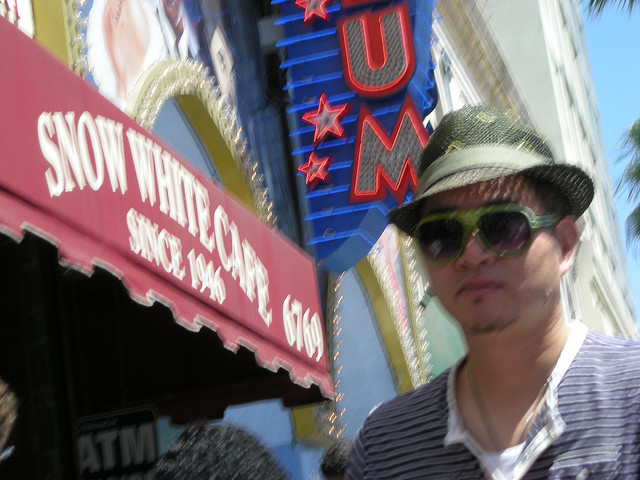
In the meantime, the short walk (two and a half blocks) between the Egyptian Theater and the Loew’s Hollywood Hotel where the film memorabilia vendors (and Martine) are working and where our car is parked, is as wild and woolly as ever. Tattooed monkeys and brainless girls wearing next to nothing seem to predominate. There are endless tours of Hollywood surrounded by teams of touts who try to funnel tourists into the buses. everal times a day, I have to tell them I’m not interested because “I live in this sh*thole.”

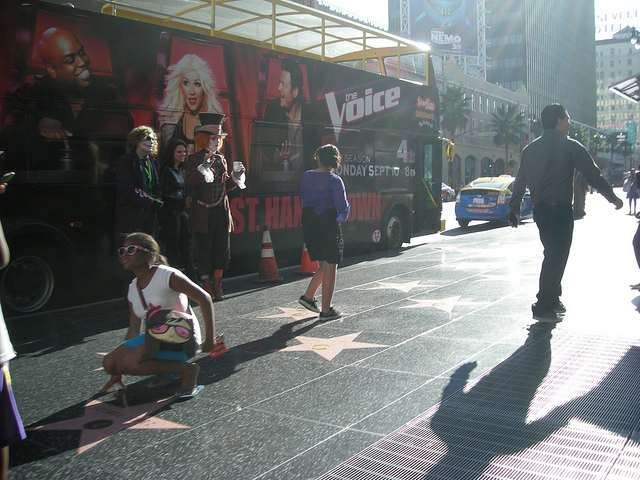
The scene above is of Zoo Central in front of the Hollywood & Highland Center next to Grauman’s Chinese Theater. You see one girl at the left being photographed by one of the stars on the Hollywood Walk of Fame. Behind her is one of the tour buses, accompanied by someone dressed as Johnny Depp in some recent movie whose title slips my mind.

I have been seeing some great films at the Egyptian, however, especially today. I sat through Robert Florey’s Dangerous to Know (1938) with the lovely Anna May Wong and Akim Tamiroff; Madge Kennedy in Dollars and Sense (1920); W. S. Hart in Wild Bill Hickock (1923); and John Blystone’s Gentle Julia (1936) with Marsha Hunt and Jane Withers, both of whom were in the audience as guests.

Last night, Martine and I saw Erle C. Kenton’s Always a Bridesmaid (1943) with the Andrews Sisters. A special treat was a film clip of the famed Nicholas Brothers dance duo, with two granddaughters of Fayard Nicholas tap dancing in synch with what was on the screen.

So, on the whole, it’s a mixed blessing: Great films in a particularly nutty place.

Hollyweird Again

On the Boulevard in Hollywood

I will be taking a break from posting to this weblog over the next few days. Every year during Labor Day Weekend, Martine and I have been attending the Cinecon show in Hollywood. While Martine helps my an old friend of mine sell movie memorabilia at Loew’s Hotel at Hollywood and Highland, I will be spending most of my time at the Egyptian Theater watching somewhere between fifteen and twenty old movies that, for the most part, have not been available to the public since they were first released.

Many of the titles will be silent with organ accompaniment, with most of the others dating from the early sound era. Typically, there are a few outliers whose originals were on nitrate film stock that has been transferred to safety film and cleaned up in the process. Nitrate stock is a fire hazard, and virtually all films before 1948 or so were shot on it. (I recall seeing the studio version of Alfred Hitchcock’s 1948 production of Rope go up in flames at a USC screening years ago.) Some more recent films had serious problems with fading color which film technicians have been able to restore to their almost original color quality.

For more information about Cinecon 48, visit their website for background information, a summary of films being screened, and the screening schedule.

As much as I like old films,spending time in Hollywood will be a drag. Labor Day Weekend almost always brings with it a heat wave.Add to that the problem of finding a decent restaurant on the Boulevard, where most of the eateries are oriented to downmarket tourists who come to stare at the stars’ names on the Hollywood Walk of Fame. Or to the even more downmarket residents of Hollywood, consisting in teenage runaways, low-rent hipsters, prostitutes of multiple genders, and the homeless.

It has always amused me that tourists who have failed to do their research come to Hollywood expecting to see celebrities in what has evolved over the decades into a rather ugly slum. The only hope I see for Hollywood is that public transportation improvements, especially with the Red Line, have made it profitable for developers to try to do something to gentrify the place a bit.