Love and Pain

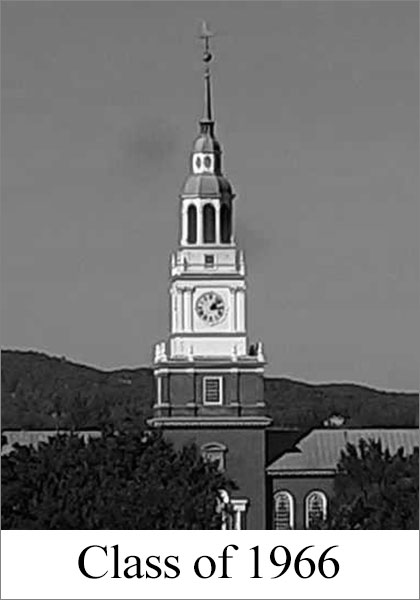
The Dartmouth College Campus in 2005

I spent four years at Dartmouth College in New Hampshire while suffering from a brain tumor that caused severe frontal headaches that lasted until midnight. It was then that I started my homework, not going to sleep until three or four in the morning. It was truly horrible when I had classes scheduled for 8:00 AM.

Worst of all were the morning swimming classes that I had to attend the first two years. At the time, the college had a requirement that all students be able to swim fifty yards in one minute. I was, of course, handicapped by my pituitary tumor; but I eventually passed the test. If MRIs and CAT Scans existed back in the mid-1960s, I would have been excused. But they didn’t. The doctors all thought that I was just being a pussy. It was not until I graduated in 1966 that I collapsed at home in Cleveland, just prior to leaving for graduate school at UCLA.

Still, I loved going to Dartmouth. It was everything I wanted. It was far from home at a time when my parents were undergoing a rough patch in their marriage. It was a college that challenged students to excel intellectually. And, situated in the upper Connecticut River Valley, it was a place of beauty. Most of the majestic elm trees are long gone, having succumbed to Dutch Elm Disease; but while I was there, the campus was strikingly beautiful.

When I went with Martine to re-visit the campus in 2005, I was appalled by the campus building program that was putting multi-story buildings in all the green spaces where I tossed a frisbee with my classmates. But then, I guess that that is a problem common to many campuses. It wasn’t the buildings that educated me: it was the caliber of the faculty and the students.

My Cities: Hanover, NH

Main Street, Hanover, New Hampshire

It was hardly a city. When I was attending Dartmouth College between 1962 and 1966, there were no traffic lights at any of the intersections. There were a few thousand people, most of whom were directly or indirectly connected with the college.

When my parents drove back to Cleveland, I found myself alone for the first time in my life. Actually, it didn’t bother me as I thought it would. It was probably because my father and mother were going through a rough patch in their marriage, and I didn’t want to be back home for that. And I wasn’t really alone, because my roommate Frank Opaskar was a classmate from my high school.

In the end, we didn’t get along too well—for a strange reason. He slathered Noxzema on his face every night before going to bed, and I had the top bunk over him. Every night I drifted off to sleep in a noisome chemical fog. After two years, we parted company and I got a solo room.

Winters in Hanover were long and cold. The snow, once it fell, lasted all winter. (I wonder if it still does, what with global warming.) By the time March came along, you could see where every dog in Hanover had urinated. Spring was the worst time, because all that snow turned to slush. It was not until May that we could walk on the grass without our shoes making a sucking sound.

The town itself had a much loved grocery store called Tanzi’s and a number of restaurants. Early on, I gave up on the college dining hall and patronized only the restaurants. Farther down the street were the Dartmouth Bookstore and the Nugget Movie Theater, where I spent great gobs of time.

I remember the meatballs and spaghetti at Lou’s Restaurant, those few times he offered it as a special. And I had a lot of pizzas at Minichiello’s. I remember the Mom and Pop cooks there trying to get me to give their cute but clearly wild daughter sage advice about life, when what I really wanted was to be wild with her. Nothing came of it because, alas, I had not yet reached the age of puberty because my pituitary gland was being eaten up by a tumor which was operated on three months after I graduated.

Whistling Past the Cemetery

Sometimes I wonder why I am alive today. My father died at the age of 74 in 1985; and my mother, at the age of 79 in 1998. One reason I have survived is that between 1962 and 1966, I had to walk a mile to classes at Dartmouth College from one of the more distant dormitories, the infamous Middle Wigwam Hall, later renamed McLane Hall.

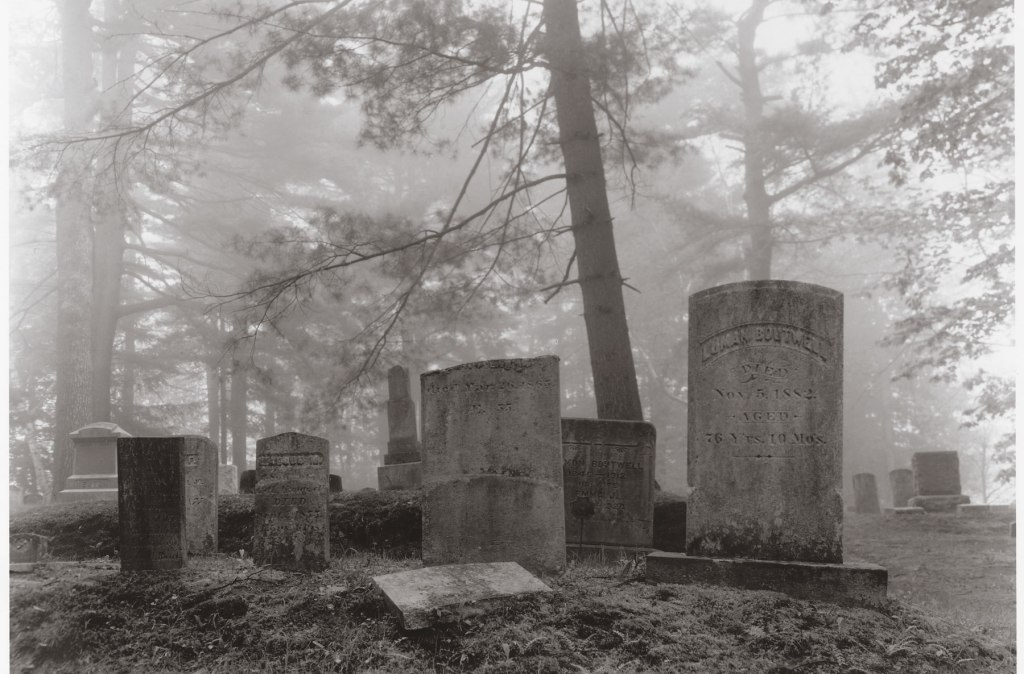
My journey led me past the Thayer School of Engineering, the Tuck School of Business, several dormitories, and the scary Hanover, New Hampshire cemetery. Burials in that graveyard went back to the 18th century. At the time I was in college, the walk past the cemetery was dark, lonely, and long. In the winter, it was also quite icy.

Then, after I graduated from college, I had brain surgery entailing the removal of my pituitary gland, after which I started growing again. My left hip did not like that, so the orthopedists at UCLA put me on crutches for two years. More exercise.

No sooner did I get off crutches than I did a lot of walking. It was 1.5 miles (2.4 km) from my apartment in Santa Monica to System Development Corporation, and 2.5 miles (4 km) from the same apartment to my next job at Urban Decision Systems. During that time, I also did a lot of hiking in the Santa Monica Mountains, sometimes on trails that were up to 10 miles (16.1 km) in length.

I don’t do so much walking any more, but over the years I had developed some good habits which, I think, are standing me in good stead today.

About Those Eyebrows

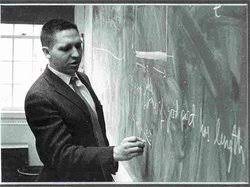
Hazleton “Terry” Mirkil III, Associate Professor of Mathematics at Dartmouth

In the Winter Trimester of my freshman year at Dartmouth College, I took the second of my two math courses, which were required of part of the college’s “distributive requirements.” The term refers to courses in fields that don’t interest you so that you could become a well-rounded person. The course was called something like “Introduction to Probability and Statistics,” though it was mostly the former.

There are only two things I remember about the course. The first is that in any random group of thirteen people, there is an even chance that two of the party share the same birthday. (That was more than I can recall about my previous math course on Calculus.)

The other thing I remember were Professor Hazleton Mirkil’s wild eyebrows. In profile, they stood out like wild antennae reaching up to an inch from his brow. His eyebrows come to mind because I seem to have developed the same antenna-like eyebrows. When I get a haircut, my barber trims them for me, though they always grow back thrusting in all directions.

Thinking about Professor Mirkil’s eyebrows, I decided to see what I could find out about him on the Internet. What I found was not much, inasmuch as he had committed suicide in 1967, the year after I graduated from Dartmouth. According to the West Lebanon Valley News:

Hazelton Mirkil III, 44, associate professor of mathematics at Dartmouth College, was found dead Wednesday afternoon in the woods back of Chase Field. Dr. I. A. Dinerman of Canaan Grafton County medical referee attributed death to suicide by shooting. He said that Prof. Mirkil, was “dead at least a month or two,” was shot through the head and found with a revolver in his hand.

Prof. Mirkil was on leave from Dartmouth for the current academic year and had been at the Veterans Hospital at Northampton, Mass. Having obtained leave from the hospital and not having returned,
he was reported missing March 17.

Very likely, my Math prof received a bad diagnosis from the VA Hospital. The above photo was the only one I could find except for a tiny picture in uniform during WW2. That’s typical for people whose lives have ended well before the advent of the Internet.

I never was much good in math. I received a C+ in both Calculus and Probability. I am certainly not a graduate that the Math Department at Dartmouth would be proud of. (Nor the English Department, as I ended that last sentence with a preposition.)

If you fear that I, too, would blow my brains out because of my unruly eyebrows, don’t worry. I am too funny-looking on a number of counts to worry solely about my eyebrows.

Acquainted With the Night

Poet Robert Frost (1874-1963) with Dog

I was privileged to attend one of Robert Frost’s last poetry readings at Dartmouth College’s Hopkins Center. Let me tell you something about Frost: He was no doddering sweet old man. His mind was sharp, and he have the appearance of knowing exactly what he was doing. He had attended Dartmouth College in his youth, but dropped out.

Acquainted With the Night

I have been one acquainted with the night.
I have walked out in rain—and back in rain.
I have outwalked the furthest city light.

I have looked down the saddest city lane.
I have passed by the watchman on his beat
And dropped my eyes, unwilling to explain.

I have stood still and stopped the sound of feet
When far away an interrupted cry
Came over houses from another street,

But not to call me back or say good-bye;
And further still at an unearthly height,
One luminary clock against the sky

Proclaimed the time was neither wrong nor right. 
I have been one acquainted with the night.

His poems sound so simple at first, but look again ….

Middle Wigwam

The Hanover NH Cemetery

As a student at Dartmouth College in the mid 1960s, I spent four years in the second farthest dormitory from the center of campus. Why? It was one of three new dormitories, and many of the older dormitories didn’t appeal to me for various reasons. Initially, my dorm was called Middle Wigwam; then it changed its name to McLane Hall. God knows what it’s called now, as the college erected numerous other buildings in the immediate vicinity and called another building McLane Hall. I certainly hope that the McLanes are happy with that.

There were several problems about being so far from the center, which mostly became apparent in the fierce New Hampshire winter. First of all, the central heating plant was more than a mile away. When the temperature dipped down to -30° degrees Fahrenheit (-34° Celsius), it wasn’t particularly easy to heat the building. Fortunately, I had an electric blanket for those days when the mercury sank way below comfort level. We never needed a refrigerator most of the year: windows were festooned with gallon jugs of apple cider.

Secondly, in going to and from classes and meals, I had to take a long walk on a frequently icy (and in Spring slushy) Tuck Mall past the Hanover town cemetery, which at night was a scary experience. Many of the graves dated back to the 18th century and looked ominous from dusk on.

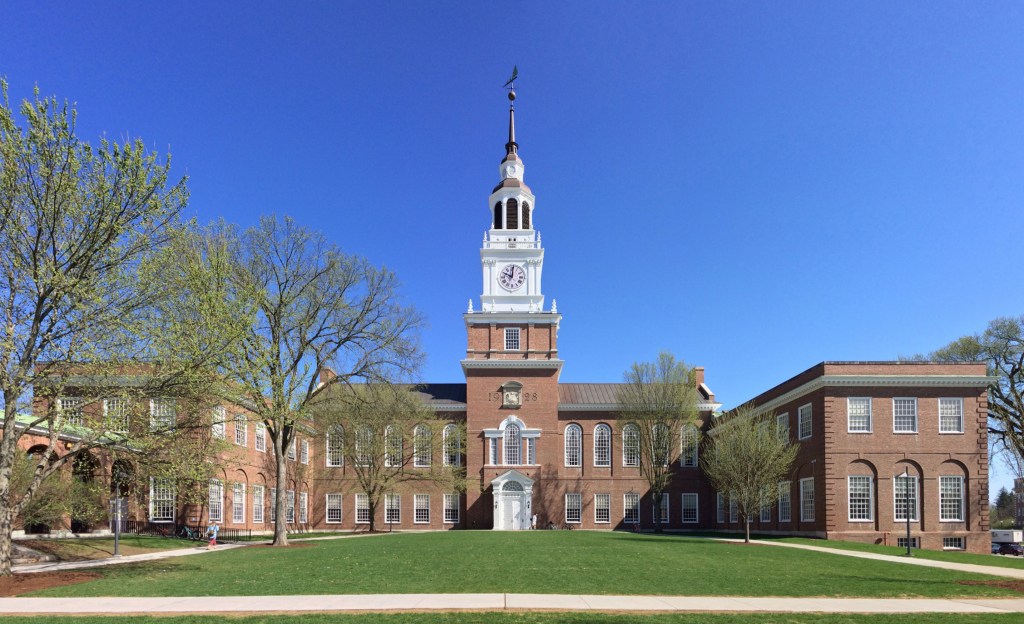
Baker Library (As It Was Called Then) at Dartmouth

In my college years, I was frequently sick with severe frontal headaches that made going to class or the dining hall a misery. It was only after I graduated that I found the cause: a benign tumor was growing in my pituitary gland and pressing on the optic nerve. I was basically a pretty unhealthy young man who was taking long walks every day during the school year. Of course, once I got to my classes or the dining hall, I hung out in the Baker Library (now the Baker-Berry Library) or the Hopkins Center or—that’s where my habit began—the Dartmouth Bookstore.

I was fortunate to have survived my college years. All the times I showed up to the student infirmary, I was told I had migraines or hay fever or some such—pure bosh! But then, in those early years, all they had to go on were X-Rays; and the pituitary, being directly in the center of the head, did not show up well on the X-Rays of the period. MRIs and CAT Scans were all in the future.

Even so, I enjoyed most of my time at Dartmouth. It was a beautiful place, with majestic elm trees all over the place. No more! And the college’s aggressive building program has destroyed much of the campus’s charm.

The Cleveland Limited

When I traveled back and forth from Cleveland to Dartmouth College (in Hanover, NH) from 1962 to 1966, I had to take an involved route that involved one train and two different bus companies:

  • The New York Central Cleveland Limited, Train #58, connected Cleveland to New York City by way of Albany. Westbound, it was Train #57.
  • The Vermont Transit bus picked me up in front of Albany’s Union Station and dropped me off it Rutland, VT.
  • A White River Coach Company bus picked me up in Rutland and drove me to White River Junction, VT, where I transferred to another White River bus to Hanover.

In September, the family made a vacation of driving the 609 miles (977 km) to Hanover and staying at the Chieftain Motel for a few days while they enjoyed the New England countryside. Also, when I graduated, the family drove me and my gear home. All other times, I had to take the train and buses.

A year or two after I graduated, the New York Central, as such, was no more; and the Albany train station, which I described in a pretentious poem I wrote as a student as “oldgold in decrepitude,” was turned into an office building; and the trains stopped across the river at a new Albany-Rensselaer Station.

Typically, I was the only Dartmouth student to take the Cleveland Limited. Most of the others were bound for Chicago and points west and took the New York Central Wolverine, which bypassed Cleveland by going through Canada between Buffalo and Detroit.

The train was grotesquely uncomfortable. The cars were either too hot or too cold, sometimes both on the same trip. Once I made the mistake by buying over-the-counter sleeping pills (I think it was Sominex), which kept my eyes propped open all night. Only once did I get a sleeping compartment: It was too expensive, but it was rather nice.

Once, I transferred to another train in Albany and got off at Springfield, MA. There I waited for several hours for a Boston & Maine passenger train to White River Junction.

Escaping Thayer

It’s now called the Class of 1953 Commons, but when I was attending Dartmouth College between 1962 and 1966, it was called Thayer Hall. All students were required to eat there, which for me was a disaster. The meat was like slabs of granite, accompanied by bland potatoes and overcooked vegetables.

Supposedly it has improved since the days when Miss Jeanette Gill (who was reputed to be a retired marine) ruled the dining hall with an iron spatula. But then there were troops of dogs fighting for table scraps. When we saw the truck from the Precinct Pig Farm parked outside of Thayer, we were wondering whether they were picking up to slop the hogs or delivering to slop the students.

When I returned to Cleveland for Christmas vacation in December 1962, I managed to get a doctor’s note excusing me from eating at Thayer because it was making me sick. Which it was.

That left the handful of restaurants in Hanover, New Hampshire for me to explore. Probably my favorite was Lou’s Restaurant, owned by Louis Bressett, who, once every blue moon, served a devilish good spaghetti with meatballs. There was the usually reliable College Inn, and always the possibility of a splurge at the Hanover Inn.

I also enjoyed a local restaurant called Minichiello’s. Let me quote a 2015 post:

One of the places I ate was Minichiello’s: They had good pizza and were friendly. The only problem was they thought I was such a nice boy. You must remember that when I was a college senior, I looked as if I were still twelve; and I was subject to bullying by the local high schoolers until they saw I was carrying a college ID. So there I was, munching away at my pizza, when they introduce their daughter to me. She was very cute in a bad girl sort of way, and here her parents were holding me up as an example she should follow—instead of those bad boys who worked at the local garage.

God knows, if it weren’t for the fact that I was seriously ill with a pituitary tumor and, as a result, had not yet physically reached the age of puberty, I would much rather be doing with her those things her parents feared she was doing with the bad boys.

So for the rest of my college career, I avoided Thayer Hall. Where food is concerned, there’s a lot to be said for the privilege of being able to choose.

Glory Days

There are many possible pathways through a life. For many, the high point of their lives came early, in high school or college. As they settled down into family life, they rarely ever cracked a book or veered in a different direction. When one talks to them, most of their talk is of their glory days—and their present lives are a long comedown.

Although I was a high school valedictorian who was accepted for a four-year scholarship at an Ivy League college, I never felt I had any real laurels upon which to rest. The first seven years of my life were spent in a Hungarian household, where the Magyar language was the only one spoken. This gave me a slightly different outlook from most others. As I learned English and began to see myself as an American, I also saw myself as something of a hyphenated American who had his feet in two cultures.

During my high school and college years, I was walking around with a pituitary tumor that gave me severe headaches as it pressed against the optic nerve. So my glory days of youth were spent mostly in pain. When I was successfully operated on after I graduated in 1966, I looked like an 11-year-old rather than a college graduate. You can imagine how that affected my self-image.

In the intervening years I had two careers: first, as a computer programmer and director of marketing for a demographic data supplier, and then as a computer specialist and office manager for two tax accounting firms. In both professions, I saw myself as a mercenary who was actually after different game.

Now that I am retired, I am coming into my own as a writer here on this WordPress site. Oh, I am no “influencer.” I have no intention of getting you to buy crap, or anything else. If I am selling anything, it is my thoughts and feelings as a human being living in difficult times. I feel good and am considerably happier than I was during my youth.

It looks as if I am now living through my glory days.

After Apple-Picking

The Mailbox at Robert Frost’s Franconia, NH House

I attended a Robert Frost poetry reading at Dartmouth College shortly before he died in 1963. Although he was just short of ninety years old, the impression I got was of a wily octogenarian who knew what he was doing. The auditorium in Hopkins Center was filled to overflowing with an appreciative audience. After all, Frost had studied at Dartmouth for a while before he listened to the call of his muse and dropped out.

Although he was almost the quintessential New Englander, Frost was actually born in San Francisco. I think that was all part of his wiliness. I had the feeling he could fit in almost anywhere.

Here is one of my favorite poems of his:

After Apple-Picking

My long two-pointed ladder's sticking through a tree
Toward heaven still,
And there's a barrel that I didn’t fill
Beside it, and there may be two or three
Apples I didn’t pick upon some bough.
But I am done with apple-picking now.
Essence of winter sleep is on the night,
The scent of apples: I am drowsing off.
I cannot rub the strangeness from my sight
I got from looking through a pane of glass
I skimmed this morning from the drinking trough
And held against the world of hoary grass.
It melted, and I let it fall and break.
But I was well
Upon my way to sleep before it fell,
And I could tell
What form my dreaming was about to take.
Magnified apples appear and disappear,
Stem end and blossom end,
And every fleck of russet showing clear.
My instep arch not only keeps the ache,
It keeps the pressure of a ladder-round.
I feel the ladder sway as the boughs bend.
And I keep hearing from the cellar bin
The rumbling sound
Of load on load of apples coming in.
For I have had too much
Of apple-picking: I am overtired
Of the great harvest I myself desired.
There were ten thousand thousand fruit to touch,
Cherish in hand, lift down, and not let fall.
For all
That struck the earth,
No matter if not bruised or spiked with stubble,
Went surely to the cider-apple heap
As of no worth.
One can see what will trouble
This sleep of mine, whatever sleep it is.
Were he not gone,
The woodchuck could say whether it's like his
Long sleep, as I describe its coming on,
Or just some human sleep.