Off the Grid: Slab City

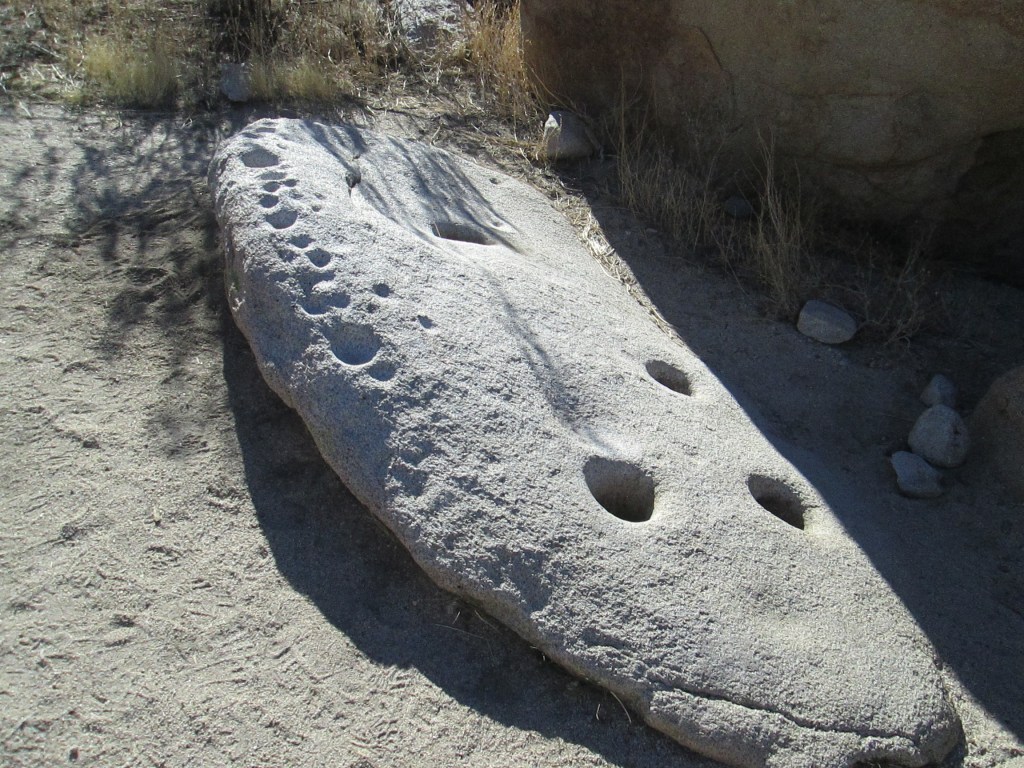
Former Marine Sentry Post

Bombay Beach was only an appetizer. For real off-the-grid living, there’s no place like Slab City, several miles inland from Niland, California, along a fast deteriorating paved road.

Once upon a time, this used to be the Marine Corps’ Camp Dunlap, used for artillery training during World War Two and also as a bombing range for planes flying out of Marine Corps Air Station El Centro. Around 1950, the USMC started closing up shop. They took away all the buildings and tents, leaving only the slabs. Due to an interesting legal error, which I will discuss in tomorrow’s post, the area was left open for whoever wanted to squat on the premises.

It didn’t take long before the squatters starting showing up. Billing itself as “the last free place,” Slab City started taking off in the 1980s after articles in trailer and Recreational Vehicle (RV) magazines wrote articles featuring it.

Do You See Any Power Lines? Nope

Unlike Bombay Beach, the subject of yesterday’s post, there is neither running water nor electrical power nor trash pickup in Slab City. I imagine that water has to be trucked in from elsewhere in Imperial County. As for power, there are a lot of solar panels and probably not many air conditioners. During the summer, the mean daily maximum temperature is between 102° and 107° Fahrenheit (39° and 42° Celsius). Being in the middle of the desert, the precipitation is mostly nonexistent, and the wind can be wicked, bringing with it chemicals from the polluted Salton Sea shore.

On the other hand, there is no cost to live in Slab City. In addition to about 150 year-round residents, during the winter months thousands of snowbirds from around the US. and Canada park their RVs in an empty spot along the road and prepare to enjoy a life of doing not much.

Apparently there is a nearby hot spring where people can bathe and even shower. As Slab City is situated along the San Andreas fault, one can count on a number of natural hot springs along its length. (And one can also count on earthquakes from time to time.)

For an interesting picture of what it is like to visit Slab City, check out the Wiki Voyage page. And don’t forget to drink lots and lots of water.

Off the Grid: Bombay Beach

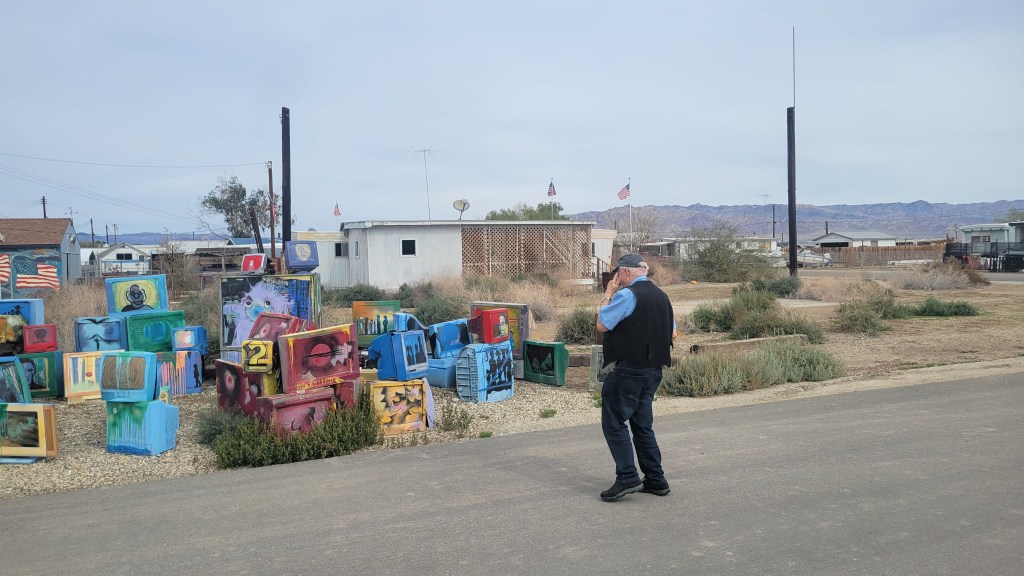
Me Photographing Bombay Beach TV

You cannot find a more low-down community in the United States. Literally. That’s because the unincorporated town of Bombay Beach is 223 feet (68 meters) below sea level. It used to be larger, but each successive census has shown a drop in population, in 2020 down to 231. And that number is a little dicey because of the large number of snowbirds who winter there.

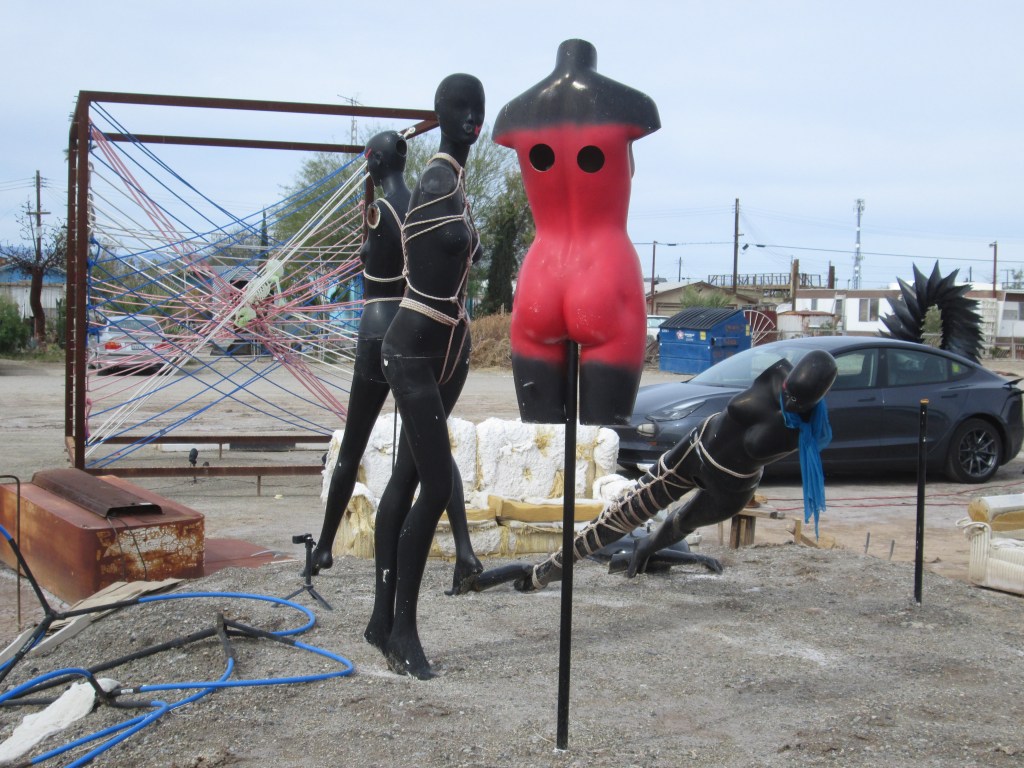
In 1999, Huell Howser did an episode of his show “Visiting” in a Bombay Beach which is hardly recognizable today. Back then most of the residents appeared to be senior citizens. At some point since then, the hipsters moved in, and the whole place became something of an art installation.

As such, it’s a fun place to visit. My bother and I spent a couple hours there last Saturday.

Art Installation in Bombay Beach

The beach itself is no beauty. At times, the town of Bombay Beach floods when the sea, which has no outlet, rises in an unusually wet year. Part of the town is now isolated from the beach by a protective berm. In any case, the sea frequently smells bad because of all the fish die-offs. In fact, the Huell Howser video shows him walking noisily on the bones of dead fish that line the shore.

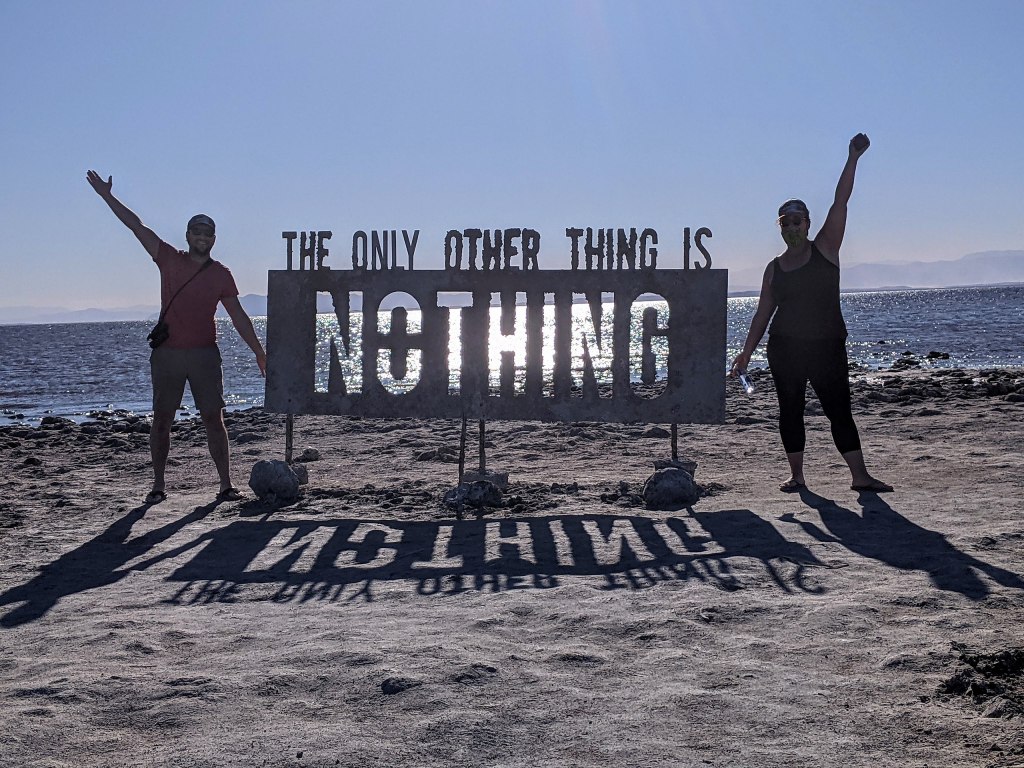
Art Along the Beach

Many of the current residents of the town are living off the grid, using solar panels to provide electricity. There is water service provided by the Coachella Valley Water District. I rather doubt that sewage is piped out of town, as the next populated place is Niland, California, some 18 miles (29 kilometers) south. There is no gas station in town, and only one bar/restaurant and possibly one convenience store.

Beginning tomorrow, we will visit a place that is really off the grid.

“In the Desert”

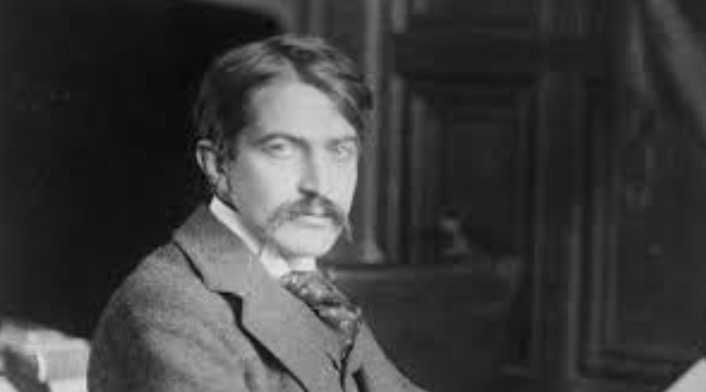
American Writer Stephen Crane (1871-1900)

One of the great “What Ifs” of American literature is what we would have had if Stephen Crane had not died at the age of 28. As it is, we had a great novel (The Red Badge of Courage), an interesting novelette (Maggie: A Girl of the Streets), and two great short stories (“The Open Boat” and “The Bride Comes to Yellow Sky”). Here is a short poem from Crane, the last two lines of which were used by Joyce Carol Oates as the title for one of her early novels:

In the Desert

In the desert
I saw a creature, naked, bestial,
Who, squatting upon the ground,
Held his heart in his hands,
And ate of it.
I said, “Is it good, friend?”
“It is bitter—bitter,” he answered;

“But I like it
“Because it is bitter,
“And because it is my heart.”

A Visit to Asteroid City

A Strange Film Set Near the California-Nevada Border in the 1950s

Yesterday afternoon, I went to see a matinee performance of Wes Anderson’s Asteroid City (2023). I had seen his earlier The French Dispatch (2021), which did the same for France as Asteroid City did for the 1950s American desert.

Is it a great film? Not exactly, but I think it is definitely worth seeing. Wes Anderson has, rattling around somewhere in his head, a great film; and I believe it will eventually be made.

Picture a group of Junior Stargazers and their parents descending on a nowhere town in the Mohave Desert. With a cast that includes Tom Hanks, Scarlett Johansson, Jason Schwartzman, Tom Hanks, Tilda Swinton, Margaret Robie, Steve Carell, and some very talented juvenile actors, the film ranged from riveting to “What the …?”

During the Junior Stargazers awards ceremony, a space alien kidnaps a meteor that was on display and later returns it with various inventory markings. The military proceeds to put Asteroid City on lockdown, with no one able to leave or arrive—until the alien makes his second appearance.

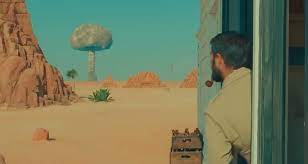
One of Two Nuclear Tests That Occur During the Course of the Film

The most striking thing about the film is its visual style. It all looks like desert postcards of the period. except for a connecting story of a writer and a group of play actors which is not only shot in black and white, but in Academa 4:3 ratio, whereas most of the film is in color and wide screen. In fact, the weakest part of the film is this connecting story.

I remember when I first saw The French Dispatch on TV at my brother’s house. At first, I didn’t know what to make of it. Some of it I loved, some I thought deplorable.

No matter, just hold your nose during the bad parts and enjoy the scenes set in Asteroid City.

Hot! Hot!! Hot!!!

They Weren’t Whistling Dixie

I returned yesterday from the Coachella Valley after four days of excess 100° Fahrenheit (38° Celsius) temperatures. When summer temperatures arrive in the lower desert, it is time to seek air-conditioned comfort. No walkies, no hikes, no outdoor activities of any sort: It is simply time to seek air-conditioned comfort and hunker down. Even the steering wheel of my Subaru Forester was hot to the touch.

Knowing full well what was in store for me, I had a god time nonetheless. My brother’s house in Palm Desert is comfortable, and I enjoyed reading and talking with him and with my sister-in-law Lori. Yesterday, before setting out for Los Angeles, I had breakfast with Dan and my niece Hilary, who had just arrived by plane from Seattle. After an hour of pleasant chatter, I hit the road with only a single rest stop in Rowland Heights.

The Los Angeles temperature was a full 40° Fahrenheit (22° Celsius) cooler than the Coachella Valley. I found I needed a jacket when I unloaded the luggage from my car.

The net result: I didn’t really go anywhere which I could feature in my blog posts. Sometimes, it just happens that way. Fortunately, the hot weather did not stop me from enjoying myself.

A Garden in the Desert

Jael Hoffmann’s “Topography of Belief”

No, it’s not a garden of plants, but rather a sculpture garden, right near one of the turnoffs from U.S. 395 to Panamint Springs and Death Valley. It’s off the side of the road on the left as one heads north on the highway. I’ve noticed it several times on my trips to and through the Owens Valley as I passed through the town of Olancha, just south of Lone Pine.

As soon as Martine’s broken wrist heals, I hope to spend a little time studying the metal sculptures of Jael Hoffmann and photographing them. Unlike most modern sculptures, which leave me cold, I find that Jael’s work sets off little explosions in my head. Really great art does that: It makes you a different person than the what you were a few minutes earlier.

There is an excellent video on YouTube in which the artist is interviewed and discusses several of her sculptures—including most especially the one illustrated above. It is called “Internal Scapes,” which is an accurate description of how they affect me.

An Interview with Jael Hoffmann

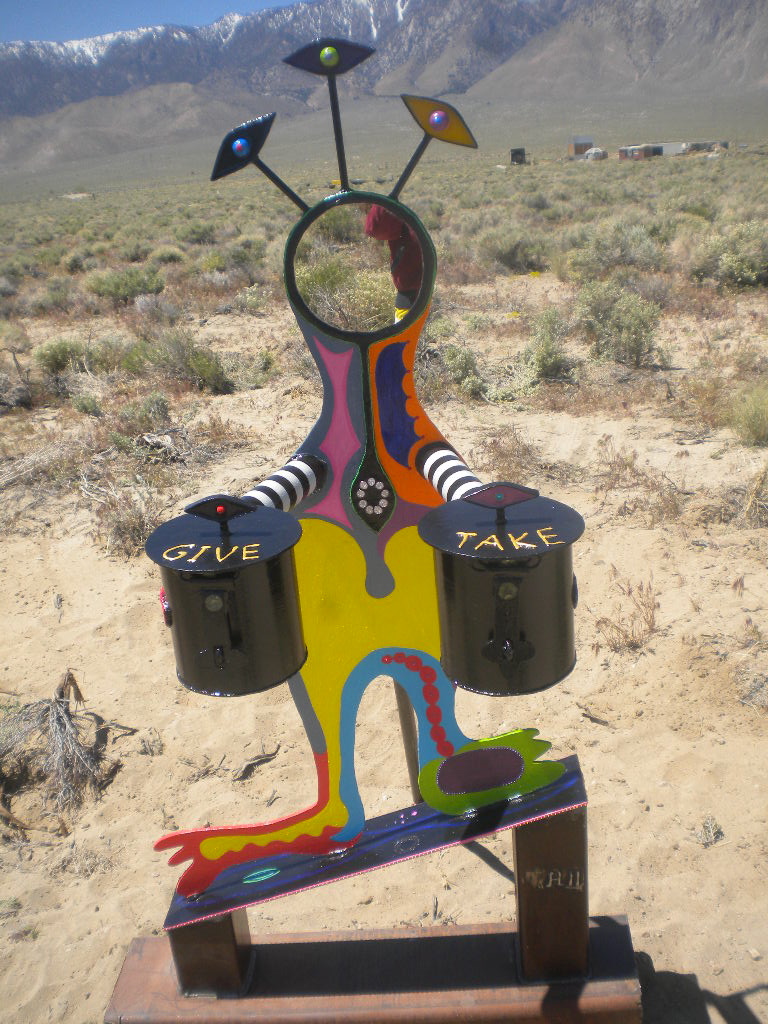
Below is one of her sculptures entitled “Give and Take”: It urges you to donate something in the can marked “Give” and take something from the can marked “Take.” As you examine both cans, your face is reflected in a mirror. Perhaps it will make you feel guilty if you take something without giving.

Jael Hoffmann’s “Give and Take”

Finally, there is another work I like which its creator calls “The Hitchhiker.” All three sculptures shown in this post are discussed in the YouTube video referred to earlier.

Jael Hoffmann’s “The Hitchhiker”

To see more of her work, I suggest you check out Jael’s website at www.jsculpt.com.

My Lizard Life

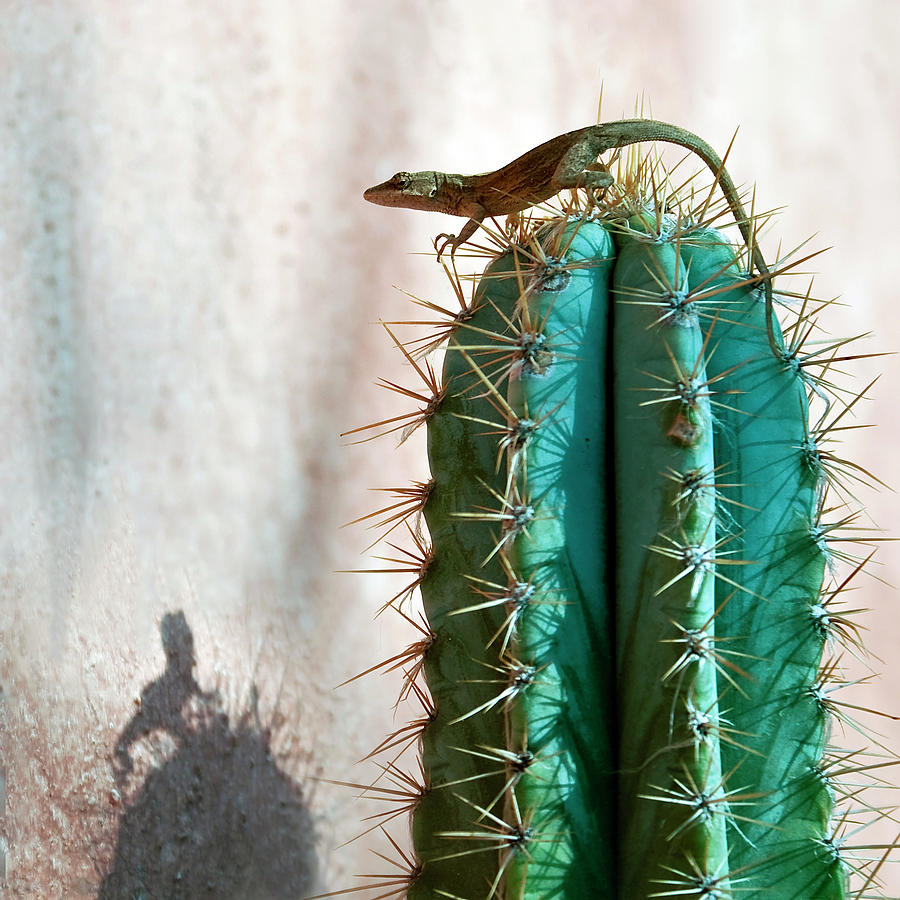
Gecko and Opuntia Cactus

As the heat dome over the Western US continues, I continue to make like a lizard. Unlike a lizard, however, I seek shady cool places rather than sunny rocks or cacti for my perch. Today, I even went to see a movie: Bullet Train with Brad Pitt was no winner—but at least I sat for three hours in air-conditioned comfort while the people outside the theater looked decidedly wilted.

My dinners lately were very appropriate to a desert dweller. Several days ago, I went to the Persian market across the street and purchased Persian lavash flatbread, French feta cheese, and Turkish pickled vegetables (2 varieties). For breakfast today, I made two quesadillas with flour tortillas, Monterey Jack cheese, and pickled rajas de jalapeño. Despite the hot morning, I had my usual cup of hot Indian black tea with honey and a squeeze of lime.

Tomorrow, while Martine braves the dead hot air of downtown LA, I will probably make my way once again to Burton W. Chace Park in Marina Del Rey to catch stray breezes while reading O. A. Bushnell’s 1963 novel Molokai, about the Hawaiian leper colony. During that time I will constantly hydrate myself with mineral water to keep from getting dehydrated.

This weather is no fun.

Hit the Road, Jack!

After our recent trip to Vegas, I am thinking of provoking the Covid-19 demons with another road trip. It’s fun to travel, and my predilection for wanderlust has been seriously subdued by the pandemic.

I don’t think I can get Martine interested in another desert destination—even though she liked the Vegas trip—but there are other less arid possibilities like Catalina, San Diego, Santa Barbara, or the Santa Ynez Valley and Solvang. I’ll just have to put my thinking cap on.

Actually, there is one desert trip that Martine likes, which we have taken twice: Up U.S. 395 along the Eastern Sierras and the Owens Valley. To see what a rich target this is, check out this California Through My Lens website.

Because It Is Bitter…

The following poem by Stephen Crane is short and cryptic. But it sticks in one’s craw. And the last two lines were taken by Joyce Carol Oates as a title for one of her novels.

In the Desert

In the desert
I saw a creature, naked, bestial,
Who, squatting upon the ground,
Held his heart in his hands,
And ate of it.
I said, “Is it good, friend?”
“It is bitter—bitter,” he answered;

“But I like it
“Because it is bitter,
“And because it is my heart.”