
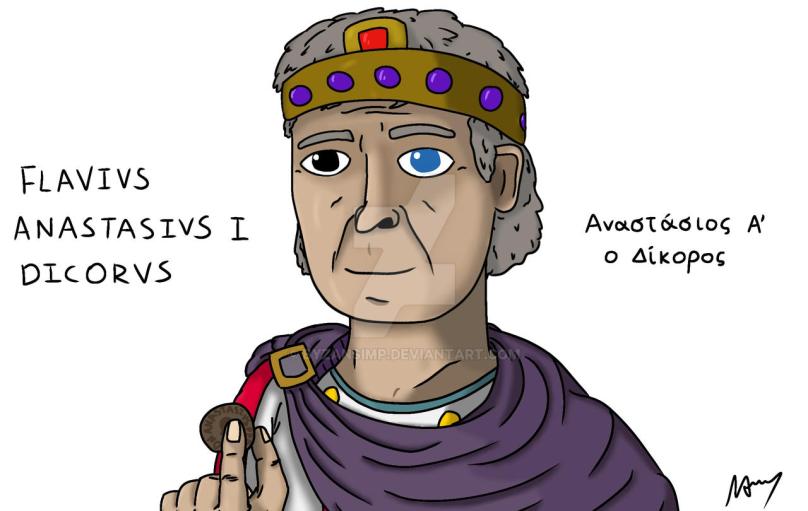
Byzantine Emperor Anastasius I Dicorus
The following humorous anecdote is from a speech that English Poet Robert Graves made at Mount Holyoke College in South Hadley, Massachusetts, in 1956. It is reprinted in his collection of essays entitled The Crane Bag and Other Disputed Subjects.
This has started me thinking about the Epeirot recruit from Dyrrhachium who enlisted in the Byzantine Army in the middle of the fifth century A.D. He was a tough, shrewd, energetic peasant and distinguished from all the other tough, shrewd, energetic peasant recruits that year, because he had eyes of two different colours. His name was Anastasius, but they nicknamed him ‘Dicorus’, which is the Greek for that peculiarity. Well, you can guess how it was. The captain of his company didn’t know half his men by sight or name but always recognized Dicorus; and as Diocorus was always clean on parade and alert on sentry duty, and held the correct religious views, the Captain naturally promoted him to corporal, and then to sergeant. The Colonel, similarly, did not know half the sergeants by sight, but Dicorus was easily distinguished by his eyes; so because he had a crisp word of command and kept his section in good order, the Colonel made him sergeant-major. One day an inspecting General remarked: ‘A very fine body of men, Colonel. I suppose you owe a lot to that sergeant-major of yours—fascinating, his eyes, eh? Significant, even. My old grandmother used to say that two eyes of different colours are lucky. I’m going to take him on my staff in the “Silentiaries”’—meaning the Lifeguards.
Meanwhile, Diocorus had been studying Frontinus and Vegetius and Army Regulations. He made a good Staff Officer, and went up the tree quickly, because he was a distinguished man, and had significant eyes. Indeed, everyone thought, when the Emperor Zeno died, that Dicorus was obviously the man to fill the vacant throne and marry the Empress Ariadne. So he became the Emperor Athanasius, but they continued to call him ‘Dicorus’, because he was the only Emperor to have eyes of different colours; and all their grandmothers had always told them what a lucky sign this was. He made, by the way, a most unsuccessful Emperor, and all his successors for the next thousand years had both eyes of the same colour.
I cannot help but think that the same general principle of promotion applies to the corporate business environment.


You must be logged in to post a comment.