Eclipse

Enough Fentanyl to Kill a Regiment

Yesterday afternoon, I heard some strange animal-like sounds coming from below my living room window. I pushed back the blinds, only to see several policemen and paramedics tending to something hidden by the hedge separating my building from the neighboring building. As I continued to look, I saw the paramedics hauling a black man in a bloodied t-shirt who was still howling.

Just another day on the streets of L.A., watching as our civilization is being eclipsed. And not just for a few minutes, either, but for the long count.

I do not understand why anyone would think that recreational drugs would be an improvement on real life. Even when real life is grim, it beats madness and suicide by chemical.

What is the tipping point after which there are so many people on drugs that reality has been supplanted? For a possible picture, read Polish sci-fi author Stanislaw Lem’s The Futurological Congress.

Was I Ever a Hippie?

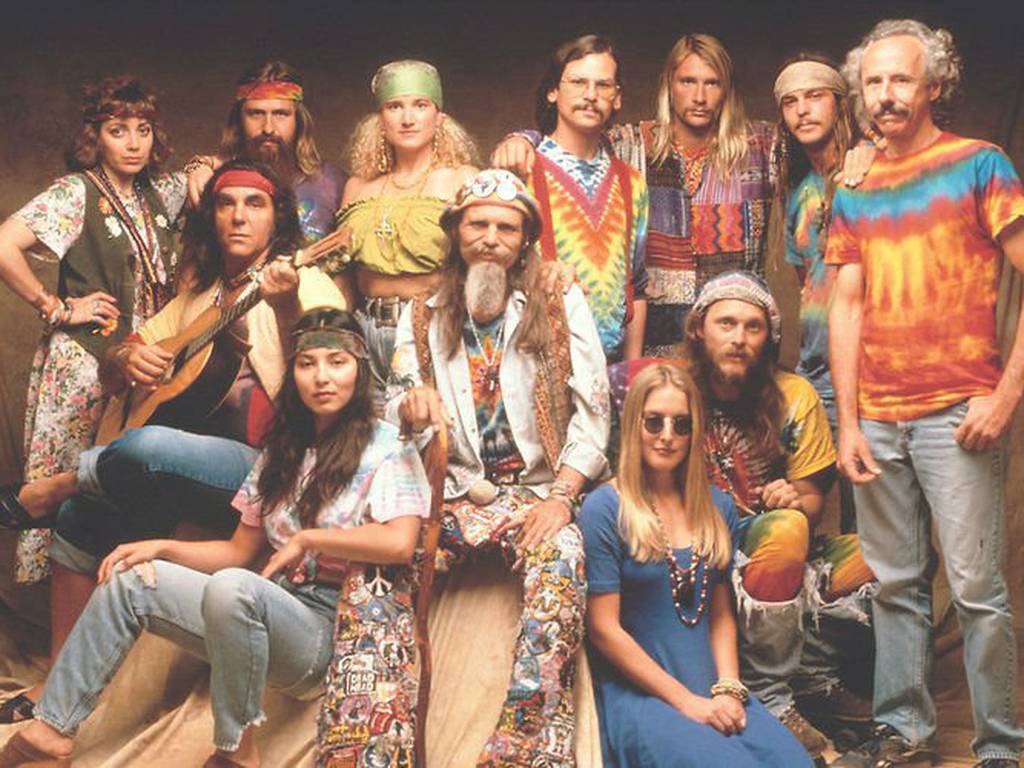
You Won’t Find Me in This Picture

I arrived in Los Angeles at exactly the point when the Hippie movement was reaching its height. Many of my acquaintances looked much like the poseurs in the above photo. Oh, I had long hair all right, but nothing that was radical for the period. I went around dressed in chinos and a Jeans jacket, usually with a black cowboy hat which I bought at Disneyland.

In fact, I never really got close to any Hippies: I regarded them as not quite real, more like play actors.

There was another even more compelling reason I never became a Hippie: I had just undergone brain surgery for the removal of a pituitary tumor and had no desire to experiment with recreational drugs. In the late 1960s, I did not think I was long for this world. I had no desire to rush my exit from this life.

Though not drawn to the Hippies, I was something of a political radical. For a brief time, I attended meetings of the Progressive Labor Party at UCLA, but found studying Marx’s Surplus Theory of Value breathtakingly boring and the girls in the group heartbreakingly ill-favored.

Due to the influence of my late friend Norm Witty, I hung out for a while with The Resistance, which protested the Vietnam War by attempting to interfere with the draft process. In fact, I sent my draft card back to my draft board in Cleveland, fully expecting to be arrested for two felonies ([1] Returning my draft card and [2] Refusing to carry a draft card on my person) and sent to a Federal prison. It turns out that so many of my fellow students returned their draft cards that the Federal Government decided it was too expensive to prosecute and imprison the offenders.

Cries in the Streets

Tents of the L.A. Homeless

In our 21st Century city of Los Angeles, there are tens of thousands of people who are living in scattered Medieval tent cities. Even though the city has banned tents from across the street from my apartment, there are a number of bums who “sleep rough” on the sidewalk. Martine and I can hear them when they raise their voices in anger in the middle of the night, particularly if they are competing for the attentions of a homeless woman.

I am very happy that I am not a politician, because then I would have to pretend as they do they these homeless are all poor unfortunates who need to be placed in public housing. That’ll work for some of them, the roughly 50% who really just need a place to bed down and are willing to follow the rules about drink, drugs, and violence. Except a very large percentage don’t want to follow any rules whatsoever. When they are offered housing, they will get drunk or stoned and smear their feces on the wall—whereupon they find themselves in the street again.

America is full of raggedy men who do not give a tinker’s damn about THE RULES. What they want is the freedom to live as they want to, even if they are burying the city of their residence in piles of fetid garbage. They don’t particularly care if their pursuit of freedom is toxic to others.

It’s kind of like American politics as a whole, which can best be summarized by who can say EFF YOU the loudest and longest. We used to have two political parties with platforms. Now we have one party that has a platform, and the rest have EFF YOU as their platform.

The homeless who don’t want to be homeless I can understand. The ones who want to spend all night drinking, shouting, getting high and meth and Fentanyl, and whoring with female ratbags do not have my sympathies.

Sympathy for Mules

Drug Smuggler Caught by Airport Police

Of late I have been fascinated by a National Geographic Channel series called “To Catch a Smuggler.” The show concentrates on drug smugglers attempting to smuggle cocaine, heroine, so-called party drugs, and other narcotics in their luggage or on their persons.

Initially, I was elated that people smuggling drugs into this country (or, in fact, any country) were being caught. Then, as I viewed more of the series, I started feeling some compassion for the drug mules, who were mostly poor people in serious debt who were persuaded by the real criminals that they would not get caught if they carried heroine in a false bottom in their luggage or swallowed rubber contraceptives full of cocaine. In the latter case, if one of the rubbers broke while in transit, the result would be a fatal overdose.

When caught, the drug mules would begin by denying everything. Then, when presented with clear evidence of their crime, they would break down. Allowed one phone call to their loved ones, they broke down when they realized their lives were irretrievably ruined.

Thinking one could smuggle several kilos of drugs past trained dogs, experienced security and customs personnel, and instant chemical tests for banned substances is a form of magical thinking. Unfortunately, the prison sentences for smuggling can be up to thirty years in countries like Peru and Colombia, and somewhat less in Europe.

Also on the show are another set of “smugglers,” except what they are smuggling are themselves. Show after show highlights cases of Syrians, Turks, and Albanians attempting to get to the United States or Europe with forged or otherwise false travel documents. It seems that many Muslims are desperately trying to leave their home countries, many of which are either despotisms or fighting endless civil wars.

I think one would have to be Marjorie Taylor Greene to watch this show and not feel for the perpetrators.

The People Under the Bridge

The Homeless Encampment Under the I-10 Bridge Over Centinela Avenue in West L.A.

There is no monolithic group which falls under the term “homeless.” It includes a wide variety of people, some of whom are in transition to a better life, some of whom are out of their gourds, some of whom want to be able to take drugs and drink excessively without police interference, and some of whom are psychotic criminals.

In Los Angeles, they are begging for “spare change” by every freeway onramp and in front of virtually every convenience store. Many of them have sad stories to tell, some of which are partially true. They stretch out on bus seats and commuter trains and ride back and forth all day, occasionally hassling the other riders. The police are reluctant to deal with them because so many are vectors of communicable diseases. (I once worked with a secretary who was married to a U.S. Marshal who contracted tuberculosis from escorting a prisoner.)

Unlike the terminally Woke, my attitude toward the homeless is not: “Oh, the poor homeless!” In my mind, I separate the ones who are capable of being re-housed and following rules regarding behavior, booze, and drugs from those who actually prefer to live and die on the streets. It is my belief that most of the homeless fall into this latter category. I regard them as intractable bums who should be locked up.

Most bum encampments are surrounded by piles of trash of no earthly use to anyone. Martine and I have seen some bums emptying trash cans into the street or even setting fire to them. I am not inclined to be gentle with such rapscallions. Unless these sociopathic types are incarcerated, setting up a tent on the sidewalk will become an attractive alternative to anyone who is not interested in anything but destroying their minds and bodies.

The United States of Addiction

Across the street from my apartment is a row of some dozen or more tents usually surrounded by piles of trash and inhabited by people we typically refer to as homeless. (To me, that’s about as useful as referring to my neighbors in this building as “the housed.“) The easternmost tents have the most stable residents, while the ones to the west come and go. Some die of drug overdoses; some are hauled away by the police or ambulance; and, hopefully, some manage to escape life on the streets by happier means. They spend much of the night yelling at one another, particularly if one of the campers is a woman. It’s nobody’s idea of a stable community. Yet Los Angeles has tens of thousands of similar campers, whose numbers seem to be growing every week.

What are the causes of this phenomenon? One could certainly point to economic causes, such as the insanely rising cost of housing. There are also various social causes, such as people released from prison. In my neighborhood, many of the tent dwellers are military veterans as I live two miles from a major Veterans Administration hospital. I suspect, however, that the major causes are a combination of mental illness, alcoholism, and drug addiction.

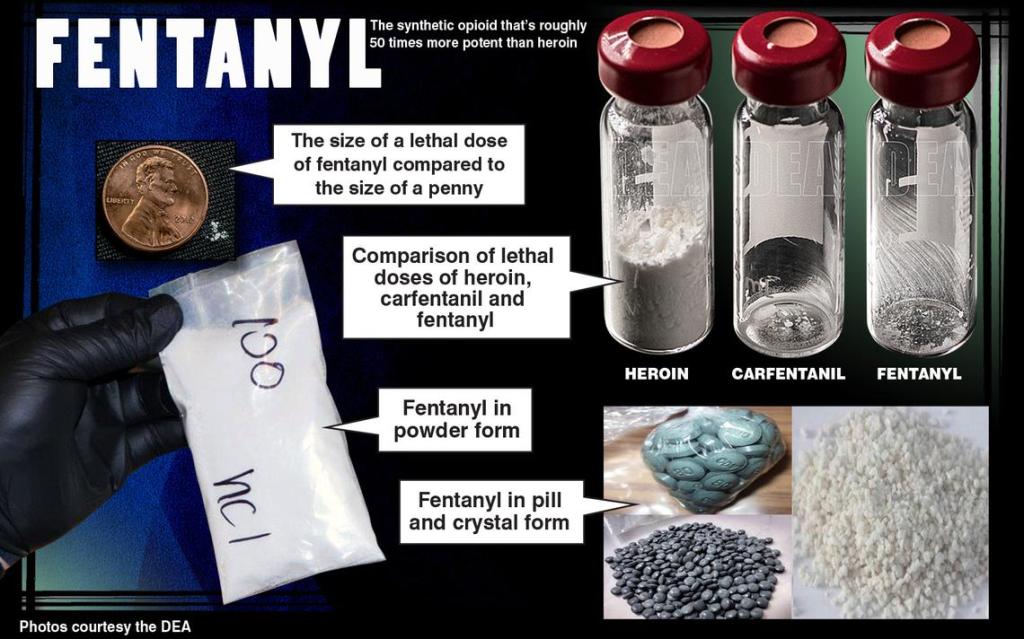
I am currently reading a new book by Sam Quinones entitled The Least of Us: True Tales of America and Hope in the Time of Fentanyl and Meth. Its author talks about how a relatively new drug called Fentanyl has taken America by storm. Not relying on growing and processing a crop, such as cannabis, cocaine, or opiois, fentanyl is produced in the lab from such substances as Benzylfentanyl and 4-Anilinopiperidine. It is now readily available and devastatingly cheap. So cheap that small amounts are frequently mixed in with cocaine and opioids. The result is twofold: .

  • A more satisfying high
  • A vastly increased mortality rate

The above illustration from the Drug Enforcement Administration tells the whole story, comparing the amount required to cause overdose deaths of heroin, carfentanyl (developed to anesthetize rhinoceroses), and fentanyl. As you can see, if a drug dealer gets a pound of fentanyl or carfentanyl, he or she can make thousands of pills with it and still have enough left over to mix with heroin or cocaine. Because so little is needed—beyond which the risk of overdose looms—one can see how a drug dealer can more easily move the drug without being apprehended and also make a killing selling it.

Most fentanyl comes from China. Although the Chinese government has outlawed its sale, drug manufacturers can evade prosecution by making slight changes to the molecular structure of their product.

I have no doubt that most of the tent dwellers across the street from me are users of fentanyl. It’s compact. It’s cheap. And it’s deadly.

Financialism

Some Wealth Is Real—Based on Actual Products and Services That Fill a Need—Then There Is Financialism

One of the things that really bothers me about this economy is that, increasingly, it is based not on satisfying real needs, but on playing games with finance. According to an essay by Ezra Wasserman Mitchell:

Financialism is a system in which the real economy plays a secondary role to the financial economy, in the process stripping future real economic profits for present consumption. While it bears similarities to the process often identified in the economic literature as “financialization,” it differs both in historical scope and in its suggestion that financialism differs fundamentally from capitalism.

Let me give you several examples:

  • Executives in such “gamed” industries as pharmaceuticals, insurance, or rental real estate get together and decide what level of profit they want for the coming year. In order to achieve their goals, they raise prices to achieve goals that are based on how much money they want—not how much money they can reasonably be expected to earn in the course of business.
  • Crypto-currencies like Bitcoin represent financial speculations divorced from providing products and services. It’s not so much the finger pointing at the moon so much as it is a finger pointing at a finger pointing at the moon.
  • Bank charges and airline nickel-and-dime fees can cause real economic pain that is far removed from the actual value of the services being accounted for.

This came home to me today when I discovered that the forms of insulin I must take for my Type 2 Diabetes have been removed from Anthem Blue Cross’s drug formulary. Outraged, I called Blue Cross and suggested they accompany their “drug not in formulary” notices with ads for cemetery plots and mortuaries. That didn’t go over well with them, but I was pissed. Evidently, if Anthem Blue Cross saw their projected profit as more important than they basic services they provided.


On the Bus

The MTA Santa Monica Blvd, #704 Express

Since I am now on a fixed income, I avoid expensive parking lot charges. For some of the places I hang out, I take the bus: It only costs 35¢ a ride rather than, say, the $25.00 or more it would cost to park downtown or $10.00 it would cost at the Fairfax Farmers Market. Today, I had to endure the abusive chatter of a Tourette’s Syndrome bum who was serially abusing all the passengers on the bus. Fortunately, he disembarked in Beverly Hills, where—no doubt—he started abusing the tourists who congregate there.

The Many Aspects of Tourette’s Syndrome, On the Surface and Below

I have found that Los Angeles has a fair number of angry African-American homeless persons who are angry and verbally abusive. Several months ago, on the same bus line, a bum started shouting at me. Angrily, in Hungarian, I told him I hoped he would be f*cked in the ass by a horse. Not hearing me right, he thought I was using the N-word at him, which is something I would never do. That ended with the police being called by the driver and the bum being evicted from the bus.

This time, I saw this bum approaching from a hundred feet away, enraged at the world and various unspecified rednecks. I knew he was going to be trouble. Fortunately, this particular bozo did not pick on me in particular; so I was able to maintain a neutral pose.

When I read the papers about the growing number of homeless in Los Angeles, I rarely see anything about mental illness and drug abuse. And yet those are the dominant characteristics of most homeless. It is not shelters they want (that would impinge on their freedom, such as it is), but either mental healthcare or drug treatment—that is, if they would submit to treatment at all.


(Don’t) Ask Your Doctor

So You Think You Can Second-Guess Your Physician?

You don’t have to watch a whole lot of television before you start running into a barrage of commercials attempting to influence you in “asking your physician” about the various nostrums that are being advertised. And you wonder why prescriptions cost so much?

Here is a brief survey of three such drugs I have seen lately together with a list of things that can happen to you if you were dumb enough to urge your doctor to prescribe them. Please note that while a sotto voce voice in the background warns you of impending disease and death, you are watching attractive actors indulging in an active, trouble-free lifestyle.

Humira (Adalimumab) – Abbvie Inc. – For Psoriatic Arthritis

Serious infections have happened in people taking HUMIRA. These serious infections include tuberculosis (TB) and infections caused by viruses, fungi, or bacteria that have spread throughout the body. Some people have died from these infections. Your doctor should test you for TB before starting HUMIRA, and check you closely for signs and symptoms of TB during treatment with HUMIRA, even if your TB test was negative. If your doctor feels you are at risk, you may be treated with medicine for TB.

Cancer. For children and adults taking TNF blockers, including HUMIRA, the chance of getting lymphoma or other cancers may increase. There have been cases of unusual cancers in children, teenagers, and young adults using TNF blockers. Some people have developed a rare type of cancer called hepatosplenic T-cell lymphoma. This type of cancer often results in death. If using TNF blockers including HUMIRA, your chance of getting two types of skin cancer (basal cell and squamous cell) may increase. These types are generally not life-threatening if treated; tell your doctor if you have a bump or open sore that doesn’t heal.

Taltz (Ixekizumab) – Eli Lilly – Also for Psoriatic Arthritis

Taltz affects the immune system. It may increase your risk of infections, which can be serious. Do not use Taltz if you have any symptoms of infection, unless your doctor tells you to. If you have a symptom after starting Taltz, call your doctor right away.

Your doctor should check you for tuberculosis (TB) before you start Taltz, and watch you closely for signs of TB during and after treatment with Taltz.

If you have TB, or had it in the past, your doctor may treat you for it before you start Taltz.

Do not use Taltz if you have had a serious allergic reaction to ixekizumab or any other ingredient in Taltz , such as: swelling of your eyelids, lips, mouth, tongue or throat, trouble breathing, feeling faint, throat or chest tightness, or skin rash. Get emergency help right away if you have any of these reactions. See the Medication Guide that comes with Taltz for a list of ingredients.

Crohn’s disease or ulcerative colitis (inflammatory bowel disease) can start or get worse with Taltz use. Tell your doctor if you have any of these symptoms or if they get worse: stomach pain, diarrhea, and weight loss.

You should not get live vaccines while taking Taltz. You should get the vaccines you need before you start Taltz.

Chantix (Varenicline) – Pfizer – To Stop Smoking (This ad uses a pixillated turkey rather than live actors)

Some people have had new or worse mental health problems, such as changes in behavior or thinking, aggression, hostility, agitation, depressed mood, or suicidal thoughts or actions while taking or after stopping CHANTIX. These symptoms happened more often in people who had a history of mental health problems. Stop taking CHANTIX and call your healthcare provider right away if you, your family, or caregiver notice any of these symptoms. Before starting CHANTIX, tell your healthcare provider if you ever had depression or other mental health problems.

Some people have had seizures during treatment with CHANTIX. Tell your healthcare provider if you have a history of seizures. If you have a seizure, stop taking CHANTIX and contact your healthcare provider right away.

New or worse heart or blood vessel problems can happen with CHANTIX. Tell your healthcare provider if you have heart or blood vessel problems or experience any symptoms during treatment. Get emergency medical help right away if you have symptoms of a heart attack or stroke.

Sleepwalking can happen with CHANTIX, and can sometimes lead to harmful behavior. Stop taking CHANTIX and tell your healthcare provider if you start sleepwalking.

Do not take CHANTIX if you have had a serious allergic or skin reaction to it. These can happen with CHANTIX and can be life-threatening. Stop taking CHANTIX and get medical help right away if you develop swelling of the face, mouth, throat or neck; trouble breathing; rash with peeling skin, or blisters in your mouth.

Use caution when driving or operating machinery until you know how CHANTIX affects you. Decrease the amount of alcohol you drink while taking CHANTIX until you know if CHANTIX affects your ability to tolerate alcohol.

The most common side effects of CHANTIX include nausea (30%), sleep problems (trouble sleeping, vivid, unusual, or strange dreams), constipation, gas and/or vomiting. If you have side effects that bother you or don’t go away, tell your healthcare provider.

Now if you still want to tell your doctor what to prescribe for you, you’d be letting him off the hook. After all, he doesn’t have to research and find the best drug for your condition. And it’ll make you look smart, at the possible cost of discomfort, disease, or even death.

My advice? Mute all prescription commercials. The risks far outweigh the advantages.


Talking About Homelessness

Most Discussions About Homelessness Are Too Vague

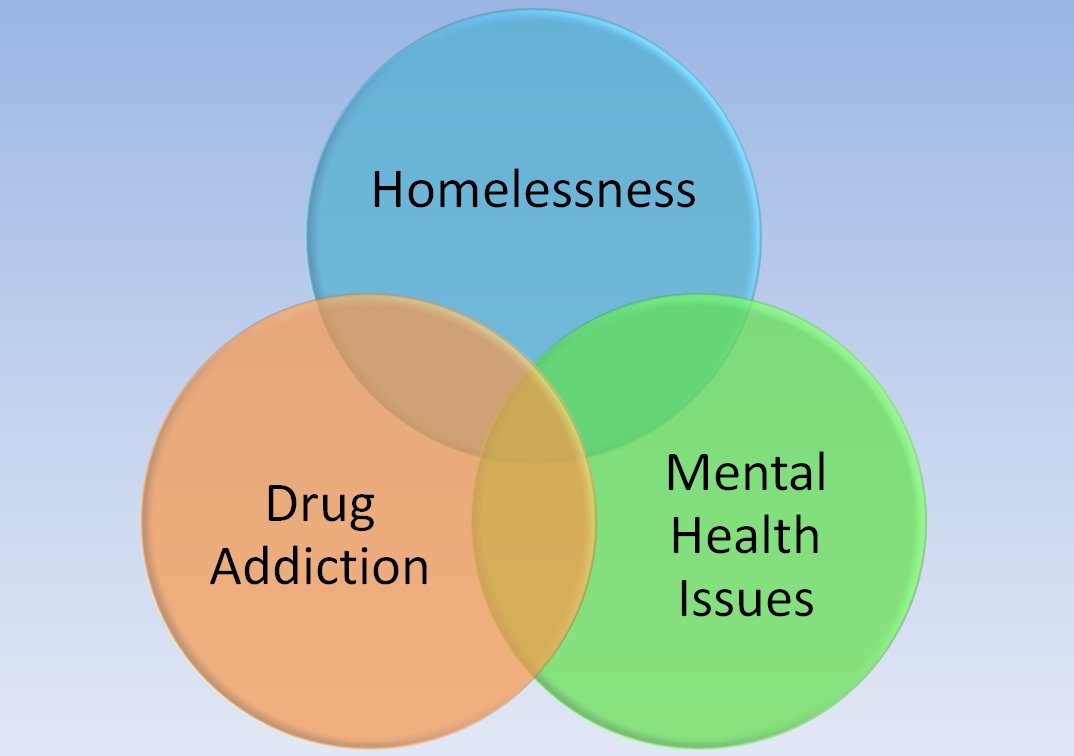
As an independent (no party) voter, I am dismayed by the way most liberals view the homeless. For one thing, I refuse to take a bleeding heart view of the hobo encampments that are spreading across American cities, particularly in the West. When I think of the homeless, I have three populations in mind, with a lot of overlap among the categories:

  1. People who, for various reasons, are homeless
  2. People who are addicted to various drugs such as alcohol, heroine, cocaine, and crystal meth.
  3. People who are mentally ill.

The Venn Diagram above shows that there are many overlaps. Some of the homeless have some hope and expectation of finding a place to live. These are mostly homeless who are not addicted to drugs or mentally ill. These constitute the majority of homeless who are living in organized shelters.

Wherever drug addiction and mental illness are involved, it is much more difficult to find shelter. These shelters have rules regarding drugs, alcohol, theft, and violence. Many of the bums in Los Angeles would not be likely to live in a shelter, if only because they have no intention of following the rules.

If you have about an hour to spare, I recommend you watch this video by news station KOMO entitled “Seattle is Dying,” which takes a no-holds-barred view of the dire homeless situation in Seattle: