
Off the Grid: The Salton Sea

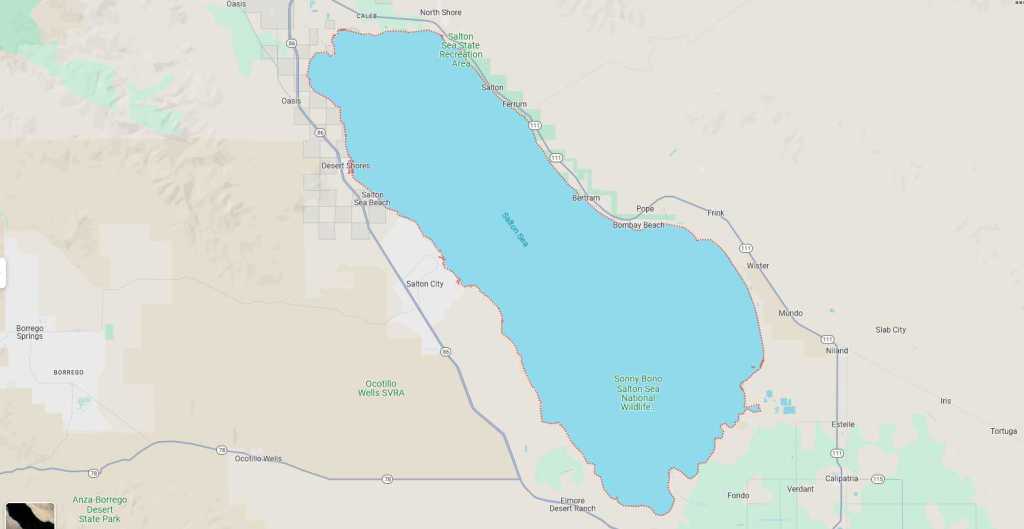
Southern California’s Salton Sea

When I was still in college trying to decide where I would go to graduate school, I kept studying maps of California because it looked like I would attend UCLA (which I did). The one thing that arrested my attention was that Southern California had a sea entirely within the state. It was called the Salton Sea, and it did not seem to have any major population centers along its banks. Why, I wondered.

It seems that the Salton Sea was created by accident in 1905-1906 when the Colorado River was diverted to flow into a low-lying basin that had been dry since the late 16th century. For a while, particularly in the 1950s and 1960s, it was a major tourist draw—but not in the summer, when the temperature frequently exceeded 120° Fahrenheit (49° Celsius). Hollywood stars swam and boated in the waters, and there were a number of resort towns along the banks.

During the 1970s, the Sea’s increasing salinity and pollution resulted in large-scale fish and bird deaths; and, suddenly, the Salton Sea was deemed an environmental disaster. Plus, it was shrinking due to evaporation. The roads to the north ran through land that was white with salt. People started to remember that the San Andreas Fault ran right through the middle.

Last Saturday, my brother and I drove along the eastern shore of the Sea to view a stark landscape that was staging a weird comeback, first as a major lithium extraction site, and secondly as a magnet for people who wanted to live off the grid.

For the next several days, I will be posting blogs in a series I call “Off the Grid,” about our visit to the rogue communities of Bombay Beach, Slab City, Salvation Mountain, and East Jesus. None of them are incorporated cities, but all are alive with a kind of ferment that lends them a certain glow.

Earthquake-Proof

Inca Stonework on Calle Hatunrumiyoc in Cuzco, Peru

The Inca were, to my mind, most eminent for their stonework. Look at this wall in Cuzco. It was built almost 700 years ago, before a number of major earthquakes, particularly the ones of 1650 and 1950, shook most of the Spanish buildings to rubble. The remaining Inca walls did not budge. Interestingly, they were constructed without mortar, with each block trimmed to fit exactly atop the stones beneath it and to either side.

Best-known is the famous Twelve-Angle stone, not more than a few feet away from the above view:

The Famous Twelve Angle Stone

Now imagine trying to get a modern-day stonemason to do something like that. This stone is so revered that it is forbidden by law to even touch it. Yet it has withstood centuries of tremors and hard usage.

Today this wall forms part of the Archbishop’s Palace, which the Spanish wisely incorporated into the present structure.

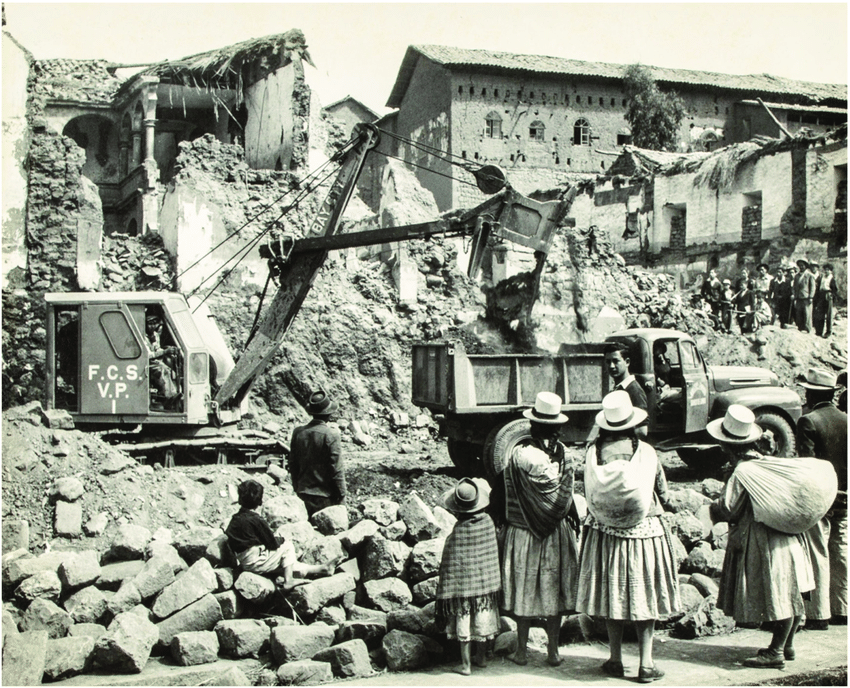
Below is an image of some of the damage after the 1950 earthquake:

Cuzco After the 1950 Earthquake

As good as the Inca were at being stonemasons, it is amazing to think that:

  1. They had no system of writing, though they did have a system of saving numerical data using a system of knotted cords known as quipu.
  2. They did not have the wheel to help them move all those heavy stones. But then they had no draft animals that could pull heavy carts, either,

Protective Detachment

Brush Fire About Five Miles from My Front Door

There I was, siting and reading the essays in Joan Didion’s After Henry, when I suddenly found a perfect phrase to summarize the sang-froid Californians feel about earthquakes and wildfires:

The notion that land will be worth more tomorrow than it is worth today has been a real part of the California experience, and remains deeply embedded in the California mentality, but this seemed extreme, and it occurred to me that the buying and selling of houses was perhaps one more area in which the local capacity for protective detachment had come into play, that people capable of compartmentalizing the Big One [that is, earthquake] might be less inclined than others to worry about getting their money out of [a real estate investment].

People in other parts of the country have told me scores of times that California is going to “fall into the ocean,” as if we were all living on a thin shelf of unsteady earth stretched out over the Pacific Ocean. In actuality, our part of the state will, instead of falling into the ocean, slowly head north to Alaska—over a period of millions of years. No matter, I won’t be around to have to buy heavy parkas.

When growing up in Cleveland, I had a deathly fear of tornadoes. They frequently featured in my nightmares. Finally, on June 8, 1953, a large tornado tore through the West Side. As an eight-year-old, we visited a family friend whose two-story house was half a block from utter devastation. At the time, we lived on the East Side and suffered no damage; but that didn’t help my dreams any.

Freeway Damage from the Northridge Quake of 1994

Because I live on a large heavily populated plain just south of the Santa Monica Mountains, I have no reason to fear wildfires. But earthquakes are a different matter. The Sylmar Quake of 1971 scared the Bejeezus out of me, and the Northridge Quake of 1994 didn’t help matters. Perhaps I don’t feel Didion’s protective detachment because I wasn’t born in California as she was.

Shimmering into Non-Existence

It was early in the morning of February 9, 1971 at precisely 6:00 AM Pacific Standard Time. I was half-asleep when I suddenly heard the howling of several dogs in the Santa Monica neighborhood where I lived. Within seconds, I felt the bed and the whole building shaking, accompanied by a deep noise as if the earth was being fractured (which it was). I held on to the mattress for dear life, but found myself on the floor nonetheless.

That was my experience of the Sylmar Earthquake, also known as the San Fernando Earthquake. Ever since then, I have been scared of quakes. Was it a small quake? Perhaps it was the precursor of a much larger quake. The Northridge Earthquake of January 17, 1994 was like that, following in the wake of several much smaller quakes centered in Santa Monica Bay.

Now when I see pictures of the Gaziantep temblor that shook parts of Turkey and Syria, I feel as if the solidity I feel of my footsteps on the ground is a possible illusion. Without warning, the buildings around me could come crashing down, possibly with me in one of them.

This afternoon, I took a walk along the Venice Boardwalk, stopping in at Small World Books to buy the work of a recommended Swiss author. As I looked at the buildings along the Boardwalk, I almost felt the ground under my feet begin to move. I remember the Tsunami Evacuation Route signs scattered around the streets in the area and felt that terra firma within a matter of seconds could sport waves like the sea; and, if the quake was out at sea, a giant wave could inundate the low-lying blocks along the ocean before I could get to safety.

If you’ve never been in a major quake, you could laugh away the small quakes. But after 1971 and 1994, there is no laughing. I am on high alert. Will it rapidly get worse? Or is this just another little memento mori?

Antigua Guatemala

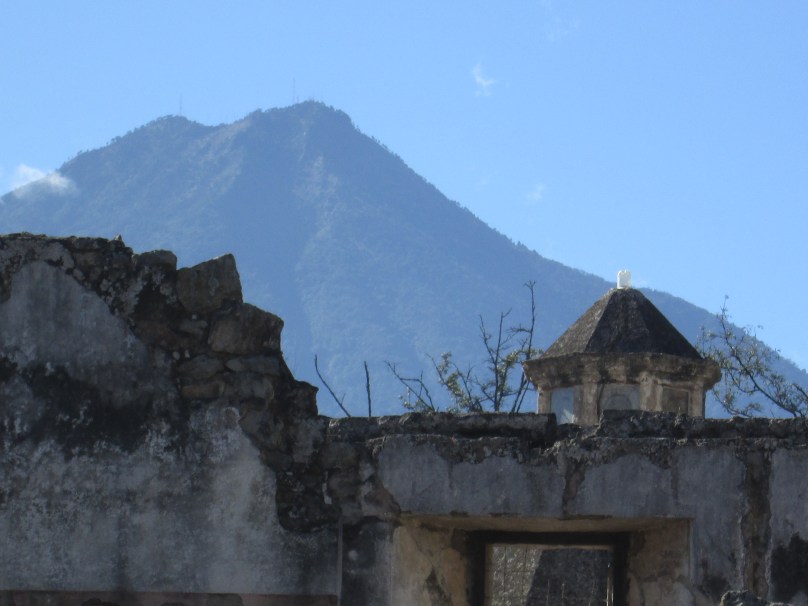
The View from the Roof Garden of My Hotel

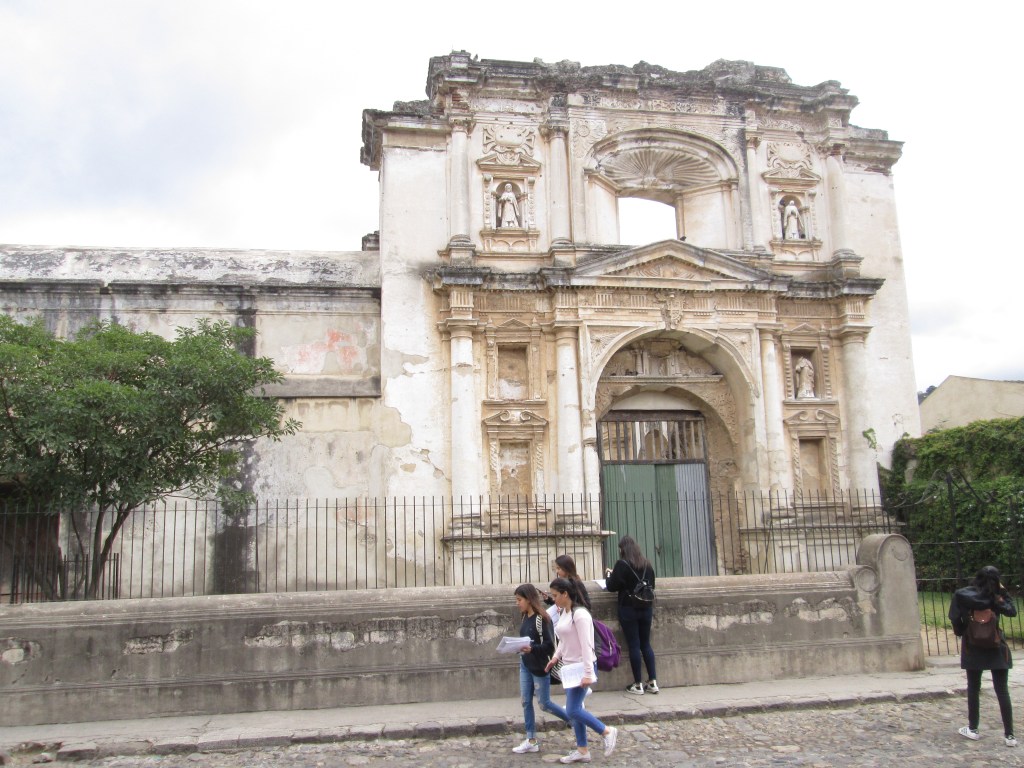
My 2019 vacation in Guatemala started out on a promising note. Instead of staying in Guatemala City, I immediately took a van to Antigua Guatemala, a beautiful city a scant thirty minutes from the capital that is surrounded by active volcanoes and the ruins of churches which collapsed during the disastrous 18th century, which required the city to move several times in its history:

  • The San Miguel Earthquake of 1717
  • The San Casimiro Earthquake of 1751
  • The Santa Marta Earthquake of 1773

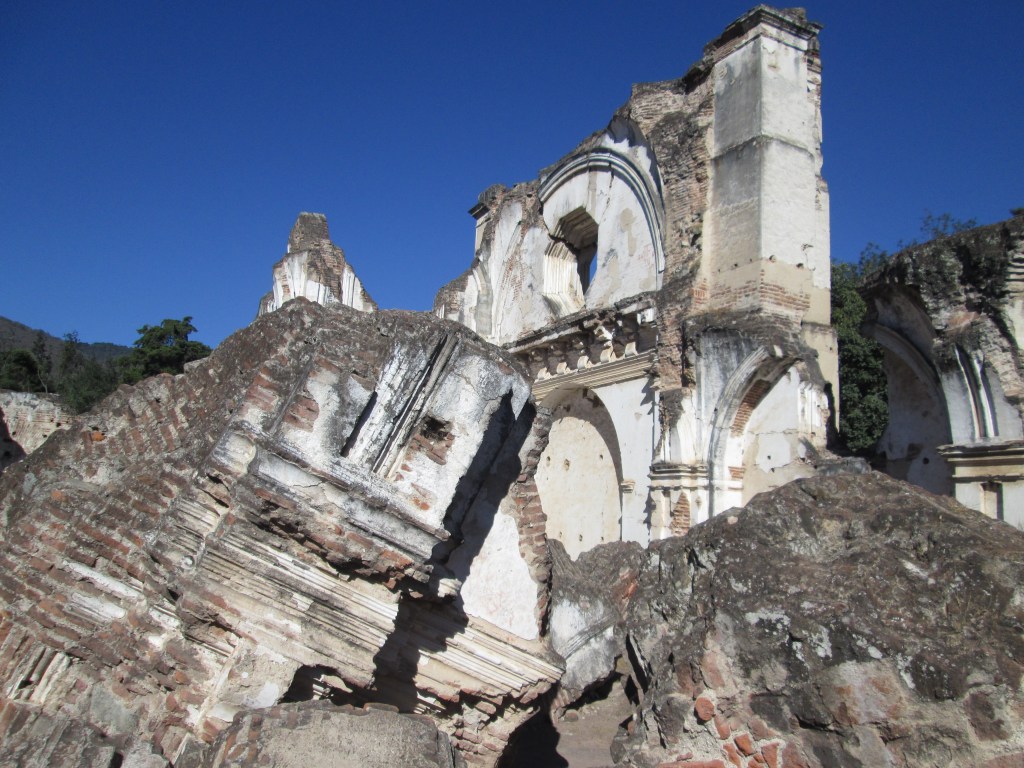
When I was in Antigua in January 2019, I spent most of my time visiting ruined churches.

Ruined Church with Collapsed Roof

In the end, I got as much fun from visiting the ruins of Spanish Catholicism as I did the Maya cities like Copán in Honduras, and Quiriguá and Tikál in Guatemala’s Petén jungle.

Although Guatemala is not known for its cuisine, the food I had was uniformly good, particularly the beans. I wouldn’t mind going again, if that is in the cards for me.

Pointing North

Icebergs Off West Coast of Greenland

Today was a strange day. Around 5 PM, there was a sharp (Richter 3.4) but brief temblor centered in El Segundo. It seems that our part of Southern California is continuing its inexorable millenias-long journey northward. As an odd punctuation to the quake, I noticed two large military helicopters at low altitude heading toward the ocean minutes later.

But my main Northern contribution today was completing Chauncey C. Loomis’s Weird and Tragic Shores: The Story of Charles Francis Hall, Explorer. Chauncey was my favorite English professor at Dartmouth. He, without a doubt, the coolest member of that distinguished faculty. What I did not know at the time was that he was such an adventurous traveler. His bailiwick went far beyond the Eighteenth Century English Novel, to places like Peru and the Arctic.

Chauncey C. Loomis (1930-2009)

Why, despite my admiration for the man, did I wait more than twenty years to seek out and read his book? I knew Chauncey when he was in his thirties (long before the above photo), a young English prof sitting in his office with a hunting dog curcled around his feet. Terminally cool!

I love the conclusion to his book after he discovered that the body of Arctic Explorer Charles Francis Hall was poisoned with arsenic:

Anyway, I didn’t write the book as a murder mystery. In fact, the idea of going to northern Greenland and performing an autopsy occurred to me only late in my research, after I read the transcript of the [Naval] Board of Inquiry’s interrogations. What first had my interest was the Arctic itself (the actual Arctic and the Arctic in the nineteenth-century imagination), the whole saga of nineteenth-century Arctic exploration, and Hall as a characteristic nineteenth-century American of a particular type. The book was intended to be more of a period piece than a murder mystery. Mostly it was meant to be a study of the Arctic conceived as a “challenge” by nineteenth-century western man, a challenge that aroused both the noble and the reprehensible in him: pety and pugnacity, visionary idealism and gross ambition, genuine heroism and macho posturing, self-sacrifice and self-aggrandizement…. I cannot make up my own mind as to whether these nineteenth-century explorers, including Hall, was heroes or fools. My waffling, I suspect, indicates humankind’s general ambivalence about heroism; we yearn for heroes, but we mock them when we have them, and then, having mocked them, we yearn for them again. We know that our world is complex, but heroes often at least seem outwardly simple: they cut through the Gordian knot of complexity with apparent abandon.

The Isle of California

The Mural “Isle of California” (1972) When It Was Newly Painted

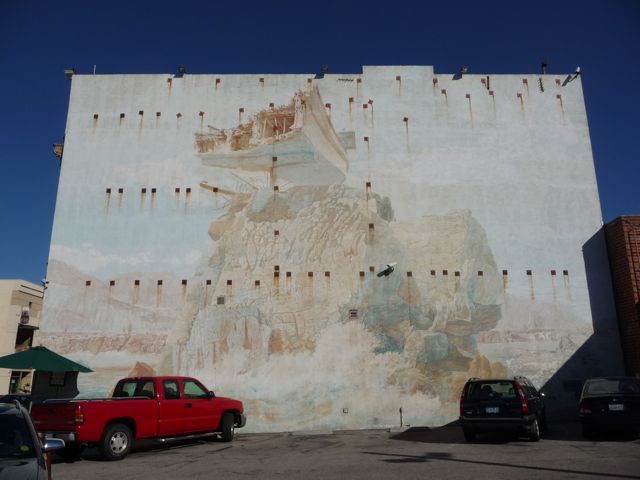
Near the West Los Angeles Post Office is the Village Recording Studio at 1616 Butler Avenue. On its back wall is a mural entitled “Isle of California” showing what remains when most of California has fallen into the ocean. It was painted in 1972 by the L.A. Fine Arts Squad consisting of Victor Henderson, Terry Schoonhoven, and Jim Frazin.

Of course, Southern California will not just fall into the ocean after “the Big One.” What is west of the San Andreas Fault will be displaced northwards, separating itself horizontally from the area east of the fault.

I saw today a fascinating quote from J. B. Priestley in Carey McWilliams’s Southern California Country: An Island on the Land:

There is something disturbing about this corner of America, a sinister suggestion of transience. There is a quality, hostile to men in the very earth and air here. As if we were not meant to make our homes in this oddly enervating sunshine…. California will be a silent desert again. It is all as impermanent and brittle as a roll of film.

Oddly, that’s what I felt shortly after I moved here. The feeling was reinforced by the Sylmar Earthquake of 1971 and the Northridge Earthquake of 1994.

The Same Mural Today: Badly Faded With Earthquake Reinforcing Bolts

Well, Southern California is still here. And I’m still here. The place still feels a bit unreal to me, but I have fallen in love with it. So if the whole place should happen to fall in the ocean after all, I’m a goner.

Western Town

Sunset in the Alabama Hills

Martine and I were in agreement: Our two favorite towns on our recent trip to the Eastern Sierras were Bishop and Lone Pine. More about Bishop later. If it weren’t for the fact that Lone Pine is a little too close to the Mojave Desert, way too close to Owens Dry Lake which, on windy days, is the largest source of dust pollution in the United States, and if it weren’t such a small town, I wouldn’t mind living there.

Oh, yes, there is one other thing: Not only is Lone Pine only 71 miles (114 kilometers) by air from the recent earthquakes at Ridgecrest, but, back in 1872, there was a major earthquake that destroyed a good part of the town and killed twenty-seven people. When you consider that the tallest peak in the contiguous forty-eight states—Mount Whitney—is just a few miles to the west, I suspect that some more disasters are in the cards for this sweet little town.

So much for the negatives. Lone Pine holds an honored place in film history for being situated close to the Alabama Hills, which for almost a hundred years have been one of the major shooting locations for movie Westerns. From the days of Jack Hoxie, Tom Mix, and Ken Maynard to the TV Westerns of the 1950s and 1960s, the Alabama Hills were seen in hundreds of film and TV productions. For this reason, the town is the site of the Museum of Western Film History, which is worth two or three hours of your time if you have any love for the genre (as I do).

Just Beyond the Alabama Hills Are the Snowcapped Sierras

Although we spent almost two hours riding the washboarded dirt roads that wind through the hills, I would gladly have allocated more time. Unfortunately, the heat was beginning to build, so I didn’t get out to take the many little hikes to particularly interesting rock formations and filming locations. Instead, we headed north to Independence to take another look at those coyote dentures I wrote about yesterday.


Shake Rattle & Roll

Little Lake Just Off Highway 395

After a twenty-year period of calm, we are once again in the throes of a series of earthquakes. Now these quakes are not quite so dangerous in Los Angeles as they are at the epicenter in Ridgecrest, CA, which is 120 miles (193 kms) as the crow flies. With yesterday’s Richter 6.4 temblor, the quake hit us as a rolling motion that lasted about a minute. Today’s Richter 7.1 temblor was a few miles northwest of yesterday’s epicenter, but it came to us as a stronger, more long-lasting rolling motion.

The funny thing is that next Monday, we will be driving by Little Lake (shown above), which is approximately ten miles west of the epicenter. We will continue until we get to Lone Pine, where we will spend the night. At Lone Pine, we will be about 71 air miles north and slightly west of the epicenter.

Today’s quake was the first one that threw a scare into Martine, because of its strength and duration, but even more because she felt two quakes in as many days.


Along the San Andreas Fault

The San Andreas Fault Cutting Through the Carrizo Plain

Yesterday, as we were motoring along the Soda Lake Road through the heart of the Carrizo Plain, Bill Korn said something that made me sit up. “Those mountains on the right have nothing to do with the ones on the left.” The truth of that remark hit me between the eyes. The Plain was a boundary between two tectonic plates—the North American Plate on the right, which was moving ever so slowly to the southwest, and the Pacific Plate, containing most of the population of California, was as slowly heading northwest in the direction of Alaska. And Bill was right, the two mountain chains, separated from each other by only a few miles, had no resemblance.

The movement amounts to an average of only a few millimeters a year, but there have been times that the motion has been more catastrophic. In 1857, the Fort Tejon Earthquake created the strange Chinese scenery of the Devil’s Punchbowl on the north slope of the San Gabriels. Then there was the 1906 temblor and fire that leveled San Francisco and the 1989 Loma Prieto quake. There will be more, a lot more, but hopefully spread over many years. I have lived through the 1971 Sylmar Quake and the 1994 Northridge Quake, both of which had me gelid with fear.

A Map of the San Andreas Fault

Perhaps I dwell too much in my blog posts about volcanoes, earthquakes, hundred year floods, and other disasters. That is because I realize how fragile our lives are. Most people would rather not think about such things, even if they are inevitable. So they build unreinforced brick houses on fault lines or live on the banks of rivers that frequently overflow their banks. Then there are those Guatemalan peasants who live on the slopes of volcanoes because the earth there is so conducive to growing coffee beans and other crops.