¡Temblor!

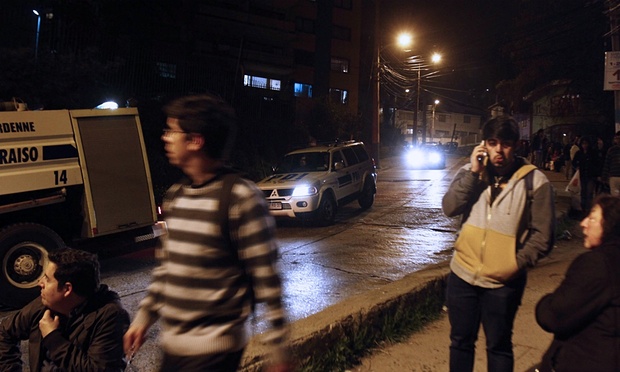
Street Crowds in Valparaíso During Tsunami Alert

Street Crowds in Valparaíso During Tsunami Alert

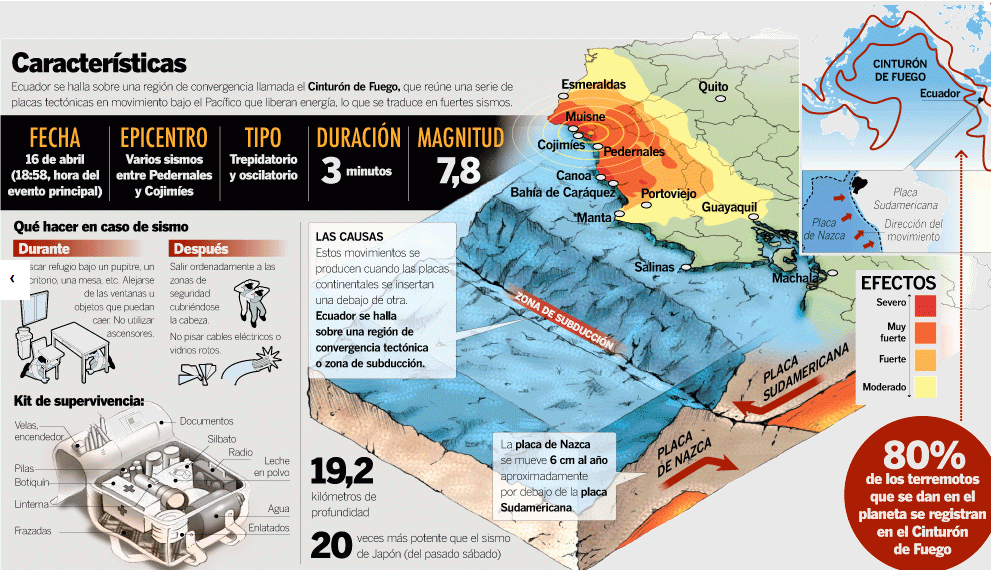
In about two months from now, I will be in one of the Ring of Fire’s “Hot Zones”—coastal Chile, where a Richter 8.3 quake has just struck not more than a couple of hours ago. Most articles centered on the effects of the quake on Santiago, though the epicenter was 144 miles northwest of the capital, which suffered minimal danger because  it is built on rock, namely the foothills of the Andes.

The city of Coquimbo, nearer the epicenter, has already seen tsunami waves as high as 4.5 meters (about 14 feet), and even California and New Zealand are expected to feel some activity.

I will be in Valparaíso for several days in late November, though I will be on higher ground on Cerro Alegre. The port area is probably the most dangerous area: If there is another major earthquake, people will be running for the forty-three hills that surround the city in a semicircle.

Crowds Gather on High Ground in Valparaíso

Crowds Gather on High Ground in Valparaíso

Oh, I suppose I could visit less dangerous areas, like North Dakota or Manitoba, but I’ve always wanted to visit Chile, even if for just a few days. By then, with luck, the aftershocks will have died down some.

Today, I checked the volcanic activity at Calbuco and was delighted to find that its alert status has been lowered to green.

Live dangerously!


Did the Earth Move for You, Too?

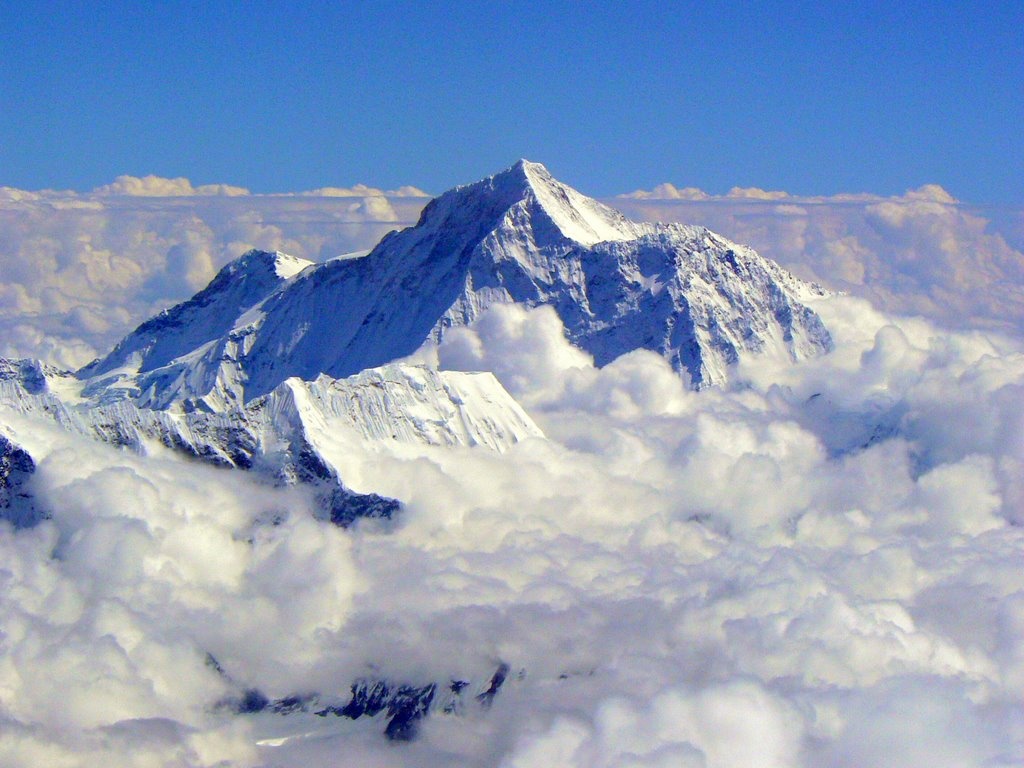
A Force That Could Push Mount Everest Around

A Force That Could Push Mount Everest Around

CNN has just announced that the recent magnitude 7.8 quake in Nepal moved Mount Everest to the southwest by 3 centimeters (1.2 inches). The story added, as an aside, that the height of the mountain is unchanged, just its location.

As Neil deGrasse Tyson once said, “If your ego starts out, ‘I am important, I am big, I am special,’ you’re in for some disappointments when you look around at what we’ve discovered about the universe. No, you’re not big. No, you’re not. You’re small in time and in space. And you have this frail vessel called the human body that’s limited on Earth.”

I am always shocked at man’s puniness, not only in the face of the universe, but just on his native planet.

Did you know, for existence, that perhaps the most powerful volcano on earth is Yellowstone National Park? (It is sometimes referred to as the Yellowstone Supervolcano.) Its caldera measures 35 by 45 miles. Three times it has erupted: 2.1 million, 1.3 million, and 640,000 years ago. Each time it substantially re-formed what is now the North American continent. Lest you feel smug, two huge magma chambers have been recently discovered in April. That doesn’t mean that Yellowstone will blow its top this year, or even in our lifetime and the lifetimes of our descendents, but when it does happen, it’ll be something to write home about, if home still exists.

There is a Buzzfeed site called 26 Pictures Will Make You Re-Evaluate Your Entire Existence. Before you decide to cut off your fellow motorist on the highway in your shiny new Porsche, perhaps you should meditate a while on it.


Down to Yellow Alert

Yes! It Looks Like Calbuco Won’t Interfere with My Trip

Yes! It Looks Like Calbuco Won’t Interfere with My Trip

I have been watching Sernageomin’s Reporta de Actividad Volcánica (RAV) on a daily basis. I have seen the warnings go from a Red Alert and a 20 km danger zone to an Orange Alert and finally a Yellow Alert. Even if Calbuco doesn’t emit so much as a puff of smoke in the next six months, the Servicio Nacional de Geología y Minería will likely not lower the alert to Green if only because the three eruptions of April 22, 24, and 30 were so spectacular as to keep the agency on its toes.

On May 9, I printed a vastly different chart showing the danger zone, the lava paths to the surrounding lakes, and the direction of wind-borne volcanic ash. My planned bus journey from Lago de Todos los Santos to Puerto Varas would have been blocked at several points by flowing lava; and both Ensenada and Petrohué had been evacuated.

As you can see from the most recent RAV chart for Calbuco (above), only parts of the Rio Frio and Rio Caliente are in any danger of pyroclastic flows; and ash is no longer coming from the caldera.

Chile is a somewhat tricky country to visit: It is not only one of the most active countries in the world due to its volcanic activity, but also due to devastating earthquakes. On May 22, 1960, Valdivia had a quake that tipped the Richter scale at 9.5. What with its associated tsunami, is is considered one of the strongest tremors in history.

So why do I want to go there? Certainly not to walk innocently into a disaster. Mountainous country is beautiful, but the taller the mountains, especially near the edge of a tectonic plate, the more Biblical are the disasters. You pay for beauty.


Shaky Town

The Aftermath of the 5.1 La HabraQuake

The Aftermath of the 5.1 La Habra Quake

In Citizens Band (CB) radio parlance, Los Angeles is called Shaky Town because of our earthquakes. It’s even in the C. W. McCall song “Convoy” that marked the apogee of the whole CB craze in the 1970s. (I suppose that’s marginally better than the truckers’ parlance for San Francisco: Gay Bay.)

We have been shaking often, but in a small way, ever since the quake swarm began a couple of weeks ago. The actual shaking was not great where we live, because we are some 25 miles from the epicenter, but there is always that sickening few seconds when you wonder whether the intensity is going to ramp up into something more devastating, like the 1971 Sylmar or 1994 Northridge catastrophes. But all that’s happened to me so far is that three or four books have fallen off their overcrowded shelves.

The activity has been along the La Puente Fault, which runs from downtown south and then east. I believe it’s the same fault that was in play for the 1987 Whittier Narrows quake, which I had the good fortune to miss because I was camping in New Mexico at the time. But because it touches downtown, the emergency officials are concerned it may knock down a skyscraper or two—maybe even City Hall.

There have been so many hundreds of aftershocks that I am beginning to think we dodged the bullet this time. When there are so many aftershocks, it’s unlikely any of them can be viewed as fore-shocks, or even five-shocks—or worse.


Tarnmoor’s ABCs: Earthquakes

Earthquake Fissure in Road

Earthquake Fissure in Road

I was very impressed by Czeslaw Milosz’s book Milosz’s ABC’s. There, in the form of a brief and alphabetically-ordered personal encyclopedia, was the story of the life of a Nobel Prize winning poet, of the people, places, and things that meant the most to him. Because his origins were so far away (Lithuania and Poland) and so long ago (1920s and 1930s), there were relatively few entries that resonated personally with me. Except it was sad to see so many fascinating people who, unknown today, died during the war under unknown circumstances.

This blog entry is my own humble attempt to imitate a writer whom I have read on and off for thirty years without having sated my curiosity. Consequently, over the next few months, you will see a number of postings under the rubric “Tarnmoor’s ABCs” that will attempt to do for my life what Milosz accomplished for his. I don’t guarantee that I will use up all 26 letters of the alphabet, but I’ll do my best.

If there is any natural phenomenon that frightens me, I would have to say it is earthquakes. During my years in Southern California, I have lived through two big ones: The Sylmar earthquake on February 9, 1971 (Richter 6.6) and the Northridge earthquake of January 17, 1994 (Richter 6.7).

On Friday, we had a small tremor centered on nearby Marina Del Rey. It was only a 3.2, but I acted as if it were just the start of a much bigger shake. Sitting in my library reading Proust, I dropped the book, jumped clear over the hassock and headed to the hallway just outside my bathroom to brace myself for what (perhaps) was to come. It didn’t. In the meantime, Martine peered around the corner and asked what was wrong. Did she feel the quake? Yes, but it was only a tiny one. But there I was, standing in the doorway with my heart racing, preparing myself for the worst.

The origins of my fear go back to 1994, when I used to sleep on an improvised futon in my living room. It was around 4:30 am when the earth began to shake in the darkness of the pre-dawn hours. Lights flashed whenever a nearby transformer exploded. Things were falling down from the walls and shelves, and some of them even rolled to where I was lying in terror as the sounds and smells and shaking had incapacitated me. What happened immediately after, I don’t recall because I actually lost my memory. All I know was that I was picked up by the police several hours later carrying two gallon jugs of purified water on Santa Monica Boulevard with blood flowing down my right leg.

Little by little, my terror subsided, only to be ramped up again with each aftershock. The damage caused by the quake was substantial: some nearby buildings were askew, and my kitchen had to be cleaned up with a shovel.

Ever since then, I do not go to bed without laying out all my clothes for the next day on a chair between the bedroom and the front door. Walking barefoot on broken glass and crockery is not a pleasant experience. So even now, a small temblor is capable of bringing back the terror, for however short a time.


The Man Who Chased Earthquakes

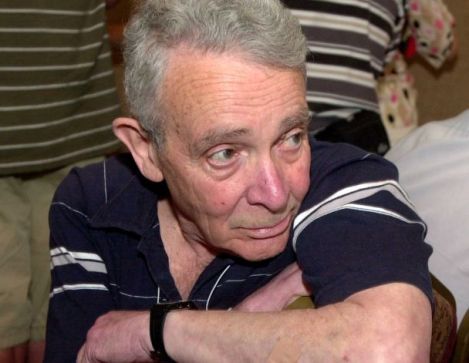
Vladimir Keilis-Borok (1921-2013)

Vladimir Keilis-Borok (1921-2013)

Last year, my neighbor Luis had knee surgery at St. John’s Hospital in Santa Monica. Because he is in his eighties and lives by himself, he spent several days recuperating at a nursing care facility across the street from the hospital. His roommate turned out to be a famous Russian scientist by the name of Vladimir Keilis-Borok, whose life work was trying to find a way of predicting earthquakes using mathematical data culled from data about faults and previous tremors.

Martine and I had seen Vladimir only twice during our visits to Luis and found him to be brilliant and engaging. He spent much of his time at the nursing facility working on mathematical models on his laptop computer. During one of my visits, he asked if I could recommend someone to help him with his computerwork. I immediately thought of my friend Mikhail, who spoke Russian and knew many computer people in L.A.’s Russian community. Somehow, it never went anywhere. Perhaps the funding just wasn’t there.

I was saddened to see that the Russian scientist passed away last week. A glowing obituary appeared in the Los Angeles Times commemorating his accomplishments and his pursuit of that Holy Grail of earthquake prediction. If somehow someone could put it all together, his work could be responsible for saving the lives of untold millions of people who, like myself, live near major fault zones.