
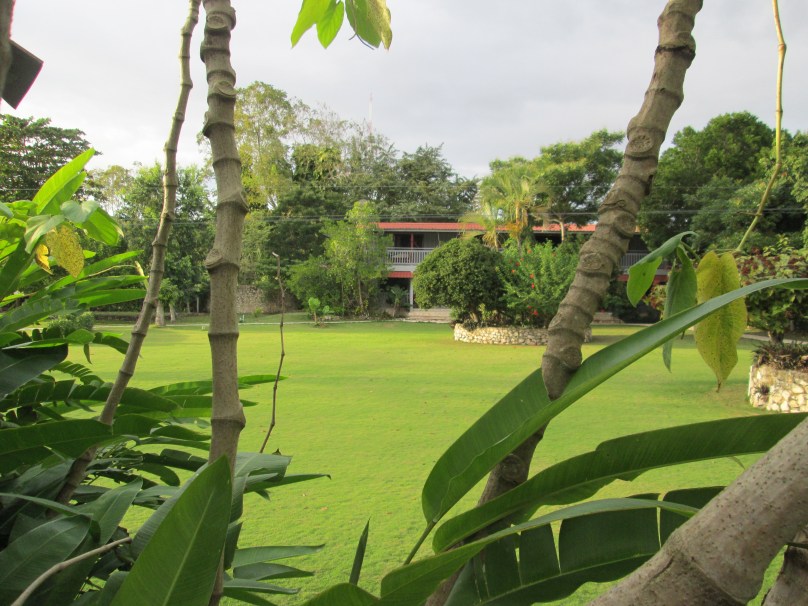
Gringo Perdido

La Casa de Don David in El Remate, Guatemala

I couldn’t find the owner’s last name on the Internet. His first name I know, however: It’s David. Supposedly, in 1974 he founded a hotel called the Gringo Perdido, “The Lost Gringo.” At some point, he sold it to its present Guatemalan owners and opened La Casa de Don David, much closer to the intersection with the road to the Maya ruins at Tikal.

If you want to visit Tikal, you can stay just outside the ruins, or hang out with the tourist throngs on the island of Flores. My choice was the village of El Remate, roughly midway between Flores with its airport and the ruins at Tikal. And what a choice it was! My 2019 stay was restful and in every way delightful. The Casa was on the eastern shore of the Lago Petén Itza, the site of the final defeat of the Maya to the Spanish conquistadors in 1697, over a century after Cortés defeated the Aztecs several hundred miles to the north.

Here is the front of the informational handout I received in 2019:
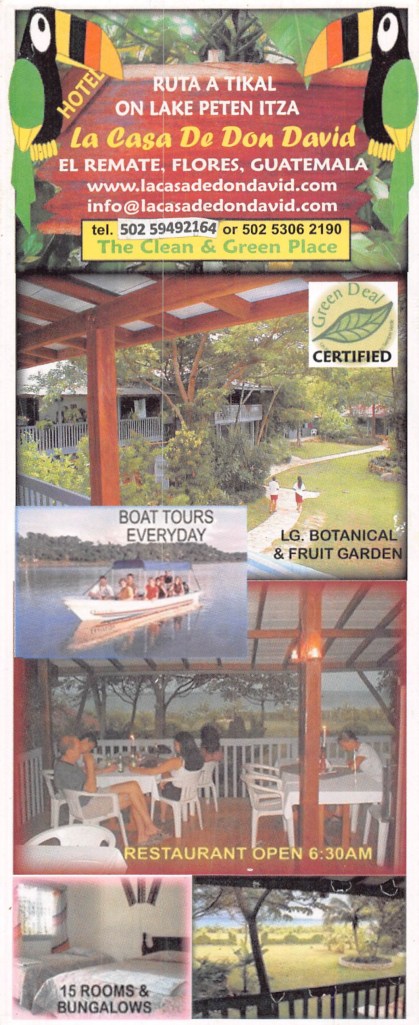
The website listed is still current, in both Spanish and English.

I spent a couple hours talking with David and liked him and his hotel immensely. In fact, I hired a guide to the ruins through the hotel who was extremely knowledgeable.

One of the things I hate about a hotel when I’m traveling is a party atmosphere. I don’t mind conviviality, but it seems that the majority of American travelers particularly travel to get drunk. Me, I like places that are restful and quiet. It helped that the food was excellent and the owner and staff friendly and helpful. If I were to return to Tikal (next time I’d like to access it through Belize, some 25 miles (40 kilometers) to the east.

Tikal

Temple 1 at Tikal in the Petén Region of Guatemala

I had always wanted to visit Tikal. In the 1980s, when I visited Yucatán several times, I wanted to swing south through Belize to the ruinsat Tikal. Unfortunately, a murderous religious madman named Efraín Ríos Montt was in charge at the time; and the State Department was recommending that American tourists stay well away from the massacres and disappearances that were plaguing Guatemala at the time.

Tikal is huge, 575 square kilometers (222 square miles) in area. It almost defined the Classic Period of Mayan archeology, from approximately 200 AD to 800 AD at its height. The area in which it is located is a monkey jungle, pure and simple. With my hared of mosquitoes, I am thinking of spending three nights in nearby El Remate, where the hotels have electricity 24 hours a day, and not just sometimes. If there is air conditioning, or at the very least a functioning ceiling fan, one can escape being bitten to death and coming home with Zika or Malaria or Dengue, to name just a few baddies.

The Shores of Lago de Petén at El Remate

Although Guatemala is not a large country by North American standards, the road from Guatemala City to El Remate takes twelve hours or more on good roads. One has to go all the way to the Atlantic Coast before cutting north. There is a little matter of some high mountains preventing a direct route. If I took the mountain route, it would take at least twenty hours and several buses. I am actually thinking of flying from Guatemala City to Flores, which is within a few miles of El Remate. (I could stay in Flores, for that matter, but if I wanted to spend two days at the ruins, I want to be a bit closer to Tikal.)

There are sunrise and sunset tours at Tikal, but I don’t want to lose sleep just so I can gamble on a perfect sunrise or sunset. I’m willing to take pot luck.