“A Hundred Windows Opened on All Sides of the Head”

Old Building on Buckeye Road

Old Building on Buckeye Road

This morning, I started reading G. K. Chesterton’s Autobiography, and it set me to thinking. I thought it would be fun to put all my earliest memories in one place, lest I forget. Chesterton had it right:

What was wonderful about childhood is that anything in it was a wonder. It was not merely a world full of miracles; it was a miraculous world. What gives me this shock is almost anything I really recall; not the things I should think most worth recalling. This is where it differs from the other great thrill of the past, all that is connected with first love and the romantic passion; for that, though equally poignant, comes always to a point; and it is narrow like a rapier piercing the heart, whereas the other was more like a hundred windows opened on all sides of the head.

I was born in a house on East 177th Street, a few houses north of Glendale. Because we moved shortly after I was born, all my earliest memories are tied up with 2814 East 120th Street, just off Buckeye Road. We lived on the second floor of a duplex. I remember lying in my crib. One of my first memories was of an argument between my mother and father about money. Both were working, my father at Lees Bradner & Company, my mother at the Cleveland Woolen Mill.

Like most toddlers, I was fairly rambunctious. Mrs. Nebehaj kept shouting from her first floor rooms, “Missus, the ceiling is coming down!”

From a very early age, I was cared for by my great grandmother Lidia and great grandfather Daniel. As Daniel died when I was one, I do not remember him. I was always told he wanted to live long enough for me to buy pipe tobacco for him at the grocery store on Buckeye Road. It was not to be.

My oldest friend was Joyce. Now for the sex: I was fixated on the crook of her knees, which to me was smooth and lovely. There wasn’t too much I could do about it, but I remembered it nonetheless. Once, when I was playing with her, I lost control of my bladder, and the pee ran down my leg. My landlord saw me and asked why I was dripping. I said I stepped in a bucket of water, and it was running down my leg. Was that my first lie?

On Buckeye Road, near East 120th, there was a ramshackle old building that sold furnace pipes and such like. I remember playing in the small yard that fronted the building. There were a number of tree stumps on which I could play with my toy soldiers.

Of course, everybody spoke Hungarian. So did I. It was almost a 100% Hungarian neighborhood, and we didn’t have a television set until 1949. Broadcasting would begin around 4:00 PM with the Kate Smith Hour, followed by the Howdy Doody Show, which I watched religiously.

Once, I remember going with my father to pick up Mom at the Woolen Mill, and there was a big fire in a nearby building.

My life changed when I attended kindergarten beginning in January 1950. Trouble emerged at once when my teacher, Mrs. Idell, refused to understand my Hungarian. My friend András, who was similarly afflicted, and I began kicking her shins. Also, my brother was born in April 1951. It was time to move, and that signaled a new epoch in my life.

Berezina in a Dish

My Least Favorite Hungarian Food

My Least Favorite Hungarian Food

Whenever my mother made it, I always ran out of the house and stayed away until the smell dissipated. What made things difficult is that she always made kocsonya (pronounced KOH-chone-yah) in the winter. As my Uncle Emil used to say, he couldn’t eat any unless there was snow on the ground. I did him one better: I couldn’t eat kocsonya if there was any in the Western Hemisphere.

I’ve always said that a serving of the noxious stuff reminded me of a frozen river with mangled human and animal remains—very like the Berezina River in Belarus where Napoleon lost thousands of his remaining forces after retreating from Moscow.

Apparently there’s a Russian equivalent. In a short story entitled “Aspic,” Tatyana Tolstoya describes cooking up a batch very like the recipe I’m describing:

Now it’s boiling, raging. Now the surface is coated with gray, dirty ripples: all that’s bad, all that’s weighty, all that’s fearful, all that suffered, darted, and tried to break loose, oinked and mooed, couldn’t understand, resisted, and gasped for breath—all of it turns to muck. All the pain and death are gone, congealed into repugnant fluffy felt. Finito. Placidity, forgiveness.

Kind of makes vegetarianism attractive, no? And that’s about all I could say without retching….


A Hungarian Peasant Dish

Hungarian Káposztas Tészta, or Cabbage Noodles

Hungarian Káposztas Tészta, or Cabbage Noodles

One of my favorite dishes as a child was Hungarian Káposztas Tészta, or Cabbage Noodles, which was both cheap and good. The recipe below is taken from 2009 posting to Blog.Com describing the way I prepared it for a Hungarian Meet-Up Group potluck:

Take one head of cabbage, grate it as finely as possible. Deposit it into a large mixing bowl and salt liberally. Then cover it with a clean dish towel and come back a half hour later. You will find that the salt draws the water out of the cabbage. Pick up handfuls of the cabbage, squeeze the salt water out of it over the sink, and place in a colander. Then squeeze it hard again.

Now it’s time to get a large saucepan and melt some unsalted butter in it and add an equal amount of olive oil. (The old Hungarians used bacon fat, but butter and vegetable oil is just as good and better for you.) Sauté the cabbage and keep stirring for upwards of an hour, until the cabbage starts to get a little brown around the edges. Don’t leave the cabbage to burn: You have to attend to it fairly closely.

Around this time, start boiling water for egg noodles. My mother used to make her own, cutting them into three-quarter-inch squares that were perfect. But prepackaged noodles are almost as good. Drain the cooked noodles and add to the cabbage. I used my Chinese iron wok to mix the two together. While turning the mix around, I added salt and freshly ground pepper to taste.

Simple and good.

All-American Glop

Burger Heaven, American Style

Burger Heaven, American Style

One of the advantages of my having a Hungarian upbringing is that it allows me to cast a critical eye on what most Americans would consider good eating. Take, for example, the hamburger. One starts with a plain piece of ground meat, chars it, and adds an inch or two of cheese, lettuce, tomatoes, onions (either raw or caramelized), mayonnaise, ketchup, mushrooms, and God knows what. The result is a concoction that will likely contribute more to staining your shirtfront than satisfying your hunger.

Hungarians prefer to season the meat itself rather than topping it off with a salad. My mother used to mince (not chop!) onions, garlic, and parsley and work it gently in with the ground beef (which itself could be mixed with bits of ground pork or veal). Take a look, for example, at this recipe for fasirt, a kind of Magyar fried hamburger. Whether fried or charbroiled, the Hungarian hamburger would usually be served between two pieces of rye bread, cheese optional. It had flavor. And if we wanted vegetables, they would be there on the plate, fresh from our garden, rather than piled high over the meat patty.

The same goes for meatballs. If you get matballs and spaghetti in an Italian-American restaurant, the meatballs will usually be plain meat. Our late landlady made her meatballs the Old Country way, buy adding seasonings to the meat before cooking it.

It’s a simple technique, perhaps a little time-consuming, but it tastes ever so much better than the plain unadorned ground meat.


Majális

Celebrating May Day and Mothers’ Day Together

Celebrating May Day and Mothers’ Day Together

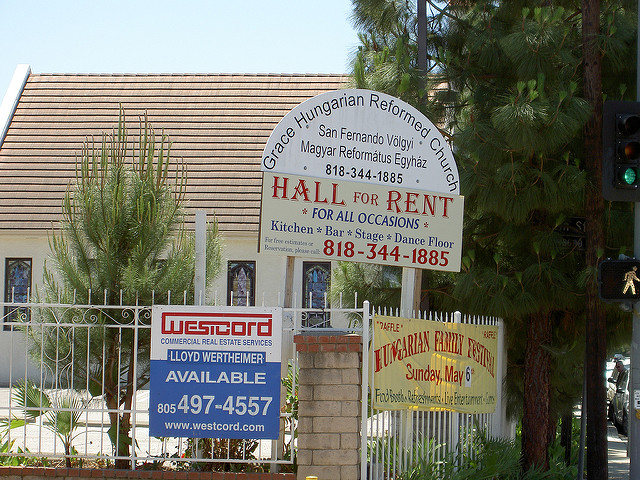
On the first Sunday in May, the Grace Hungarian Reformed Church in Tarzana celebrates May Day and Mothers’ Day together. Although we are not members of the church, we regularly show up for some good Hungarian home cooking and some cute children’s singing and recitations.

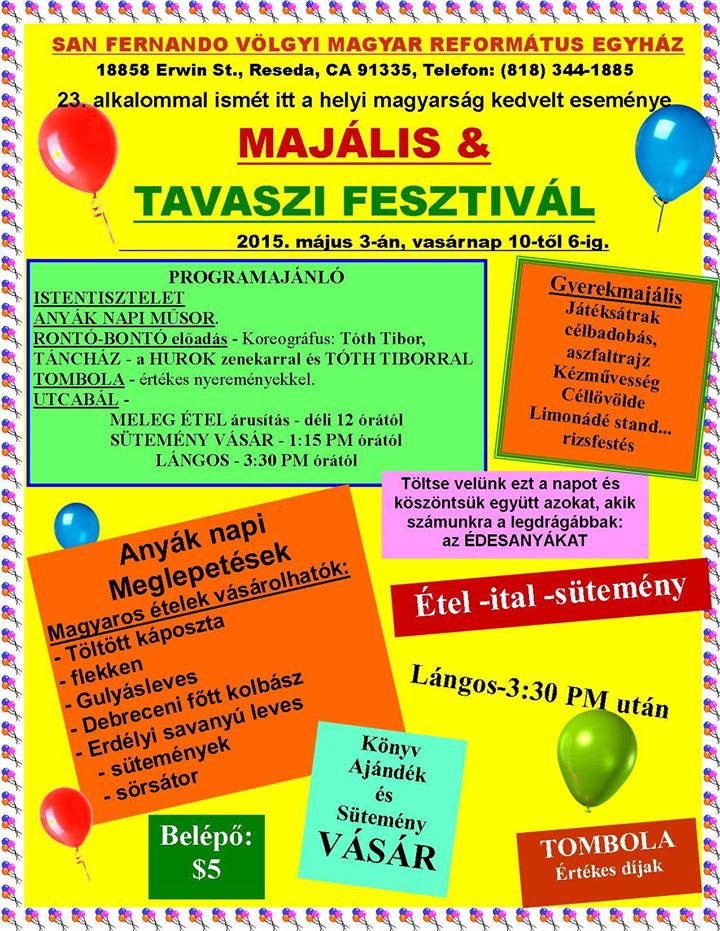
Available were not only the world-class Magyar pastries, including ground walnut rolls and a lethal type of cream pastry called crémes (pronounced CRAY-mesh), but two kinds of soups—including Hungarian goulash—sausages, flekken, and assorted beverages. You can see the menu in Hungarian below:

Program (and Menu) for the Fesztivál

Program (and Menu) for the Fesztivál

The only unfortunate event is that, toward the middle of he afternoon, I saw one elderly lady trip over a concrete parking stop and break her right shoulder. She was scared and didn’t know what to do, but one of the parishioners drove her to a the hospital. It was eerie actually seeing the same sort of thing that happened to me happen to someone else. Except that I was in the company of a friend who is a nurse for the county and who knew exactly what to do. It’s no picnic, especially at her advanced age.


“The Lark Sings for Itself and God”

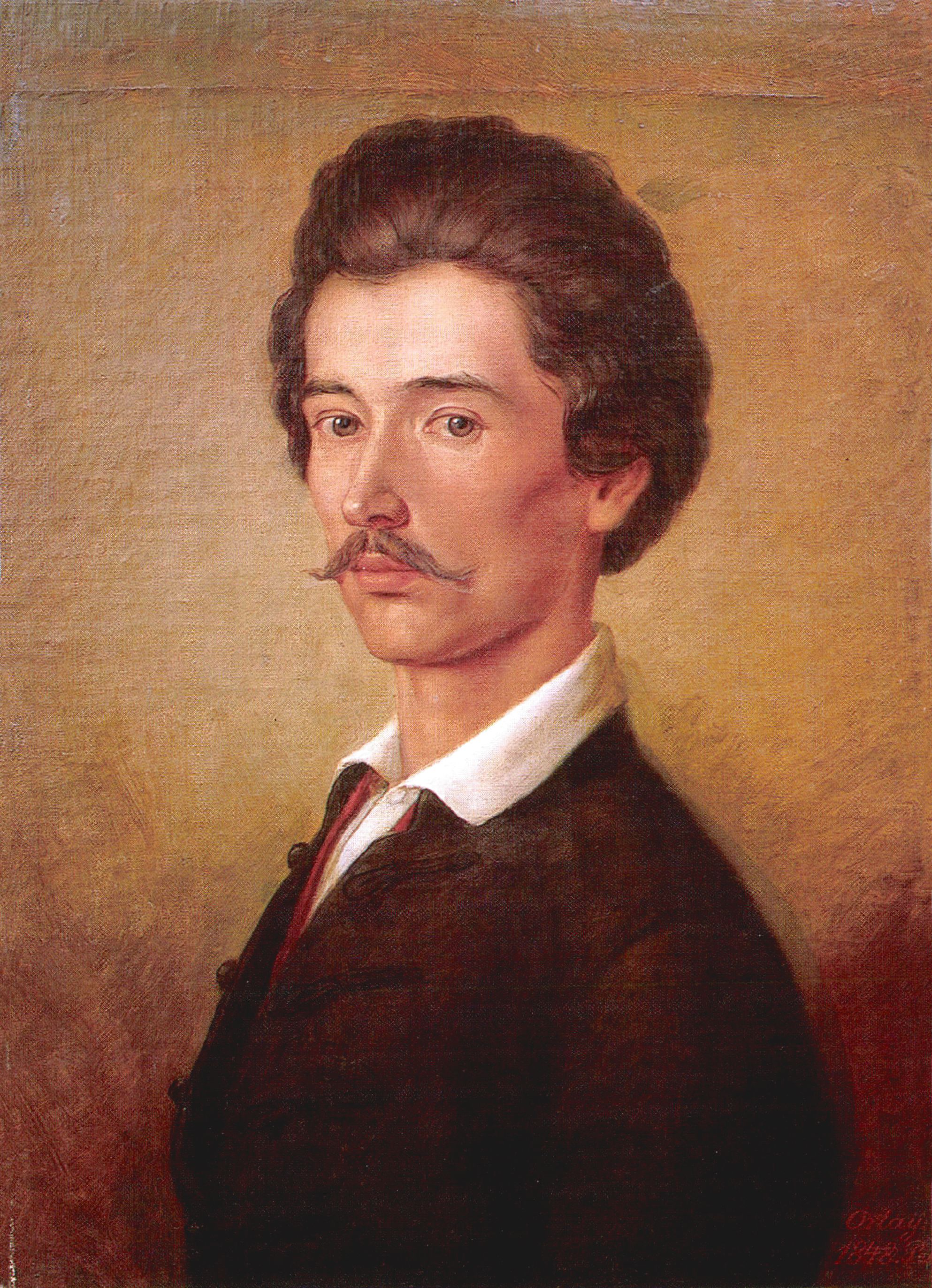
Hungary’s National Poet, Sándor Petofi (1823-1849)

Hungary’s National Poet, Sándor Petőfi (1823-1849)

Now that I am able to spell Hungarian words correctly, I will try to write more blogs about my exploration of my heritage. Today, we have a poem by Sándor Petőfi who died at the Battle of Segesvár during the 1848 Revolution against Austrian rule, where he was shot by Russian troops allied with the Austrians.

Why Are You Still Singing Gentle Bards? (Mit Daltoltok Még ti, Jámbor Költők)

Why are you still singing gentle bards,
in times like these what good is the song?
The world can hardly hear your words,
the noise of war drones on and on.

Lay down your lute, wholesome boys,
your beautiful music falls too flat.
Even the lark’s melodious voice
disappears amid thunderous claps.

Or maybe not. Birds don’t really care
if down here they are even heard?
In the vast blueness of their air,
the lark sings for itself and god.

When sorrow or joy touches our hearts
songs fly from us so naturally,
and sail on the waves of a steady wind
like the tattered leaves of a rosewood tree.

So let us sing lads, like we used to,
but even louder, so our lutes will vie
with the clamor of a disturbed earth,
and add a note or two to the clearing sky.

Half the world in rubble … a bleak vision
and though it troubles our hearts and heads
let our souls descend on these harsh ruins,
and our songs like ivy gently spread.

At home, I have Petőfi’s complete poetic works in a volume I purchased in Budapest, when I was there in 1977. The above poem was translated by Arlo Voorhees and is one of several that appears at Pilvax Online Magazine. I may also in future add some translations of my own.

Looking East

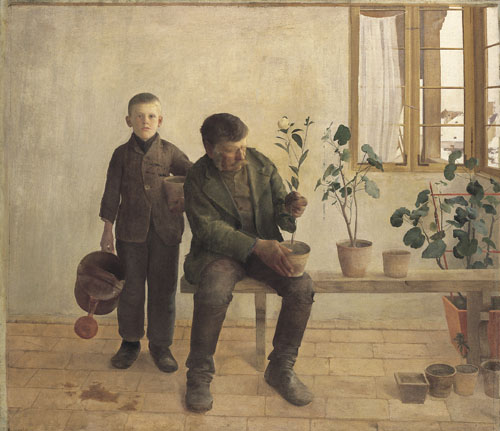
Károly Ferenczy’s “The Gardeners”

Károly Ferenczy’s “The Gardeners”

I know next to nothing about academic Hungarian art, but I would like to know more. Today I searched the website of the Hungarian National Gallery looking for paintings that caught my eye. The one above looks like a typical folk subject, a gardener and his son. The gardener works at potting what looks like a yellow rose while his son holds an empty pot and a watering can while blankly staring into the distance.

From my childhood, I know a bit about popular art, which consists of all sorts of peasant scenes, with picturesque cottages, rustic wells, and galloping Magyar cowboys (we called them csikosok). We had one such reproduction in our living room which actually scared me. If one stared at the shadows of branches and leaves against the wall of the cottage, it looked like a sinister face with a hand raised threateningly.

Here is another work that caught my eye:

Jenö Gyárfás’s “Youth and Age”

Jenö Gyárfás’s “Youth and Age”

From time to time I will return to this subject, hopefully becoming a little more learned in the process.

You Won’t Roue the Day …

The Base for All Great Hungarian Soups

The Base for All Great Hungarian Soups

In response to a request from my friend Lynette, I’m going to tell you all about what makes for a great Hungarian soup—and probably most great vegetable and meat soups as well. The secret is rántás, the Magyar equivalent of roue. Let’s begin with the ingredients, with the amounts for a week’s worth of soup for two (Martine and I like home-made soups):

  • 1 oz unsalted butter
  • 1 oz olive oil (need not be virgin: I prefer olive oil that’s been around, if you know what I mean)
  • 3 tbsps white flour
  • 1/2 minced onion (minced means chopped up real tiny)
  • 1/2 bunch minced parsley (again: go to town with your knife here)
  • 2 tbsps real Hungarian Szegedi paprika (not Spanish paprika!)

Heat the butter and oil in a saucepan until it melts, stirring well. Give it a minute or two before adding the white flour. Stir until the flour turns brown. Add the onion and parsley and finally the paprika. When your rántás is done, scoop it into your soup toureen and start adding the other good stuff.

Note that the photo above is your rántás after the first three ingredients only. In time, you will adjust the ingredients to more accurately accord with your taste buds.

You can sometimes find good Hungarian paprika in supermarkets, but I wouldn’t bet on it. I get mine from Otto’s Hungarian Import Store in Burbank, and I prefer this variety, the Imported Szegedi Hungarian Paprika. When you get your paprika, keep it in the refrigerator: bugs love it too much.


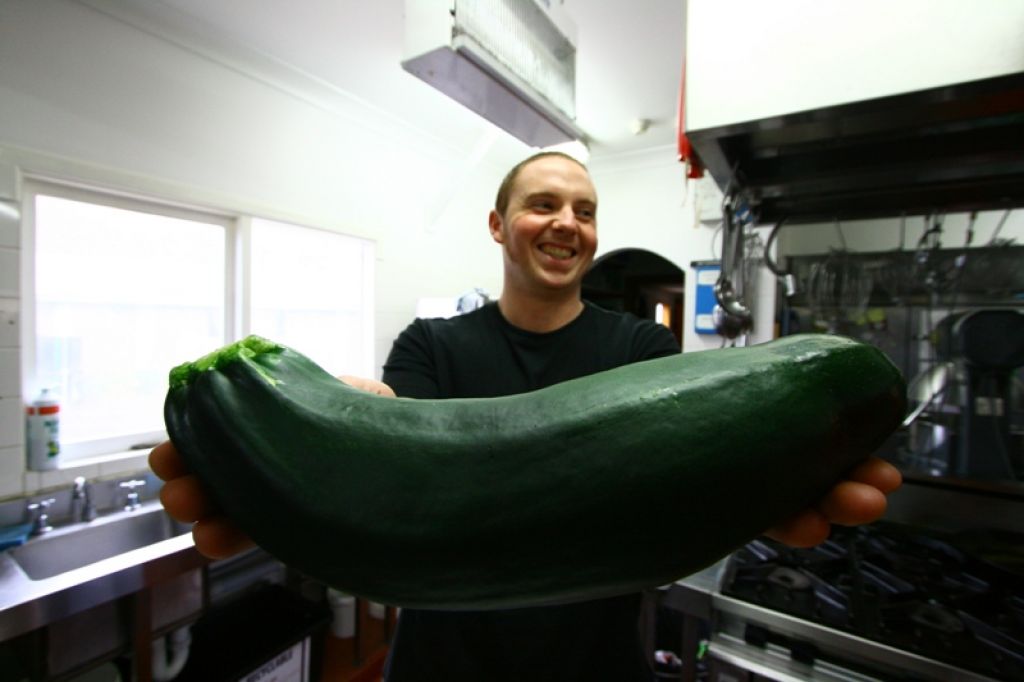
Doohickeys

This Does Not Look Like Standard English

This Does Not Look Like Standard English, Does It?

Rick Steves refers to them as “little doo-hickeys over some letters that affect pronunciation.” I call them diacritical marks, a sure sign that you are dealing with a foreign language. Sometimes you find them in English in words such as rôle, coöperate, or façade.Then you might think, “Gosh but this is old-fashioned!”

More than just doohickeys, diacritical marks are extensions of other countries’ alphabets. A couple weeks ago, I wrote a posting entitled “Dysinventions”, mostly of my dislike of touchscreen keyboards. In the post, I wrote:

I feel bad enough that there are some Eastern European diacritical marks I can’t use, such as an anacrusis or the Hungarian double-acute-accent over the “o” and “u” to indicate an extended vowel sound. In time, I will figure this out. But not on one of those touchscreen keyboards. I can imagine it would be gruelling just to type an average paragraph shifting between upper and lower case letters and numbers, let alone diacritical marks.

If I can’t make it look as if it were typeset, I would just as soon forget the whole thing. It just wouldn’t be me.

Well, I finally did figure it out. There is a great Internet resource called Typeit.Org which enables me to quote directly from twenty-six different character sets, including: Currencies, Czech, Danish, Dutch, Esperanto, Finnish, French, German, Greek, Icelandic, thye International Phonetic Alphabet (IPA) for English, the full IPA, Italian, Maori, Math, Norwegian, Polish, Portuguese, Romanian, Russian, Spanish, Symbols, Swedish, Turkish, and finally Welsh.

Now there is nothing I cannot type with my keyboard in any of the above configurations. Just so that I can control the type font, there is one additional step: I paste the text into Microsoft’s Notebook, which strips out Typeit’s default font information, and then copy and paste the result into WordPress.

At long last, I feel confident that I can print in Hungarian without misspelling such passages as:

Bár külön beállítási opció nincsen rá, egy egyszerű szintaxis használatával lehetséges a régi szótárból ismert teljes egyezésre, bármilyen egyezésre, vagy akár szó végére is keresni.

Note in particular that word egyszerű with its doubly accented “u”.

Please don’t worry that I’ll go crazy with this new tool. After all, nem akarom, hogy ellenátkok. (“I don’t want to befuddle you.”)


The Deal

Dancers from Karpatok

Dancers from Karpatok

The deal was made at some point before I was born. Because my father was a Roman Catholic Slovak and my mother was a Protestant adhering to the Calvinist Hungarian Reformed Church, my parents decided that any boys in the family were going to be Catholic and any girls, Protestant. As it happened, there were two boys born to Alex and Sophie Paris, my brother and I.

We were a religiously tolerant family: My father (occasionally) went to Mass, and my mother (occasionally) listened to the Reverend Csutoros’s weekly radio program and his sonorous sermons.

So what am I today? In Peru, I was a Catholic. Here in Los Angeles, I am evenly torn between the Hungarian Reformed Church—in honor of my mother—and the Greek Orthodox Church. Wherever I go, I find God.

Today, Martine and I attended the church fall bazaar at the First Hungarian Reformed Church of Los Angeles in nearby Hawthorne. We had some good Magyar home cooking, renewed our friendship with several families active in the church, and listened to the usual excellent program of music and dance. Present were members of the Karpatok Hungarian Dance Ensemble (shown above) who put on the usual spirited performance.

It is good to be a Hungarian from time to time, to speak the language of my youth with some good people and share a few hours with them.