Some Icelandic Humor

The Juck Is on You!

The Juck Is on You!

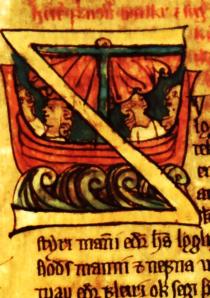
I have become a fan of Jóhannes Benediktsson of the Iceland Review staff. The following text and illustrations are from an article in the Review’s “Daily Life” section on February 13 earlier this year entitled “An Urgent Message from the Lighthouse Bureau”. We begin with the text accompanying the above illustration:

Yuck!  Yuck!  Yuck!

What is YUCK?
You talk like an ignorant woman.
Try YUCK!
YUCK is world class quality.
YUCK is available everywhere.

International Yuck Co. Ldt.

oldad_advorun

Warning.

There is a large hole in the road next to Pétursborg. Should anyone stick a foot in, he or she could be badly hurt. For that reason, I advise all to proceed with caution, except for the Bureau of Public Roads.

oldad_blauturthvotturIt was wet laundry that Húlli and Ási carried in that tub down Bergstaðastræti on Monday the 14th of September 1924, at 6 o’clock.

oldad_frautlondum

From abroad

there are no particular news. The Germans don’t seem to be up to very much at Verdun, but they probably have some trickery up their sleeves, be it on land or sea. Only some minor skirmishes between the Austrians and the Italians. The Russians claim to be launching an attack on the Germans in the near future. No news of the conflict in Turkey.

Mexican bandits have caused damage in the United States. Some insist that the government send the army to Mexico to disperse their posse. As of yet, it remains unclear what will happen.

oldad_tolud_ord_tekin_aftur

Spoken Words Rescinded

I wish to make it known to all that the words spoken by me in inebriety and carelessness to Ms. Sigríður Þórðarsen of Akureyri on the 16th of this month are hereby declared null and void.

Randver Pétursson.

oldad_vitamalastjori

An announcement from the Lighthouse Bureau Commissioner: – There is no announcement from the Lighthouse Bureau Commissioner today.

Commissioner of the Lighthouse Bureau.


New Land

Islands Seen from Storhofdi Peninsula on Heimaey

Islands Seen from Storhofdi Peninsula on Heimaey

Geologically speaking, the Westmann Islands south of Iceland are brand spanking new. The most recent island in the group, Surtsey, suddenly rose up from the sea during a volcanic eruption in November 1963. Even fifty years later, access to the island is restricted to scientists and naturalists. Even Heimaey, the “Home Island” of the group, was enlarged by the world’s youngest volcano, Eldfell, which came into existence in January 1973, forcing the evacuation of the island.

As the result of a miraculous save by the Icelanders, who pumped cold seawater on the advancing lava forcing it to form an ever-higher berm that prevented the town from being more than one-third inundated. (The story is ably told by John McPhee in his book The Control of Nature.) On the other hand, two square kilometers of new land were created on the east side of the island.

The only fatality from Eldfell was a druggie who broke into an apothecary and was overcome by the fumes.

I will be spending three days and two nights on Heimaey in June. I plan to visit the Storhofdi Peninsula and photograph the puffins that congregate on the cliffs there.


Sumardagarinn Fyrsti

In Iceland, This Is the First Day of Summer

In Iceland, This Is the First Day of Summer

If you can find a place in Iceland that looks like this, let me tell you, my friend, you are not in Iceland. In today’s Iceland Review, there was a brief article about today’s being the first day of summer, or, in Icelandic, Sumardagarinn fyrsti. This holiday falls annually on the first Thursday following April 18 and is a bank holiday throughout the island. The article continues:

According to the science website of the University of Iceland, the first day of summer was also considered the first day of the year, which is why people used to count their ages, and their animals’ ages, in winters rather than years.

It was common to distribute summer gifts on Sumardagurinn fyrsti, four centuries before Christmas presents became a tradition, and the summer gift tradition is still practiced in some households. People celebrated with a feast, often finer than on Christmas Eve.

Farmers took a break from their hard work and children were allowed to play with their friends from the neighboring farms. The day was dedicated to young women and to children (it’s also known as Children’s Day). On this day young men would often reveal whom they fancied.

Another tradition on the First Day of Summer, called húslestur, involved people getting together and listening to readings from the Icelandic sagas, poems or other literature.

If the weather was summery, farmers would let their cattle and rams out, to allow the animals to greet summer, and to also entertain themselves by watching the animals play.

People used to go to mass on Sumardagurinn fyrsti until the mid-18th century when the inspectors of the Danish church authority discovered that mass was being held on this heathen day and banned the practice.

According to legend, people considered it a good sign if summer and winter ‘froze together’ (if there was frost on the last night before summer).

People would put a bowl filled with water outside to check whether it had frozen in the early hours of the next morning, before the morning sun could melt it. If the water had frozen, the summer would be a good one.

As I prepare for my vacation in Iceland, little stories like this help motivate me to learn even more about where I’m going. The idea of spending New Years Day reading sagas, poetry, and other great literature out loud is a welcome change from watching bowl games and merging with one’s inner couch.

Dribbling Dritskers and Elf-Frighteners

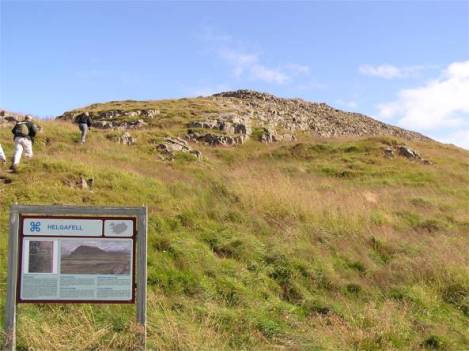
The Hill of Helgafell Just South of Stykkisholmur

The Hill of Helgafell Just South of Stykkishólmur

The old Vikings had a word for it. I learned about it last night as I was reading the thirteenth century Saga of the People of Eyri (also known as the Eyrbyggja Saga).In it, we learn about Thorolf Moster-Beard who dedicated a temple to his namesake god, Thor, atop Helgafell, a smallish hill near his farm at Thorsnes (now called Stykkishólmur) along the south shore of Breidafjórd. Let’s use the words of the skald who wrote the saga:

He named this mountain Helgafell and believed that he and all his family on the headland would go there when they died. At the place where Thor had come ashore, on the point of the headland, Thorolf held all court sessions and he established a district assembly there. He considered the ground there so sacred that he would not allow it to be defiled in any way, either by blood spilt in rage, or by anybody doing their elf-frighteners there—there was a skerry [small rocky islet] named Dritsker (Shit-Skerry) for that purpose.

Now this is a longish lead-in to the point I am trying to make, which is that television and the other news media are so full of people saying such ridiculous things leading variously to outrage (on the part of all right-thinking people) or pride (on the part of American Conservative wing-nuts). I am referring to people such as Wayne LaPierre; the “Reverend” Pat Robertson; Ted Nugent; Senators Lindsay Graham of South Carolina, Jim Imhofe of Oklahoma, and Rand Paul of Kentucky; Michele Bachmann; Sarah Palin; and Rush Limbaugh. Whenever they move their lips, all that comes out are various shapes and scents of dritskers and elf-frighteners.

Perhaps there should be a skerry someplace to which they can all be transported and where they can practice their creativity without scaring the dogs and children.

If you want to see more pictures of the area around Helgafell, where I will be visiting this June, check out The Magic of Iceland, from where I hijacked the above pic, which is actually one of the least interesting of the bunch.

Iceland’s Bell

A Long Review of Halldór Laxness’s Great Novel

A Long Review of Halldór Laxness’s Great Novel

The following is a review I published on Goodreads.Com yesterday:

There are several Icelands in history. Best known is the Iceland of the Vikings, roughly from the time of settlement in the 9th century to the transfer of the country to the Norwegian King Haakon in the 13th century. Then we skip the better part of a millennium to come to the hip modern Iceland, land of the runtur and of bankruptcy.

In between those two extremes was the Iceland of poverty and servitude. The Danes took over Iceland from the Norwegians and installed their merchants, gifting them with monopolies that made the merchants wealthy, but impoverished the natives. Halldór Laxness, the country’s only winner of the Nobel Prize for Literature (in 1955), wrote Iceland’s Bell to remind his countrymen of the utter waste and fecklessness of the Danish rule. (This theme is similar to the same author’s World Light, which is set in a later period.)

Iceland’s Bell is set early in the 18th century and is presented in three acts, each with a different hero. We begin with Jon Hreggvidsson of Skagi, who is arrested for stealing a length of cord. (Apparently, the Danes, not needing fish themselves, deliberately made it harder for the Icelanders to feed themselves with the piscine riches of their island.) Things go from bad to worse for Jon, who is then arrested for murdering the hangman who whipped him for his crime. But he is let loose on the night before his hanging by …

Snæfriður Bjornsdóttir, daughter of the magistrate who sentences Hreggviðsson, is a young beauty whose hand in marriage is sought by Icelanders of the best families. Unfortunately, the fair maiden weds a drunk, though really she loves the Icelander Arnas Arnaeus, a thinly disguised portrait of Arni Magnusson, famous for collecting texts of the old Icelandic sagas and advising the Danish king how to control his subjects.

Arnaeus is a patriot of sorts, but an unfaithful suitor to Snæfriður. His belief is that the texts which he has collected, and which are almost burned in a massive fire in Copenhagen, are the source of his people’s pride and fame. It is Arnaeus who says, “A fat servant is not much of a man. A beaten servant is a great man, because in his breast freedom has its home.” On another occasion, he says, “I regret nothing that has happened, neither in words nor thoughts. It may be that the most victorious race is the one that is exterminated.”

And under Danish rule, Iceland did come close on several occasions to being utterly annihilated, from plague and smallpox; from the volcanic eruption at Lakagigur in the 1780s that led to an even more vicious plague; and starvation.

Laxness is not only a great Icelandic and Scandinavian author: He is perhaps one of the very best novelists of the Twentieth Century—period! His love for Iceland and its sad plight shows itself frequently throughout the book:

Over verdant lowlands cut by the deep streamwaters of the south hangs a peculiar gloom. Every eye is stifled by clouds that block the sight of the sun, every voice is muffled like the chirps of fleeing birds, every quasi-movement sluggish. Children must not laugh, no attention must be drawn to the fact that a man exists, one must not provoke the powers with frivolity — do nothing but prowl along, furtively, lowly. Maybe the Godhead had not yet struck its final blow, an unexpiated sin might still fester somewhere, perhaps there still lurked worms that needed to be crushed.

I have now read all but three novels by Laxness that have been translated into English. I intend to read them all, and to hope against hope that the novelist’s other work finds a translator.

The Source of the Greatest Song

Icelandic Nobelist Halldór Laxness (1902-1998)

Icelandic Nobelist Halldór Kiljan Laxness (1902-1998)

He lived through a broad swath of the Twentieth Century, won the Nobel Prize for Literature in 1955, yet is mostly unknown outside his little country. I have read most of his novels now, and will probably finish Iceland’s Bell by Thursday. There are many of his contemporaries with inflated reputations: There are few who are more deserving of all the praise the world can bestow upon them.

Reading his work, one is often startled by the insight of Halldór Laxness, as in the following quote:

This was the first time that he has ever looked into the labyrinth of the human soul. He was very far from understanding what he saw. But what was of more value, he felt and suffered with her. In years that were yet to come, he relived this memory in song, in the most beautiful song this world has known. For the understanding of the soul’s defencelessness, of the conflict between the two poles, is not the source of the greatest song. The source of the greatest song is sympathy.

He has written many novels, stories, poems, plays, and essays; but only the following are available in English translation:

  • The Great Weaver from Kashmir (1927)
  • Salka Valka (1931-32)—long out of print
  • Independent People (1934-35)—probably his most famous work.
  • World Light (1937-39)
  • Iceland’s Bell (1943-46)
  • The Atom Station (1948)
  • The Fish Can Sing (1957)
  • Paradise Reclaimed (1960)
  • Under the Glacier (1968)

The only ones I have not read are the first two and the last one. I would rate Independent People, World Light, and Iceland’s Bell as his best works—though all are worth reading.

The Laxness Novel I Am Now Reading

The Laxness Novel I Am Now Reading

I have always been amazed by relatively small countries that have produced great writers—people like Augusto Roa Bastos of Paraguay, Czeslaw Milosz of Lithuania, Ivo Andric of Bosnia, V. S. Naipaul of Trinidad, Gyula Krúdy of Hungary, and Franz Kafka of Czechoslovakia. But smaller than the smallest of the above is Iceland, with only 300,000 or so people.

Sometimes big things can indeed come in small packages.


The Last Time I Saw Hvolsvöllur

The Mountains Around the Markarfljót Valley

The Mountains Around the Markarfljót Valley

It was around the end of my 2001 trip to Iceland, one of the first days in the month of September. I was sitting around in my Reykjavík guesthouse paging through my Lonely Planet guide when I decided to check out the Saga Center in Hvolsvöllur. I walked over to the BSÍ bus station on Vatnsmýrarvegur and hopped on a bus to Hvolsvöllur, which is about an hour or two east of the capital.

It was before lunchtime, so I decided to walk around the town—really, it was just a village. I ook a wide loop around the area, seeing Icelandic schoolchildren in uniform being taken for a walk on this uncommonly nice fall day (fall starts early on the island that is Ísland). I saw a couple of pizza places, which looked interesting because for some reason Iceland makes really good pizza. (Good bread, good cheese—that’s more than half the battle.) In the end, I settled in at the gas station named after one of my literary heroes—Hliðarendi—and has a sandwich stuffed with hangikjöt, a tasty lunchmeat made with lamb..

Gunnar Hamundarson of Hliðarendi was one of the heroes of Njals Saga, that greatest of the medieval sagas. Outlawed by the AlÞing, he left his home in the Markarfljót Valley, but made the mistake of taking a look back. At once, he made the decision not to leave, because it the sight was so breathtakingly beautiful. He paid for this decision with his life.

Another View of the Area Around Hvolsvöllur

Another View of the Area Around Hvolsvöllur

The Saga Center in Hvolsvöllur was well worth visiting. It is, insofar as I know, one of only two museums in the world dedicated to a single work of literature, in this case Njals Saga. (The other one is in Borgarnes and is dedicated to Egil’s Saga.) The Saga Center was clearly a labor of love. I spent a couple of hours talking to a beautiful young Icelandic blonde who worked there. She was a very sweet lady who was suffering from some strange stomach ailment. I wonder whether she still works there.

That evening, I picked up my tattered Penguin paperback edition of Njals Saga and started re-reading it. In June, I will read it a third time. Why not? It is one of the greatest works to come out of the Middle Ages. I kept re-reading it until my plane landed in Los Angeles.

Visiting the Angry Sisters

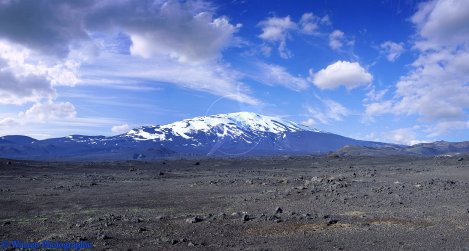
Mount Hekla

Mount Hekla in South Iceland

Whenever I have a few minutes during the craziness of tax season, I check out the Daily Life column on The Iceland Review’s website. Yesterday’s entry by Katharina Hauptmann (half of the Daily Life columnists are from outside Iceland) had the following to say:

In the past two days news broke about unusual seismic activity around the volcano Hekla.

Naturally, it became talk of the town.

Officially, a level of uncertainty has been issued and the related parties continue to monitor Hekla closely.

So can you by keeping your eyes on the volcano with this webcam.

Actually, everybody was waiting for Hekla’s neighbor Katla to blow, as an eruption is more than overdue.

Now it seems that Katla’s little sister Hekla is keeping the world on tenterhooks.

Here in Iceland, one usually refers to Hekla and Katla as the “angry sisters.”

I was once told that volcanoes had women’s names in Iceland because their nature was just like women: unpredictable and explosive.

During my upcoming visit to Iceland, I hope that neither Katla nor Hekla nor the dread Eyjafjallajökull erupt, because I will be spending four days in the South of Iceland in areas that would have to be evacuated (Hvolsvollur and Heimaey). And if it happens while I am in Höfn for two days, I will have to go all around the island to return to Reykjavik.

In European history, it is Hekla (shown above) that has the horrendous reputation. During the Middle Ages, it was widely regarded as the mouth of hell, and fishermen could see its eruptions from hundreds of miles away. By the way, there is a Hekla webcam you can visit. Just note that Iceland is on or near Greenwich Mean Time, and it is likely to be night there when you try.

You may recall the widespread cancellation the last time Eyjafjallajökull erupted twice in 2010. Newspapers around the world showed photographs of the devastation:

Eyjafjallajökull

Eyjafjallajökull

With volcanoes, one could get a day or two of warning before—literally—all hell breaks loose. But isn’t that all part of the fun?

Sons and Dóttirs

Icelandic Mystery Writer Yrsa Sigurdardóttir

Icelandic Mystery Writer Yrsa Sigurdardóttir

The following is loosely excerpted from a review I wrote on Goodreads.Com about Ashes to Dust by the Icelandic mystery writer Yrsa Sigurdardóttir:

Yrsa Sigurdardóttir’s work reminds me of an Icelandic “delicacy” called hákarl, which consists of shark meat which is fermented for several months, sometimes underground, until the ammoniac stench is strong enough to repel the most ravenous shorebirds. I do not mean to imply that Ashes to Dust is as appetizing as road kill: It is just that its author has a tendency to go for the gamier edge of crime. That was also the case with her first book, Last Rituals. I was surprised to read that Ms. Sigurdardóttir is an engineer, because I would have guessed that she was a pathologist.

Ashes to Dust is about three bodies — accompanied by a severed head — which were discovered more than thirty years after the eruption of the volcano Eldfell on the Westmann Islands, which destroyed some 400 homes on the main island of Heimaey. Attorney Thóra Gudmundsdóttir is trying to build a case for the innocence of the man accused of the murders, back when he was a teenager and the volcano erupted in January 1973. The story gets rather complicated (as in her other book that I read), but the author manages to keep all the threads in play until the very end.

Iceland is becoming quite a haven for mysteries: In addition to Yrsa and Arnaldur Indriðason—not to mention the American Ed Weinman (who has lived in Iceland for many years)—there seems to be a growing trend for the small island to become a major force in the production of mystery novels.

I thought I would segue into a not entirely unrelated topic, namely Icelandic names. You may have noticed that most of the names I’ve mentioned in this post end either in -dóttir or -son. That is partly because, until recently, it wasn’t considered quite kosher to have a last name that was anything but a patronymic.

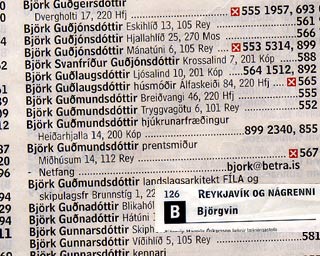
Let’s see how this works. If I were an Icelander, my name would be James Alexson, “James the Son of Alex,” and Martine would be Martine Wilsonsdóttir, “Martine the Daughter of Wilson.” Take a look at the image below from an Icelandic telephone directory:

Bjork to Your Heart’s Content!

Bjork to Your Heart’s Content!

Notice that the names in an Icelandic telephone directory are alphabetized by first name, in this case Björk, and patronymic. In case you didn’t already know, Björk Guðmundsdóttir is the Icelandic recording artist Björk. My guess is the recording artist is probably the one whose address is in Reykjavik 101, which is the Icelandic equivalent of Beverly Hills 90210.

I Book the World’s Youngest Volcano

The Town of Heimaey, Iceland, Flanked by Two Volcanoes

The Town of Heimaey, Iceland, Flanked by Two Volcanoes

I had been there on a day trip from Reykjavik twelve years ago. Because I was afraid of seasickness on the three-hour ferry from Þorlákshöfn, which was famous for rough seas, I flew from the small Reykjavik airport. Several years ago, the Eimskip Line opened a new ferry port at Landeyjahöfn, which is only a thirty-minute ferry ride from the Westmann Islands. This time, I’ll take the ferry, fortified with Dramamine.

Heimaey (literally “The Home Island”) is a beautiful town flanked by two volcanoes, Eldfell (on the left) and the extinct Helgafell (right). Until January 23, 1973, Eldfell didn’t exist. What was a suburban development suddenly turned overnight into a volcano, forcing the evacuation of the entire island. While lava destroyed some 400 homes, the ingenious Icelanders found a way of forcing the lava to form a berm by endlessly pumping cold seawater on its leading edge. The story is told by John McPhee in his book, The Control of Nature.

I had a difficult time booking a room in Heimaey on my original desired dates. Then, just for the heck of it, I decided to hang around a few extra days along the Suðurland, or South Coast, of Iceland (at Hvolsvöllur and Höfn) and try for a few days later. Bingo! I got into the best accommodation on the island. My guess is that there was a local event, like a soccer game or a festival, that drew a crowd on the original dates.

Why do I want to go to the Westmann Islands again? First of all, it is drop-dead beautiful, a major fishing port, and the place where I am most likely to be able to photograph puffins:

Puffins

Puffins

I am told the island’s southernmost peninsula has the world’s largest concentration of the picturesque seabirds at a place called Störhofði.

Puffins and I go way back. I tried to find them in Scotland in September 1998, but they hadn’t arrived there yet. Then I went to Heimaey late in August 2001, but they had all just left.

Martine would love to see them, but I’ll just have to take a load of pictures so that she could enjoy them vicariously.