Where Everbody Knows Your Name

Not Always an Advantage!

Not Always an Advantage!

The theme song of the old Cheers TV sitcom touts the advantages of hanging out “Where Everybody Knows Your Name.” But what if you lived in a small city in an even smaller country where you can’t go anywhere without recognizing friends, acquaintances, and co-workers? Such is the case in Reykjavik, Iceland. The population of Reykjavik is only 199,000, and the population of Iceland stands at 322,000.

I was reading an interesting article on The Reykjavik Grapevine by Valur Gunnarsson entitled “Why Is There No Dating in Iceland?” according to which:

If you were to go out on a date with someone, say to the movies or a coffee shop, you would invariably bump into someone you know. Said person would give you a curious glance, perhaps followed by a smirk and then ask everyone you mutually know: “Are those two seeing each other?” The cat is out of the bag by now and your first and perhaps only date suddenly feels more like an engagement ceremony.

Much better then to wait until the lights go out, everyone you know has gone home, is too drunk to care or engaged in their own business. In other words, going out, getting hammered and then heading home with whoever happens to be standing next to you at closing time carries much less social penalty than meeting in broad daylight. It is widely understood that what happens at the bar doesn’t really count. Leave it until the morning after to figure out if you two really have something in common and if the same thing happens again next weekend with the same person, you have yourself a relationship.

One of the reasons the dating scene in Reykjavik is no notorious is that men and women can’t get to know each other in a social setting without being observed and commented on by their peers. Young Icelanders tend to hang out in bars and go home with one another for an “afterparty” around closing time. What happens at or after the “afterparty” is anybody’s guess, but the word is that it’s a pretty wild scene. There is even a book by the notorious Roosh Vorek entitled Bang Iceland: How to Sleep with Icelandic Women in Iceland, which is a popular item among the more randy international travelers.

(Allow me to say that I have had no such dealings with Icelandic women during my two trips to their country. I’m a respectable old man who needs his sleep.)

Gunnarsson continues:

The flipside of drunken sex is that Icelandic relationships actually develop quite quickly. Whereas in bigger cities the whole vetting process may take weeks or even months while you are asked about everything except your bank statements and family history of mental disease (and sometimes even that), people here tend to jump directly into a committed relationship right after the second sleepover, or thereabouts. In fact, it is generally considered bad form not to. Once doesn’t matter, but do it twice without following through and you start to get a bad reputation.

This all goes back to point two again. The smallness. Dating several people at the same time is socially impossible. Everyone would know. Fistfights would ensue. Better to do the trial and error one person at a time, which is why Icelanders tend to have a series of either one-night stands or serious relationships, but no overlapping dates. So now you know.

One result of this non-dating sexual behavior is that there is a large number of illegitimate children born on the island. Fortunately, there is little or no stigma attached to a single parent entering into a marriage. It does have the advantage of stirring up an otherwise rather static gene pool. (In 2013, it was estimated that 93.44% of the population is of Icelandic ancestry.)
How Elves Came To Be Born

We’re Talking Icelandic Elves Here

We’re Talking Icelandic Elves Here

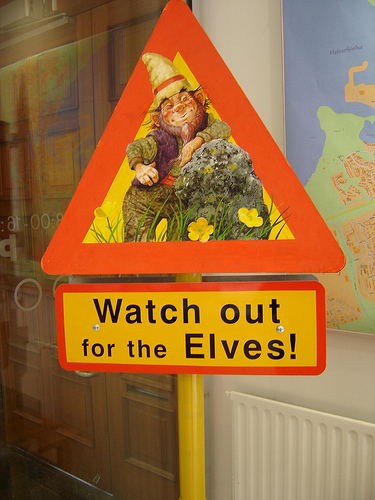
If your idea of elves comes straight out of Tolkien, you might not want to read any further. In Iceland, elves are not quite the smooth white-skinned Liv Taylor, Cate Blanchett, and Orlando Bloom types. Icelandic elves are much more grotty. The following was submitted by my favorite contributor to The Iceland Review, Jóhannes Benediktsson and is a direct quote from his November 14 posting:

There are few theories about where elves come from, according to the Icelandic folktales.

The one most commonly cited, describes God’s journey to Paradise. He visits Adam and Eve, who salute him and show him how they live. They introduce him to the kids, but leave out the dirty ones. God knows about this and states, that what is to be hidden from him, shall also be hidden from everyone else. The unclean children then go on living in hills and stones, and their descendants are what we call elves.

There are more stories about elves and their origin, all referring to some Bible events in one way or another. My favorite is a bit strange. It includes Adam and Eve, like the one mentioned above, but takes another approach. It describes their relationship problem.

I have re-written this story as a two-hander play. I call it Trouble in Paradise and have very high hopes that it will one day reach Broadway.

TIME: Close to midnight.
PLACE: Paradise.
MUSIC: Barry White.

The scene starts with Eve entering the room. Adam is lying on a bed of roses, running his index finger suggestively over Eve’s side of the bed.

ADAM: Hello, cupcakes! How about getting naked?

EVE: You mean lose the fig leaf?

ADAM: Yeah!

EVE: Knock it off, you idiot! I’m not in the mood.

ADAM: Oh, come on! You never are!

Eve starts to get into the bed and goes to sleep, leaving Adam heartbroken once again.  He walks away from her and talks to the audience.

ADAM: This is my life. God has sentenced me to live with a frigid woman for all eternity and calls it Paradise. That’s rubbish! I’m a passionate man, who needs a flame in his life – a fire!  Why didn’t he create someone like that for me? 

He looks at Eve, sights and then looks back to the audience.

ADAM: I guess I’ll have to do with some solo-action once again. Enjoy your popcorn.

Curtains fall.

[Part 2]

TIME: Nine months later.
PLACE: Paradise.
MUSIC: Not Barry White.

Eve walks back and forth on the stage. She is furious. This morning, a bunch of babies appeared out of nowhere on their doorsteps.  They all look like little versions of Adam.

EVE: Who is she?!

ADAM: Who?

EVE: That bimbo you’ve been cheating with!

ADAM: I promise. You are literally the only woman in my life.

EVE: I don’t believe you. How do you explain the children?

ADAM: A miracle of God?

Eve starts throwing apples at Adam, who runs in a silly manner around the stage.  A thundering voice comes from above, overwhelming both of them.  It’s God.

GOD: Stop this nonsense, both of you.  I’ll explain what happened.  Do you remember, Adam, nine months ago when you did that… guy thing?

ADAM:  Erm… are you talking about the …

GOD: Yes, yes!

EVE: What guy thing?

GOD (ignoring Eve): Well… some of that got into a hole in the soil. And that soil somehow got pregnant and… well… these are your children. Their descendants will be known as elves.

ADAM: What!

Eve starts shouting and the throwing of apples once again and Adam seeks a shelter behind a tree. Avoiding the missiles, Adam turns his head humbly to the sky with one final question.

ADAM: God. Can you tell me one thing?

GOD: Sure.

ADAM: Why did you make her like that?

GOD: It amuses me.

ADAM: I thought so.

Curtains fall again. The show’s over.

By the way, Gin unlike Tolkien, Icelandic elves can do nasty things. Perhaps I’ll tell you about some of them one of these days.

Where on Earth Is Frisland?

It Looks As If It Is South of Iceland

It Looks As If It Is South of Iceland

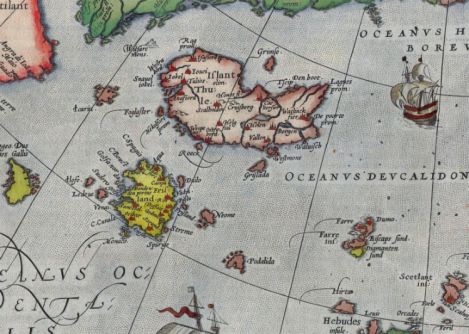
Until late in the Sixteenth Century, maps of Europe had a largish island called Frisland (also called Frischlant, Friesland, Frislandia, or Fixland) situated south of Iceland. It is thought that an Italian mapmaker named Nicolo Zeno was first responsible for the placement of the imaginary island on his charts in 1558. Then, in 1573, the Fleming Abraham Ortelius picked it up for his maps, followed by Gerard Mercator (he of the projection) of Duisburg. In 1576, Martin Frobischer thought he was in Frisland when, actually, he had overshot it and found himself in Greenland.

I am indebted to Benedikt Jóhannesson of the Iceland Review for turning me on to this existence of this cartographic canard. I remember standing on the farthest southern point of the Westmann Islands in Iceland and looking south. I saw quite a few small, rather volcanic rocks to the south—but nothing as large as Frisland is represented to be. Perhaps it’s the original Fantasy Island.

Curiously, this part of the ocean lies along the Mid-Atlantic Ridge. There have been volcanic islands that arose from the bottom of the sea, only to subside or be eroded away after the eruption that created them spent its fury. Perhaps someone reported some such island—though no way that large—and some mapmakers picked it up and embellished it a bit. A good example of such an island is Ferdinandea, between Sicily and Tunisia, which appeared and disappeared several times. It lasted long enough for several countries in the Nineteenth Century to dispute its ownership.

Birthday of an Island

The Island of Surtsey as It Is Today

The Island of Surtsey as It Is Today

Fifty years ago today, the Island of Surtsey was born as the result of an undersea volcanic eruption in Iceland’s Westmann (Vestmannæyjar) Islands. Named after Surtr, one of the giants of Norse mythology, the island was at one time one square mile, but as a result of erosion has over the last fifty years been whittled down to a little more than half that size.

Did I visit Surtsey on my trip to Iceland this summer? I would have if it weren’t forbidden. Only scientists can visit the island, and only under restrictive conditions. For instance, they must not carry seeds to the island. One time, tomato plants started to grow as a result of a tomato seeds being in one of the researchers’ excreta. All biota on the island must have come there naturally as a result of wind or transport by birds. There are few places on earth which are unaffected by human habitation: The intent is to see what happens when we humans don’t have our thumbs resting on the scales.

The photo above is from Páll Stefánsson of The Iceland Review.

Fish Story

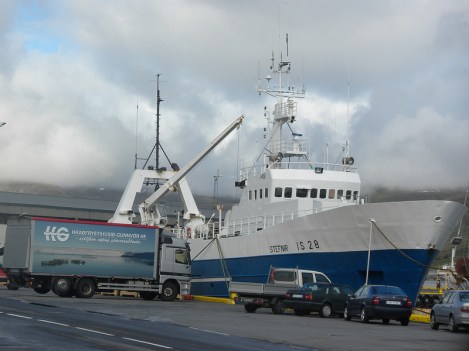
The Stefnir Preparing to Sail from Isafjördur

The Stefnir Preparing to Sail from Isafjördur

One of the stories I tell my friends about my recent trip to Iceland is that, at most of the seafood restaurants where I ate, I could look out the window and find ships of the fishing fleet. Here, I am standing outside the Cafe Edinborg in Isafjöordur, where I had the most flavorful and moist halibut of my life. Sure enough, right in front of me was the fishing trawler Stefnir ready to sail. According to a bus driver with whom I was speaking, the ship was idle for a long time because it had caught its quota of fish early and was only now ready to work on its next period’s quota. You can find out more about these quotas, which are big news throughout the island and strictly enforced, by visiting the website of the Ministry of Fisheries and Agriculture.

When roughly half of the gross national product is attributable to the fishing fleet, it behooves Iceland to carefully guard fishing stocks so that the tiny nation doesn’t suddenly find itself out of luck as a result of overfishing.

From the 1950s to the 1970s, Iceland actually fought several engagements with Britain because the latter’s trawlers ignored Iceland’s territorial water claims. You can read about the so-called Cod Wars on Wikipedia. In Reykjavik, I actually saw one of the Coast Guard ships involved in the hostilities (see below).

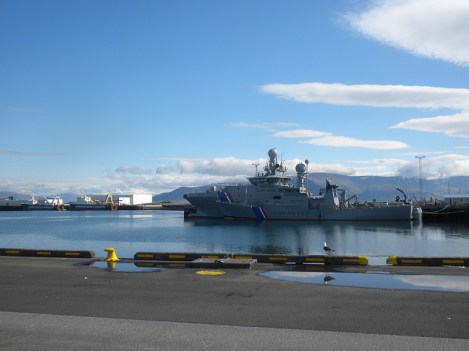
Icelandic Coast Guard Vessel

Icelandic Coast Guard Vessel

Iceland does not have an army nor a navy, but it takes its Coast Guard seriously. How else can it continue to maintain its fishing presence in the territorial waters against the encroaching vessels of other countries?

One Day in Isafjördur …

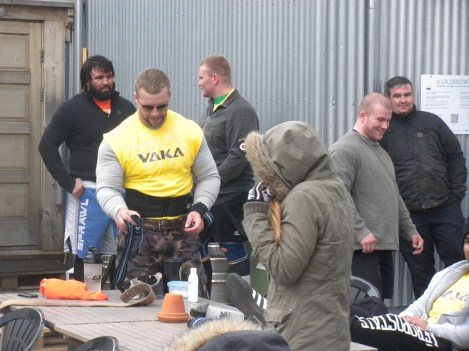
Icelandic Weightlifters in the Rain

Icelandic Weightlifters in the Rain

I had just spent a couple of hours at Isafjördur’s little Westfjords Folk Museum and started to trudge back to my youth hostel in a drizzle that was progressively growing worse, when all of a sudden I came across a sight that struck me by its incongruousness, especially given the weather. Just outside the tourist information center, several hefty Icelandic men were hoisting over their heads what looked like a hot water heater. Surrounding them were several locals cheering them on and taking pictures. I had never seen weightlifters before working with improvised weights, but I guess it’s all the same thing. After all, we were right by the fishing port, and there were several large scales in evidence that could be used to verify the weight.

Despite my eagerness to get out of the weather, I stuck around for the end of the show. Afterwards, I took several pictures of the contestants. They turned out to be a friendly group and didn’t mind posing for a few snapshots.

One of the things that I love most about travel are the little surprises, such as the time in Merida, Mexico, when there was a brass band concert on the zócalo around six in the morning. Another time, in Guadalajára, there was a parade of Mexican military cadets through the center of town, accompanied by several bands playing marching music. Finally, on a frigid day in London, there were a number of slightly blue fashion models in clad in skimpy bikinis for the opening of some store.

In the end, what remembers most fondly were the things one didn’t plan for, that just unfolded in front of one’s eyes. It is always special to be there on the spot when that happens.

A Short Season

Rental Car Sandblasted by Storm in Southeast Iceland

Rental Car Sandblasted by Storm in Southeast Iceland

We are now rapidly approaching the fall solstice. Curiously, tourists are still traveling around Iceland as if it were still summer. This last week, there was a fierce storm in East Iceland that led to tourists being stranded when wind, sand, and blowing rocks (yes!) broke windows and forced them to a halt. The following excerpt is from the Iceland Review website:

 “We were approaching Skaftafell when the wind picked up,” Marie Storm, who had been traveling in the region with her boyfriend since Friday, told Fréttablaðið. Squalls reached 30 to 40 meters per second [that’s between 67 and 89 miles per hour].

Storm said they decided to stop the car after the sandstorm blocked visibility completely. They waited in the car for several minutes. “Suddenly a rock flew through the window, which exploded over us.”

Sand blew nonstop into the car and glass was shattered over them, cutting their hands. The couple therefore decided to leave the car and seek shelter on the side of the road. “We couldn’t see anything and sand and rocks rained over us. We couldn’t even open our eyes.”

The couple called the emergency hotline 112, who contacted search and rescue squad Kári in Öræfi, who were driving around the region in an armored car, picking up stranded commuters. They arrived a half an hour later.

Storm described the wait as unbearable. “It was a complete nightmare. We were in shock. We thought we would die.” Their eyes hurt after the ordeal and so they are planning to seek medical attention.

She maintained that they hadn’t seen any signs indicating that the road was closed.

The Icelandic Road Administration’s light sign had read ófært (‘impassable’) in Icelandic. The administration now intends to replace that word with ‘closed’ to catch the attention of foreign tourists.

I was in this area toward the end of June. It is a narrow ribbon of road between the giant Vatnajökull glacier and the black sand beaches facing the Atlantic. Until global warming forced the glacier back several hundred yards in the last eighty years, it was not even possible for there to be a road. The nearness of the glacier and of the Atlantic leads to some truly horrific storms.

Iceland is a stunningly beautiful country which just happens to have some terrible weather during most months of the year. One cannot just assume that, because the weather is fine in your country of origin, the cruel Norse gods will let you off scot-free.

One interesting sidelight: Icelandic auto rentals do not insure for conditions such as those described above. Not only did the tourists wind up fearing for their lives, they will also end up paying through the nose for their poor judgment.

What I Will Remember Most

Under Attack by Arctic Terns

Under Attack by Arctic Terns

Now that I’ve been back from Iceland for six weeks now, what do I remember most about that remote and somewhat wild island? The place that keeps coming back to me are the West Fjords. Only some seven thousand people live on a large peninsula punctuated by basaltic ridges and broad fjords. It is quite possibly one of the most isolated parts of Europe, even though one can reach it from Reykjavík by bus in about eight hours.

Above is our little guide Thelma (which she pronounces as Talma) walking with a tourist surrounded by an angry cloud of arctic terns who are aggressively defending their nearby nests. I can understand them, in a way. It’s been a bad year for Icelandic birds, what with the puffins of Vestmannæyjar being unable to produce a bumper crop of little pufflings, and arctic terns likewise having problems due to global warming.

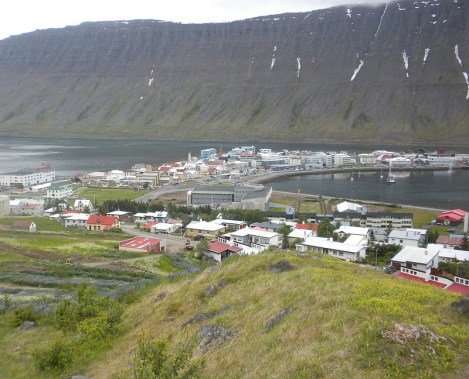
The Little Town of Isafjörður

The Little Town of Isafjörður

Not that I felt particularly warm in the West Fjords “capital” of Isafjörður” (shown above) which has only some two thousand inhabitants. It’s on a little sandy spit of one of Iceland’s largest fjords, and it is fully about ten degrees Fahrenheit colder than any other part of Iceland that I visited, with the exception of the glacier Vatnajökull.

Why does the image of the West Fjords stick with me so much? And not only with me, but with other travelers as well. Most of them go to backpacking to Hornstandir, a desolate peninsula with spectacular views jutting out into the Denmark Straits that separate Iceland from Greenland. I myself did not go there, but most of the European kids who stayed at the youth hostel made that their number one destination. I’d like to see it some time, but I doubt I am up for a multi-day trek with tent, sleeping bag, camp stove, and food.

No, I will remember the long bus rides on gravel roads past spectacular waterfalls and cute little villages like Thingeyri and Patreksfjörður. I will remember the bird cliffs at Latrabjarg, where a gale-force wind was trying to blow me to my death on the rocks several hundred feet below. I will remember the island of Vigur (top photo), where a single family ekes out a living gathering eider down and welcoming summer tourists with coffee, tea, and homemade cakes.

These places are all etched in my memory. The beauty will remain with me forever.

Lobster Town

Lobster Restaurant in Höfn

Lobster Restaurant in Höfn

They’re not lobsters as we think of them in the United States or Canada, but the langoustine or Nephrops norvegicus (Norwegian Lobster) of Iceland is every bit as good. The Maine Lobster is a giant, but the langoustine fits the same great flavor into a smaller package.

The lobster capital of Iceland is the town of Höfn, which is pronounced very much like a hiccup. Let’s take it slowly: HOEP, with the oe sounding like the oe in French oeil, “eye.” And where did that “p” sound come from? It seems that, in Icelandic, certain diphthongs change the pronunciation of the first consonant. Just like the name of Iceland’s International Airport. It looks as if it should be pronounced KEFF-lah-vick, but it’s actually KEP-lah-vick or KEB-lah-vick, with the “f” sounded halfway between a “p” and a “b.” And if that confuses you, don’t bother going to Hafnarfjörður, or the elves will do evil things to your vocal chords.

Getting back to lobster, Höfn is a relatively recent town that owes its growth to its location midway between East Iceland and the towns of the Southwest, including Reykjavík and Selfoss. In addition, it has one of the better harbors in the Southeast, if a little treacherous because of shifting shoals. But it is spectacular to wake up in the shadow of Europe’s biggest glacier, Vatnajökull.

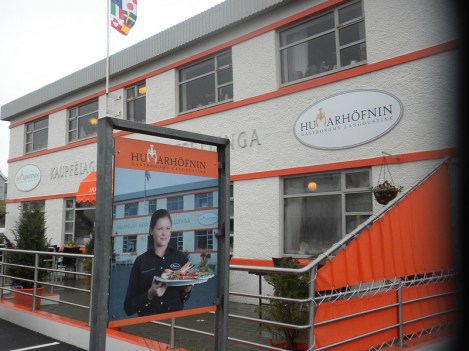
Also, for some reason, the langoustines are especially plentiful and tasty around Höfn. If you visit the place, as you should when coming to Iceland, be sure to try the langoustines. They are especially good at the Humarhöfnin Restaurant pictured above. And please don’t ask me to pronounce it.

You’ll Get There Strætoway

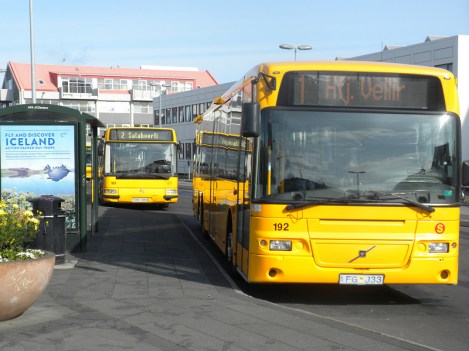
The Central Bus Terminal at Hlemmur

The Central Bus Terminal at Hlemmur

I’ve always thought that one of the most fun things about visiting a foreign country is using the local bus system, especially when it’s so well organized (as it usually is in Europe). It’s an altogether different proposition in Latin America and Asia, where it’s not easy to find out beforehand where a particular bus goes and how often.

Reykjavík’s Stræto (pronounced STRY-toe), on the other hand, is pretty easy to use. Their yellow buses go all over the capital, and schedules are readily available on the Internet—in English. There are a number of regional terminals, such as Mjódd, from which the Stræto long-distance buses depart for the south and west of Iceland. These are usually a better deal than using the Reykjavík Excursions buses with their preponderance of backpackers. Then there is Háholt in Mosfellsbær and Fjörður in Hafnarfjörður in the southern part of the “metroplex.” (The quotes are there because Reykjavík has only about 150,000 residents.)

Stræto Buses at Hlemmur

Stræto Buses at Hlemmur

The bus fare for Stræto local buses is over $3.00, but there are several ways one can save. For more tourists, I recommend getting the Reykjavík Welcome Card, which allows you unlimited free bus travel for 1, 2, or 3 days. Also included is free admission to museums and swimming pools in the area. One could also buy panes of bus tickets. Note that long-distance services charge additional tickets, and these can either be purchased in advance at bus terminals or via credit card from the driver.

One interesting feature of the yellow Stræto buses is a display of what the next stop is, together with the name pronounced in proper Icelandic. It’s a great way to learn how to pronounce what is a real tongue-twister of a language.