The End of the Tether

This is a difficult subject to treat because I myself am reaching the age at which one can pay most grievously for mistakes made earlier in life. I have just finished re-reading Joseph Conrad’s The End of the Tether, about a British sea captain in Malayan waters who has passed up a peaceful retirement to help out his daughter, who had married unwisely.

Although Captain Whalley in his youth was one of the most brilliant sea captains in the South Seas, he has grown old and forced himself to take on a rickety steamship in need of repair. The owner is a nervous former lottery winner who serves as the ship’s engineer. While he spends every spare hour evaluating possible winning lottery numbers, Captain Whalley, with the help of a native serang, handles the sailing of the vessel.

Unknown at the outset is that Captain Whalley is going blind, and it is primarily the Malay serang who is responsible for captaining the ship. As one can guess, things do not end well.

As I approach eighty years of life on earth, I see many of my friends in their retirement years similarly afflicted as a result of difficult situations that over time have gone critical. I earnestly hope that I will not be one of them.

For one thing, I did not save up enough money for retirement, having spent obscene amounts of money on books. Today I have a fantastic library of five or six thousand volumes. But what happens if I should suddenly die? That would leave Martine in the position of trying to find out how to turn my library into cash, if possible. This at a time when there are precious few bookstores around that could buy hundreds of books at a time.

At least I don’t buy books any more. The Los Angeles Library and my Amazon Kindle account for most of the books I read.

I owe it to the people I love to whittle away at my library, however it pains me. Alas, I am mortal. I have made mistakes. I will pay for those mistakes.

“It Is Bells Within”

Like me, Emily Dickinson loved reading. (Unlike me, she had the talent to show for it.) Today, I present one of her untitled poems on the joys of books.

Unto my books so good to turn
Far ends of tired days;
It half endears the abstinence,
And pain is missed in praise.

As flavors cheer retarded guests
With banquetings to be,
So spices stimulate the time
Till my small library.

It may be wilderness without,
Far feet of failing men,
But holiday excludes the night,
And it is bells within.

I thank these kinsmen of the shelf;
Their countenances bland
Enamour in prospective,
And satisfy, obtained.

The Blind Librarian

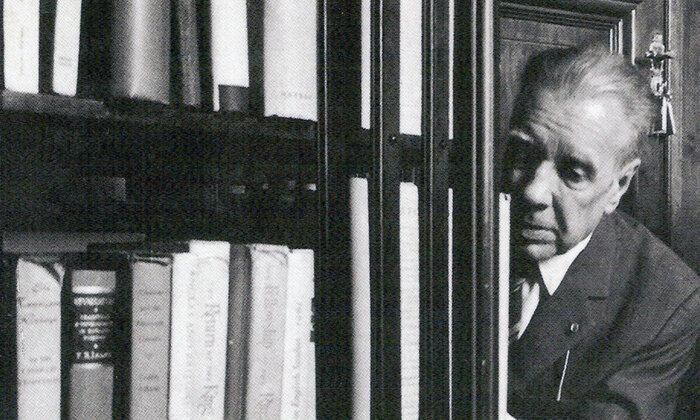
Argentinian Writer and Poet Jorge Luis Borges (1899-1986)

Just as he was descending into blindness, Jorge Luis Borges was appointed director of the Argentine National Library. He wrote a poem about how he, as a lifelong bibliophile, felt about being in charge of so many books he could no longer read. In the last stanza, he mentions Paul Groussac, a previous director of the Library in the 1920s, who was also blind and, like Borges, also a distinguished writer.

Poem About Gifts

Let none think I by tear or reproach make light
Of this manifesting the mastery
Of God, who with excelling irony
Gives me at once both books and night.

In this city of books he made these eyes
The sightless rulers who can only read,
In libraries of dreams, the pointless
Paragraphs each new dawn offers

To awakened care. In vain the day
Squanders on them its infinite books,
As difficult as the difficult scripts
That perished in Alexandria.

An old Greek story tells how some king died
Of hunger and thirst, though proffered springs and fruits;
My bearings lost, I trudge from side to side
Of this lofty, long blind library.

The walls present, but uselessly,
Encyclopedia, atlas, Orient
And the West, all centuries, dynasties,
Symbols, cosmos, and cosmogonies.

Slow in my darkness, I explore
The hollow gloom with my hesitant stick,
I, that used to figure Paradise
In such a library’s guise.

Something that surely cannot be called
Mere chance must rule these things;
Some other man has met this doom
On other days of many books and the dark.

As I walk through the slow galleries
I grow to feel with a kind of holy dread
That I am that other, I am the dead,
And the steps I make are also his.

Which of us two is writing now these lines
About a plural I and a single gloom?
What does it matter what word is my name
If the curse is indivisibly the same?

Groussac or Borges, I gaze at this beloved
World that grows more shapeless, and its light
Dies down into a pale, uncertain ash
Resembling sleep and the oblivion of night.

The Book Collector

My apartment is home to my collection of books, five to six thousand volumes in all. In addition to my library, which is dedicated to my collection, I have crowded book-cases in every room of my apartment, including the kitchen and bathroom.

There was a time when I could not visit a bookstore without buying several new or used books. In addition, I purchased books from EBay, Abebooks.Com, and a fair number of other Internet book dealers.

Right now, I am reading with great enjoyment Walter Scott’s Guy Mannering; or, The Astrologer (1815), the second of his Waverley Novels. Forty or fifty years ago, I would think nothing of trying to find the complete works of any author I liked. In fact, at one time I owned a complete hardbound set of the Waverley Novels. Now I only have some twenty selected titles—but in nice editions. In this, I resemble Dominie Sampson in Guy Mannering:

The lawyer afterwards compared his mind to the magazine of a pawnbroker, stowed with goods of every description, but so cumbrously piled together, and in such total disorganisation, that the owner can never lay his hands upon any one article at the moment he has occasion for it.

Guilty as charged! But now that I am approaching my eightieth year, I would like to find a good home for most of my books. It helps—sad to say—that bookstores, in disappearing from the landscape, furnish less of a temptation.

Tomorrow, I will travel downtown to return some library books (and get some new ones). I will be strongly tempted to visit the (appropriately named) Last Bookstore at 5th and Spring Streets and check out their more obscure Sir Walter Scott titles, such as Peveril of the Peak, Count Robert of Paris, Anne of Geierstein, and The Fortunes of Nigel.

But, really, who am I kidding? Will I really read all of Scott’s novels? If I live long enough, I sure would like to try. But why buy the books when I can check them out of the Central Library or download them on my Amazon Kindle. Old habits die v-e-r-y hard.

The Book Collector

Me in My Library in Palmier Times

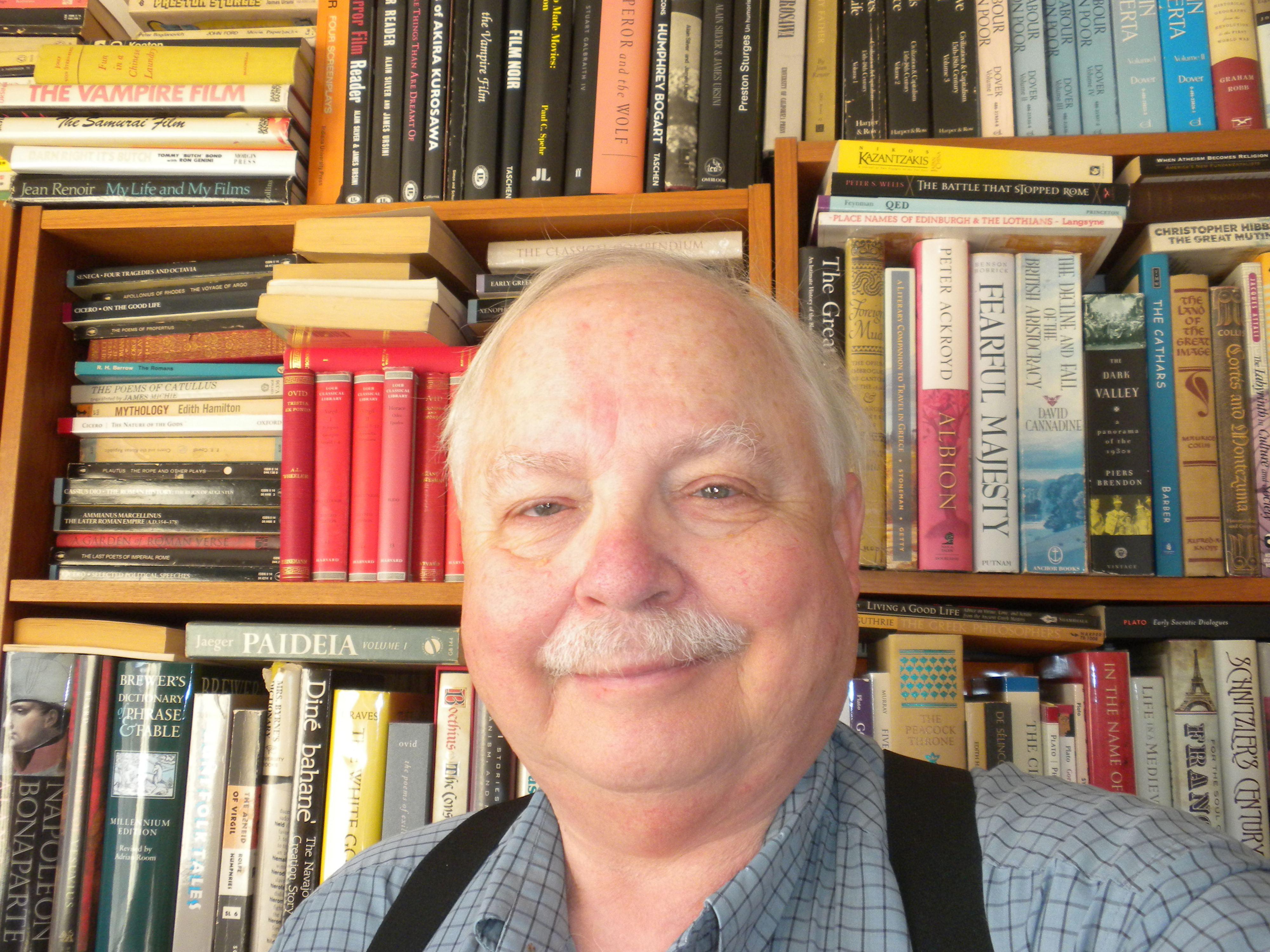
Ever since I was very young, I wanted to live surrounded by books. And I did, spending hundreds of dollars a month on books—hardbounds, paperbacks, even e-books. There is a tendency for accumulations to get out of hand. I have known collectors who lived in fear of being crushed under their film collections, movie poster collections, book collections. Collections can grow so out of bounds that they become a kind of illness, related to hoarding. When Martine and I moved from room to room, we had to take prescribed paths, because the floor was piled high with books. It was frequently a bone of contention between us.

Beginning late last year, I started donating books to the Mar Vista Branch of the Los Angeles Public Library. In a twelve-month period, I have given well over a thousand books to the library. Some will be sold by the library at one of their bimonthly sales, some will be sold for a dollar a book at the branch, some (the cheaper ones) will just be given away. Who knows? Perhaps some of them might even be incorporated into he library’s own collection. A lot of them are great titles in prime condition.

If you look at the books behind me in this picture, I would have to say that about 30-40% are no longer in my possession. Twice a week, a put together a box of books for donation, with Martine’s eager cooperation.

Now that I am living on a fixed income, I buy relatively few books, and then only if I intend to read them in the near future. Today, for example, I purchased a nice harbound copy of Paul Theroux’s Sir Vidia’s Shadow, about the author’s decades-long friendship with V. S. Naipaul.

Do I read as much as ever? Of course I do—perhaps even more so. It’s just that I no longer feel I have to own all the books I love. I just have to read them.