Could You Spare a Crust of Bread for a Hungry Peacock?

Where’s His Cardboard Sign?

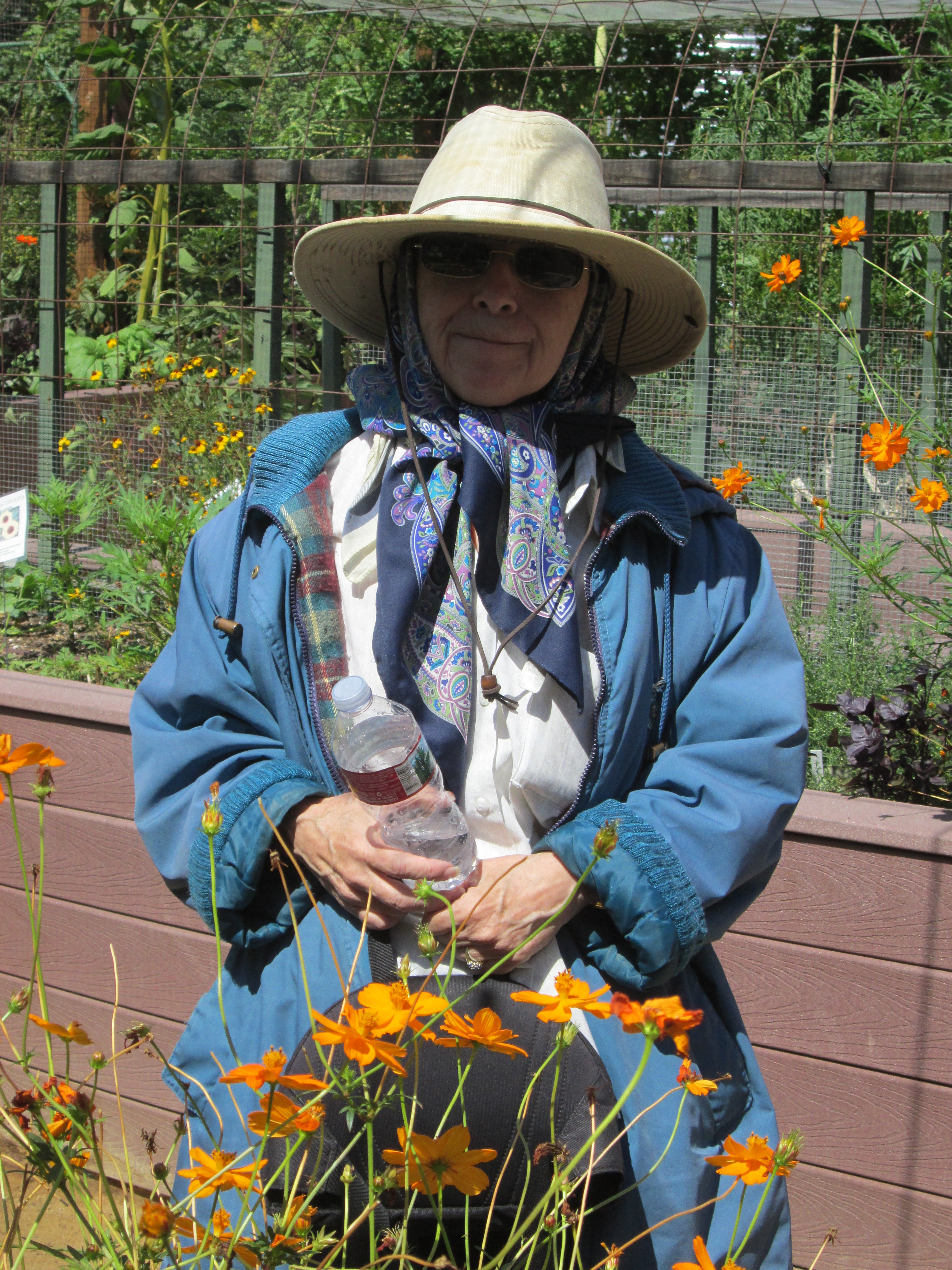
Today I took Martine to the Los Angeles Arboretum. There we ate at the Peacock Café, where various peacock moochers attempted to cadge some treats from us. Martine was good (the Arboretum doesn’t want visitors to feed their wildlife), but I couldn’t help leaving a few crumbs of bread on the side of the table, which were voraciously accepted.

Martine and I are going through a difficult period. She still wants to leave Los Angeles. Not being married, I could not stop her. All I could do is keep the welcome mat out for her at all times. If she left, she would probably go back to Sacramento, where pretty much the only people she knows are in the cemetery. I feel sometimes as if I were treading barefoot on broken glass. Still, the way things are, I prefer being with her than without her. We have been together for almost thirty years, and I like being with her, even during difficult times.

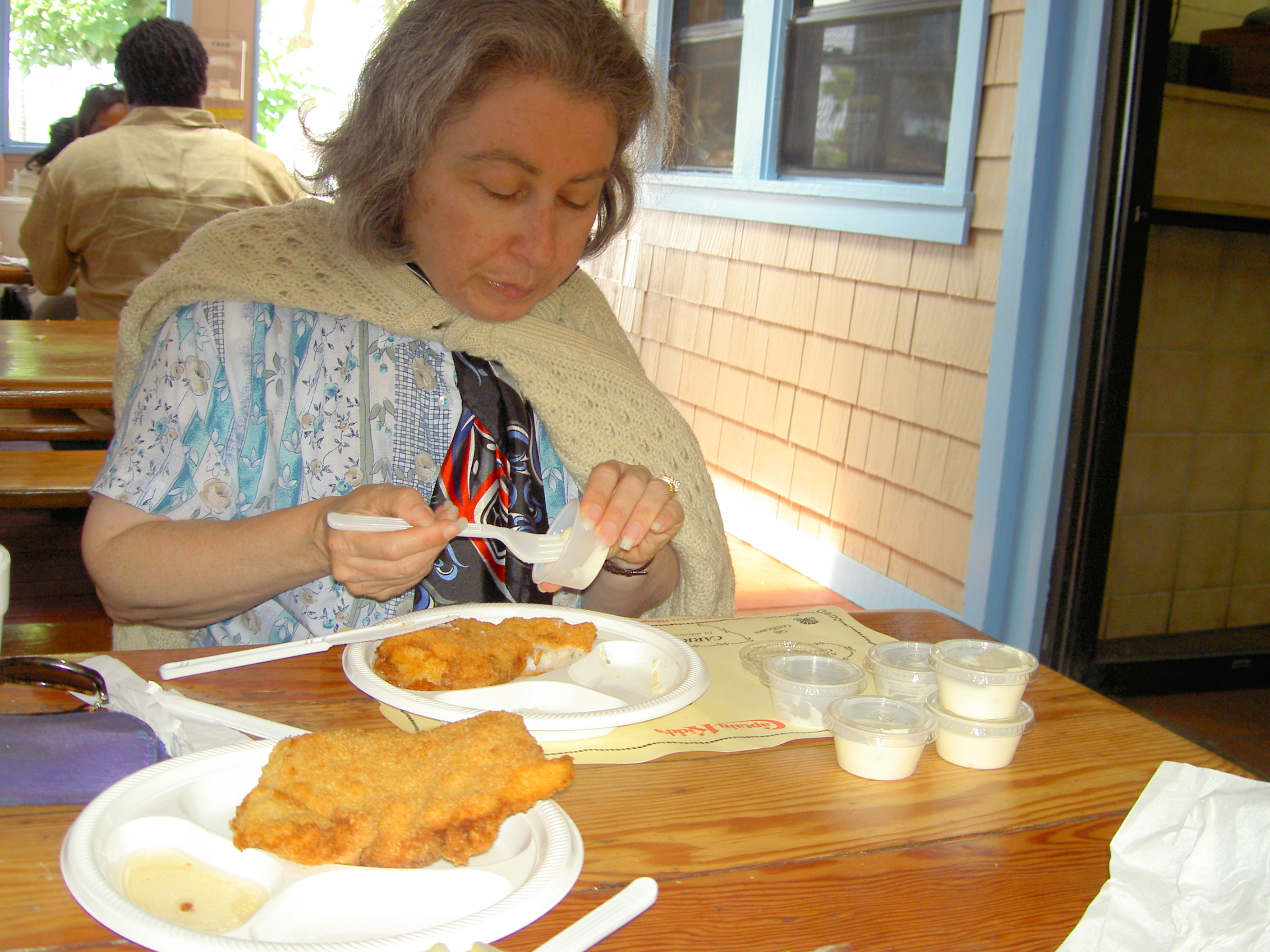
Martine at the L.A. Arboretum

No, I am not interested in looking for someone else at this point so that I can celebrate Martine’s attempts to live alone without friends or funds. Some people are difficult, but if they are at the same time gentle and kind, they are worth their weight in gold.

Afterwards, we went to the China Islamic Restaurant in Rosemead, where I ordered lamb chow mein with fresh dough-cut noodles and sesame green onion bread.

Gemina

Gemina, the Giraffe With the Crooked Neck

Tomorrow, I will take Martine to one of our favorite places, the Santa Barbara Zoo. Martine will probably leave me at some point in the next two or three weeks, so I want to spend some of that time revisiting places we love.

Although Los Angeles has a bigger zoo, it is so crowded and so constricted by constant construction that visitors have a hard time negotiating the paths without getting run over by harassed parents pushing strollers. As their website says, the SB Zoo has 500 animals and only 30 acres. That’s just about our speed, and tomorrow promises to be a nice day.

The most remarkable animal we have seen at the Zoo is the late Gemina, the giraffe with the crooked neck. The following long quote is a release from the zoo that I thought I’d like to pass on to you:

If you visited the Zoo between 1990 and 2008, you probably saw an unusual giraffe. Her name was Gemina and she had a crook in her neck.

Born at the San Diego Wild Animal Park (now San Diego Safari Park) in 1986, Gemina was a Baringo (or Rothschild’s) giraffe, and joined the Santa Barbara Zoo’s giraffe herd when she was just about a year old.

Her neck seemed normal until a bump appeared when she was around three years old. Slowly, over time, it sharpened into a distinctive “V”, which interrupted the graceful curve of her neck.

Though she was examined by veterinarians, a cause for the crook could not be determined. The good news? In spite of her appearance, she didn’t exhibit any signs of being in pain.

In fact, the crook didn’t hamper Gemina’s life at the Zoo. She received normal treatment by zookeepers, ate normally, gave birth to a calf, and was an accepted member of the Zoo’s giraffe herd. She was beloved by our guests, locals and visitors alike.

Long before I came to work here as the Zoo’s publicist, management had decided not to sensationalize Gemina. We could have emblazoned her image on t-shirts and made banners with her silhouette, but that’s not our style. She was a member of the giraffe herd, and not to be exploited. We responded to media requests, but didn’t push out the story.

But Gemina became an icon in spite of our low-key approach. In its second season (2004), “The Bachelor” filmed a sunset dinner at the giraffe exhibit, and the couple met Gemina. In the 2005 television show “Miracle Workers,” she was the source of inspiration for a young boy with severe scoliosis. In 2007, she was voted Number One of the “Seven Wonders of Santa Barbara” in a local radio station poll.

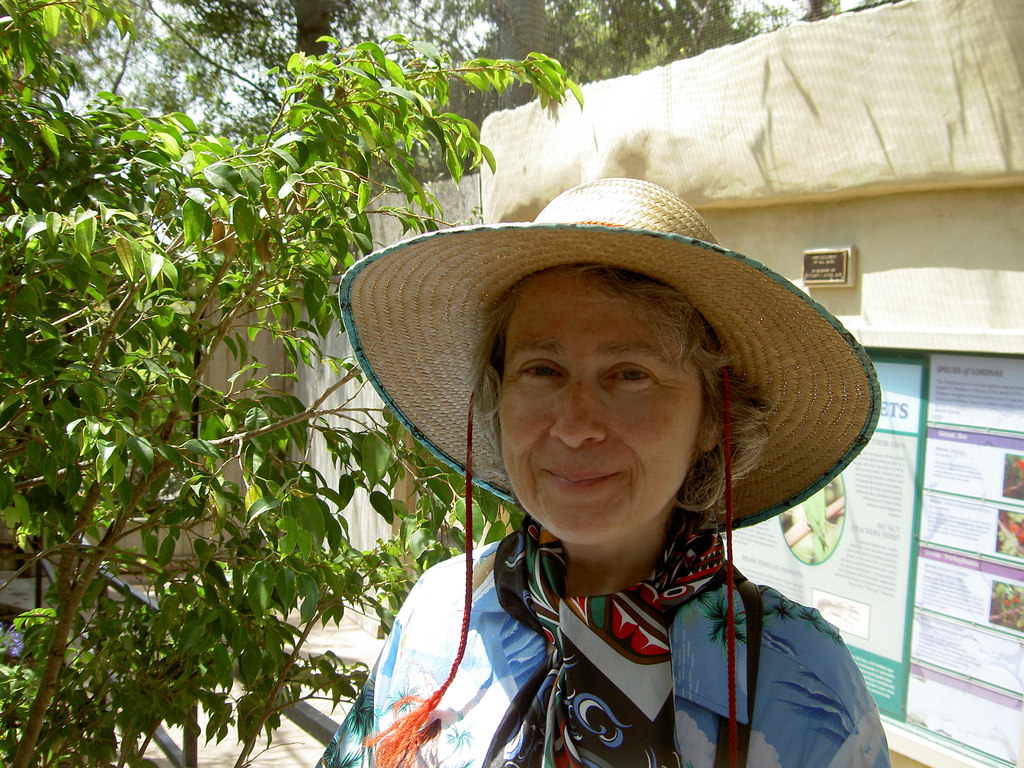
Martine at the Santa Barbara Zoo in 2007 … in Happier Times

By then, she was 20 years old, which is elderly for a giraffe in captivity. We threw a party for her 21st birthday, knowing that her time was nearing an end. Many of us had tears in our eyes when Zoo Campers, wearing self-made giraffe hats, sang “Happy Birthday.”

She lived another five months, before she stopped eating and her health declined. Gemina was humanely euthanized on January 9, 2008. It was a sad day at the Zoo.

But her memory lives on. Gemina is still the most asked-about animal at the Zoo, even eight years later. A children’s book, “Gemina the Crooked-Neck Giraffe,” written and illustrated by Karen B. Winnick, was released in 2013, and is still for sale in the Zoo Gift Store (all proceeds benefit the Zoo).

Now, her fans can again visit Gemina. Her distinctive top six vertebrae, skull, and jawbone have been preserved and rearticulated, and are now on view in a display case as part of the Zoo’s “Animals…Inside Out” art exhibit in the Discovery Pavilion’s Volentine Gallery.

It’s free, with admission, to view Gemina and the exhibit of cool animal x-rays. Gemina’s skeleton is on view 10 a.m. to 3 p.m. weekdays, and 9:30 a.m. to 4:30 p.m. on weekends.

Thanks goes to Skulls Unlimited for her skeletal work, and to TruPart, a Ventura company, for building the display case free of charge.

Gemina reminds us all that being different is just fine. She’s a reminder to me not to blithely feed the media’s appetite for the odd and outrageous. That we can tell a quieter story, about being accepted in a herd of your peers and loved by a generation of visitors. That one giraffe can still stand tall, even with a crooked neck.


Wandering Mindfully in DTLA

The Millenium Biltmore Hotel on Pershing Square in Los Angeles

I am facing a change in my life relating to my relationship with Martine. It appears that, before long, we will not be together. The odd thing is that we still love each other: The reason for Martine’s desire to leave has more to do with how she feels about herself. There is a French expression bien dans sa peau: Feeling comfortable within one’s own skin. Ever since she got a pinched nerve in her back early in 2013, she has not felt well. Plus, she seems to just want to leave Los Angeles, which I cannot do at this time without quitting my job and running through my savings..

My first reaction was anger and sadness. The sadness is still there, but to make her feel even more depressed would be doing her an injustice. All I can do is hope she will discover that life with me is indeed preferable—even if it is in Los Angeles. My door will remain open for her.

How am I coping with this event? I will concentrate on my mindful meditation practice. I wandered around downtown LA (a.k.a. DTLA) after my meditation session at the Central Library. I ate lunch at the Bugis Street Brasserie at the Millenium Biltmore Hotel on Pershing Square. The red awnings at the lower right of the above photo is where the restaurant is located.

Then I stopped in at the Last Bookstore at 5th and Spring, looking for more Teju Cole books. Apparently they sold out. Then I took the Dash D bus to Union Station and waited for the Santa Monica Big Blue Bus #R10 to take me back home.

Home will be a different experience, but I am resolute about not poisoning the well.


Riding the Cumbres & Toltec RR

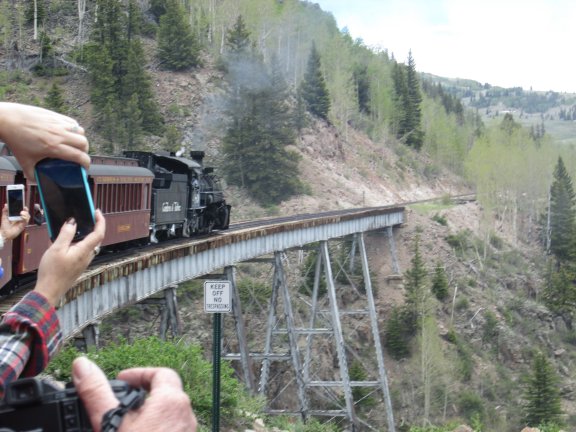
Our Train Going Over a Trestle

There are two narrow gauge steam trains relatively close to each other, both once part of the Denver & Rio Grande Western. One runs in Colorado between Durango and Silverton and is, in fact, called the Durango & Silverton. The other runs between Chama, New Mexico, and Antonito, Colorado. That is the Cumbres & Toltec—named after Cumbres Pass and the Toltec Gorge, two of the scenic highlights along the route.

Martine and I went on the Cumbres & Toltec, and had planned on also taking the Durango & Silverton. Unfortunately, Martine came down with a headache from the high altitude and was afraid of aggravating it by taking both trains. In addition, the pinched nerve in her back was irritated by the constant lurching of the cars as the train went downhill. So, after our ride on the Cumbres & Toltec, we sought lower ground, even if it was to put us back in the middle of the desert heat we were hoping to avoid.

So it goes.

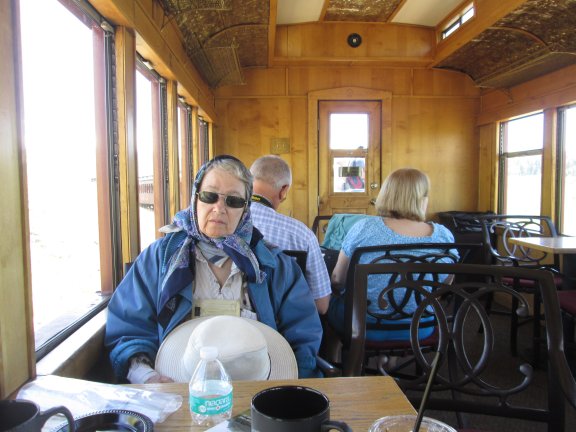
Martine on the Cumbres & Toltec Narrow Gauge Railroad

The Cumbres & Toltec ascended to the snow level at around 10,000 feet at its highest point, before going back down 2,000 feet to Antonito. At Antonito, we took a bus back to Chama. The ride took only one hour, whereas the train, on a parallel route, took five hours.

At Osier, Colorado, we were unloaded from the train to have a substantial free buffet lunch before continuing to the end.

Hopefully, some day I may yet take the Durango & Silverton, though without Martine who is puzzled by my love of trains. That love goes way back to my scouting days, when we took the Erie Railroad to Ashtabula, Ohio. Then, in college, I road the New York Central from Cleveland to Albany, New York, from where I took the Vermont Transit bus to Rutland, Vermont, and the White River Coach bus to Hanover, New Hampshire.

I love trains so much that I even enjoy taking the light rail to downtown Los Angeles.


What’s Happening to American Food?

Yeah, Well, I Mean Other Than That ….

In the big cities on the Right and Left Coasts, what we know of as American food is—I think, anyhow—starting to disappear. Not that American cuisine is necessarily the best in the world. Being Hungarian, I know it couldn’t hold a candle to a home-cooked Magyar meal. But there are some good American dishes of which I am quite fond. For someone who truly hates the Confederacy, I like Southern food: fried catfish, grits, collard greens, black-eyed peas—though I stop short at chicken. (Martine, on the other hand, is a big time poultry devotee.)

I think the problem is those guys with toques who like to think of themselves, standing in their kitchens, as masters of all they survey. The Food Channel has introduced us to a whole generation of soi-disant chefs who basically like to screw around with food, mix flavors like crazy, and build photogenic little towers on the plate. I think of these toque-n chefs the same way I think of those little kids who like to mix Coke with Mountain Dew with Root Beer at one of those automatic soda dispensers, thinking they’ll come up with something new and interesting. Of course, they never do.

Martine is unable to eat the range of food that I can. I would be perfectly content eating nothing but Asian food all my life, or Mexican, or Argentinean. She has irritable bowel syndrome and needs good plain food. We usually compromise when we go out: one meal to make me feel good, and maybe the next to make her feel good.

Today, for instance, we found that a restaurant chain we loved that had been out of business for over 10 years still had one branch in Sherman Oaks, near the intersection of Moorpark and Van Nuys Boulevard: It was Hamburger Hamlet. The food was not great—not like pigging out in New Orleans on a po’ boy or in Boston on scrod—but it is good; and the menu is large enough and interesting enough to make me feel better than dining at Denny’s or Norm’s.

In our lifetimes, I think the American coffee shops will disappear, at least in the big cities. I hate to think what the chefs of tomorrow will do to our stomachs.

Where Smokey Bear Is King

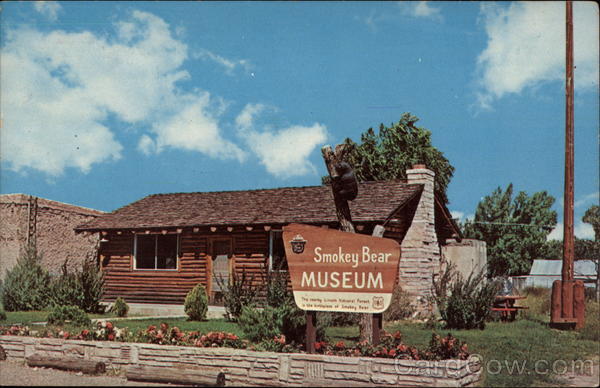
Smokey Bear Museum Capitan

Smokey Bear Museum Capitan

Everybody knows the Smokey Bear of advertising, but do you know there was a real living Smokey Bear.According to Wikipedia:

The living symbol of Smokey Bear was an American black bear three-month-old cub who in the spring of 1950 was caught in the Capitan Gap fire, a wildfire that burned 17,000 acres (69 km2) in the Lincoln National Forest, in the Capitan Mountains of New Mexico. Smokey had climbed a tree to escape the blaze, but his paws and hind legs had been burned. According to some stories, he was rescued by a game warden after the fire, but according to the New Mexico State Forestry Division, it was actually a group of soldiers from Fort Bliss, Texas, who had come to help fight the fire, that discovered the bear cub and brought him back to the camp.

Originally called Hotfoot Teddy, his name was changed to Smokey and he became a living symbol, ensconced at the National Zoo in Washington until his death in 1976. His remains were returned to Capitan, New Mexico, where there was a museum and a funerary monument in his honor.

The museum is still there, as well as a Smokey Bear Motel and a Smokey Bear Restaurant. We visited in 2003, and plan to drop in again to pay our homage to Smokey. Martine has a special devotion to Smokey. She has a special 50th anniversary stuffed Smokey Bear, as well as a zipper pull. Our refrigerator has two Smokey Bear magnets.

This Sign Appears All Over the Southwest

This Warning Sign Appears All Over the Southwest

There is even an Idaho company called Woodland Enterprises, which Martine has visited and which sells Smokey Bear (and Woodsy Owl) memorabilia. We shop there annually for gifts.

So Capitan, New Mexico, you can expect us some time this summer.

Dreaming of … London?

50327110. Tulum, QRoo.- Los voladores de Papantla y los Guerreros Mayas, dan la bienvenida a los más de dos mil turistas locales, nacionales y extranjeros, que día a día visitan la zona arqueológica, que es de un kilómetro, donde algunos prefirieren hacerlo caminando o existe a su disposición un pequeño transporte en forma de tren. NOTIMEX/FOTO/FRANCISCO GÁLVEZ/COR/ACE/

Totonac Voladores at El Tajin

Last night I had particularly vivid dreams. Was it because I had eaten watermelon before going to bed? If so, I might be in for more dreams tonight.

Martine and I were in London at a large museum. I noticed that a number of English dressed in red “Beefeater” costumes were flying in the air by their feet just like the Totonac voladores at the ruins of El Tajin in Mexico’s State of Veracruz. I mentioned to Martine that it must be a traditional English Maypole ceremony—though, God knows, the real Maypole does not involve anything quite so spectacular.

At the same time, I noticed that several large buildings in London were aflame. Since the fires were several blocks away, I didn’t particularly care. I was slightly miffed that Martine, as usual, was being too slow and meticulous about seeing all the exhibits. I, on the other hand, wanted to catch a particular train to the north.

Somewhere along the line, my desire to go was also to visit a particular bookstore. At that point, I woke up.


A Weekend With Dan

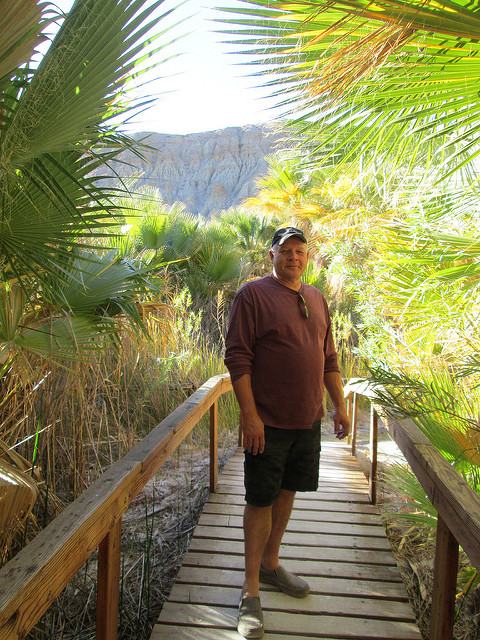
My Brother Dan in the Thousand Palms Oasis

My Brother Dan at the Thousand Palms Oasis

I will be taking the next three days off from posting on this website. Tomorrow morning, I will pick up a rental car and start heading for Palm Desert to spend some time with my brother and sister-in-law. Among other things, I need to coordinate with Dan about our upcoming trip to Ecuador.

Unfortunately, Martine will not be coming with me—at her request. Not only does she hate the desert after spending two years working at the Twentynine Palms Marine Combat Center, but she is now on a super-strict diet regimen called FODMAP.  That’s short for Fermentable Oligo-Di-Monosaccharides and Polyols. (You’ll need Adobe Acrobat to be able to read this file.)

Two weeks ago, she finally saw a gastroenterologist at Cedars-Sinai Medical Center and was told to avoid onions, garlic, and virtually all foods that have vowels in their names. She has done a fair job of adhering to it, and she has been free of abdominal pain and irritable bowel syndrome (IBS) during that time. I wish her luck, and I very much want one day to travel with her again.

If I have the time, I hope to have some new desert photos to share with you.


The Cook

I Do All the Cooking at Home

I Do All the Cooking at Home

At some point during the 1960s, I discovered that eating out at restaurants all the time was going to:

  1. Eat into my finances
  2. Deprive me of the fruits and vegetables I needed to survive and
  3. Make me tired of eating out all the time

I knew what good food was because I was raised on my Mom’s Hungarian home cooking, supplemented by my great grandmother Lidia’s special dishes. But I made the mistake of never learning from them, though I did help my Mom from time to time, mostly stirring the pot so the food would not burn.

My first experiments were pretty bad: They usually had too many spices (more or less randomly chosen) and relied excessively on rice and pasta as the carbohydrate base. Also I used way too much ground beef, for which I now substitute lean ground turkey.

When Martine came to live with me in the early 1990s, I also had to learn to cook to please her. This is not easy. Martine cannot eat spicy food, and there are too many ingredients that she flat-out doesn’t like. Also, as she suffers from recurring bouts of irritable bowel syndrome, I have to be able to turn on a dime and cook something especially bland at a moment’s notice. This week, for example, despite the heat and humidity, I made a pot of vegetable soup.

Tonight, I plan to cook Ree Drummond’s spaghetti with artichoke hearts and tomatoes. I like her recipes because they are well conceived, simple, and lavishly illustrated. Her cooking column is called “The Pioneer Woman.” I haven’t found a clinker yet in the lot.

Why do I do all the cooking? Well, for one thing, Martine is notably maladroit at cooking; and her mother prepared the most vile dishes I have ever eaten. (Her vegetables were greasy!) Secondly, I like to cook. It makes me feel good about myself. Every once in a while I experiment with a new recipe that I have to throw out, but essentially I have a fairly decent repertoire of healthy dishes that I can rely on to see us through.

I’ve cooked the spaghetti with artichoke hearts and tomatoes two or three times before with good results. I just have to make sure the tomatoes are chopped up fine because big pieces of tomato are one of Martine’s bête noires.

Back from Mexico Lindo

At Cabo’s El Arco

At Cabo’s El Arco

We just returned from Cabo San Lucas a few hours ago. It was everything I hoped it would be: I got a good rest just before the rigors of another tax season. For Martine, it was not so good. She was so frightened of getting traveler’s diarrhea that she was overcareful of what she ate and drank. Also, her problems with sleep came down to Mexico as part of her luggage. I tried my best, but some other solution will have to be found for her. I suspect the ultimate solution for her as-yet nameless ailment will be either chiropractic of acupuncture. AMA-style medicine just gets her into trouble with bad prescription drug reactions. Getting her to agree to either will take some doing.

Fortunately, we stayed at a nice resort on Solmar Beach called the Playa Grande Resort & Spa. We ate most of our meals there, making occasional forays into town to have great seafood dishes for which Cabo, as a fishing town, is famous.