The Moral of Dutch Still Life Paintings

Jacob van Hulsdonck’s “Still Life with Lemons, Oranges, and a Pomegranate”

I have always found classical Dutch still life paintings to be interesting. In many of them, one can find insects devouring the fruits and flowers depicted. But even if insects are not present, as in Jacob van Hulsdonck’s fruit bowl above, there is an implied message that the fruits depicted will be only around for a while.

According to the Getty Center’s website description of the painting:

The still life attests to the fragile and fleeting properties of the natural world. The dimpled skin of the lemons and oranges; the juicy, glistening insides of the pomegranate held gently together by the thin white tissue of the pulp; the leaves and blooms still attached to fruit; and the shiny droplets of water in the foreground are all brilliant, short-lived effects captured on panel.

Ever since I first noticed this tendency, I have always spent extra time viewing Dutch still life paintings. Even if it’s not a Rembrandt, it is a message to us from four centuries ago that tempus fugit. The message is underlined by the fact that the fruit sits in a Ming dynasty bowl of the sort that could be found in a prosperous merchant’s house.

The Art of Mihaly Munkácsy

Mihály Munkácsy’s “The Cell of the Condemned”

This is the first of several posts I will write about famous Hungarian painters. IO begin with Mihály Munkácsy (1844-1900), known primarily for his genre paintings and Biblical scenes. Although of Bavarian origin, he changed his name to reflect the town of his birth: Munkács. He traveled extensively in Europe and worked with a number of well-known artists of the time.

According to Andrienn Szentesi, writing in The Essential Guide to Being Hungarian, edited by István Bori:

Mihály Munkácsy’s first masterpiece was Siralomház (Cell of the Condemned). Fifteen human figures can be seen in this painting, people to whom, it is safe to presume, something terrible has just happened. Dark hues, not least various shades of brown and black, have the run of this painting, too; and of course this serves to reinforce the work’s depressing theme. Also discernible, however, is just ba bit of white and red; for example, a little girl calls attention to herself as she stands in a corner in a red skirt. What has she just been through? What fate awaits her?

Mihály Munkácsy’s “Paris Interior”

Somewhat lighter is Munkácsy’s Paris Interior (above). A young woman sits reading while a small child plays on the floor behind her.

Mihály Munkácsy’s “Christ Before Pilate” (1882)

Above is one of three Biblical subjects painted in a series that also included Golgotha and Ecce Homo.

Munkácsy dies in a Bonn mental hospital in 1900. As the Wikipedia article on him says, “Neither 19th century visual art nor the historical developments of Hungarian art can be discussed without considering Munkácsy’s contributions. His works are considered the apogee of national painting. He was a standard-setter, an oeuvre of reference value.”

Pitocchetto

Giacomo Ceruti’s “The Beggar at Rest”

Yesterday, I decided to escape the summer heat by visiting the Getty Center and reveling in some great works of art. One of my favorite discoveries was a whole gallery full of paintings by the Italian Giacomo Ceruti (1698-1767). He was known as Pitocchetto, which means “The Little Beggar,” probably because so many of his paintings highlighted beggars, the poor, and people in humble occupations.

It’s a nice change from all the magnificent kings, princes, and nobles resplendent in gold and silk. One art critic, Mira Pajes Merriman, writes that Ceruti’s paintings confront us with

the detritus of the community; the displaced and homeless poor; the old and the young with their ubiquitous spindles, eloquent signs of their situationless poverty and unwanted labor; orphans in their orderly, joyless asylums plying their unpaid toil; urchins of the streets eking out small coins as porters, and sating them in gambling; the diseased, palsied, and deformed; lonely vagabonds; even a stranger from Africa—and all in tatters and filthy rags, almost all with eyes that address us directly…

And yet, confronted with one of his paintings, one is arrested by a different vision of the baroque era, not so different from our own tent encampments of the homeless.

“The Dwarf” by Giacomo Ceruti

One thing that sets Ceruti apart is that he allows his subjects their dignity, irrespective of the lowliness of their social status. He is above all a compassionate artist who is not above showing us an alternative picture of his times.

Dream Pictures

There is something dreamlike in the paintings of Henri Rousseau (1844-1910), mistakenly nicknamed Douanier Rousseau (he never worked for customs). Perhaps his most famous painting is that of the Sleeping Gypsy, shown above, in the presence of a lion, a stringed instrument, and a piece of pottery. Many of Rousseau’s paintings are set in the jungle or the desert, though he himself never visited either.

Below is one of his jungle scenes:

This painting is title Dreams of Henri Rousseau. The two jungle cats in the foreground have the same expression of the eyes as the lion in Sleeping Gypsy. As the art historian Daniel Catton Rich wrote:

His approach was far from literal. Inspired by his vision he arbitrarily rewove the appearance of nature to suit his purpose. The long series of imaginative paintings show Rousseau obsessed by one repeated scheme of composition. He imagines a strongly lighted distance against which he silhouettes darker forms of trees or foliage. Plane upon plane is piled up in intricate design, and usually two small figures focus the eye on the foreground. This same ‘dream picture’ haunted him from the days of “Carnival Evening” to the last jungle picture he painted.

Hitherto tied to the more realistic classics, Henri Rousseau represented an abrupt journey in the direction of modern art. His reality was what he dreamed it to be. Fortunately, it was close enough to actual reality in its intent if not its execution to remain mainstream long after many masterpieces of abstract expressionism fall by the wayside.

Rembrandt Laughs

Rembrandt Laughing—Self Portrait ca. 1628

One thing about the later paintings of Rembrandt Harmenszoon van Rijn’s later paintings: They were pretty somber. Not only somber, but Old Testament somber. Therefore, it was nice to see something he painted in a lighter vein when he was in his early twenties.

What made Rembrandt laugh? He must have seen me accidentally dump a bowl of clam chowder in my lap at the Getty Center. The original is a small painting, only 22.2 cm × 17.1 cm (8¾ in × 6¾ in).

I think that, as we get older, we sometimes forget to laugh.We look at the news and are dismayed. We examine the younger generation’s report cards and strange subculture and are nonplussed. We visit the doctor and realize we are not immortal. But we can still laugh. If we can laugh, I think we will live longer and better. The young Rembrandt knew that. The older Rembrandt? Not so much.

For Rembrandt to yuck so heartily while wearing an uncomfortable-looking steel collar is all the more remarkable. I like this Rembrandt. He is fun without being quite so Harmenszoon, and that is a good thing.

This is the first of a series of posts I refer to as gallery talks, based on my visits to various art museums. This particular painting is at the Getty Center.

How Not to Serve Clam Chowder

Today, for the first time since quarantine began, I went to visit the Getty Center. There was an interesting exhibit of paintings by Hans Holbein the Younger, plus the usual permanent collection.

After seeing the Holbeins, I walked down to the café and ordered a cup of clam chowder. It was good and hot and tasty. I got up to get some black pepper, but when I returned to the table, I managed to dump most of the chowder into my lap, with some going on my shirt and other bits on my work boots.

There is no way to look cool when you are wearing a serving of clam chowder. I did the best I could to wipe the chunky bits off my clothes. Then I looked for a bench in an isolated part of the grounds and sat there to let the soup dry off my clothing.

On the plus side, I did see some interesting paintings. The idea came to me to write follow-up postings on individual art works that particularly impressed me—which I will start in a day or two.

I regret to say that I am off clam chowder for the time being.

A World Class Art Museum

The Cleveland Museum of Art

One would think that I would praise the Los Angeles Museum of Art to the skies. I don’t. (Too much non-representational modern garbage.) Instead, I think back to the Cleveland Museum of Art as reflected in the lovely lagoon which leads to the main entrance. It was surrounded by two universities which have since joined into one: Case Western Reserve University used to be the Case Institute of Technology and Western Reserve University.

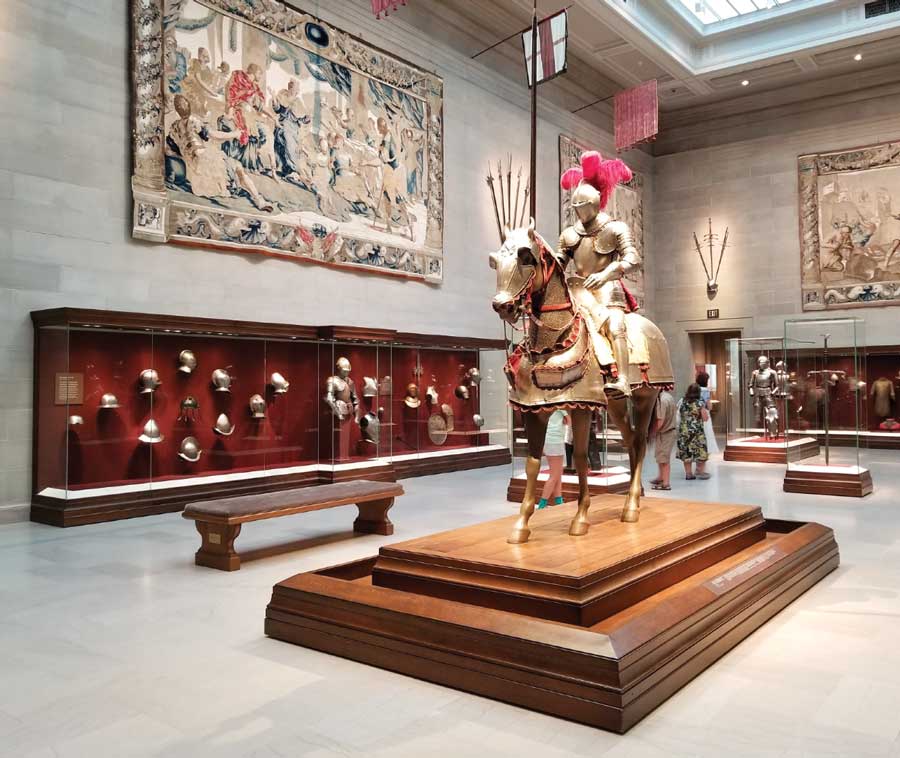
As a high school student, I used to take the bus down to University Circle and take an art appreciation class taught by the museum staff. After each class, I would stroll around the galleries, especially the one dedicated to the French Impressionists. There was a particularly beautiful Van Gogh there. And, as a kid, I loved the medieval armor gallery, the like of which I have never seen in any other art museum.

The Armor Court at the Cleveland Museum of Art

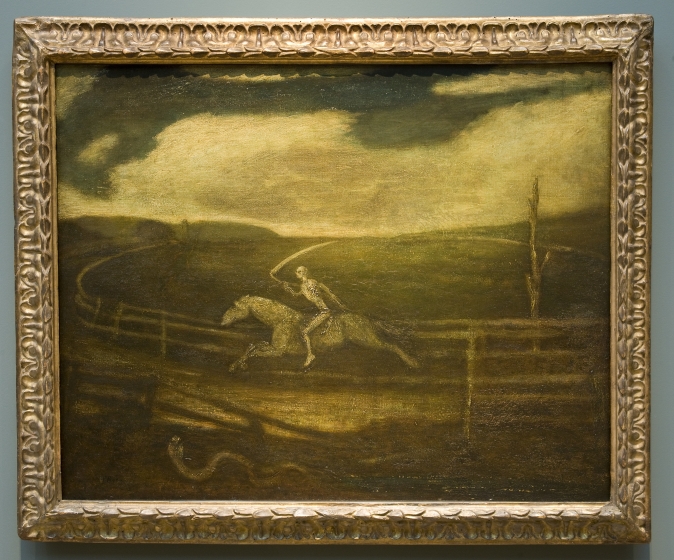
There wasn’t a whole lot of abstract expressionism around, though I suspect there is more now. The closest I came to liking modern art was a moody painting by the American Albert Pinkham Ryder (1847-1917). It was called “Death on a Pale Horse.” I am happy to hear the painting is still there.

“Death on a Pale Horse” by Albert Pinkham Ryder

Each time I went to the museum, I would have lunch at a soda fountain by East 105th Street, always ordering a lime rickey, which was pretty much like a lemonade except it was made with lime. Back then, I thought of lime as an exotic fruit instead of an accompaniment to my tequila.

Places like the Museum meant a great deal to me. It was a way I could get away from home on a Saturday and enjoy myself and learn something at the same time.

Opus Tesellatum

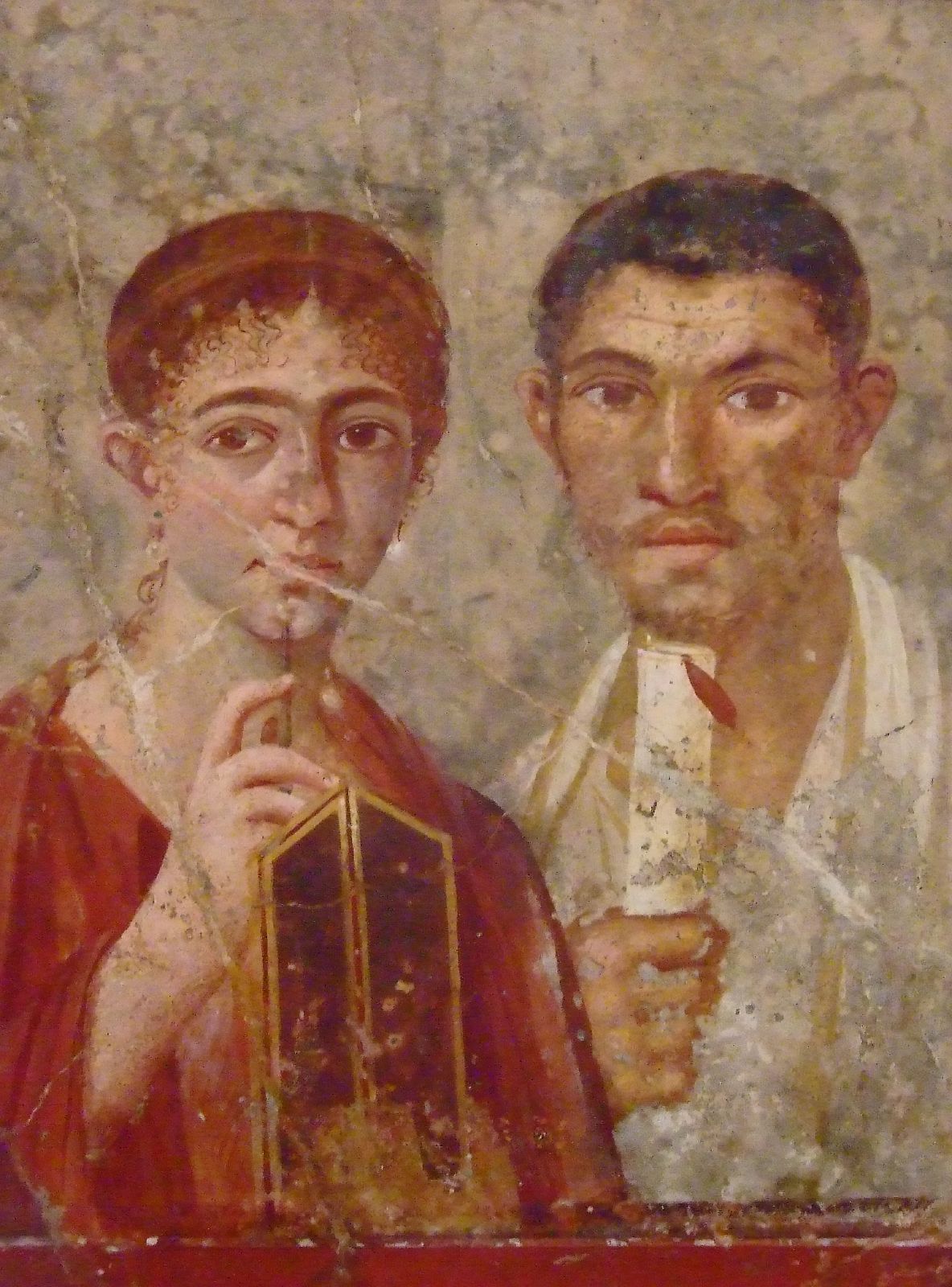
Well-To-Do Young Couple from Pompeii

Many years ago there was an exhibit at the Los Angeles County Museum of Art (LACMA) of various objects found at Pompeii that had been covered by the ash from Mount Vesuvius. I remember seeing the original of the above mosaic in the exhibit, which looked much better than the illustration above.

According to an article by Mark Cartwright published in 2013:

Mosaics, otherwise known as opus tesellatum, were made with small black, white and coloured squares typically measuring between 0.5 and 1.5 cm but fine details were often rendered using even smaller pieces as little as 1mm in size. These squares (tesserae or tessellae) were cut from materials such as marble, tile, glass, smalto (glass paste), pottery, stone and even shells. A base was first prepared with fresh mortar and the tesserae positioned as close together as possible with any gaps then filled with liquid mortar in a process known as grouting. The whole was then cleaned and polished.

In addition, there were wall paintings from Pompeii, but these dis not impress me greatly. It was as if painting was a kind of poor man’s version of mosaics. What surprised me was that, in so many instances, there were paintings of statues.

Mosaic of Fish and Ducks

There were even some historical mosaics, such as this badly damaged view of Alexander the Great and his army:

Mosaic of Alexander the Great with His Army


In almost every case I have seen, the Roman mosaics were superior to the paintings of the period that I have seen. When one sees the original of one of these mosaics, one is impressed by the vividness of the image and the superiority of the medium. When I see a Pompeii exhibit or attend the Getty Villa, I always end up feeling that, with the end of the Roman Empire, we have lost a great art form.

Outliers: Rick Bartow, Mad River Wiyot

Deer Spirit by Rick Bartow (1946-2016)

Today, Martine and I visited the Autry National Center, which was putting on a show of the late American Indian painter and sculptor, Rick Bartow, entitled “Things You Know But Cannot Explain.” I was enthralled by Bartow’s vision of people and the wild animals whose spirits have invaded them. A member of the Mad River Band of Wiyot Indians, Bartow  lived much of his life around Newport, Oregon.

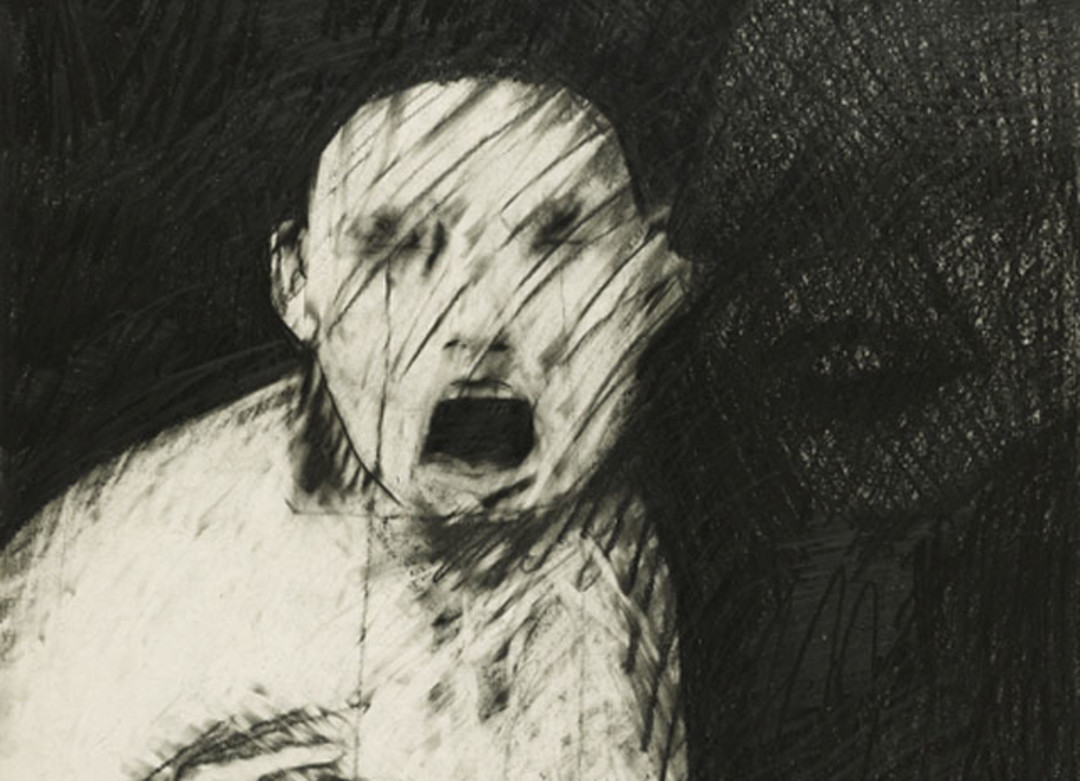
The deer spirit illustrated above is typical of Bartow’s depiction of human verging on totemic animal. Another is the drawing that gave its name to the show:

“Things You Know But Cannot Explain”

Note the face seeming to emerge from the upper right behind the foreground figure, who appears to be paralyzed with fright. Much more traditional is the drawing of three hawks below.

“Three Hawks”

I may not have a drop of Native American blood in me, but I am always delighted to see creative depictions of animals I consider to be my own personal totems, among whom I include the coyote, the raven, and the bear. Because I live at the edge of the desert and Bartow lived in the wet forests of the north, he did not depict my other totems, the frog and the turtle, both of whom I associate with life-giving rain.

Some of Bartow’s most impressive works are his sculptures. Perhaps I will do another posting on those later on. They are usually formed of wood, nails, and various found objects.

At a time when much of the art work is ruled by abstract expressionist garbage, I find Rick Bartow to be rooted in an ancient tradition that manages to speak to me today.


Outliers: Henry Darger

Henry Darger, “Untitled”

Much of 20th century art, particularly abstract expressionism, has taken painting down a rathole. Mark Rothko, Jackson Pollock, Willem de Kooning, Barnett Newman—that whole crew has eschewed images of reality in favor of splotches of color and assorted shapes referring only to themselves.

Yesterday, I read an article in The New York Review of Books by Sanford Schwartz entitled “In Their Own Worlds” (June 7, 2018) which described two art exhibitions featuring folk art and other “outsider” art:

In recent decades, a tale unfolding within the larger story of contemporary art has been our gradually learning more about, and our trying to place, outsider artists. Problems begin at once, with the label. It is a description that many remain ambivalent about, and often believe should be put in quotation marks, to indicate its tentativeness. The situation somewhat echoes the moment, beginning in the 1920s and 1930s, when folk art was being taken out of attics and looked at anew, and commentators were not sure whether that term—or the labels “self-taught,” “naive,” or “primitive,” among others—was the appropriate one or would merely suffice. “Self-taught,” though imprevcise in its way—it has been said, for example, that most of the significant painters of the nineteenth century were essentially self-trained—has remained interchangeable with “folk art” for many commentators.

I have decided to focus on one of the artists mentioned in the article, Henry Joseph Darger Jr (1892-1973).

He Seems to Like Painting Pictures of Little Girls

Darger’s paintings are frequently of little girls, clothed and unclothed, sometimes with penises. In the picture above, the girls, blonde, beribboned, and, for the most part, wearing identical dresses and red socks, are running from the path of an advancing steam locomotive.

More Little Girls, This Time Including Blondes and Brunettes

Many of the Chicago artists are in horizontal scroll format. I guess what I like about Darger’s paintings is that they are so cryptic and surrealistic. One is repeatedly drawn to the images and finding something new in them. Slightly to the left of center of the above painting, for instance, is a witch riding a broom confronting a little blonde girl riding a tricycle.

I hope to find a few more outlier painters whom I like and present their work to you in future posts.