Mucho Magma

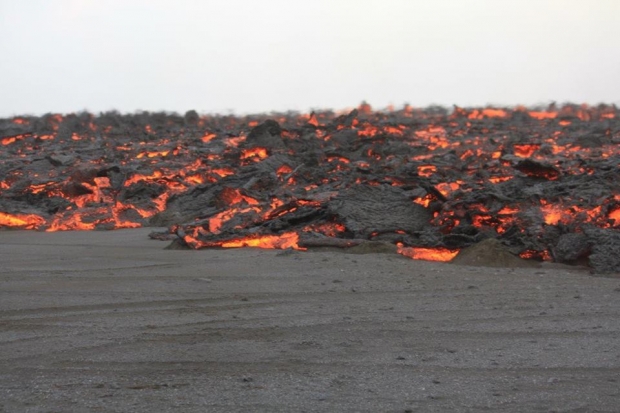
Magma from Holuhraun

Magma from Holuhraun

It’s actually a coincidence that my last two vacations were spent in countries where there are many active volcanoes. Iceland, where I spent part of Summer 2013, is now experiencing a huge eruption that is five to six times bigger than 2010’s eruptiojn at Eyjafjallajökull, which put a stop to much of Europe’s air traffic because it reduced air visibility over a wide area. It is also four times greater than Grimsvötn in the following year, which also was a major spewer of ash.

The difference with Holuhraun is that, although it has blanketed Iceland with dangerous levels of sulfur dioxide, it is known more for the massive amounts of magma produced. To date, one cubic kilometer of lava has been produced. According to The Iceland Review:

In terms of volume of lava, the Holuhraun eruption is now the biggest in Iceland since the 1783 Laki eruption (aka Skaftáreldar). The lava which surfaced during that disastrous eruption is 14 times the volume of the Holuhraun eruption.

“It now covers an area the size of Reykjavík and in some places it is 10-20 meters thick,” geophysicist Magnús Tumi Guðmundsson, who is on the Civil Protection Department’s Scientific Advisory Board, said of the new lava in Holuhraun.

This year I spent three weeks in Peru, where I saw the Volcano Sabancaya in eruption. What’s next for me? Krakatoa?

Day of the Condor

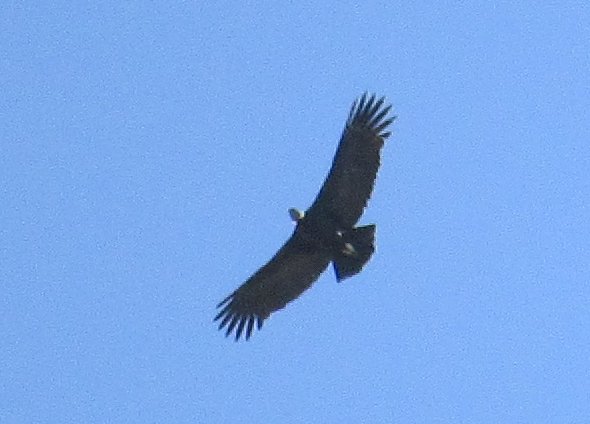
Condor at Cruz del Condor

Condor at Cruz del Condor

As I promised you, here is one of my photos of the condors at Cruz del Condor in the State of Arequipa. We were standing on the south side of Colca Canyon at a place that is famous for its thermals, which the condor population uses in the mornings as if it were an elevator to reach maximum altitude with minimum effort.

Because I do not have a super-telephoto lens that weighs half a ton, I had to enlarge the condor in this image. Even when they’re rising on a thermal, condors are lightning fast—at the same time that they are gigantic. The Andean condor has a wingspan of up to 10½ feet. Curiously, there are larger birds: the Southern Royal Albatross and the Dalmatian and Great White Pelicans, whose span can be as much as a foot longer.

Still, it is the condor that captures the imagination of South Americans. I’ll never forget seeing my first ones in Argentina in 2011, while Martine and I were taking a bus from El Calafate to Puerto Banderas to see the glaciers on Lago Argentino. Then, too, there is that most pervasive of songs, “El Condor Pasa,” a zarzuela composed by the Peruvian Daniel Alomia Robles in 1913 and popularized by Simon and Garfunkel in their Bridge Over Troubled Water album. If you’re not familiar with the tune, click here. In Lima, at the Palacio de Gobierno, I even saw a Peruvian military band goose-stepping to the music as they played it.

Paintings of archangels done by the Quechua painters of the Cusco School of Art are wearing the wings of mature condors, which are two-toned.

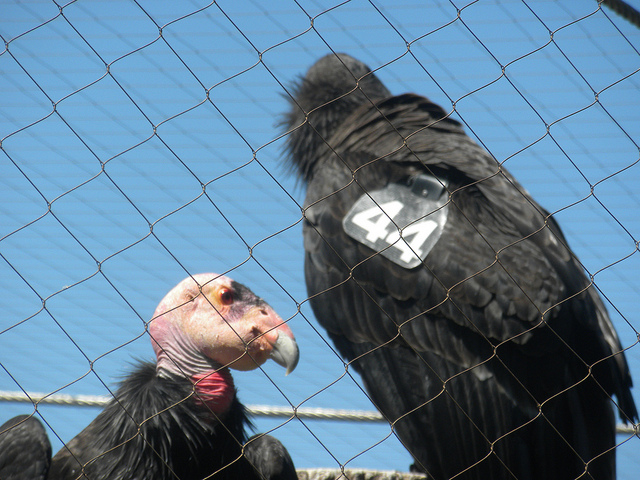
We in California have our own condors, which we are trying desperately to save from extinction. I saw a couple of them once at the Santa Barbara Zoo (below) looking very disconsolate from their extended captivity.

California Condors at Santa Barbara Zoo

California Condors at Santa Barbara Zoo

God knows they are not the most beautiful of creatures, but they come close to being among the most magnificent.


The Deepest Canyon?

Colca Canyon in the State of Arequipa

Colca Canyon in the State of Arequipa

Even before my plane ever landed in Peru, I knew that there was a lot more to see than Machu Picchu. In fact, some of the sights were probably more interesting than Machu Picchu—and a whole lot easier to get to.

It could very well be that the most interesting place I visited on my travels was Colca Canyon in the State of Arequipa. It is, together with nearby Cotohuasi Canyon, the deepest on earth—at points more than twice as deep as our Grand Canyon (though certainly not in the above photo).  It was interesting not only from a cultural point of view, but for the range of activities available, the quality of services, and the outstanding scenery.

Two native groups dwell in the area, often interspersed: the Collaguas and the Cabanas. From the time one approaches the altiplano at Patapampa (altitude 15,000 feet or 4,600 meters), one encounters them selling their handicrafts by the side of the road. One could buy quality alpaca sweaters, scarves, and other handmade objects for a few dollars. Around the canyon are a number of villages, including Chivay (the largest), Coporaque, and Maca.

Along the south bank of the canyon west of Chivay is the famous Cruz del Condor, where one can see condors riding on the thermals in groups of two or three. (Look for a separate post on this later in the week.) The scene above is on the way to Cruz del Condor. Visible on the other side of the canyon are agricultural terraces designed by the Incas. The Collaguas and Cabanas maintain them faithfully. This picture was taken at 12,000 feet altitude or 3,650 meters.

I actually took a guided tour to Colca with Giardino Tours of Arequipa. I don’t usually do this sort of thing, but I had no cause to regret it. Our tour guide, Luis, was funny and intelligent, and I deliberately arranged not to participate in some of the strenuous uphill hikes (at high altitude) that were part of the program. (As I would frequently say, my intention was not to be buried at Colca Canyon). One useful feature of the tour was that we were dropped off in Puno, eliminating the need for a separate bus.


… And Then He Spit in My Face!

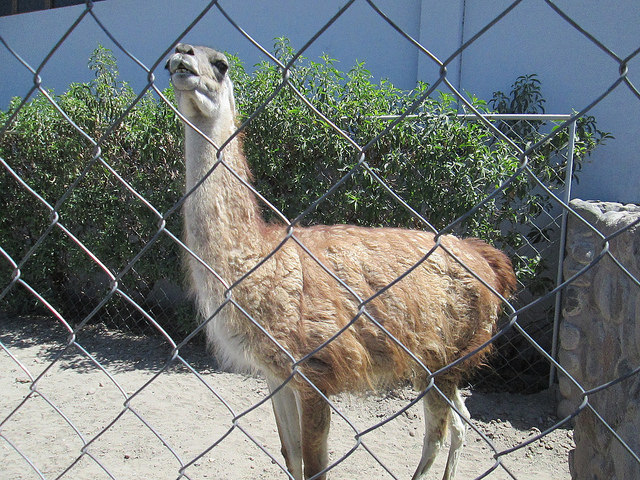
A Caged Guanaco with Exquisite Aim

A Caged Guanaco with Exquisite Aim

We all know that camels spit at people, but did you know that American “camelids” can also do it? There are four species of American camelids in South America: guanacos (Lama guanicoe), llamas (Lama glama), alpacas (Vicugna pacos), and vicuñas (Vicugna vicugna).

In any case, there I was, visiting the store and little zoo at Incalpaca on the outskirts of Arequipa. It was there I saw this guanaco depicted above who was just in the process of accumulating saliva, which he forthwith spit right into my eye. The Peruvians who were traveling with me all broke into laughter, which I could not help joining in. After all, I was wearing glasses; so all I had to do was wipe them clean.

The guilty guanaco, having done his foul deed, stood proud and tall. This one yanqui forgave him. At the end of the day, I moved on; but he was still in his cage. (At least, he didn’t have to worry about being hunted down and eaten, as his kind are frequently in Argentina and Chile.)

Kittikat Haven

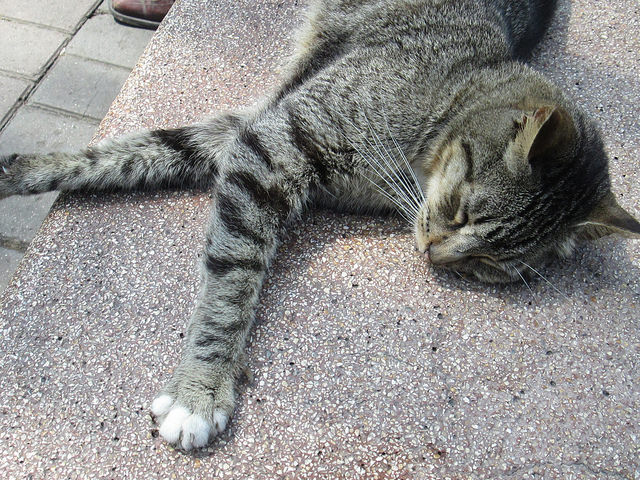
The Contented Cats of Lima’s Parque Kennedy

The Contented Cats of Lima’s Parque Kennedy

If there is a magnet to which foreign tourists are drawn in Lima, I would have to say it is Parque Kennedy in Miraflores. The triangular park is surrounded by tourist shops and restaurants, including the notorious Calle de los Pizzas. It is also full of contented cats, who were originally introduced to rid the park of rodents. But, as usually happens, the cats multiplied and became a tourist attraction in their own right. Now the city makes sure they are spayed, has an adoption program for them, and makes sure they are fed and not bothered.

Parque Kennedy reminds me of the Jardín Botánico Carlos Thays in Buenos Aires. Curiously that park is also triangular in shape; and there, too, the cats are much loved and well cared for. (I begin to detect a pattern here.)

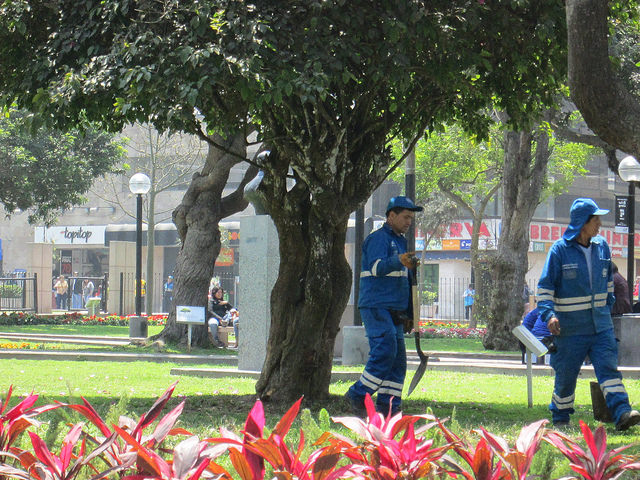
Uniformed Gardeners and Sanitation Workers in Parque Kennedy

Uniformed Gardeners and Sanitation Workers in Parque Kennedy

In parks and other public places around Peru, one finds uniformed gardeners and sanitation workers (shown above) keeping the place clean and beautiful. I believe they also feed the cats and make sure they have water to drink.Throughout Peru, the public places were like oases that drew people who wanted to rest, read a newspaper, or get their shoes shined. The day I left for Arequipa, I spent several hours there petting the cats and relaxing before having a great lunch at La Lucha Sangucheria across the street.


Jivaro Juice

Shrunken Heads from the Amazon

Shrunken Heads from the Amazon

I did not visit the Amazonian regions of Peru for two simple reasons:

  1. Mosquitoes and I do not get along well together
  2. I did not want to have my head shrunken like the two individuals above

Everything I know about shrunken heads—and many other subjects as well—come from a misspent youth reading Uncle Scrooge comics. In 1958’s “The Money Champ,” Scrooge McDuck is in competition with South African squajillionaire Flintheart Glomgold to see who has the most money. Unfortunately for the Duckburg millionaire, Flintheart has a supply of Jivaro Juice which he had obtained from head-hunting and -shrinking natives, and which he intends to use to shrink Scrooge’s money pile. In the following panel, Donald’s truck has been shrunk by the ruthless Glomgold:

What Jivaro Juice Did to Uncle Donald’s Truck

What Jivaro Juice Did to Uncle Donald’s Truck

The shrunken heads above come from Lima’s massive Museo Nacional de Arqueología, Antropología e Historia del Perú. Maybe next time I’ll visit the Amazon, but don’t count on it!


The Mysterious Convent

The Gateway to Santa Catalina Convent

The Gateway to Santa Catalina Convent

There are hundreds, perhaps thousands of colonial sights worth seeing in Peru. Probably the most fascinating of them all, however, is the Convent of Santa Catalina in Arequipa. It’s almost more of a citadel than a convent, though some nuns still live on the grounds. It is a gigantic place with stairways leading to nowhere—mainly because most of the second floor was destroyed by the many earthquakes that have hit the city.

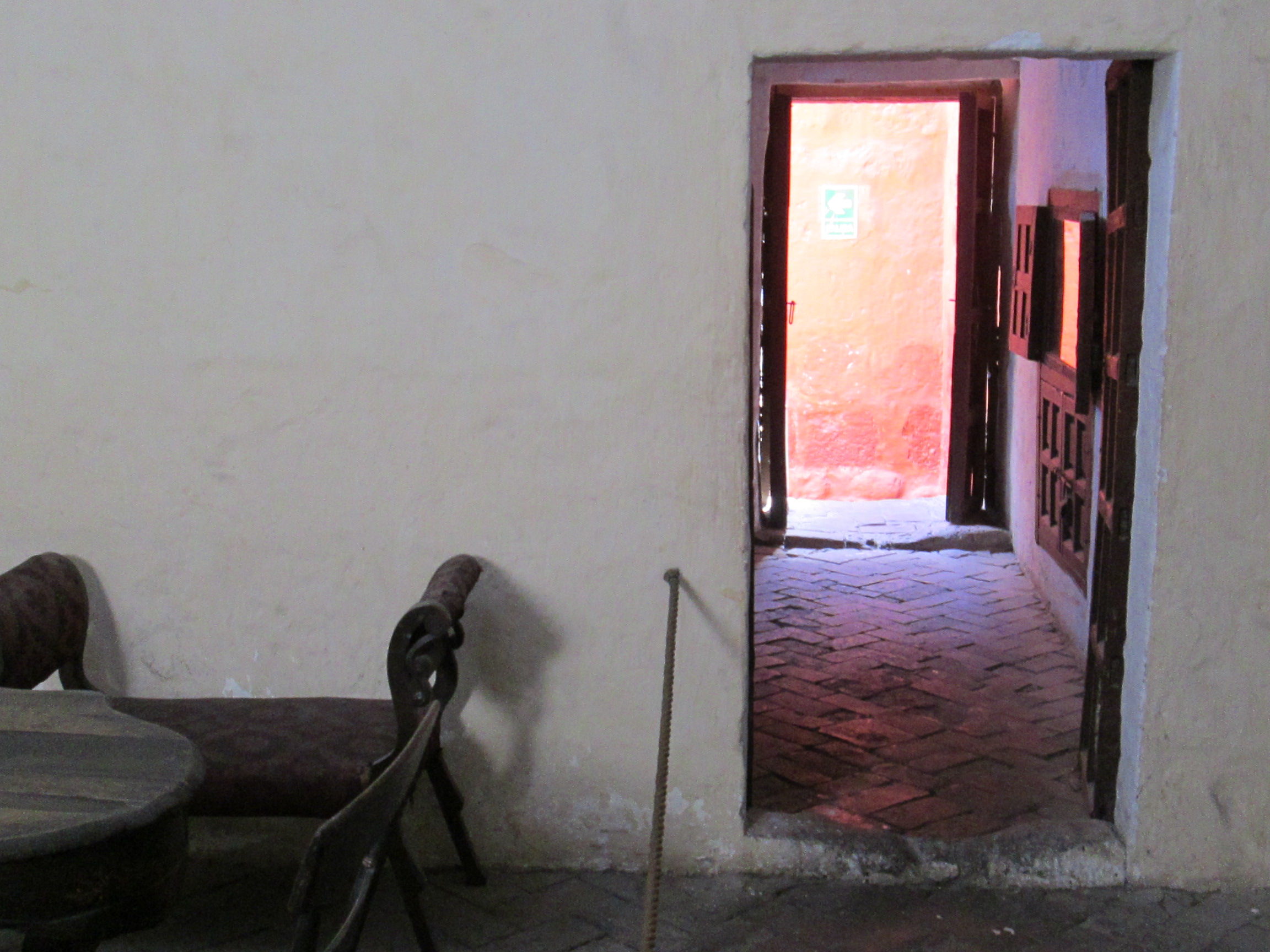
It is easy to spend all day wandering through the streets of the convent and in and out of the nun’s cells (such as the one illustrated below). More than anything else, it reminds me of the miniature cityscapes of the Anasazi ruins at Mesa Verde in Colorado, except the convent seems to go on forever.

Nun’s Quarters

Nun’s Quarters

I started seeing the convent with a tour guide. That served only to whet my appetite. After a long lunch break eating rocoto relleno at a second floor restaurant behind the cathedral, I returned to the convent and spent two more hours on my own.

It was endlessly amazing: passages that led off in every direction, walls painted red for public areas and blue for private (or at least previously private) areas. It was as if the convent were decorated by professional artists, with flowers and old furniture and cooking utensils available everywhere.

Oven and Stairway to Nowhere

Oven and Stairway to Nowhere

As I write these words, I find myself wanting to continue exploring the convent for endless hours, looking to turn that corner where I will find cloistered Dominican nuns (of the same order that taught me at Saint Henry’s School in Cleveland, Ohio) praying for my salvation.

Where Did the Other 80% Go?

The Altar of La Merced Church in Lima

The Altar of La Merced Church in Lima

According to John Hemming’s excellent history, The Conquest of the Incas, only 20% of the gold went to the King of Spain. Where did the rest go? Pizarro and the conquistadores probably got the lion’s share, but after visiting dozens of Peruvian churches, I am beginning to think that the Church came in for a huge windfall, if not sooner, then later. You can see it at the Cathedral and San Pedro in Lima, in addition to the Church of the Company in Arequipa and the massive Cathedral in Cusco.

The first church I visited in Lima was La Merced on Jirón de la Union, whose altar is shown above. As I visited more and more churches, I saw the tons of gold and silver lavishly displayed, so much so that many of them are victims of larceny, such as the church at Maca at Colca Canyon. (Although stripped of much of its gold, it still looks impressive to me.) In the nearby church at Coporaque, I discovered a motion detector that tracked my movements in the nave with an audible beep.

Nowhere have I ever seen such a display of wealth. It is no surprise that many of the churches, such as the Cathedral at Cusco, have security personnel to protect the churches’ wealth.

There was another side to the splendor of the great Peruvian churches.

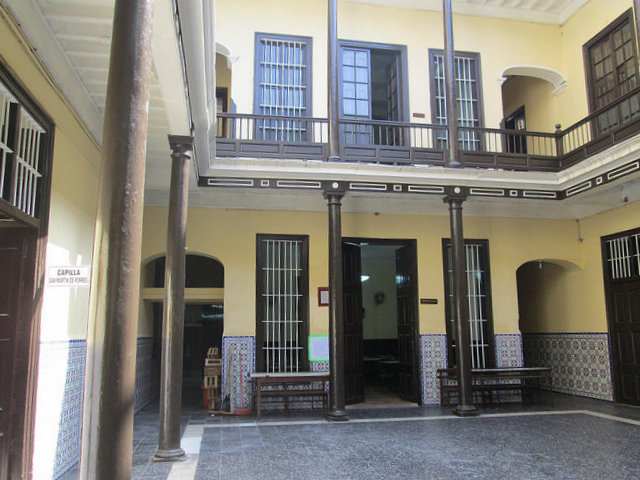
The Birthplace and Chapel of St. Martin de Porres in Lima

The Birthplace and Chapel of St. Martin de Porres in Lima

On Callao near the intersection with Tacna is the birthplace and chapel of St. Martin de Porres. The chapel is tiny (you can see the sign by the leftmost door) and contains only a prie dieu and a statue of the saint, along with a bin for prayer requests and another for contributions. The building also contains doctors’ offices and a cafeteria for the elderly poor of the neighborhood. In fact, when I was waiting for the building to open at 2:30 pm, I shared the doorway with one of the volunteers, a sweet lady who spoke little English, which added to my little Spanish, managed to allow us to communicate. Needless to say, I made a contribution.

I neglected to say that St. Martin de Porres was black and a descendent of slaves. The stories about his life have a certain sweetness to them, and he is much loved by the people of Lima.


Politics Is the Same All Over

Election Poster in Miraflores

Election Poster in Miraflores

When I arrived in Lima, I was surprised to see election posters everywhere. In the Andes, it was even worse: whole sides of houses were whitewashed and covered with election propaganda. From main highways and trains, it looked like the whole countryside was covered with “Vote for” signs. I wonder if, when the election is over, someone comes and paints over the signs; but, somehow, I don’t think so.

The two Luchos above look like they could be running for my Congressional District. And, like all politicians, they are trying to look so pleasant that you just know that they’re holding poniards behind their backs and they have closets full of skeletons.

Interestingly, in Spanish the word lucho means “I fight” or “I struggle.” Very appropriate, don’t you think?

Take the Bus to Callao?


Which Bus? Going Where and When? And Taking Which Route?

Which Bus? Going Where and When? And Taking Which Route?

I enjoy taking public transportation in other countries, even in Argentina, which manages to make sense out of several hundred bus lines. But in Lima, you pretty much have to know in advance which bus to take. There is no handy-dandy website as in France or Iceland which makes you feel confident that you’ll get where you want to go.

The street above—Avenida Jose Pardo—is probably Lima’s most European-looking thoroughfare. Both of the above buses are going to Callao (pronounced Cah-YOW), Lima’s somewhat grungy seaport, and the location of its classy airport, but I could not find any body of information that helped me decide to take the bus.

Instead, I took cabs everywhere. Even an hour-long ride from the Plaza Major to Miraflores, where I was staying, in heinous rush hour traffic cost me only about 40 soles, or about $14-16. Although one has to be careful about taking an unregistered cab, one quickly becomes used to telling the difference. When approached by a tout, who wants to take you for a roundabout walk to his ramshackle vehicle, it is best to just say no and run like hell.

Most cabbies, however, were competent and friendly and drove newish cars. No one who takes pride in his vehicle is likely to “express kidnap” you and take you a series of ATMs, where you will be forced at gunpoint to drain your bank account(s). This practice is sometimes known as the “millionaires’ tour.” Trust me, this is one tour you don’t want to take.

In addition to taking cabs, I walked for miles in Lima, Cusco, Puno, and Arequipa. By evening, I was so tired that I had no trouble sleeping for nine or even ten hours.