Fuge, late, tace

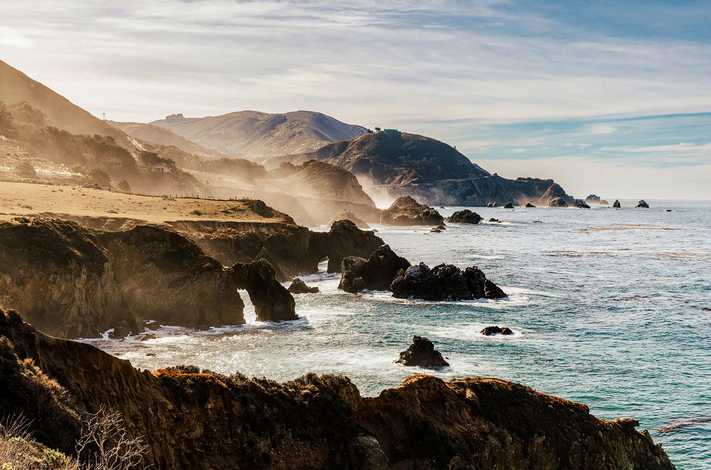
Big Sur Coastline, Central California

The last two days, I was revisiting one of my favorite authors, Honoré de Balzac. In his novel The Country Doctor (Le Médecin de Campagne), Doctor Benassis visits 5the Grande Chartreuse monastery in the French Alps and finds the following inscription left by one of the monks in an empty cell:

Fuge, late, tace

This is Latin for “Flee, hide, be silent.”

Which reminds me of Stephen Dedalus’s “Silence, exile, and cunning” from James Joyce’s Portrait of the Artist as a Young Man. It also makes me think of Russian poet Joseph Brodsky’s “If one’s fated to be born in Caesar’s empire, let him live aloof, provincial, by the seashore.”

I embrace this advice (except for the part about being silent, of which this post is a clear violation). At my advanced age, I have no hope of—or even desire for—success.

To quote the old antique dealer in Balzac’s The Fatal Skin (Le Peau de Chagrin):

Man depletes himself by two instinctive acts that dry up the sources of his existence. Two words express all the forms taken by these two causes of death: DESIRE and POWER. Between these two poles of human action, there is another principle seized upon by the wise, to which I owe my happiness and my longevity [the speaker is 102 years old]. Desire sets us afire and Power destroys us; but KNOWLEDGE leaves our fragile organism in a state of perpetual calm.

Alas, Balzac wasn’t able to follow his own advice. He burned through his life in 51 years, yearning for years to marry the Polish Countess Evelina Hanska. No sooner did he get his wish and return to Paris with his bride than he took sick and died.

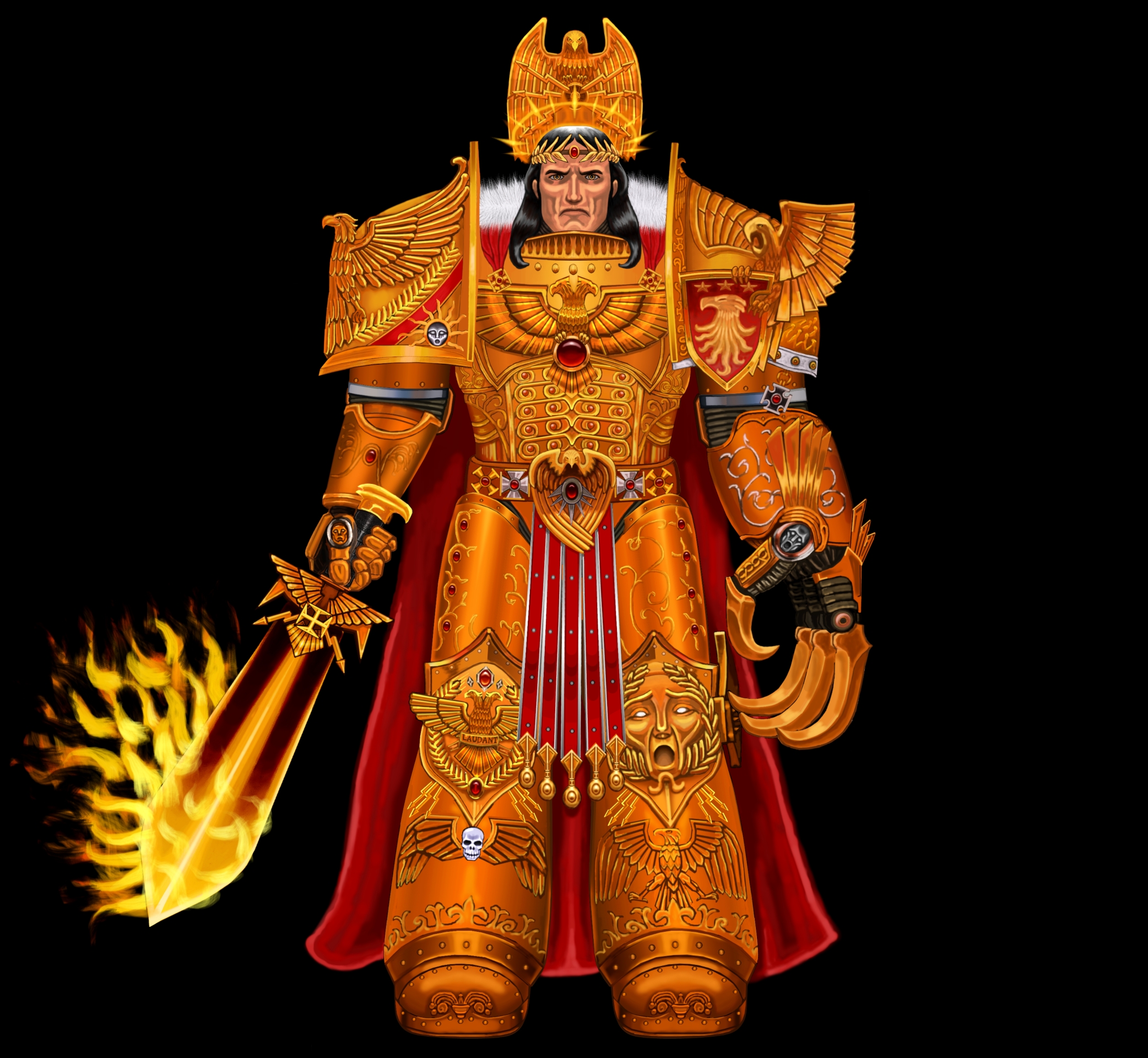
Is the Emperor Happy?

Solidus of the Emperor Petronius Maximus (Mar-May455)

I am greatly enjoying the second volume of The Barbarian Invasions of the Roman Empire, written by Thomas Hodgkin (1798-1866). This is the volume that tells of the Huns and the Vandals. More and more, I am fascinated by classic 19th century British and American historians.

The following excerpt is from Apollinaris Sidonius, a fifth century Roman poet, diplomat, and bishop. He is writing about the emperor that followed Valentinian III, who was assassinated for his part in the murder of Aetius, the last great Roman general, who defeated Attila and the Huns at Chalons in CE 451.

I received your letter … dedicated to the praises of your patron the emperor Petronius Maximus. I think, however, that either affection or a determination to support a foregone conclusion has carried you away from the strict truth when you call him most happy because he passed through the highest offices of the state and died an emperor. I can never agree with the opinion that those men should be called happy who cling to the steep and slippery summits of the state. For words cannot describe how many miseries are hourly endured in the lives of men who, like [the Roman dictator] Sulla, claim to be called Felix [fortunate] because they have clambered over the limits of law and right assigned to the rest of their fellow citizens. They think that supreme power must be supreme happiness, and do not perceive that they have, by the very act of grasping dominion, sold themselves to the most wearisome of all servitudes; for, as kings lord it over their fellow men, so the anxiety to retain power lords it over kings.

Sir Vidia Takes on Politics

Nobel Prize Laureate V.S. Naipaul

I have just finished reading V.S. Naipaul’s sixth novel, The Mimic Men (1967)—a semi-autobiographical work about what it is like to win fame and renown while coming from a place like the island of Trinidad, which he calls Isabella in the book. About fifty pages in, I came across his musings on politics and politicians, which I excerpt here:

Politicians are people who truly make something out of nothing. They have few concrete gifts to offer. They are not engineers or artists or makers. They are manipulators; they offer themselves as manipulators. Having no gifts to offer, they seldom know what they seek. They might say they seek power. But their definition of power is vague and unreliable. Is power the chauffeured limousine with fine white linen on the seats, the men from Special Branch outside the gates, the skilled and deferential servants? But this is only indulgence, which might be purchased by anyone at any time in a first-class hotel. Is it the power to bully or humiliate or take revenge? But this is the briefest sort of power; it goes as quickly as it comes; and the true politician is by his nature a man who wishes to play the game all his life. The politician is more than a man with a cause, even when this cause is no more than self-advancement. He is driven by some little hurt, some little incompleteness. He is seeking to exercise some skill which even to him is never as concrete as the skill of the engineer; of the true nature of this skill he is not aware until he begins to exercise it. How often we find those who after years of struggle and manipulation come close to the position they crave, sometimes indeed achieving it, and then are failures. They do not deserve pity, for among the aspirants to power they are complete men; it will be found that they have sought and achieved fulfilment elsewhere; it takes a world war to rescue a Churchill from political failure. Whereas the true politician finds his skill and his completeness only in success. His gifts suddenly come to him. He who in other days was mean, intemperate and infirm now reveals unsuspected qualities of generosity, moderation and swift brutality. Power alone proves the politician; it is ingenuous to express surprise at an unexpected failure or an unexpected flowering.

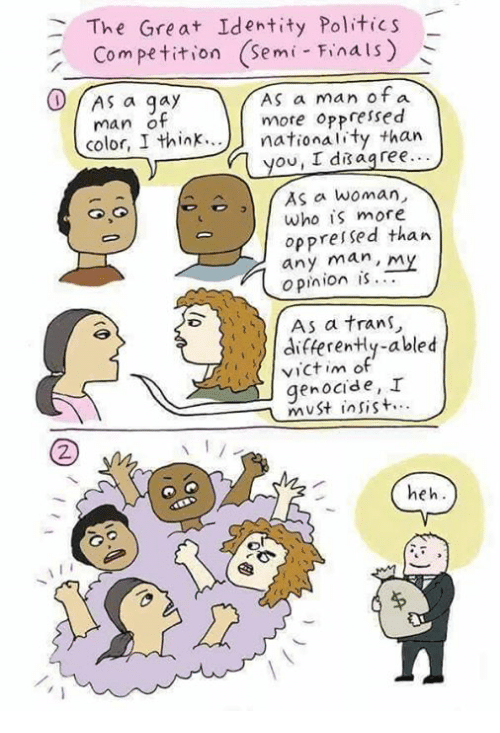
Identity Politics vs Power Politics

How We Liberals Fritter Away Our Access to Political Power

I am no longer a Democrat because I saw that the party’s emphasis on identity politics was leading it into a quagmire from which it might never return. No longer am I emboldened by gigantic protest marches—irrespective of the issues involved—nor do I care that somebody gets beaten up on Twitter or other social media. Have Liberals all become whiny little bitches who would rather be right than holding the reins of political power?

Evidently.

Hillary Clinton, Tom Perez, even Nancy Pelosi—all have been guilty of surrendering political power while pursuing some vague identity politics rewards points, which have a monetary value of $Zilch.

We are all victims of one sort or another. Instead of trading bubble-gum cards, let’s all get together, make deals with one another, and get rid of the clowns who have turned our country into a Tea Party Trash Bin. If you must insist on whining about your victimhood, lock yourself in your closet and do it in the dark, alone.


The Death of Stalin

Poster for The Death of Stalin (2018)

In my retirement, I have been seeing more current films than I usually do. Today, I went in the rain to see Armando Iannucci’s dark comedy of the transfer of power in the Soviet Union when Stalin suddenly died in 1953. Predictably, the movie was banned in Russia and several other of the former Soviet Socialist Republics. In fact, I think that in many instances the truth was stretched a bit to make a better film.

Steve Buscemi plays an ambitious Nikita Khrushchev; Jeffrey Tambor, a delightfully cowardly Georgy Malenkov; Simon Russell Beale, an incredibly evil State Security chief Lavrenti Beria; and Michael Palin, an indecisive Vyacheslav Molotov. The actor who practically runs away with the show is Jason Isaacs, playing Marshal Zhukov, who is the only member of the government who is willing to take on Beria.

Jason Isaacs as Marshal Zhukov

One of the weaknesses of the Soviet Union was that the fearless leaders were too fearful to arrange for a peaceful transition of power after their deaths. In fact, according to Simon Sebag Montefiore in his book The Court of the Red Tsar (2003), Stalin’s sudden death caused a such a crisis, so that the staff in his dacha were afraid to confront the body for fear that it meant some sort of trick that would lead them to execution or a gulag.

Georgy Malenkov is initially selected to rule because of his rank in the Politburo, but his cowardice is such that, by the end, Khrushchev is holding the reins of power.

This film is loaded with violence. Beria’s NKVD carry out executions using their sidearms with alarming regularity. There are at least several score of these executions taking place during the film.

So far, this is the best film I have seen this year.


Why I’m Not in Politics

Would I Be an Enlightened Ruler? Mebbe Not

Many years ago, a very cute young woman of my acquaintance thought I would make a good president. I looked at her, laughed, and said that I would probably be seen as another Caligula or Heliogabalus. Just look at some highlights of my first hundred days:

  • The following conservative pundits would suddenly be found dead: Sean Hannity, Rush Limbaugh, Alex Jones, the hosts of the “Fox & Friends” television show, Steve Bannon, and Bill O’Reilly.
  • Certain functionaries of the present administration would have their tongues removed, including Kellyanne Conway, Steve Miller, all of the Trumpfs, and Betsy De Vos. In addition, the head Trumpf would be physiologically unable to use Twitter once this thumbs were removed and hammered into his ears.
  • Selected weasels in Congress would be too crippled to show up for duty, most especially Mitch McConnell and Paul Ryan.
  • Anyone associated with the so-called “Alt-Right” would be considered guilty of treason and treated accordingly. Rope is cheap.

In certain conservative circles, I would be seen as the bloodiest ruler in American history. So, perhaps you all would think better of me if I were a most reasonable and non-violent member of the opposition.

Power has a way of changing people—and not always for the best.