A Grim Future?

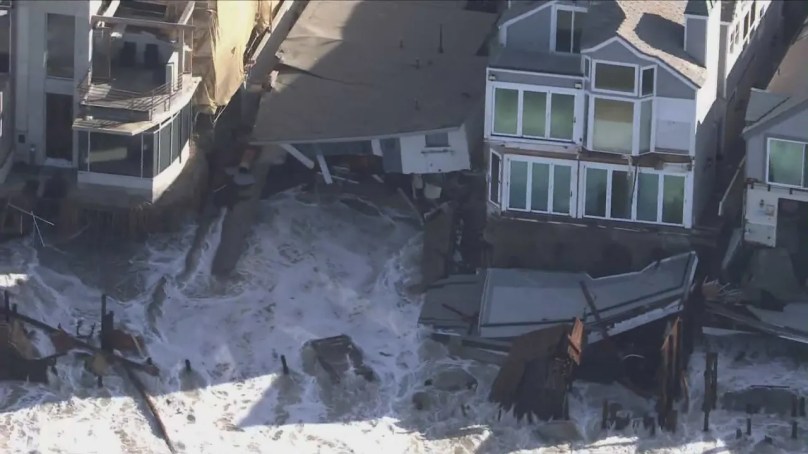
Wild Surf Destroying Beachside Homes in Dana Point

Southern California has had a rough time of it over the last two years. First there were the two January 2025 fires that destroyed two Los Angeles neighborhoods: Pacific Palisades and Altadena. Now, over the last several weeks, there was the El Niño from hell that led to the beaches from Los Angeles to San Diego counties being all but destroyed by high tides caused by a seemingly endless series of Central Pacific tropical storms.

A corollary is the superhot summer of 2026 that refuses to quit. Today the beach was hotter than the Coachella Valley. Technically, this is autumn; but it doesn’t look like it. The only thing that’s different is that the humidity is way down.

What¹s next? A killer earthquake along the San Andreas fault? The complete desertification of the California coast so that it resembles the Atacama in Chile? More wildfires? Monster flooding? Killer heat waves that make L.A. resemble a 350° oven (177° Celsius)? Will AI lead to massacres of innocent humans? Are there, in fact, any innocent humans?

Another summer like this one would make me think seriously of moving to Nome, Alaska, or Ushuaia, Argentina (which lies a mere 600 miles, or 966 kilometers, from Antarctica.

But then one tends to look mat the future by straight-lining the disasters of the past. Nature doesn’t work that way. With all our science, we have no idea what will happen next, and when, and how disastrous. Any forecasting based on this year’s events is (hopefully) jejune.

In the Year 2000

It is always fun to look at how a previous age viewed the future. More than a hundred years ago, Jean-Marc Côté drew a series of illustrations to be used for cigar boxes and postcards depicting what the world would be like in the year 2000. You can view a selection of these pictures at The Public Domain Review, from which I have taken the charming “Rural Postman” above.

Far from having flying postmen covering the farm households of America, we are now considering how to pay to deliver mail to them at all. And what kind of fuel would all these personal flying vehicles use? And, given France’s horrible auto accident rate, who would police the traffic in the air so that an accidental sneeze or text message would not send flyers plummeting to their deaths below?

A casual look outside your window would demonstrate that the steampunk dreams of yesterday were not realized. We now live in a digital world, immersed in tiny handheld gadgets with teeny-tiny screens that contain our lives and distract us mightily from the business of daily life.

And our forecasts for the future? We are so tied now to a digital paradigm that we don’t see that it can—and will—be replaced by something else, and probably sooner than we realize. Subconsciously, we have internalized Moore’s Law, which states that the number of transistors on integrated surfaces doubles every four years. But as we know, trends do not last forever. There will be a new paradigm, a new equivalent to Moore’s Law, and there we go again!

What will it be? Can it be, possibly, a return to analog? It’s possible. There may even be something which we haven’t yet begun to imagine.

Nonetheless, I will hazard a prediction. I predict that the future will bring new wonders and new problems in roughly equal measure. Certain problems that we now regard as insoluble will be solved; and new problems which will seem insoluble will emerge. Of one thing we can be sure, our children will look upon the wonders of the digital age exactly the way we look at steampunk. Those thirty-somethings tapping away on their notebook computers and iPads at Starbuck’s will look like mustachioed suspender salesmen behind the wheel of their Ford Model-Ts.