I have been to some spooky cemeteries, but I think that the spookiest one of all is El Cementario de la Recoleta in Buenos Aires. Curiously, it is also perhaps the city’s main tourist attraction.
Practically everybody who was anybody in Argentina is buried there—with some interesting exceptions. Jorge Luis Borges is interred in Geneva, Switzerland, where he died. Although Evita Perón is buried in Recoleta under her maiden name of Duarte, her husband, former dictator Juan Perón was not allowed in. He is buried on the grounds of his presidential estate at Olivos.
Many of the funerary monuments at Recoleta are spectacular. Some are grim. In a few vaults, one can look through gaps in the gates and see some occupied coffins in bad shape, apparently from families that have died out and not left instruction for their maintenance.
The last time I was in Buenos Aires, I stayed in a hotel that was across Avenida Azcuenaga from the high west wall of the cemetery. It didn’t feel spooky to me at all. It’s only by wandering up and down the rows of funerary monuments that one gets a spooky forechill.
It has now been ten years since my last visit to Argentina. Cristina Kirchner was still President of the Republic. I had an itinerary that included a visit to the Foz de Iguazu by the border with Brazil, the Patagonian resort of San Carlos Bariloche, and a bus and boat trip over the Andes to Puerto Varas in Chile.
I revisited the spectacular cemetery at Recoleta where Eva Perón is buried and the port of Tigre by the delta of the Paraná River. On my way to the bus station in Retiro, a serious attempt was made to pick my pocket at a time when I was carrying $2,000 in Argentinean pesos. (I quickly sidestepped to the right and hailed a cab.)
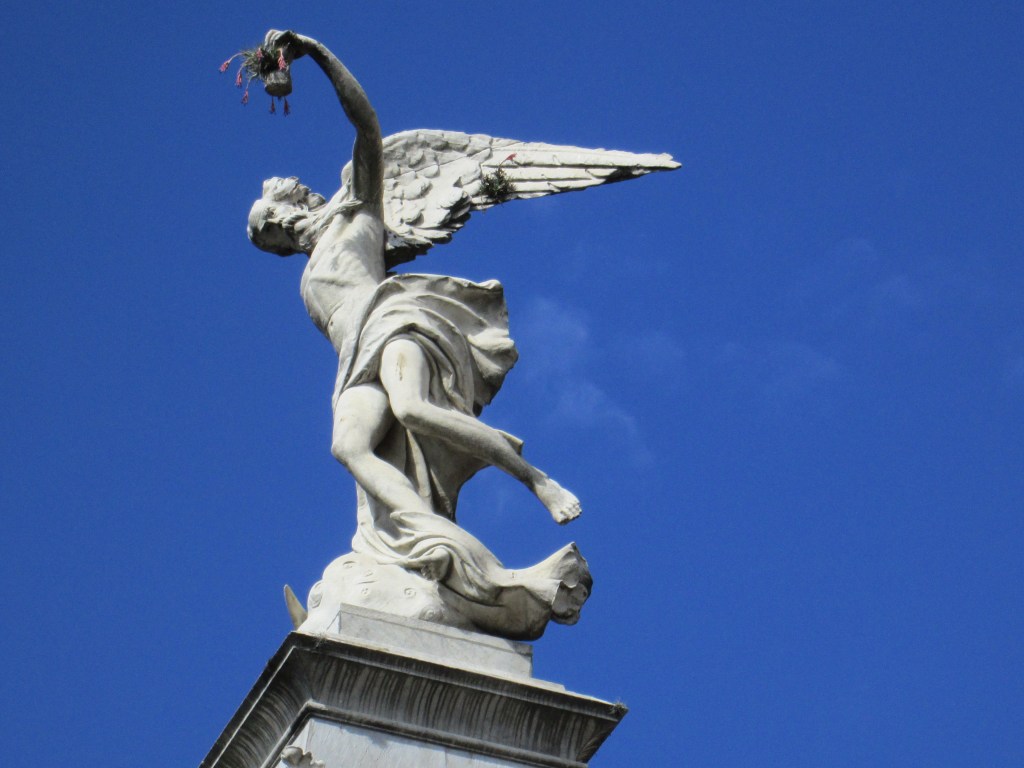
Funerary Statue at Recoleta Cemetery
I got violently ill at a hotel by the Congreso after eating a dubious steak dinner the night before, but I managed nonetheless to catch my bus to Puerto Iguazu and got better after a 10-hour bus ride that passed hundreds of fields where yerba mate was growing.
In sum, it was a great trip. As long in the tooth as I am, I would jump at the chance to visit Argentina again. The long plane ride over the Andes could be brutal, but the country is endlessly fascinating. I especially love Patagonia and Tierra del Fuego.
At the Puerto Iguazu Bus Station
Most Americans have little or no idea of what South America is really like. Over the last twenty years, I have been to Argentina, Chile, Uruguay, Peru, and Ecuador and enjoyed just about every minute of my travels there.
When former military dictator of Argentina Juan Perón died in 1974, he couldn’t be buried at Buenos Aires’s exclusive Recoleta Cemetery. It was most galling to his followers that his widow Evita did manage to be buried there with the rest of her family (née Duarte). Eventually, his body was moved to the grounds of his estate in the exclusive barrio of Olivos.
I have visited Recoleta during each of my three trips to Argentina. Why? It is actually the number one tourist destination in Buenos Aires—and it’s free. Just about everyone of note in Argentine history and culture is buried there. Adolfo Bioy Casares the writer is buried there, but the Argentina’s greatest writer, his friend Jorge Luis Borges, is buried in Geneva, Switzerland, where he died in 1986.
One of Many Bronze Commemorative Plaques Marking the Grave of Evita Perón
Among other famous denizens are past presidents such as Agustín Pedro Justo, Bartolomé Mitre, Domingo Faustino Sarmiento, Hipólito Yrigoyen, Julio Argentino Roca, Pedro Eugenio Aramburu, and Raúl Alfonsín. There’s famous boxer Luis Firpo; Isabelle Walewski, a granddaughter of Napoleon Bonaparte; warlord Facundo Quiroga; writer Silvina Ocampo and her sister, publisher Victoria Ocampo; and William Brown, Irish-born founder of the Argentinean Navy (widely known as Almirante Brown).
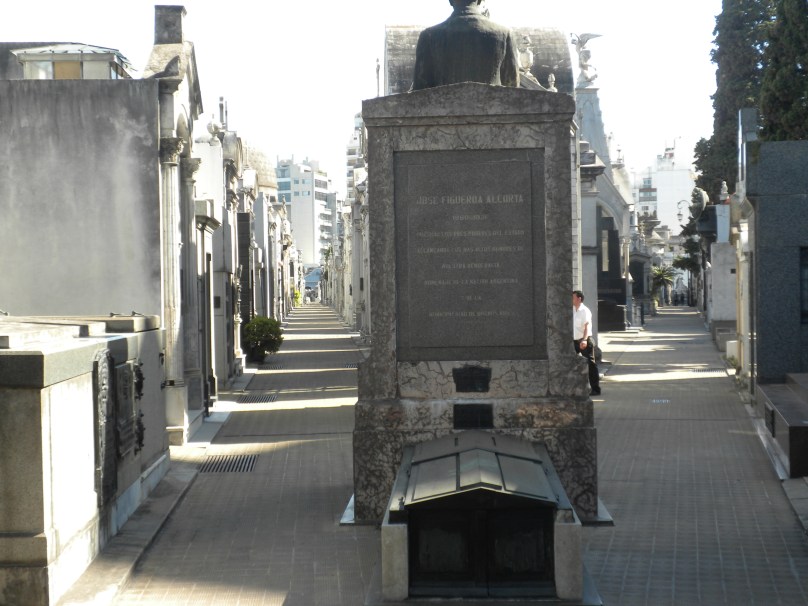
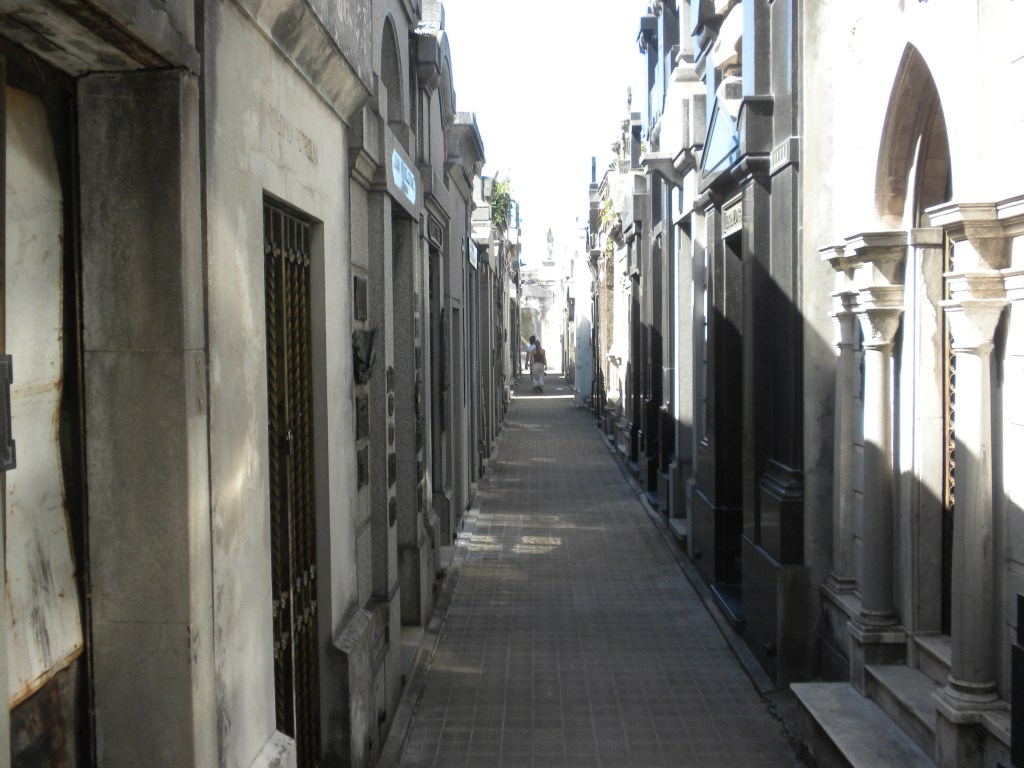
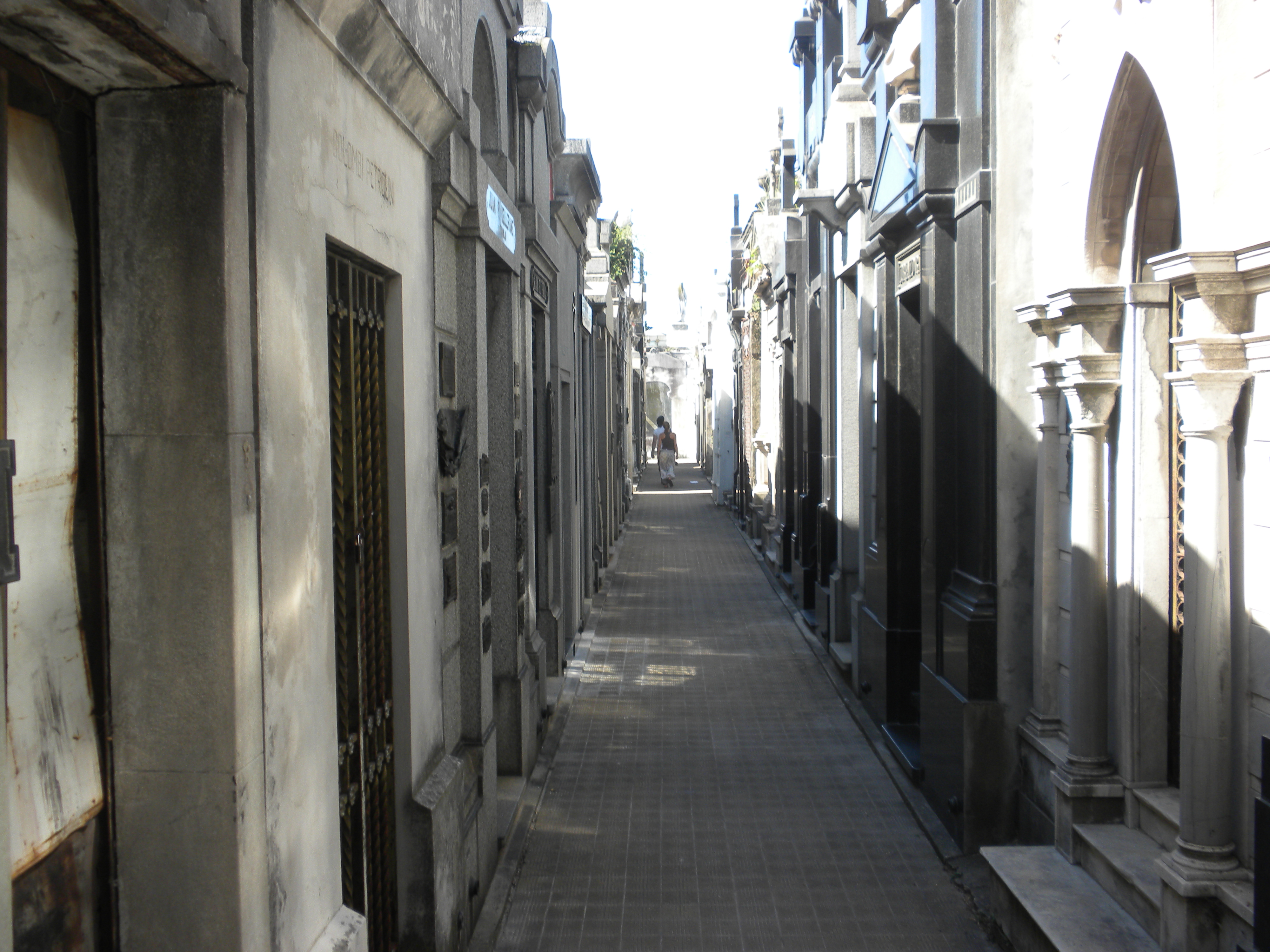
The Narrow Streets of Argentina’s Notable Dead
In fact, the last time I stayed in Buenos Aires, I stayed at a hotel right across the street from the west wall of the cemetery.
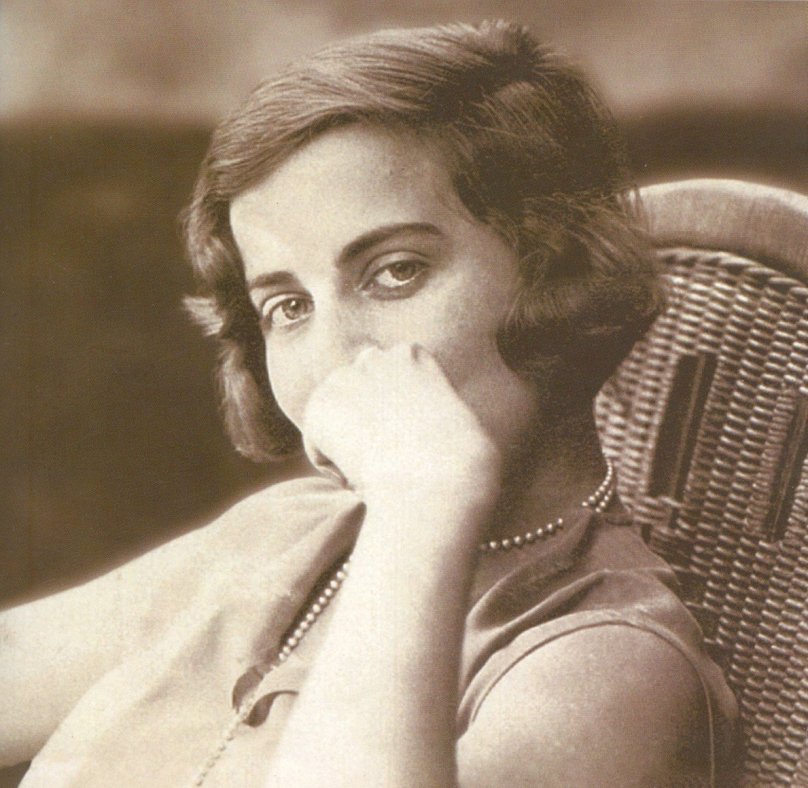
Argentinean Poet and Writer Silvina Ocampo Aguirre (1903-1993)
I’m not about to call her a poetess, because she could hold her own in the literary world of women and men. She was a great writer who was married to another great writer, Adolfo Bioy Casares, friend of Jorge Luis Borges. I understand she is buried in Recoleta Cemetery in Buenos Aires, which I have visited three times without finding her grave. I will have to make another visit and try harder to find her so that I can pay homage to her beauty and talent.
The following poem is from her collection Poemas de amor desesperado (Poems of Desperate Love, 1949).
Song
Oh, nothing, nothing is mine, not the tone of my voice, nor my absent hands, nor my distant arms! I have received it all. Oh, nothing, nothing is mine. I am like the reflections of a gloomy lake or the echo of voices at the bottom of a blue well when it has rained. I have received it all: like water or glass that turns into anything, into smoke, into a spiral, into a building, a fish, a stone, a rose. I am different from me, so different, like some people when they are in society. I am all the places I have loved in my life.
I am the woman I hated most. and the perfume that wounded me one night with decrees of an uncertain destiny. I am the shadows that entered a car, the luminosity of a port, the secret embraces hidden in the eyes. I am the knife of jealousy, and the aches red with wounds. Of the long eager glances I am the sparkle. I am the voice I heard behind the blinds, the light, the air above the cypress trees. I am all the words that I adored on the lips, in the books that I admired. I am the greyhound that fled in the distance, the solitary branch among the branches. I am the happiness of a day, the whisper of the flames. I am the poverty of naked feet, with children going silently away. I am what they did not tell me and I knew. Oh, I wanted everything to be mine! I am everything I have already lost. But everything’s elusive like the wind and the river, like the golden summer flowers that die in your hands. I am everything, but nothing, nothing is mine, not the pain, nor the joy, nor the terror, not even the words of my song.
This poem can be found in the excellent edition of Silvina Ocampo’s poetry published by NYRB/Poets and translated and edited by Jason Weiss.
One of the biggest tourist draws in Buenos Aires is Recoleta Cemetery, surrounded on all sides by a high-toned urban neighborhood. Tourists go mainly to see where Evita Perón is buried (she’s buried there under her maiden name, Eva Duarte, in the Duarte family crypt. In addition to Evita, virtually everyone who was anyone was at Recoleta, including a number of former presidents, as well as numerous generals and admirals. Not buried at Recoleta is Juan Perón, who was refused admission there, buried at Chacarita Cemetery off to the south, and then, after the body was vandalized, moved to a special crypt at the Museo Histórico Quinta 17 de Octubre in the suburb of San Vicente.
Not quite so well known is that Recoleta Cemetery is full of cats. It is one of several public places in B.A. that is infested with felines, including a botanical garden in nearby Palermo. The kind-hearted Argentinians typically feed these cats, so they are not quite 100% feral. They are a bit wild, however, though they recognize their benefactors. I thought the cats wandering the concrete walkways of the Recoleta were a nice touch.
As I have written on earlier occasions, Recoleta Cemetery is one of the major tourist attractions in Buenos Aires. I have visited it during my two previous trips to Argentina, in 2006 and 2011. And now, I will be staying in a hotel within sight of the tombs on Avenida Azcuénaga. It is possible that the blue-green building in the left background could be on Azcuénaga, but I’m not sure.
One of the nice things about staying in the Recoleta area is that it is full of classical old café/restaurants such as La Biela, El Sanjuanino, El Rincón, La Cocina, La Barra, and the Rodi-Bar—places that have been around for a hundred years or more and become national treasures.
On Saturdays, the Plaza Francia in front of the cemetery is the site of a craft fair that features leather goods; items made with rhodochrosite, a magnesium carbonate mineral that is the national precious stone of Argentina; and yummy snacks. Nearby is La Biela, under the shade of a giant old ombú tree, where one can enjoy a cold Imperial beer and a light lunch.
I will be leaving a week from Tuesday, and as the time gets closer, I am looking forward to the trip more and more.
In the United States, there is no single cemetery where everybody who is anybody is interred. France has its Père Lachaise and Pantheon, and Argentina has La Recoleta.
There you will find the tombs of Argentina’s presidents, including Bartolomé Mitre, Carlos Pellegrini, Domingo Faustino Sarmiento, Hypólito Yrigoyen, Julio Argentino Roca, Marcelo Torcuato de Alvear, Pedro Eugenio Aramburu, and Raúl Alfonsin. Perhaps its most famous inhabitant is Evita Perón, who is buried here under her maiden name of Duarte. Not here is the only Argentinean president most people are likely to know: Juan Perón. He was buried at Chacarita Cemetery, then moved to a mausoleum some 35 miles outside of Buenos Aires.
Although Jorge Luis Borges—Argentina’s most famous writer—is buried in Europe, here you will find Silvina and Victoria Ocampo and Borges’s collaborator Adolfo Bioy Casares.
Walking through the labyrinthine passageways between the crowded crypts, one finds fabulous wealth (such as that of the Bullriches) side by side with neglected tombs with broken glass and crumbling plaster.
And yet, to pass eternity in this place has a high entrance requirement. Many of the tiny crypt spaces are more expensive than mansions in the more elegant parts of the city. These are the most exclusive fourteen acres in all of South America.
If you find yourself in Argentina, a visit to Recoleta is a must.




 Tarnmoor
You must be logged in to post a comment.