An Embarrassment to the Russians

Cardinal Jószef Mindszenty

Cardinal Jószef Mindszenty

I have just finished reading Victor Sebestyen’s excellent Twelve Days: The Story of the 1956 Hungarian Revolution. As a Hungarian-American I was acutely conscious of the events of that Fall. I never forgave President Eisenhower, Secretary of State John Foster Dulles, or Secretary-General Dag Hammarskjöld of the United Nations for what I felt was their craven refusal to confront a very sticky issue. Did I say confront? They essentially ignored it—even while Radio Free Europe was broadcasting military advice and promises of American and U.S. military aid. Aid that never came. All that came was a mass invasion of Russian troops and armor that crushed the rebellion definitively.

As a kid in Cleveland in 1956, and as a student at St. Henry’s Catholic School, I had always thought that one of the heroes of the Revolution was Jószef Cardinal Mindszenty, Prince Primate, Archbishop of Esztergom, and leader of the Catholic Church in Hungary from the last year of World War II to his death in the 1970s. Poor Mindszenty had been imprisoned by the Hungarian Communist leadership until the beginning of the Revolution, in which he actually played no real part. Just days after he was released from prison, he sought asylum of the American legation in Budapest, where he stayed for the next fifteen years.

As a Catholic school kid, we were urged to sell the Diocese of Cleveland’s Catholic Universe Bulletin from door to door in our neighborhoods. According to the Universe Bulletin, Mindszenty was the hero of the Hungarian Revolution, whereas actually he played pretty much a walk-on, walk-off role. But I was just a kid and I believed all that pap.

In the end, Mindszenty proved an embarrassment to the Russians because it kept the memory of the uprising alive in peoples’ minds, even if he himself was a non-player. In the end, Pope Paul VI ordered Mindszenty to leave Hungary, and the Kádár government allowed him to go. His continued existence in the American legation made it difficult for the Catholic Church to come to any accommodation with the Kádár régime.

Mindszenty was just a minor embarrassment to the Russians. It was the Hungarian Revolution itself that proved to be a much greater embarrassment. After 1956, the Communist parties of Western Europe felt that Russia had behaved brutally. Never again were the Communist parties of France, Italy, Britain, and other countries bring any serious political influence to bear. From 1956, it was a mere 31 years before Soviet Communism itself crumbled.


“Her Impact Was … Very Slight”

Politkovskaya

Anna Politkovskaya

I would like to say a few words on this subject [of Anna Politkovskaya’s murder]. First of all, I would like to say that no matter who committed this crime and no matter what the motives behind it, it was a horribly cruel crime and it cannot go unpunished. There could have been a number of different motives. This journalist was indeed a fierce critic of the current authorities in Russia. But, as the experts know, and as journalists should realise, I think, her impact on Russian political life was only very slight. She was well known in the media community, in human rights circles and in the West, but her influence on political life within Russia was very minimal. The murder of someone like her, the brutal murder of a woman and mother, was in itself an act directed against our country and against the Russian authorities. This murder deals a far greater blow to the authorities in Russia, and in Chechnya, to which she devoted much of her recent professional work, than did any of her publications. This is very clear to everyone in Russia. But, as I said, no matter what the motives behind the perpetrators’ actions, they are criminals and they must be identified, caught and punished. We will do everything necessary to ensure that this is done.—Vladimir Putin, News Conference in Germany, 2006

Revisiting: Anna Politkovskaya

Anna Politkovskaya: Read Her Books to Understand Today’s Russia

Anna Politkovskaya: Read Her Books to Understand Today’s Russia

This is an article I wrote for the old Yahoo! 360 back in 2008. Currently, I am reading Is Journalism Worth Dying For? Final Dispatches.

I have just had a harrowing experience, having finished reading Anna Politkovskaya’s A Dirty War: A Russian Reporter in Chechnya. We don’t hear much about Chechnya these days: Vladimir Putin has succeeded in muddying the waters by getting us all to regard the entire civilian population of the province as Muslim terrorists. Based on Politkovskaya’s reportage, there are actually four groups of terrorists in Chechnya:

  1. The actual terrorist bands themselves, highly mobile groups widely dispersed in the mountains of Chechnya, Ingushetia, and Daghestan.
  2. The Chechen civilian government under the Russians, which cynically exploits the suffering of the local population for financial gain.
  3. Contract soldiers, the Russian equivalent of Blackwater, which is a force on its own. They maintain pseudo-checkpoints which are simply an excuse for mayhem.
  4. The Russian Army itself, which authorizes local “cleansing” operations, consisting of robbery, torture, rape, and murder without being held responsible to anyone. Also, Russian soldiers themselves are frequently the victims of other units which have a bone to pick with them.

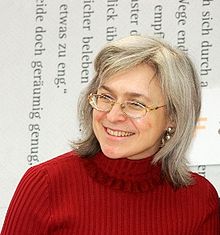
Running through the book are a series of stories about the Grozny Old Peoples’ Home. Most of the sick, elderly tenants are Russians, not Chechens; Russian Orthodox, not Islamic. Yet the residents are treated by all parties as the enemy. Politkovskaya (photograph above) wrote several articles explaining their plight, checking back with them every few months. They had no food or medical care, and were afraid to venture outside for fear of running afoul of armed parties of any description.

The only hospital in bombed-out Grozny had a few volunteer doctors, but no medicines. Such medications as were sent from Moscow were intercepted by the Chechen [pro-Russian] civilian government and sold on the black market.

When there were too many casualties in a Russian army operation, it was not unusual for the wounded to be taken not to a nearby military hospital, but to a more distant civilian hospital where there was no electricity, no medications, and only a skeleton staff. Whether they live or die, they are considered as deserters and therefore do not adversely affect any Russian officer’s military reputation. Many of the wounded soldiers die without identification, leading their families to spend years and a small fortune trying to find out what happened to their sons. (I wonder if this sort of thing was also going on [during the Soviet occupation of] Afghanistan.)

If you leave your apartment in Grozny, be very careful. You might find well-hidden anti-personnel mines at your doorstep or even within the apartment. This is a common cause of death throughout Chechnya.

When Politkovskaya encountered particularly obnoxious politicians or generals, she would publish their cell phone numbers in the Novaya Gazeta, for whom she worked at that time, and urge people to say to their face what they thought of them.

As one could expect, a woman like this makes lots of powerful enemies. On October 7, 2006, the crusading journalist was shot to death in the elevator on the way to her apartment in Moscow. After an “investigation” of sorts, no guilty party was found. Vladimir Putin, who most likely ordered the assassination, points the finger at some unnamed gunman from the West. After all, he says, she had no influence in Russia: Her audience were mostly liberals in Europe and America.

Politkovskaya was a singularly brave journalist and paid the ultimate price for it. Compare them to American journalists who were supinely complicit in the atrocities of the Bush-Cheney administration. No awards for courage there.

He’ll Probably Get Away With It

Vladimir Putin Shows Us He’s a Man’s Man

Vladimir Putin Shows Us He’s a Man’s Man

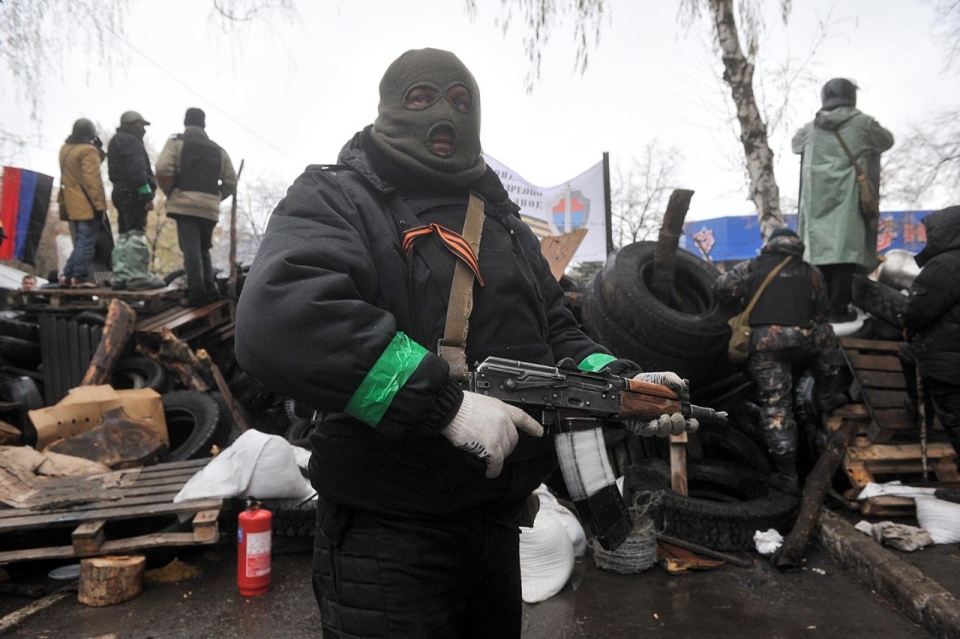
As far as the Crime of the Crimea is concerned, Vladimir Putin will probably not only get away with it: He’ll come out ahead in the hearts and minds of the Russian voters. He stood up for the poor Russian majority in the Crimea, where they were being harassed by Ukrainian thugs, such as the notorious Svoboda Party skinheads, who are actually part of the government in Kiev.

We are dealing with a part of the world where good guys are few and far between. All the leaders of the Ukraine, including the somewhat cute Yulia Tymoshenko, were corrupt to varying degrees, with the deposed Viktor Yanukovych bidding fair to be the worst. Admittedly, we’re not talking about people who are as bad-ass as Putin himself. (If you want some background about Putin’s crimes, read whatever you can find by Anna Politkovskaya, the Novaya Gazeta reporter who investigated the Chechen War and who Putin had assassinated at the door of her flat.)

If you go back a few years to the Second World War, you will see some strange things happening: there were guerrillas who were simultaneously fighting Hitler and Stalin, and conducting their own pogroms just for fun. (These are the goons who morphed into the Svoboda Party.)

So was it “right” for Russia to annex the Crimea? Strictly speaking, no. But then, the Crimea was a gift to the Ukrainian SSR from Nikita Khrushchev, himself a Ukrainian, some fifty years ago. Before then? It was a part of Russia. Demographically, it’s heavily Russian; so it was perhaps inevitable. But do I think well of Putin for pulling his strong man act? Not really, he is to my mind a contemptible cur, a murderer at arm’s length, and quite possibly a Dick Tracy villain. (But then, that is true of many of our politicians as well, no?)

One final note: Two days of a run-up in the stock markets of Europe and the United States indicates to me that most of the talk about sanctions is pure swamp gas. It would only strengthen Putin.

Mischa the Penguin

A Lone King Penguin Among Magellanic Penguins on Isla Pajaros

A Lone King Penguin Among Magellanic Penguins on Isla de Pájaros

Serendipity strikes again. I just read an obscure Ukrainian crime story by Andrey Kurkov entitled Death and the Penguin. The narrator is one Viktor Akelseyevich Zolataryov who writes for publication what his editor refers to as obelisks. These are obituary essays written about living people so that, when death comes to them, the newspaper is not caught short for materials to publish quickly. Oddly, though, it seems that all too many of the individuals Andrey memorializes in his deathless prose wind up … dead.

My favorite character is Viktor’s pet and companion, the King Penguin Mischa. When the zoo in Kiev was suffering a financial meltdown, they sold their penguins; and Viktor bought the one he called Mischa.

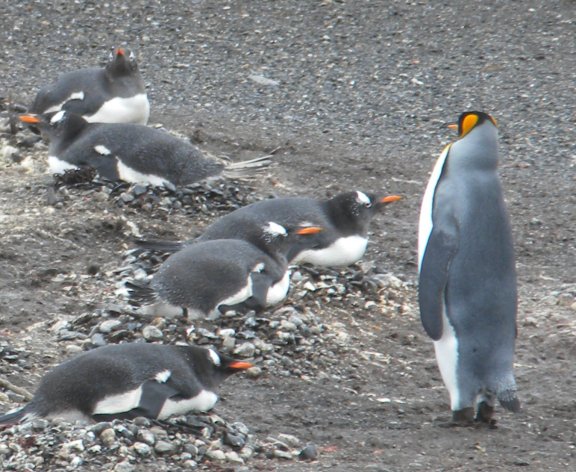
Mischa is very like the King Penguin at the right in the above picture, which was taken on the Isla de Pájaros on the Beagle Channel in Tierra Del Fuego. The largish penguin took a wrong turn into the Beagle Channel and wound up in a rookery consisting mostly of Magellanic Penguins and some Gentoos. It was obviously very lonely and disappointed. Every once in a while, he would try to mate with one of the Magellanic females, but caused uproars every time he tried.

Viktor’s Mischa shambles around the apartment, looking into the mirror, establishing a kind of hiding place behind some furniture, and displaying all the symptoms of a morose and puzzled disposition occasionally verging on depression. Even while Viktor worries that his writing job is connected with an assassination ring, Mischa slowly keeps getting worse. At the same time, he winds up taking care of Sonya, the daughter of one “Mischa-non-penguin,” who was associated with the editor who hired the writer, and who disappears after leaving money and a pistol. He also hires a teenage girl, the niece of his friend Sergey (who dies mysteriously) as a nanny for Sonya, who lethargically enters into a relationship with him.

I loved Death and the Penguin for its mellow strangeness. For a man surrounded by violent death, to which he may be contributing in some unexplained way, Viktor is relatively cool. Eventually, the situation changes rapidly. Mischa becomes ill and gets a heart transplant; and Viktor, well, let us say he takes action of an unexpected kind.

Bunny Love

Russian Boy with Bunny

Russian Boy with Bunny

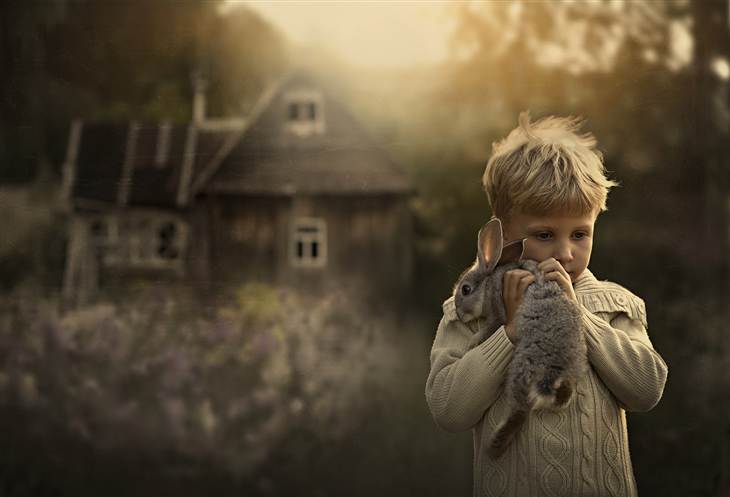
Quite by chance, I ran into a website showing selected photographs from Elena Shumilova at today.com. Her pictures were a revelation to me: Imagine the most beautiful scenes of Russian farm life, children, and animals—and take it to the power of ten! You can see more of her work at 500px.com, along with a portrait of the photographer.

There is something so warm and tactile about Shumilova’s photographs that I could not even imagine anything better on the theme. Having read Ivan Turgenev’s Sketches from a Hunter’s Notebook, Anton Chekhov’s The Steppe, and Nikolai Leskov’s The Enchanted Wanderer, I have long marveled at the Russians’ love of their countryside. It is as if Shumilova’s photographs opened a window into these authors’ hearts.


For Love of a Tree

Fanning Her Insomnia with Dreams

Fanning Her Insomnia with Dreams

Poems written in other languages have a difficult passage to get to English. In the end, what we see is a mere simulacrum of the original. Still, the greatness of a poem will out. If a poem was originally written in French, Spanish, or Hungarian, I can get more of a feeling for the original; but what of the poems of the great Anna Akhmatova (1889-1966), which were written in Russian? I have approached several of her translated works and loved them, or else loved the pale reflections they cast in English, such as this one:

Willow

In the young century’s cool nursery,
In its checkered silence, I was born.
Sweet to me was not the voice of man,
But the wind’s voice was understood by me.
The burdocks and the nettles fed my soul,
But I loved the silver willow best of all.
And, grateful for my love, it lived
All its life with me, and with its weeping
Branches fanned my insomnia with dreams. But
—Surprisingly enough!—I have outlived
It. Now, a stump’s out there. Under these skies,
Under these skies of ours, are other
Willows, and their alien voices rise.
And I am silent … As though I’d lost a brother.

(Translated by D. M. Thomas)

The poem becomes clearer when you understand what its author endured through her long life. I quote one paragraph from the Wikipedia entry on her:

Primary sources of information about Akhmatova’s life are relatively scant, as war, revolution and the totalitarian regime caused much of the written record to be destroyed. For long periods she was in official disfavour and many of those who were close to her died in the aftermath of the revolution. Akhmatova’s first husband, Nikolai Gumilev was executed by the Soviet secret police, and her son Lev Gumilev and her common-law husband Nikolay Punin spent many years in the Gulag, where Punin died.

Perhaps if an ogre like Stalin could take everyone you ever loved away from you, then perhaps your soul will be fed by “the burdocks and the nettles.”


Will Petrograd Fall to the Whites?

Victor Serge

Victor Serge

“Never, perhaps, have I lived in such total serenity. There is great happiness in being detached from everything and understanding everything. The happiness I feel is immense, bitter, painful, and calm. Life appeared suddenly before me stripped of everything that encumbered it: habits, conventions, duties, worries, superfluous relations. We end up abandoning our souls almost entirely to these things. Do you remember that story by Kipling we read together at Vevey: ‘The Miracle of Purun Bhagat’? It’s the tale of an old Westernized Hindu who retires high up in the mountains in order to finish out his life there with the earth, plants, tame animals—eternal reality. I’m an occidental. I have no wish to remove myself from men or from action: these too belong to eternity. I wish only to overcome my own impotence and to finally understand the curve described in the sky by the hurricane which is carrying all of us along with it.

“All man’s miseries are reduced to naked simplicity here. We live the life of the poor. And I understand the poor, their direct vision of reality, their power to hate, their need to overturn the world. I have no hate, except, perhaps, in the end, for the things I love the most—I believe we are almost all of us without hate in this prison. I may be mistaken, for I don’t observe the others enough. I don’t have the time, would you believe it?

“They say the terror is going to end; I don’t think so. It is still a necessity. The storm must uproot the old trees, stir the ocean to its depths, wash clean the old stones, replenish the impoverished fields. The world will be new afterward.”—The Counterrevolutionary Professor Lytaev in Victor Serge’s Conquered City

Aristocide

Children of the Nobility Wearing Russian Peasant Costumes

Children of the Nobility Wearing Russian Peasant Costumes

What happened to the Russian nobility after the October Revolution of 1917? Either they escaped the Soviet Union, or they became targets for extermination under Stalin. Around 1918 Grigory Zinoviev declared that as much as ten percent of Russia’s then population of ten million would have to be annihilated as being “counterrevolutionaries.” As Zinoviev’s colleague Martin Latsis said:

Do not look in the file of incriminating evidence to see whether or not the accused rose up against the Soviets with arms or words…. Ask him instead to which class he belongs, what is his background, his education, his profession. These are the questions that will determine the fate of the accused. That is the meaning and essence of the Red Terror.

Ironically, after the assassination of Sergei Kirov in 1934, Zinoviev was ordered to be arrested and tried during the first of the big show trials what became Stalin’s purges. Of course, he was found guilty and executed, along with thousands of others.

In a new book by Douglas Smith entitled Former People: The Final Days of the Russian Aristocracy, a brief description entailed what happened to one noble family, the Obolenskys:

Prince Vladimir Obolensky was killed at his estate in early 1918; later that year his older brother Alexander was shot at the Fortress of Peter and Paul in Petrograd. Prince Mikhail Obolensky was beaten to death by a mob at a railroad station in February 1918. Prince Pavel Obolensky, a cornet in the Hussars, was shot by the Bolsheviks in June 1918 and left for dead…. Princess Yelena Obolensky was killed at her estate in November 1918; her dead body was burned along with her manor house. Many more Obolenskys suffered similar horrific fates; they included seven members of the family who perished in Stalin’s prisons years later.

Particularly brutal were the fates of those aristocrats who sided with the White Army during the Civil War that followed the Revolution. And then along came Stalin, who did his best to demolish what remained.

This is not to say that there weren’t survivors, former aristos who “blended in” with the proletariat and lay low to avoid the attention of the Chekhist agencies of the Red Terror. What is astonishing was that the Bolsheviks and Stalinists found it necessary to execute an entire class which had already forfeited all its powers and wealth. But then, that’s what tyranny is all about: It is not above kicking you when you’re already down.


Hugging the Enemy

General Vasily Chuikov, Commander of the 62nd Army at Stalingrad

General Vasily Chuikov, Commander of the 62nd Army at Stalingrad

We know a whole lot more about Field Marshal Friedrich Wilhelm Ernst Paulus, who commanded the German 6th Army besieging Stalingrad, than we know about General Vasily Ivanovich Chuikov, who fought the German war machine to a draw by his creative leadership of the Soviet 62nd Army. Part of the reason is that we have letters from Paulus and his staff describing the horrors of the siege of Stalingrad, letters that were to give Hitler and Goebbels fits as they tried to devise their own myth as to what really happened on the banks of the Volga.

What really happened was one of Stalin’s generals, who lived in a society where candid comments in private letters were used by the NKVD (predecessor of the KGB) as evidence of disloyalty to Stalin. Whatever Chuikov may have thought, it was what he did that made him one of Stalin’s favorite generals.

Both Hitler and Stalin had issued contradictory clear-cut orders regarding Stalingrad. Hitler insisted that the Wehrmacht capture the city at all cost, and that surrender was not an option. Stalin, on the other hand, issued equally clear-cut orders that the city must be held at all costs, and that surrender was not an option.

For almost six months, Chuikov invented a new kind of urban warfare in which the idea was to “hug the enemy.” By staying close to the Germans, Chuikov prevented the aerial bombardment by the Luftwaffe in that it turned out to be as dangerous to the Nazis as to the Red Army. By this time, much of the city was rubble. Chuikov ingeniously hid artillery and tanks in the ruins, and used small squads of six to eight men, supplemented by sharpshooters, to attack pockets of Wehrmacht troops. Extensive use was made of hand grenades and Molotov Cocktails.

Frequently, burnt-out tanks became bases for these squads, as the men were protected by the wrecked tank above their heads. The following is a quote from Chuikov:

The Germans underestimated our artillery. And they underestimated the effectiveness of our infantry against their tanks. This battle showed that tanks forced to operate in narrow quarters are of limited value; they’re just guns without mobility. In such conditions nothing can take the place of small groups of infantry, properly armed, and fighting with utmost determination. I don’t mean barricade street fighting—there was little of that—but groups converting every building into a fortress and fighting for it floor by floor and even room by room. Such defenders cannot be driven out either by tanks or planes. The Germans dropped over a million bombs on us but they did not dislodge our infantry from its decisive positions. On the other hand, tanks can be destroyed from buildings used as fortresses.

For five months, Chuikov fought the Germans to a draw. During this time, Marshal Georgi Zhukov formulated his Operation Uranus, which led to the encirclement and surrender of Paulus’s 6th Army.

Even as his men were out of ammunition and close to starving to death and being eaten alive by lice and other vermin, Hitler prevented them from surrendering. As it became obvious to the Fuehrer that Stalingrad was lost to him, he preferred the German people to think that the 6th Army committed mass suicide rather than surrender to the Russians. In the end, the 90,000 men who remained did surrender. Total German casualties were between 500,000 and 850,000 killed, wounded or captured.

Chuikov later led one of the armies converging on Berlin, where he accepted surrender of the city from General Helmuth Weidling. After the war, in 1955, he was made a Field Marshal by Khrushchev and eventually served as a member of the Central Committee of the Communist Party of the Soviet Union.

Even under a tyrant such as Stalin, it is possible to find heroism and innovation such as Chuikov’s. Because we tend to see World War Two as mostly a Anglo-American alliance, we have suppressed any knowledge of the awful 3,000-mile front that was the war in Russia, called by them the Great Patriotic War. They earned their victory … the hard way.