The Tyger

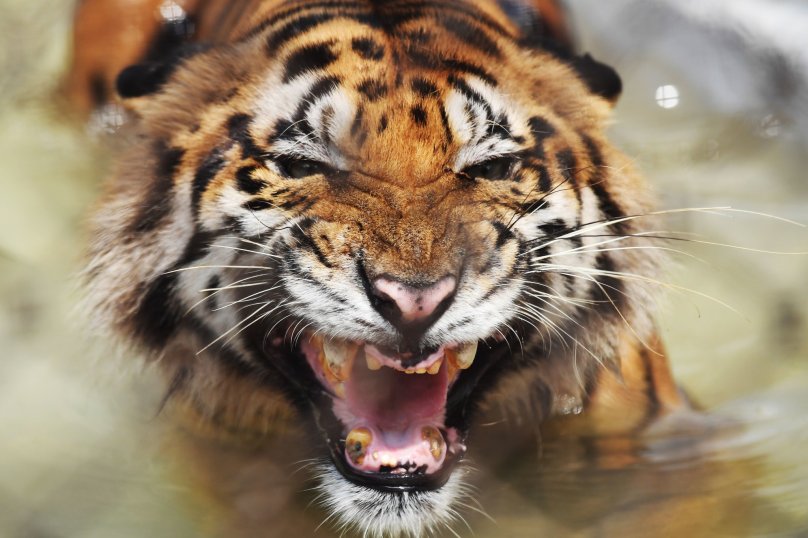
Every time I read this poem by William Blake, I am impressed anew by its greatness. Its very simplicity is deceptive, as it hints at levels of mystery and savagery that underlie our workaday world. I have posted this poem before, but I continue to be mightily impressed by it.

The Tyger

Tyger Tyger, burning bright, 
In the forests of the night; 
What immortal hand or eye, 
Could frame thy fearful symmetry?

In what distant deeps or skies. 
Burnt the fire of thine eyes?
On what wings dare he aspire?
What the hand, dare seize the fire?

And what shoulder, & what art,
Could twist the sinews of thy heart?
And when thy heart began to beat.
What dread hand? & what dread feet?

What the hammer? what the chain,
In what furnace was thy brain?
What the anvil? what dread grasp.
Dare its deadly terrors clasp?

When the stars threw down their spears 
And water’d heaven with their tears:
Did he smile his work to see?
Did he who made the Lamb make thee?

Tyger Tyger burning bright,
In the forests of the night:
What immortal hand or eye,
Dare frame thy fearful symmetry?

To a Cat

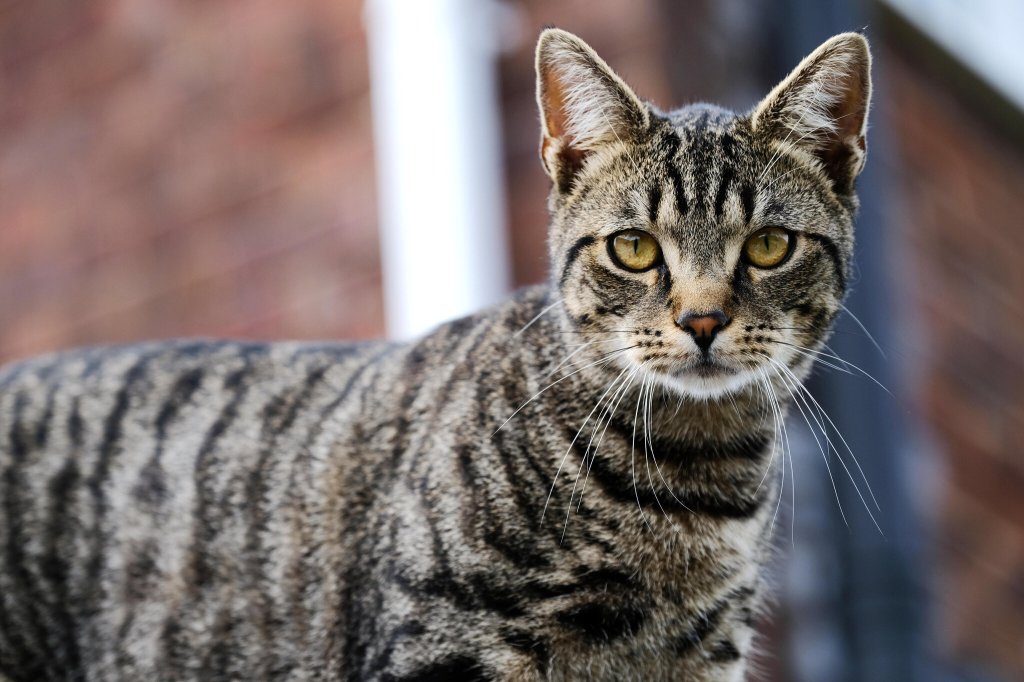
The Argentinian poet Jorge Luis Borges could not play with a cat without thinking of those other cats he saw at the Buenos Aires Zoo too large and too ferocious for play.

To a Cat

Mirrors are not more silent
nor the creeping dawn more secretive;
in the moonlight, you are that panther
we catch sight of from afar.
By the inexplicable workings of a divine law,
we look for you in vain;
More remote, even, than the Ganges or the setting sun,
yours is the solitude, yours the secret.
Your haunch allows the lingering
caress of my hand. You have accepted,
since that long forgotten past,
the love of the distrustful hand.
You belong to another time. You are lord
of a place bounded like a dream.

The Tiger at the Buenos Aires Zoo

The Buenos Aires Zoo that Jorge Luis Borges visited to be inspired by its tigers was closed in 2016, five years after Martine and I visited it. Its former space in Palermo is now occupied by an EcoPark.

Although he became almost totally blind in the 1950s because of an ophthalmic ailment inherited from his father, Borges in his poetry returned again and again to the tigers he heard roaring in the old zoo.

Below is one of my favorites—“The Gold of the Tigers”—translated by Alastair Reid:

The Gold of the Tigers

Up to the moment of the yellow sunset,
how many times will I have cast my eyes on
the sinewy-bodied tiger of Bengal
to-ing and fro-ing on its paced-out path
behind the labyrinthine iron bars,
never suspecting them to be a prison.
Afterwards, other tigers will appear:
the blazing tiger of Blake, burning bright;
and after that will come the other golds—
the amorous gold shower disguising Zeus,
the gold ring which, on every ninth night,
gives light to nine rings more, and these, nine more,
and there is never an end.
All the other overwhelming colors,
in company with the years, kept leaving me,
and now alone remains
the amorphous light, the inextricable shadow
and the gold of the beginning.
O sunsets, O tigers, O wonders
of myth and epic,
O gold more dear to me, gold of your hair
which these hands long to touch.

In this poem, Borges refers to William Blake’s poem “The Tyger”; to the Greek myth of Zeus impregnating Danaë disguised as a shower of gold; and the Norse myth of Draupnir, the self-replicating gold ring. The only color Borges was able to see as his blindness worsened was yellow. Finally, the golden-haired beauty referred to at the end was probably Norah Lange, the Norwegian-Argentinian writer whom Borges loved but who chose to marry rival poet Oliverio Girondo instead.

Tiger Hunting

Jim Corbett with Man-Eating Tiger

There are relatively few tigers left in the world today; but, a hundred years ago, there were individual tigers who were responsible for the deaths of hundreds of villagers in the northwest Indian region of Kumaon, just west of Nepal. Perhaps the most famous of the “white hunters” of these man-eating tigers was Edward James Corbett, better known as Jim Corbett (1875-1955).

Now what am I doing talking about a killer of endangered tigers? Surprisingly, Corbett himself was a naturalist:

A tiger’s function in the scheme of things is to help maintain the balance in nature and if, on rare occasions, when driven by dire necessity, he kills a human being or when his natural food has been ruthlessly exterminated by man he kills two percent of the cattle he is alleged to have killed, it is not fair that for these acts a whole species should be branded as being cruel or bloodthirsty.

Corbett is as famous for photographing and preserving the tiger population as he is for hunting them. In the introduction to his most famous book, Man-Eaters of Kumaon, he writes:

When, therefore, a tiger is suffering from one or more painful wounds, or when its teeth or missing or defective and its claws worn down, and it is unable to catch the animals it has been accustomed to eating, it is driven by necessity to killing human beings.

I was surprised how well-written his book is. He is able to produce an elegant word picture of the circumstances of each hunt. Because of the strength and agility even of man-eating tigers, one rarely has time to reload if one misses. Even if he shoots his prey in the head, the tiger can survive long enough to make a meal of his hunter.


Three Tigers

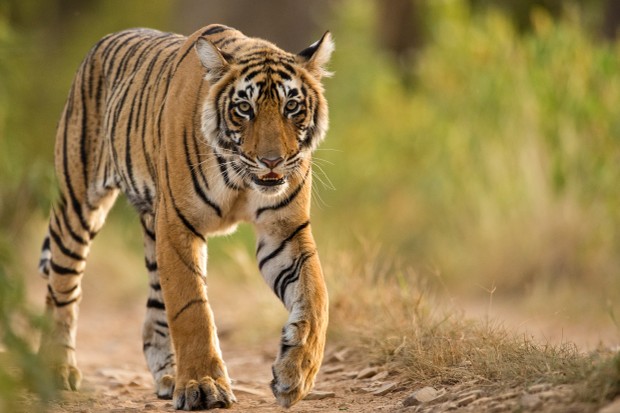
Wild Bengal Tiger (India)

Nobody does poems about tigers better than Jorge Luis Borges—with the sole exception of William Blake. Here is a poem translated by Alastair Reid entitled “The Other Tiger”:

The Other Tiger

And the craft createth a semblance.
—Morris, Sigurd the Volsung (1876).

I think of a tiger. The half-light enhances
the vast and painstaking library
and seems to set the bookshelves at a distance;
strong, innocent, new-made, bloodstained,
it will move through its jungle and its morning,
and leave its track across the muddy
edge of a river, unknown, nameless
(in its world, there are no names, nor past, nor future
only the sureness of the passing moment)
and it will cross the wilderness of distance
and sniff out in the woven labyrinth
of smells the smell peculiar to morning
and the scent of deer, delectable.
Among the slivers of bamboo, I notice
its stripes, and I have an inkling of the skeleton
under the magnificence of the skin, which quivers.
In vain, the convex oceans and the deserts
spread themselves across the earth between us;
from this one house in a remote lost seaport
in South America, I dream you, follow you,
oh tiger on the fringes of the Ganges.

Afternoon creeps in my spirit and I keep thinking
that the tiger I am conjuring in my poem
is a tiger made of symbols and of shadows,
a sequence of prosodic measures,
scraps remembered from encyclopedias,
and not the deadly tiger, the luckless jewel
which in the sun or the deceptive moonlight
follows its paths, in Bengal or Sumatra,
pf love, of indolence, of dying.
Against the symbolic tiger I have planted
the real one, it whose blood runs hotly,
and today, 1959, the third of August,
a slow shadow spreads across the prairie,
but still, the act of nameing it, of guessing
what is its nature and its circumstances
creates a fiction, not a living creature,
not one of those who wander on the earth.

Let us look for a third tiger. This one
will be a form in my dream like all the others,
a system and arrangement of human language,
and not the tiger of the vertebrae
which, out of reach of all mythology,
paces the earth. I know all this, but something
drives me to this ancient and vague adventure,
unreasonable, and I still keep on looking
throughout the afternoon for the other tiger,
the other tiger which is not in this poem.

“The Beast Not Found In Verse”

Borges and His Tigers

As you may (or may not) know, I am and always have been a devotee of the stories, poems, and essays of Argentinean writer Jorge Luis Borges. Here is a poem in which he tries to bring a tiger to life through sheer artistry, but fails—or does he?

The Other Tiger by Jorge Luis Borges

A tiger comes to mind. The twilight here
Exalts the vast and busy Library
And seems to set the bookshelves back in gloom;
Innocent, ruthless, bloodstained, sleek
It wanders through its forest and its day
Printing a track along the muddy banks
Of sluggish streams whose names it does not know
(In its world there are no names or past
Or time to come, only the vivid now)
And makes its way across wild distances
Sniffing the braided labyrinth of smells
And in the wind picking the smell of dawn
And tantalizing scent of grazing deer;
Among the bamboo’s slanting stripes I glimpse
The tiger’s stripes and sense the bony frame
Under the splendid, quivering cover of skin.
Curving oceans and the planet’s wastes keep us
Apart in vain; from here in a house far off
In South America I dream of you,
Track you, O tiger of the Ganges’ banks.

It strikes me now as evening fills my soul
That the tiger addressed in my poem
Is a shadowy beast, a tiger of symbols
And scraps picked up at random out of books,
A string of labored tropes that have no life,
And not the fated tiger, the deadly jewel
That under sun or stars or changing moon
Goes on in Bengal or Sumatra fulfilling
Its rounds of love and indolence and death.
To the tiger of symbols I hold opposed
The one that’s real, the one whose blood runs hot
As it cuts down a herd of buffaloes,
And that today, this August third, nineteen
Fifty-nine, throws its shadow on the grass;
But by the act of giving it a name,
By trying to fix the limits of its world,
It becomes a fiction not a living beast,
Not a tiger out roaming the wilds of earth.

We’ll hunt for a third tiger now, but like
The others this one too will be a form
Of what I dream, a structure of words, and not
The flesh and one tiger that beyond all myths
Paces the earth. I know these things quite well,
Yet nonetheless some force keeps driving me
In this vague, unreasonable, and ancient quest,
And I go on pursuing through the hours
Another tiger, the beast not found in verse.

Last year around this time, Martine and I were in Buenos Aires. Because she was curious about guanacos, we visited the Buenos Aires Zoo in Palermo at Sarmiento and Las Heras. Now that was the same zoo where Borges would visit before the days of his blindness set in to see the tigers.

He would write frequently about tigers, even titling one of his books Dreamtigers. The above poem is probably my favorite of all.