Potato and Spinach Curry

Vegetarian Potato and Spinach Curry

After cooking a bland mushy dish for Martine—at her request—I had a sudden urge to make something hot and spicy. A simple and tasty vegetarian dish is a potato and spinach curry. Here are my cooking instructions:

  1. Pour several tablespoons of sunflower oil into a cooking pot and light a medium fire under it.
  2. Add about 2 tablespoons of black mustard seeds when the oil gets hot.
  3. Add the same amount of cumin seeds (jira).
  4. After about a minute, add 2 peeled russet potatoes cut into 3/4 inch cubes. Stir frequently to avoid ticking to the pot.
  5. Add approx 1 tablespoon each of turmeric, ground cumin, ground coriander, and powdered chile pepper.
  6. Add salt to taste.
  7. While cooking potatoes, soak 1 bunch of spinach leaves in a large bowl, shake off any dirt, and chop and add to the potatoes after spices added..
  8. If you like your curry fiery, chop up and add a serrano chile.
  9. Cover and cook until potatoes sufficiently cooked.
  10. Serve with plain yogurt to cut the hotness of the chiles.

Our Salvation Lies in Robots?

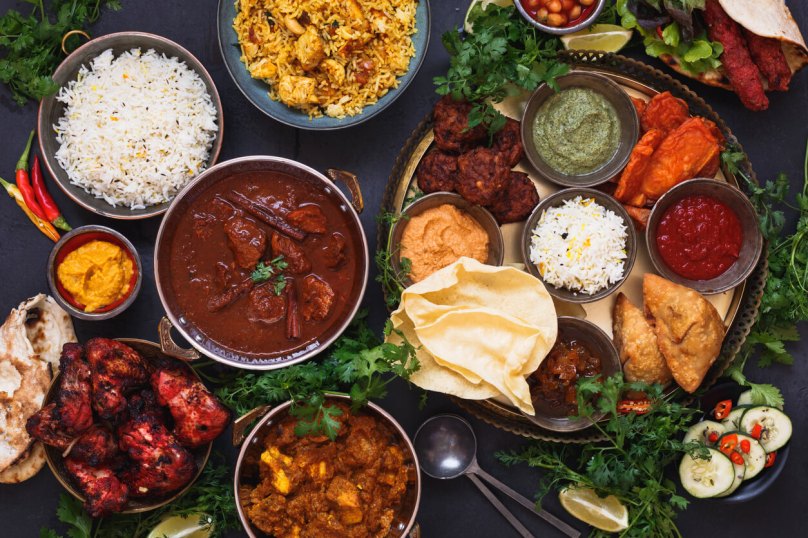
Some of the Food Offerings at India Sweets & Spices

About once a week on the average, I drop in for a quick lunch at India Sweets & Spices in Culver City. The vegetarian curries are tasty and not overly expensive, and one does not have a order a meal too big to finish.

As I entered the store, I was greeted by a garrulous retiree who was sitting at one of the outside tables. As is my custom, I answered him politely, but in the 1930s Hungarian rural dialect which I adopt when trying to avoid a chatty individual.

He took the hint quickly while I passed inside to order a samosa and lentil fritter. When I came out with my food, I had to sit at a table within earshot of him. He was regaling one of his captives with an encomium on robots and how they were going to replace surgeons. Someone looking at my face at that point would have guessed that I had just smelled something foul.

You can’t talk about robots without talking about computer algorithms. And I was a person who had just spent an hour explaining to my pharmaceutical mail order firm—three times—that I am not Hispanic (marque dos) before getting to speak to a human being. If most companies cannot reasonably handle automated phone attendants, why would I submit to a computer algorithm with my body for surgery?

Fortunately I was able to finish my vegetarian snack quickly and vanish from sight before hooting derisively.

Currying Flavor

A Vegetarian Curry

The biggest change in my diet since the Covid lockdown has been my growing preference for cooking vegetarian curries. This has dismayed Martine, as she is a confirmed avivore, especially of chicken and turkey. Before, I have been cooking various pasta and rice dishes with ground turkey; but of late, I have tended to avoid ground meat.

Although I have always like curries, my preference has always been for vegetarian curries. That could be the influence of my old friend Mohan Gopalakrishnan, a Brahmin, but I have always thought that Indian cuisine has by far the tastiest vegetarian recipes. It has gotten to the point that I disdain bland American vegetarian dishes. (There are, however, a few Hungarian vegetarian dishes that I’ve always loved.)

Today I cooked up a potato, cauliflower, tomato, and pea curry with a diced-up Serrano chile. To jack up the hotness, I added a little super-hot Indian chile powder. To cool down the dish slightly, I served it with mango chutney and some plain yogurt.

The spices used include black mustard seeds, cumin seeds, turmeric, and garam masala (which is mostly cardamom). The great thing about Indian cuisine is that you can vary the spices and consequently the flavor quite easily. Of course, it helps to have an Indian food store nearby. I usually go to India Sweets and Spices in Culver City. They also have a very decent lunch counter which I patronize regularly.

Spanish Barley

Sort of What My Recipe for Spanish Barley Looked Like

Although I am tending more and more toward a non-Vegan vegetarianism, I have always thought that most American vegetarian cooking is totally blah. I take my cue from Indian cuisine, which is not afraid of strong flavors. The basic recipe I used can be found at GoBarley.Com.

I followed the recipe, but with two additions and two substitutions. At this time of year, one can buy Hatch chiles from New Mexico at a good price. I fire-roasted two chiles and peeled off the blistered skin. Then I chopped up the chiles and added it to the recipe.

Instead of diced low-sodium canned tomatoes, I used eight fresh Roma tomatoes which I chopped. Then, in place of plain paprika, I used smoked paprika to give it additional flavor.

Finally, when I served the barley, I added some Fly by Jing Sichuan Chili Crisp, which I described in an earlier post.

Americans are not used to cooking barley as if it were rice, but there are a number of advantages. First of all, it is far better for someone with Type 2 Diabetes to eat grains with a higher percentage of fiber to carbohydrates. One cup of long-grain white rice has 9% of the daily value of fiber, but 54% of the daily value of carbs. Compare that to raw pearled barley: a cup of barley contains 111% of the daily value of fiber compared to 56% of the daily value of carbohydrates.

Foods that are rich in fiber compared to carbohydrates tend not to overload the pancreas. It’s sort of like a mechanism to time-release carbs to the body rather than bomb the pancreas.

Oh, and it also tastes really great. More chewy than rice, but every bit as good if not better.

The Only Way To Be a Vegetarian

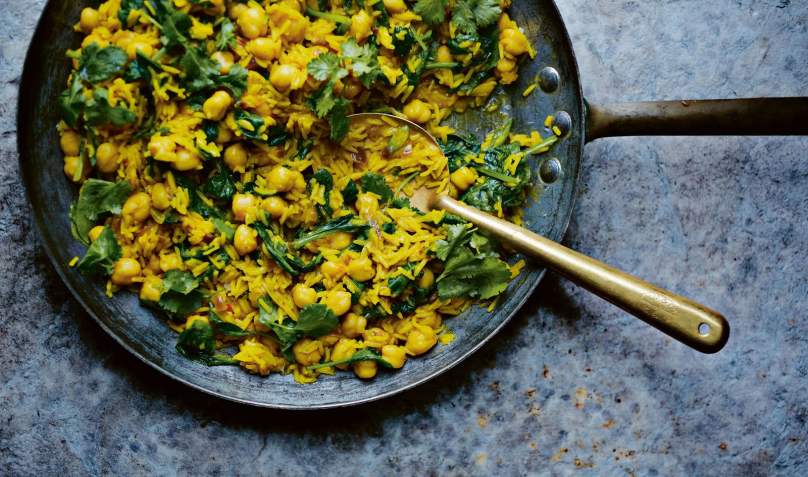
Chick Pea and Spinach Pilau

I am a frustrated vegetarian, mostly because Martine wants me to cook more meat dishes. But every once in a while, such as when her irritable bowel syndrome acts up, I will prepare for myself a vegetarian curry dish redolent with chiles and other spices.

Why do most people become vegetarians? I suspect the answer is that they feel a certain Yuck Factor when it comes to meat. At that point, they usually turn to the boringly bland and unimaginative diet that seems to characterize many Americans. I’m talking about lots of salad (which Martine calls “rabbit food”) and plant-based meat imitations.

To me, it makes more sense to use an existing vegetarian cuisine which is flavorful and exciting. That describes Indian cooking to a tee. I like food that is rich with layers of flavor. Coming from a Hungarian background, I find most bland food more than slightly offensive, as if no one cared to make it good.

When I visit Latin America, I have no trouble settling into a comfortable routine of vegetarian food and my one meat craving, fresh seafood. I remember an octopus ceviche in Progreso, Yucatán, and a filete de pescado Veracruzana in Champotón that sent me into ecstasy.

In Ecuador, I fell in love with the soups, particularly an avocado-based soup in Quito and an egg soup in Cuenca. Insofar as salads are concerned, in Latin America I love the fruit salads.

Cooking With Manjula

Manjula Jain, Master Chef and YouTube Luminary

During this hyperextended coronavirus quarantine period, I have picked up a few good habits. Perhaps the best of them is taking authenticity more seriously in my cooking. I have been making Indian vegetarian dishes for over thirty years, but now, thanks to YouTube, I am more serious about trying to cook them approximately the way a resident of India would.

For one thing, that involves a more serious attention to the spices used in Indian cooking. Fortunately, there are a number of Indian groceries in Culver City along Venice Boulevard, my favorite being India Sweets & Spices. Just to give you an example, here is a list of spices for Chickpea Pulav, which I will be preparing later this week:

  • Cumin seeds (jeera)
  • Asafetida (hing)
  • Bay leaves (tajpat)
  • Ginger (I use a bottled ginger/garlic paste from Laxmi)
  • Turmeric (haldi)
  • Mango powder (amchoor)
  • Garam Masala (which is mostly cardamom)

In addition, I will also be adding a few additional spices not called for in the recipe, including powdered red chile, cumin powder, cilantro, and coriander powder.

If you are interested in Indian vegetarian cooking, I highly recommend Manjula Jain’s Cooking with Manjula, 2nd Edition, which can be obtained for $5.00 in a downloadable format. (In my case, it turned out to be Microsoft Edge PDF, which took me a little while to learn how to print so that it doesn’t stretch off the page.) There are approximately 150 pages of recipes, which make it a good deal for the cost involved.

I highly recommend you try the Chickpea Pulav first, which Manjula calls a “Spicy Rice with Chickpeas.” I am going to be busy trying her other recipes, which you can also find on the web and YouTube. Here’s the YouTube recipe for the Chickpea Pulav: Click here.


Black Beans and Rice

(Mostly) Vegetarian and Muy Picante

As time goes by, I become more vegetarian. Although I do all the cooking in our household, I can’t altogether dispense with meat. This is mostly because Martine seems to think that meat is the only good source of protein. So I alternate meat dishes with vegetarian dishes. At times, I can cook something that Martine is not interested in sampling, such as my black beans and rice.

Now black beans and rice is not normally a spicy dish—but the way I make it, it is. Here is a list of ingredients:

1 cup Basmati rice
1 chopped onion
2 minced Serrano chiles
Several dried chile pods
Several cloves of garlic, minced or crushed
1 15 oz can of black beans with liquid
2½ cups chicken or vegetable stock
Salt and pepper to taste
Garnish with parsley or cilantro

As a certified chile-head, I occasionally have to indulge my love of capsicum. (Don’t worry, I got something else for Martine, who hates chiles so much that she can’t be in the apartment when I cook with them.)

Years ago, I read a book by Frances Moore Lappé entitled Diet for a Small Planet. Her belief was that one could get all the protein one needs by using ingredients whose amino acids, when cooked together, form a complete protein. Beans and rice are two such complementary foods.

Although I tend to use chicken stock to cook the rice, I do not add pieces of meat. So, in fact, my way of preparing it with chicken stock is not technically vegetarian. If you want, you can use vegetable stock or even water.


The Singing Chef and Others

Singing Chef Harpal Singh

Although I still have a shelf of cookbooks, it is unlikely that I will add to it. For my own ventures into cooking, I am increasingly turning to YouTube where I can see the dish being made and what it looks like when it is completed.

As I grow older, I am becoming more interested in vegetarian cuisine. And which is the greatest vegetarian cuisine, but the foods of India. If I am cooking for myself these days, I am more than likely to go for a good curry recipe like one of the following:

Chef Harpal Singh’s Mumbai Mast Tomato Pullao

Chef Harpal Singh is a charming presence who likes to entertain you by singing (or is it singhing?). I have not made this dish yet because Martine prefers me to cook dishes with meat. So I have to wait until she has an episode of irritable bowel syndrome before trying it. (Those episodes last for about a week.)

A Tasty Eggplant and Potato Curry from HowToCookGreatFood.Com

The chef here does not introduce himself by name, but he is a wizard. I have prepared this dish twice and love it. My friend Mona, who is a health nut, thinks I am crazy for liking a dish whose primary ingredients are both members of the deadly nightshade family. Happily, I have not yet succumbed to any sort of nightshade poisoning.

There are other sources, which I may introduce at some later date, such as Chef Odon Hankusz from Budapest. Unfortunately, his instructions are all in Hungarian, but his Gulyás Leves is a dish for the gods!

American Cuisine? No Thanks!

Burger and Fries … and Fries and Burgers

As I grow older, I realize more and more how different I am from most Americans. Politically, I have re-defined myself as independent of the two major political parties, and totally uninterested in the minor ones. Racially, I no longer consider myself to be white—ever since I have become so disgusted with misbehaving whites in the Trumpf era. (As a Hungarian, I consider myself to be of Other Race, namely Finno-Ugric, the language family to which the Hungarian language belongs, originating in the borderlands between Europe and Asia.) Now I find myself disliking most American food. At those times I am forced to eat at an American restaurant, I am usually lucky if I can finish 30% of my meal.

I make an exception in the case of the foods of the American South and Southwest. And I like Italian, Latin American, Asian, African, and Middle Eastern foods. And I still love Hungarian food, if I can find any! But don’t offer me a burger and fries. Been there. Done that. Am finished with it once and for all.

That has led to some problems with Martine. Most of the time, she likes to eat stuff I don’t like, such as burgers, pot roast, fried chicken, and mashed potatoes. I will indulge her on weekends when we go out to eat, but I don’t make much of a dent in what is served to me. And no Cokes or Pepsis, please, just iced black tea without chemical additives. In the end, I make sure she gets what she wants, but she is frightened that I am becoming a vegetarian of the Indian Subcontinent variety.

During the last six weeks, Martine has had major digestive issues, so that I have concentrated on improving my vegetarian curries. And I have done so substantially, to an extent that alarms my little French girl. I suspect that we shall come to some sort of agreement in the end, even if I have to cook some foods I am not interested in tasting.

Kale and Turnips—Not!

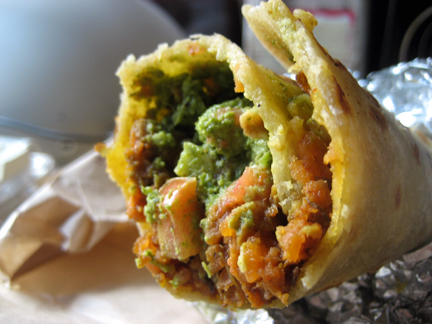
The Bombay Frankie Company’s Aloo Gobi Matar Wrap

Last week, I ran into a rabid vegetarian at the Ralph’s Supermarket in Santa Monica. She had her groceries in two piles, momentarily confusing the checker, who asked me if her second pile was mine.

I answered him: “Hmm, kale and turnips. Nope, that doesn’t look like what I’d eat.”

This angered the customer, who turned to me and started critiquing the groceries I was purchasing, much of which was for Martine, who has been ill with a bad cold. I stayed silent until she slunk away with a sour look on her face—a look that could only be the result of eating a diet of kale and turnips.

Actually, I consider myself a part-time vegetarian. The one difference between me and the other customer is that I refuse to eat bland, tasteless food, regarding it as an insult. I was raised on Hungarian food, some of which was vegetarian, especially when times were bad and we couldn’t afford meat. But it was good food and tasted great!

I cannot for the life of me stomach American vegetarian cuisine, which I find objectionable in the extreme. Hungarians have good vegetarian dishes, as do Italians and Persians. The best vegetarian chow, in my opinion, is from the Indian subcontinent. Indian curries are the epitome of a great vegetarian cuisine, such that I prefer to cook vegetarian when I make curry.

In preparation, I visit an Indian specialty food store, such as India Sweets & Spices in Culver City, where I can buy curry leaves, black mustard seeds, good turmeric, cumin, and coriander—and where the owner usually gives me a cup of chai masala for free. In fact, if Martine were not still hitting the soup trail for her cold, I would cook a potato and spinach curry this week.

One of the oldest books I own is Monica Dutt’s The Art of Indian Cooking, which has been my guide to learning how to cook curries. Today I had an Aloo Gobi Matar wrap (as illustrated above) at the Bombay Frankie Company in West L.A., which is located at one end of a Chevron Station at the Santa Monica Boulevard exit on the I-405.