
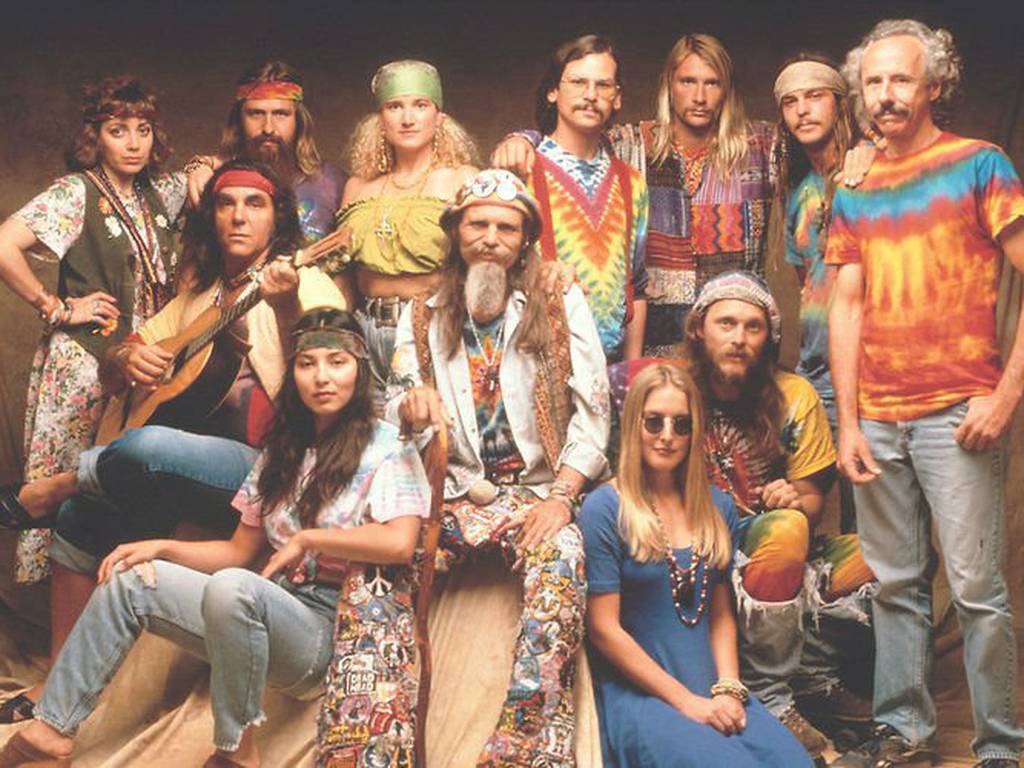
Was I Ever a Hippie?

You Won’t Find Me in This Picture

I arrived in Los Angeles at exactly the point when the Hippie movement was reaching its height. Many of my acquaintances looked much like the poseurs in the above photo. Oh, I had long hair all right, but nothing that was radical for the period. I went around dressed in chinos and a Jeans jacket, usually with a black cowboy hat which I bought at Disneyland.

In fact, I never really got close to any Hippies: I regarded them as not quite real, more like play actors.

There was another even more compelling reason I never became a Hippie: I had just undergone brain surgery for the removal of a pituitary tumor and had no desire to experiment with recreational drugs. In the late 1960s, I did not think I was long for this world. I had no desire to rush my exit from this life.

Though not drawn to the Hippies, I was something of a political radical. For a brief time, I attended meetings of the Progressive Labor Party at UCLA, but found studying Marx’s Surplus Theory of Value breathtakingly boring and the girls in the group heartbreakingly ill-favored.

Due to the influence of my late friend Norm Witty, I hung out for a while with The Resistance, which protested the Vietnam War by attempting to interfere with the draft process. In fact, I sent my draft card back to my draft board in Cleveland, fully expecting to be arrested for two felonies ([1] Returning my draft card and [2] Refusing to carry a draft card on my person) and sent to a Federal prison. It turns out that so many of my fellow students returned their draft cards that the Federal Government decided it was too expensive to prosecute and imprison the offenders.
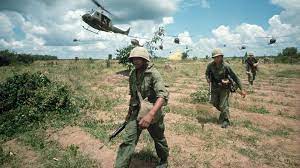
On Foot in Pinkville

U.S. Troops in Vietnam

“Pinkville” is the name that the soldiers who fought on the ground gave to the villages around My Lai, site of the 1968 massacre in which hundreds of Vietnamese civilians were killed in 1968. It is an area well described by Tim O’Brien, whose books on the Vietnam War from the point of view of the troops on the ground are probably the best books to read about the war as it was fought.

O’Brien started in 1975 with his own experiences in the war, set forth in a book entitled If I Die in a Combat Zone, Box Me Up and Ship Me Home. He asks “Can the foot soldier teach anything important about war, merely from having been there? I think not. He can tell war stories.”

And that’s exactly what O’Brien does. The stories are all true in his first book, with only the names of characters being changed.

Then, in 1978, he wrote Going After Cacciato, the first of two fictional works about the war. This was followed in 1990 by The Things They Carried, which is my favorite of his books.

Whether writing fiction or straight memoir, O’Brien is a powerful writer. In If I Die in a Combat Zone, there is a chapter entitled “Step Lightly” about the different kinds of land mines used by the Viet Cong. The most horrifying of these is the Bouncing Betty:

The Bouncing Betty is feared most. It is a common mine. It leaps out of its nest in the earth, and when it hits its apex, it explodes, reliable and deadly. If a fellow is lucky and if the mine is in an old emplacement, having been exposed to the rains, he may notice its three prongs sticking out of the clay. The prongs serve as the Bouncing Betty’s firing device. Step on them, and the unlucky soldier will hear a muffled explosion ; that’s the initial charge sending the mine on its one-yard leap into the sky. The fellow takes another step and begins the next and his backside is bleeding and he’s dead. We call it “ol’ step and a half.”

Yipes!

Veterans: In Harm’s Way

I don’t usually pay much attention to holidays. That does not mean I’m a Jehovah’s Witness: It just means that I think most holidays are a major pain in the ass. Some of them, such as Thanksgiving and Christmas, are notorious for putting incredible stresses on families, and sometimes breaking them up.

The men and women of our armed forces typically did not join because they wanted to serve our country. I think most wanted to lift themselves out of poverty and take advantage of educational opportunities that would jump start their post service careers. Unfortunately, in the process, they often put themselves in harm’s way fighting our nation’s interminable wars.in Korea, Vietnam, the Dominican Republic, Lebanon, Grenada, Panama, Kuwait, Iraq, Somalia, Haiti, Bosnia, et cetera ad infinitum.

In those “little wars,” some 100,000+ Americans gave their lives. And a much larger number came back with debilitating physical or mental scars.

I consider myself fortunate that my brain surgery operation in 1966 gave me a Selective Service rating of 4F, so that I would not have to fight in Vietnam. Truth to tell, I would probably have been 4F in any case, as I had been walking around with a pituitary tumor for ten years or more and was not in great shape.

During the Vietnam Era, many war protestors held a grudge against the armed forces. I didn’t. Most of them were just trying to survive under difficult circumstances. Instead, I wish them well.

War Games and Random Play

Norman Mailer

Norman Mailer

As I read the words, I felt the hairs on the back of my neck rising. The book was Norman Mailer’s The Armies of the Night (1968), about a demonstration against the Pentagon against the Viet Nam war. At the time, I was also under the political influence of another Norman, my late friend Norman Witty, who was very active with the Los Angeles draft resistance movement.

This is a good look at the sort of thing that influenced me some half a century ago:

On a day somewhat early in September, the year of the first March on the Pentagon, 1967, the phone rang one morning and Norman Mailer, operating on his own principle of war games and random play, picked it up. That was not characteristic of Mailer. Like most people whose nerves are sufficiently sensitive to keep them well-covered with flesh, he detested the telephone. Taken in excess, it drove some psychic element of static ino the privacies of the brain; so he kept himself amply defended. He had an answer service, a secretary, and occasional members of his family to pick up the receiver for him—he discouraged his own participation on the phone—sometimes he would not even speak to old friends. He had the idea—it was undeniably oversimple—that if you spent too much time on the phone in the evening, you destroyed some kind of creativity for the dawn. (It was taken for granted that nothing respectable would come out of the day if the morning began on the phone, and indeed for periods when he was writing he looked on transactions vis telephone as Arabs look upon pig.)

To this day, I still feel that way about receiving telephone calls. Was it Mailer’s influence? Or is it some ornery impulse that makes it all right for me to make a call, but a damned imposition to receive one?

I was so impressed by Mailer writing about himself in the third person, with his occasional wry asides, that for many years I thought of him as America’s best essayist. Curiously, to this day I have not read any of his fiction, even his famous WW2 novel, The Naked and the Dead. Well, maybe later.


A Forgotten War

Chinese Troops in the Sino-Vietnamese War of 1979

Chinese Troops in the Sino-Vietnamese War of 1979

Once the U.S. abandoned Saigon to the Viet Cong in 1975, we seem to have lost all interest in Southeast Asia. There was, however, a lot happening. The Pol Pot regime in Cambodia, which was supported by the Chinese, was engaged in genocide on a massive scale. Also, we must not forget at that time that the Sino-Soviet conflict was at its height: The Russian-Chinese border fairly bristled with guns and military units. At the time, the Hanoi government had a military alliance with the Soviet Union. When Vietnam invaded Cambodia and deposed the Khmer Rouge, China decided to punish its neighbor to the south.

On February 17, 1979, somewhere between 200,000 and 600,000 troops of the Peoples’ Liberation Army (PLA) invaded North Vietnam and occupied the all territory for approximately twenty miles south of the border. It appears that China either wanted to test the alliance with Russia or divert the crack Viet military units engaged in Cambodia—or both, or neither. A number of reasons have been adduced for this incursion, and China wasn’t owning up to its motivation for so doing. Vietnam met the attack by the 1st and 2nd military regions—essentially militia—under the command of Dam Quang Trung and Vu Lap. The number engaged of the Vietnamese forces was a fraction of the Chinese force, but it inflicted heavy casualties on the PLA, and suffered heavy casualties in return. (The numbers vary depending on whether one is following Chinese or Vietnamese statistics.)

Newsweek Cover in Feb 1979

Newsweek Cover on March 5, 1979

When I heard that, after thirty-five years of relative peace, the Chinese are once again testing the resolve of the Vietnamese by drilling an oil well off the Paracel Islands in the South China Sea, which are claimed by both nations, my antennae started to tingle. Tiny uninhabited islands are big news these days, mainly because they extend the territories claimed by adjoining land powers. Claiming a tiny rock can extend one’s territorial waters by literally thousands of square miles. And both China and Vietnam need all the oil they can get.

The Vietnamese responded by rioting and attacking Chinese within their borders, along with the businesses they ran. China has been chartering flights to evacuate its nationals from Vietnam.

Although the PLA is huge, it is largely untested in battle. The Sino-Vietnamese War of 1979 was probably the largest military conflict it faced in the last half century—and it did not fare too well faced with a smaller number of Vietnamese militia. At that time, one must remember that the Vietnamese had been at war ever since the end of World War Two and, as a people, were probably as battle-hardened as one could be.

It would be interesting to see whether China is willing, once again, to test Vietnam’s resolve.


A Tribute to an Old Enemy

General Vo Nguyen Giap of Viet Nam

General Vo Nguyen Giap of North Viet Nam

He was the greatest military figure of the Twentieth Century. In turn, he defeated the Armed Forces of France at Dien Bien Phu in 1953, and of the United States in 1975. Oh, and along the way, he defeated the Chinese Red Army in 1979, when they decided to invade Viet Nam in response to the latter’s occupation of Cambodia in 1978. And he cheated death for 102 years, dying today in Hanoi.

France, the United States, and China—in succession!

I could only wish the United States had produced a military leader as accomplished as Giap; but whenever they tried to, they ran into the hide-bound Pentagon and Washington bureaucracy. People like Billy Mitchell, George S. Patton, and Douglas MacArthur had the potential; but they did not have the political backup.

So, General Giap, I toast you as an honorable enemy!

The Hamfisted Military of America

Infantry in Viet Nam

Infantry in Viet Nam

The United States has probably the most powerful military in the world—provided, of course, that it is used to fight the battles of the Second World War over again. You know what I mean: Those large set-piece battles with penetrations, encirclements, flanking maneuvers, the whole West Point 101 ball of wax.

Too bad that the wars we have gotten entangled in since the Second World War do not play to our strengths. One doesn’t need a college degree in military science to appreciate the following factors:

  1. Whereas the people of the United States know nothing about foreign languages and cultures, all cultures know a great deal more about us than we know about them.
  2. Because our news media blares all around the world, guerrilla fighters know when the American people are tired of a war and want to end it.
  3. If the “bad guys” a.k.a. “freedom fighters” want to win, they just have to blow up one or two Americans to smithereens every day or so. Just so long as every news cycle has some bad news in it.
  4. The nationals who have allied themselves with the American forces are highly suspect as to their allegiance. The ARVN (Army of the Republic of Viet Nam), for instance, acted as intelligence for the North Vietnamese. (Guess why so many incidents of “terror” in Afghanistan are committed by fighters wearing the uniforms of Karzai’s army and police.)
  5. Before long, the American forces will be confined to “Green Zones” or “strategic hamlets” or other fortified places where they could be picked off at will—usually just one or two at a time.

The thought keeps hitting me between the eyes: If we’re so stupid about it all and keep making the same mistakes over and over again, why do we even bother? What do we accomplish?