Laki and Tambora

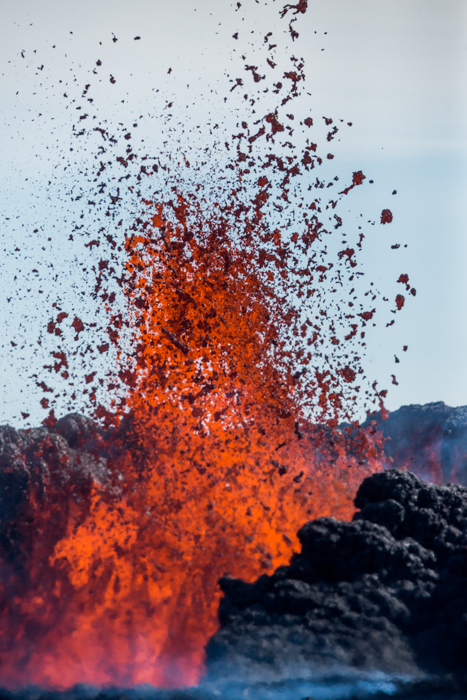
Volcanic Eruption at Holuhraun in Iceland

Volcanic Eruption at Holuhraun in Iceland

After all these billions of years, it never fails to amaze me that, beneath the crust of the earth, there are superhot gases that could, at a moment’s notice, change all our lives. Since our country was founded, there have been two volcanic mega-events that caused widespread death, destruction, and—surprisingly—temporary global cooling.

In answer to a question from an American reader, ESA, one of the staff writers of The Iceland Review wrote the following about Laki:

The Laki eruption (aka Skaftáreldar) took place over an eight-month period between June 8, 1783, and February 7, 1784. The eruption occurred in the Lakagígar craters in fissures on either side of Laki mountain between Mýrdalsjökull and Vatnajökull in the southern highlands and the adjoining Grímsvötn volcano in Vatnajökull….

The eruption began as a fissure with 130 craters opened with phreatomagmatic explosions. This event is rated as 6 on the Volcanic Explosivity Index (VEI). The scale is open-ended with the largest volcanoes in history given magnitude 8. For comparison, the 2010 Eyjafjallajökull eruption is rated as magnitude 3 on VEI.

The Laki eruption produced an estimated 14 km3 (3.4 cubic miles) of lava, and the total volume of tephra emitted was 0.91 km3 (0.2 cubic miles). Lava fountains were estimated to have reached heights of 800 to 1,400 meters (2,600 to 4,600 feet).

The gases emitted, including an estimated 8 million tons of hydrogen fluoride and 120 million tons of sulfur dioxide (SO2), caused the death of over 50 percent of Iceland’s livestock, leading to a famine killing approximately 25 percent of the country’s inhabitants.

The Laki eruption and its aftermath caused a drop in global temperatures, as SO2 was spewed into the Northern Hemisphere. This caused crop failures in Europe and may have caused droughts in Asia. The eruption has been estimated to have killed over six million people worldwide, making it the deadliest in historical times.

Not too long after, in 1816, there was another mega volcanic event. Bill McGuire, in The New Scientist (28 March 2015), wrote:

Two hundred years ago, a simmering tropical volcano tore itself apart in spectacular fashion. Mount Tambora, on the Indonesian island of Sumbawa, erupted in a colossal blast that led to the deaths of more than 70,000 people in the region. So large was the explosion that its reach extended far beyond South-East Asia, loading the stratosphere with 200 million tonnes of sulphate particles that dimmed the sun and brought about a dramatic cooling with widespread ramifications half a world away.

The extended climate disruption saw 1816 dubbed “the year without a summer.” There was a wholesale failure of harvests in eastern North America and across Europe, contributing to what economic host John Post has called “the last great subsistence crisis in the western world.” Famine, bread riots, insurrection and disease stalked many nations, while governments sought to cope with the consequences of a distant geophysical phenomenon they didn’t understand.

It can happen again at any time somewhere along the Ring of Fire that encircles the earth. Pray that it doesn’t happen in our lifetime.

Volcano Land

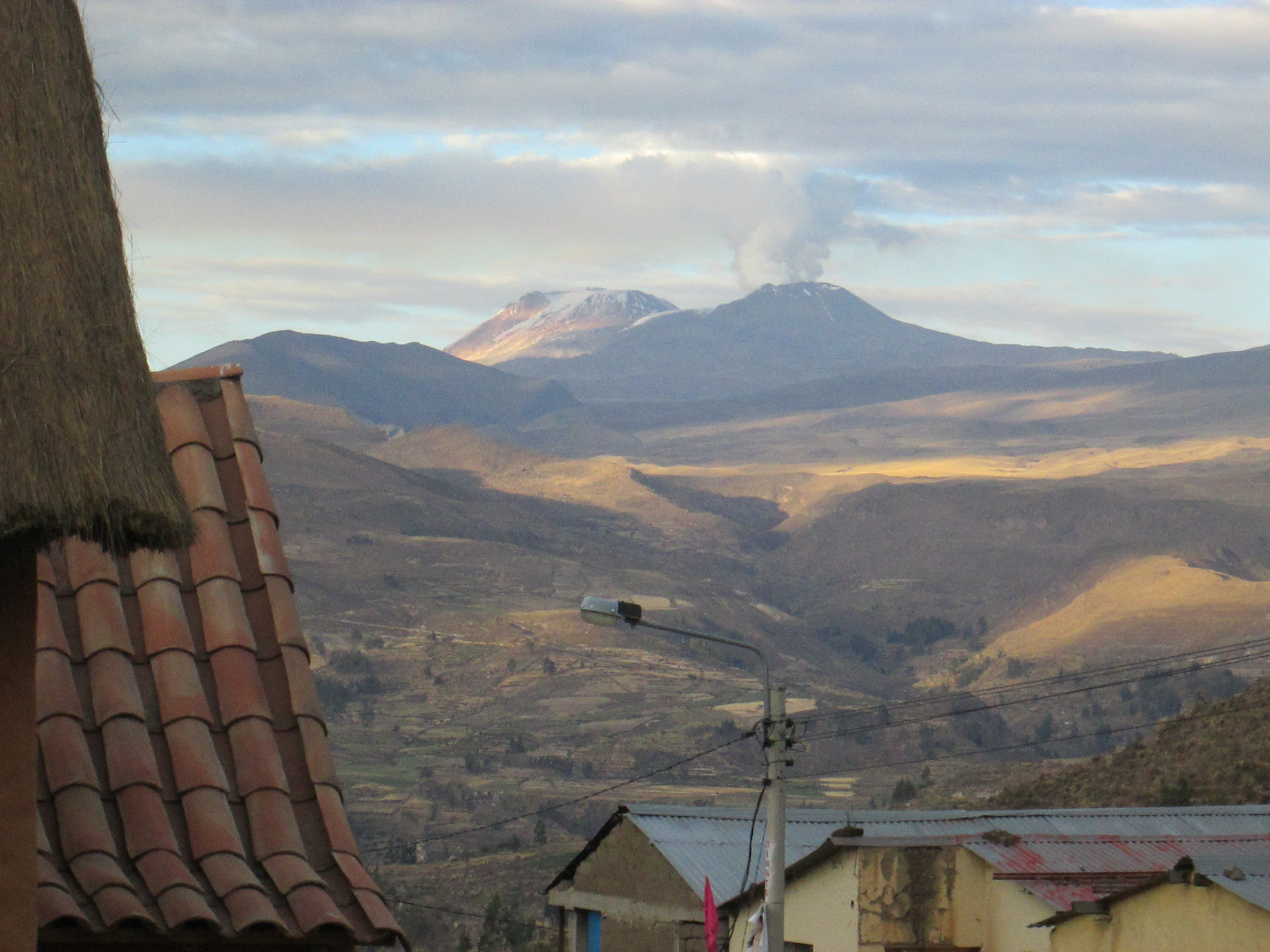
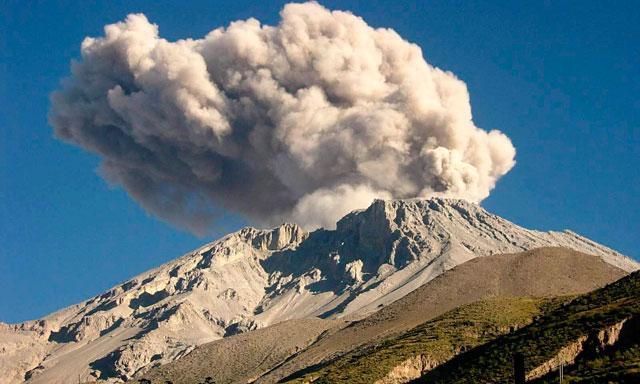
Mount Sabancaya Erupting

Mount Sabancaya Erupting—Seen from Coporaque

The State of Arequipa is full of active volcanoes. Two of them in particular—Sabancaya and Ubinas—have been in eruption for weeks, if not months.

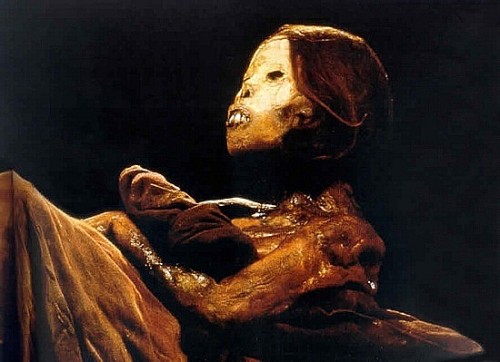
In fact, before the Spanish ever made it to Peru, an eruption of Sabancaya triggered the sacrifice of an Inca maiden (named by archaeologists as Juanita) on neighboring Nevada Ampato to satisfy the angry earth gods. A 12-year-old girl of good family, “Juanita” was marched up Ampato with an escort of priests, given some chicha to drink to calm her nerves, and clubbed to death. It was only in 1995 that Johan Reinhard discovered her remains and brought her body down to Arequipa, where it is on display in the city’s Museo Santuarios Andinos, where I saw it.

The Remains of the Inca Maiden Called “Juanita”

The Remains of the Inca Maiden Called “Juanita”

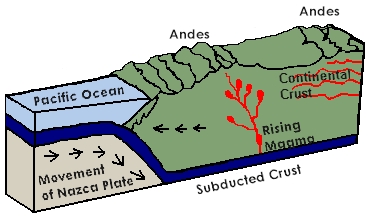
When I stayed in Arequipa, I awoke every morning to see the city ringed by the volcanoes Chachani, El Misti, and Pikchu-Pikchu. Going north to Colca Canyon, I saw perhaps a score of other volcanic peaks. This is a volatile section of the Pacific Ring of Fire, where the Nazca Plate is slipping under the South American Plate and making the Andes rise and providing pathways for the fires under the earth to rise to the top on occasion.


Ring of Fire

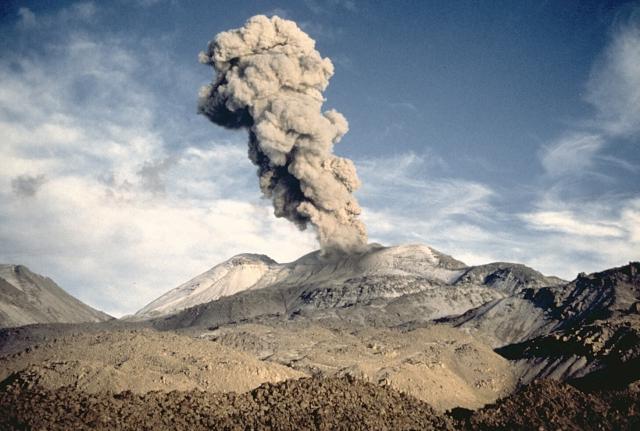
The Volcano Sabancay: Erupting Again

The Volcano Sabancaya: Erupting Again

The Pacific Ring of Fire stretches from Indonesia and the Southwest Pacific in a massive arc around Asia, North America, down to the West Coast of South America. According to Peru This Week, this zone “is the site of 85% of global seismic activity caused by friction between shifting tectonic plates.”

In South America, the culprit is the Nazca Plate, which borders the Pacific side of the continent, and which features a convergent boundary subduction zone and the South American Plate, which action has formed the Andes. Hardly a day passes by when I don’t hear of another earthquake in Peru (usually in the Richter 4.0-5.5 range); and hardly a month passes by without a new volcanic eruption. Today, it is reported that Sabancaya (see above) in the State of Arequipa has begun to spew ash. If it continues, I will probably be there to see it in person next month at this time.

Below is an illustration of how the Nazca Plate (in light brown) subducts the South America Plate (in green), thereby causing all these dire events (and, by the way, over the millennia, causing much of the beauty of the Andes as well):

The Nazca Plate Takes a Dive, Wrinkling the Face of the Earth

The Nazca Plate Takes a Dive, Wrinkling the Face of the Earth

Last year, I visited Iceland, through which runs the boundary between the Eurasian Plate and the North American Plate, resulting in several dozen active volcanoes and frequent earthquakes. In fact, the boundary runs right through the middle of Thingvellir National Park, where it is expanding the size of Iceland (and the park) year by year.

What is it with me and volcanoes? Is it because I live in multiply cross-faulted Southern California with its own history of earthquakes? Maybe in future I should visit Krakatoa and Mount Vesuvius?


Volcán Ubinas

A Volcanic Eruption Once Again Threatens My Vacation

A Volcanic Eruption Once Again Threatens My Vacation

Three of my last four vacations have been affected to some degree or other by volcanic eruptions. In 2011, it was Chile’s Puyehue-Cordón Caulle which covered San Carlos Bariloche in Argentina with ash and shut down the railroad from Viedma that I was hoping to take with Martine. In 2012, we went to Northern New England and the Canadian Maritime Provinces, which have not been volcanic for some thousands of years. In 2013, I was in Iceland’s Westmann Islands and Hvóllsvöllur when Hekla threatened to blow. (It didn’t, fortunately.)

Now, it looks like the stratovolcano Ubinas in Peru’s State of Arequipa which is smoking and causing evacuations of nearby villages located near its base. Ubinas is Peru’s busiest volcano, with historical eruptions dating back to 1550 and as recently as 2006.

Ubinas Seen from Above

Ubinas Seen from Above

I am scheduled to spend four or five days in the State of Arequipa, visiting the City of Arequipa itself as well as Colca Canyon. The latter is twice the depth of Arizona’s Grand Canyon, and should be quite a view—providing, of course, that I am not engulfed by massive amounts of lava and volcanic ash.

My fingers are crossed.

Diamonds on Black Velvet

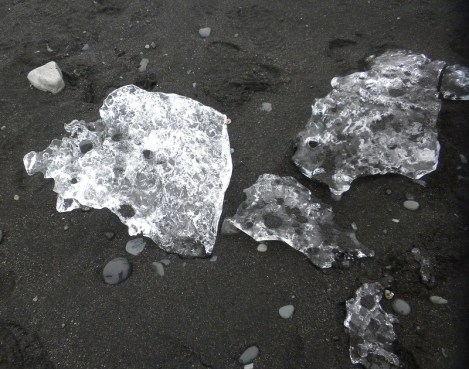
The Volcanic Sands of Breidamerkursandur with Chunks of Glacial Ice

The Volcanic Sands of Breidamerkursandur with Chunks of Glacial Ice

It’s just on the other side of the road from the Jokulsarlon glacial lagoon, one of Iceland’s primo tourist destinations. But for every one hundred backpackers milling around the lagoon, only two or three walk over to where the lagoon debouches into the North Atlantic. There you will find miles of black sand dotted with the remnants of icebergs. The effect is like looking at diamonds on a black velvet background.

I first heard about Breidamerkursandur (“Sands of the Broad Boundaries”) and Skeidararsandur (“Sands of the Open Spaces”) in Katharine Scherman’s excellent 1976 book Daughter of Fire: A Portrait of Iceland. There are very few places in the world where one can find miles and miles of black volcanic sand. I am told that Sicily, around Mount Etna, is another such place.

Years ago, my French friend Alain entertained a cousin from the old country who complained about the sands of Santa Monica being tan-colored, rather than pure white like the beaches with which he was familiar. The reason for the difference was not that our sand was dirty, but rather that it was formed by the ocean beating for millenia against sandstone rather than limestone. Certain volcanic rocks just happen to produce sand that is jet black, as at the beach at Breidamerkursandur.


New Land

Islands Seen from Storhofdi Peninsula on Heimaey

Islands Seen from Storhofdi Peninsula on Heimaey

Geologically speaking, the Westmann Islands south of Iceland are brand spanking new. The most recent island in the group, Surtsey, suddenly rose up from the sea during a volcanic eruption in November 1963. Even fifty years later, access to the island is restricted to scientists and naturalists. Even Heimaey, the “Home Island” of the group, was enlarged by the world’s youngest volcano, Eldfell, which came into existence in January 1973, forcing the evacuation of the island.

As the result of a miraculous save by the Icelanders, who pumped cold seawater on the advancing lava forcing it to form an ever-higher berm that prevented the town from being more than one-third inundated. (The story is ably told by John McPhee in his book The Control of Nature.) On the other hand, two square kilometers of new land were created on the east side of the island.

The only fatality from Eldfell was a druggie who broke into an apothecary and was overcome by the fumes.

I will be spending three days and two nights on Heimaey in June. I plan to visit the Storhofdi Peninsula and photograph the puffins that congregate on the cliffs there.


Visiting the Angry Sisters

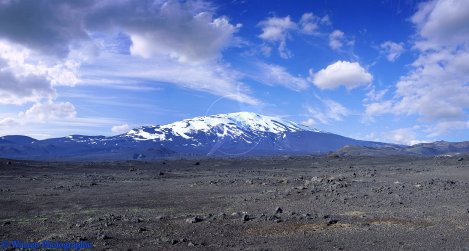
Mount Hekla

Mount Hekla in South Iceland

Whenever I have a few minutes during the craziness of tax season, I check out the Daily Life column on The Iceland Review’s website. Yesterday’s entry by Katharina Hauptmann (half of the Daily Life columnists are from outside Iceland) had the following to say:

In the past two days news broke about unusual seismic activity around the volcano Hekla.

Naturally, it became talk of the town.

Officially, a level of uncertainty has been issued and the related parties continue to monitor Hekla closely.

So can you by keeping your eyes on the volcano with this webcam.

Actually, everybody was waiting for Hekla’s neighbor Katla to blow, as an eruption is more than overdue.

Now it seems that Katla’s little sister Hekla is keeping the world on tenterhooks.

Here in Iceland, one usually refers to Hekla and Katla as the “angry sisters.”

I was once told that volcanoes had women’s names in Iceland because their nature was just like women: unpredictable and explosive.

During my upcoming visit to Iceland, I hope that neither Katla nor Hekla nor the dread Eyjafjallajökull erupt, because I will be spending four days in the South of Iceland in areas that would have to be evacuated (Hvolsvollur and Heimaey). And if it happens while I am in Höfn for two days, I will have to go all around the island to return to Reykjavik.

In European history, it is Hekla (shown above) that has the horrendous reputation. During the Middle Ages, it was widely regarded as the mouth of hell, and fishermen could see its eruptions from hundreds of miles away. By the way, there is a Hekla webcam you can visit. Just note that Iceland is on or near Greenwich Mean Time, and it is likely to be night there when you try.

You may recall the widespread cancellation the last time Eyjafjallajökull erupted twice in 2010. Newspapers around the world showed photographs of the devastation:

Eyjafjallajökull

Eyjafjallajökull

With volcanoes, one could get a day or two of warning before—literally—all hell breaks loose. But isn’t that all part of the fun?