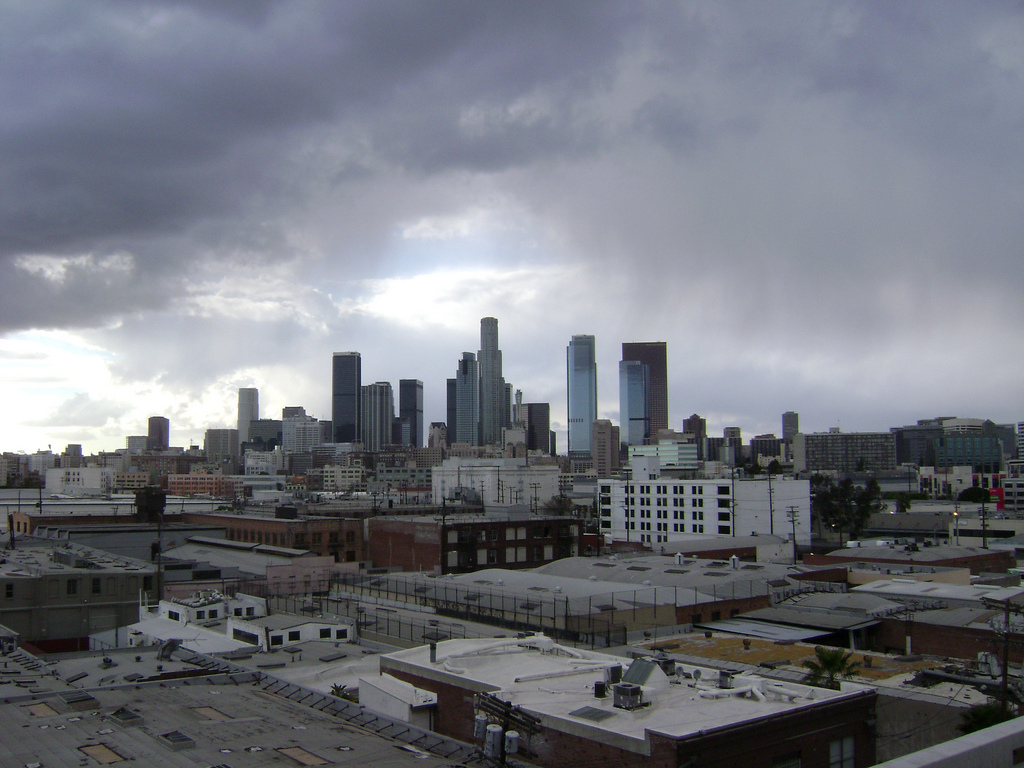

Thanks, Mario! The Mexican storm of this name has, upon dissipating flooded California with moist, tropical air and the threat of thunderstorms. As I went downtown today for my weekly Mindful Meditation session at the L.A. Central Library, I suddenly felt many of my joints protesting—from my formerly broken shoulders (both of them) to my left hip (replaced a quarter of a century ago).
Somehow, I made it, even though the elevator down to the Metro Rail station at Seventh Street was closed for repairs. Back when it was built, the architects decided they didn’t need a down escalator: Stairs should do nicely. Hah!
The humidity will probably last through the weekend, regardless what the weather forecaster say. What do they know?
I remember from my early days in Cleveland, whatever happened to one side of the city also happened to the other sides. That’s because Cleveland was, if not as flat as a pancake, pretty darn flat. In fact the highest elevation in the whole State of Ohio is 1,549 feet (472 meters).
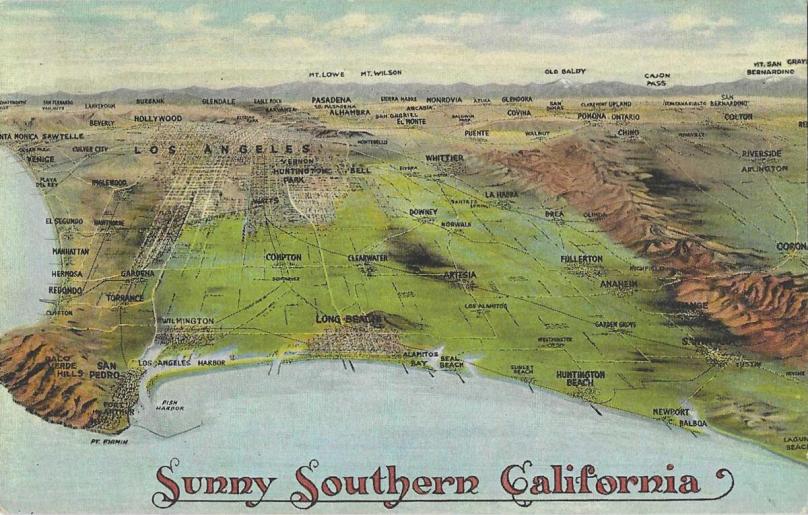
Compare that with Los Angeles County where I live. When I look out my front door, I can see the Santa Monica Mountains just a few miles north of me, where the highest elevation is 3,111 feet (948 meters) at the curiously named Sandstone Peak. Curiously named because it actually isn’t sandstone. And there is one peak in the San Gabriel Mountains—Mount San Antonio, aka Mount Baldy—which rises to 10,064 feet (3,069 meters).
When the news gives the regional weather report, it has to differentiate between several different weather zones:
Coastal (where I live)
Los Angeles basin
Valleys (San Fernando and San Gabriel)
Mountains
“Inland Empire” (San Bernardino and Riverside)
Lower desert
Upper desert
If the forecasters warn of an upcoming rainstorm, we in the coastal region might see only a few stray drops, while the San Gabriel Mountains might have a foot of snow dumped on their peaks.
So any “all-purpose” one-line weather forecast for Los Angeles is pretty meaningless. Los Angeles County is pretty big—4,084 square miles or 12,310 square kilometers, exceeded in area by only eight States. So if you’re flying into LAX from the East, you might want to check out Weather.Com or the National Oceanic and Atmospheric Administration (NOAA) website—provided that the Musk-Rat doesn’t gut it.
If you hate hot weather and have to live in California, near the beach is the place to be. My brother in Palm Desert is experiencing temperatures over 100° Fahrenheit (38° Celsius) on an almost daily basis. My friends Bill and Kathy in Altadena are typically getting temperatures over 90° Fahrenheit (32° Celsius). Martine and I, on the other hand, live two miles (3.2 km) from the beach and have been comfortable in temperatures not much warmer than 80° Fahrenheit (27° Celsius).
The reason for this is that we are enjoying what is referred to as the marine layer, which is what you get when relatively warm and dry air moves atop a body of cooler water. Sometimes, this layer only goes inland several hundred feet, or several miles, or even all the way to the edge of the desert.
As I drive to the beach, I enjoy looking at my Subaru’s thermometer reading dropping as I near the water. Today, fore instance, from Centinela Avenue to Chace Park in the Marina, a distance of two or three miles, the temperature dropped six degrees Fahrenheit from 83° to 77°. Plus there was a steady breeze that disappeared only a few hundred feet inland.
We live in an apartment that was built in 1945 (the year I was born) without insulation. We have fans, but no air conditioning. (We couldn’t afford it.) It is generally cheaper to live farther inland, but one cannot survive without air conditioning.
Only later in the summer and into early fall does the marine layer becomes less of a factor when the Santa Ana Winds bring the hot dry desert air to the beach communities and blows the marine layer offshore.
In terms of the calendar, summer began on Thursday; but in terms of the actual weather, it began today with high humidity (76%), relatively high temperatures (around 80° Fahrenheit or 27° Celsius), and a parade of majestic cumulus clouds.
If I were to identify the “microseason” we are entering, I would say it is Mexican Monsoon Season, where we are the recipient of the northern edges of Mexico’s summer monsoons.
That’s a fair trade, I suppose, because the united States begins sending in late autumn its nortes, or “northers,” which wreak serious havoc along the Gulf Coast of Mexico. In November 1992, I have memories of two nasty northers which led to extensive flooding in both Campeche and Mérida. I remember wading to the Campeche bus station in knee-deep water to buy tickets for the next morning’s ADO first class bus to Mérida.
When the next morning dawned, I was surprised to see that most of the flooding had subsided considerably.
Is it time to turn on the news yet? And when it is, what do you expect to hear? I don’t know about you, but I have come to the conclusion that the purpose of the news is to sell advertising by making the viewers fearful, such that they will want to be “informed” on the latest developments and continue to come back for more.
I have been asked by several friends outside of California whether I have “survived” the rainstorms that have hit the state this month. Evidently, I have, as I am writing this blog.
Southern California weather news can be illustrated by the following Venn diagram:
The blue circle indicates that “there has been too much rain”; the yellow circle, that “there has not been enough rain.” And what about the pale green zone where the two circles intersect? That’s when some weather reports are saying “there has been too much rain” and some others are saying that “there has not been enough rain”—at the same time!
At the same time we have been bombarded by reports of too much rain, there have been numerous stories that now a La Nina weather pattern is being established and that soon we will not be getting enough rain.
Apparently, there is no such thing as “just the right amount of rain.” It’s always a case of too much or not enough.
My suggestion for all of you: Try not to turn on the news just before going to bed. It will play havoc with your sleep.
This isn’t altogether scientific, but I think I might possibly see how global warming translates into disastrous weather such as tornadoes, hurricanes, typhoons, and other types of storms associated with heavy rains and flooding.
It all begins with hot weather. According to National Geographic Magazine, the hotter it gets, the more evaporation takes place;
The National Weather Service in the United States measures the rate of evaporation at different locations every year. Scientists there found that the rate of evaporation can be below 76 centimeters (30 inches) per year at the low end, to 305 centimeters (120 inches) per year on the high end.
The variability is based on temperature. The evaporated vapors form clouds until the air in a place just can’t take any more. The article continues:
Once water evaporates, it also helps form clouds. The clouds then release the moisture as rain or snow. The liquid water falls to Earth, waiting to be evaporated. The cycle starts all over again.
Many factors affect how evaporation happens. If the air is already clogged, or saturated, with other substances, there wont be enough room in the air for liquid to evaporate quickly. When the humidity is 100 percent, the air is saturated with water. No more water can evaporate.
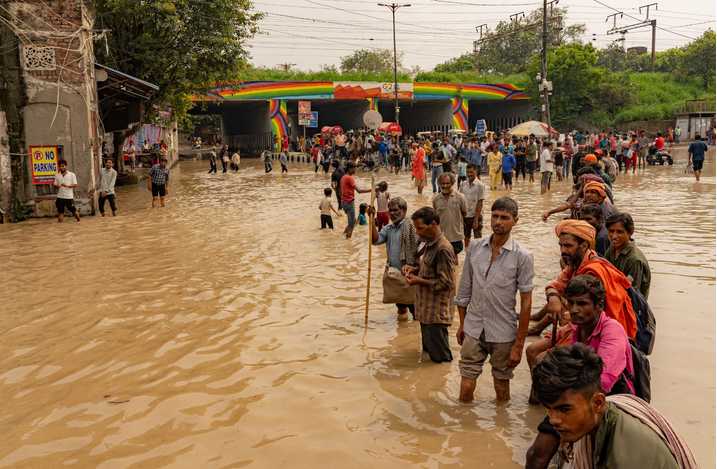
Then—you guessed it!—it comes down as rain. Sometimes, lots of rain. Such as Los Angeles received when a hurricane hit Southern California a couple weeks ago with record rainfall. Those record rainfalls have been happening all over the globe: Burning Man at Black Rock City in Nevada; Derma in Libya, at the edge of the Sahara Desert; and Delhi, India.
So I think that the whole cycle of drought and flood will become ever more extreme, sometimes in the most unlikely places.
A Tropical Storm in August—Followed by an Earthquake?
My friend Bill Korn had it right: “So. Floods. Tempests of wind. Even an earthquake. It seems like Someone is having an Old Testament-y kind of day.” Today, for the first time in eighty-four years, Los Angeles was hit by a summer hurricane that snaked its way north from Baja California. Just as a kind of bonus, we also had a Richter 5.1 earthquake around 2:40 this afternoon. (Fortunately, it was centered in Ojai, which is more than fifty miles northwest of here.)
Typically, L.A. has a short rainy season that lasts roughly from December to March. In the sixty-odd years I have lived in Southern California, we have not had any intense tropical summer storm events like this one. The rain started twelve hours ago and bids fair to continue for another whole day.
Thankfully, we are on the western edge of the storm, so we have not had any gale-force winds, just a whole lot of rain.
Martine and I went out for a Thai lunch early this afternoon, but otherwise we just stayed put, hoping with our fingers crossed that we would not have another power outage.
The Engine That Created California’s Storms This Year
Climate change is giving us a whole new language to describe the giant rain/snowstorms that have pummeled California since November 2022. Originally, there were the Pineapple Expresses which dumped large amounts of precipitation. There were maybe one or two in a rainy season, and just as likely none. Now the term Atmospheric River is used by the National Oceanic and Atmospheric Administration (NOAA). And then there are the Bomb Cyclones, fast-developing storms that occur when atmospheric pressure drops at least 24 millibars over a 24-hour period. Sometimes, all three terms are used to describe the same storm.
This year, California has experienced thirteen Atmospheric River storms this rainy season, dumping a record amount of precipitation in the form of rain and snow. I was watching a news report from Mammoth Lakes today which claimed that over 700 inches of snow have fallen in the area so far.That’s over 58 feet in all. Fortunately, it didn’t all fall at one time.
I suspect that we are probably at or near the end of these storms for this rainy season. These events have convinced me that there is risk entailed by siting a house in a low river valley or by a non-rocky hillside. Or by living in a trailer park.
The good news is that California agriculture will probably recover stronger than ever, except for those crops that don’t like too much water.
Rain Predicted for Los Angeles! Flee to the Hills!
The dire warnings have been appearing on the news for several days now: Rain is coming to Los Angeles. The city of brown lawns (watering of which is forbidden) is about to entertain a soaker. In a city unused to rain, the water that turns everything green and fills the reservoirs is also a present danger.
For one thing, drivers don’t seem to be able to modify their motoring to accommodate wet roads and flooded street corners. (What, I wonder, would they do in the icy streets of Cleveland?) I always slow down when it rains. It helps that my vehicle is an all-wheel-drive Subaru Forester.
Weather forecasting in a region of mountain ranges, valleys, and dry rivers with concrete banks is a chancy thing. Undoubtedly, some areas will get several inches of rain—mostly in the mountains; but in our neck of the woods, we rarely get as much as the news forecasts. At least in the last several decades, there is been a palpable drying trend. I remember some rainstorms of the 1970s and 1980s that did significant damage and dumped large amounts of precipitation.
I actually like the rain—even when it tends to fall on the weekends. Now that I’m retired, that’s no longer an issue.
Today Martine and I set out for the Santa Barbara Zoo, which is open for prepaid admissions. The Spring marine layer was in force, with heavy clouds and some drizzle between Ventura and Santa Barbara. It had stopped by the time we got to the zoo, so we were hopeful. We had a nice time despite the absence of the elephants (which were being replaced by an “Australian Walkabout” of some sort.) Also, the aviaries and some of the indoor exhibits were closed down “because of the virus.” Also, many other animals were either missing or hiding from view.
I suppose I could understand this. If I were in a cage at the zoo, I would not be too terribly interested in gaping at the teams of children and their harried parents. So I would probably present them with my hindquarters, like the above Humboldt Penguin. (Curiously enough, these Penguins come from near the Equator off the coast of Peru—not Antarctica.)
One animal which had no problem facing down the staring zoo visitors was the African lion:
We were done in about an hour, but satisfied by our walk in the cool, cloudy weather. Zoos are never perfect, but the small Santa Barbara Zoo is better than most. The LA Zoo is characterized by massive traffic jams and stroller collisions with adult ankles.
After the zoo, we drove down to the harbor and had lunch at Brophy Brothers, one of our favorite seafood restaurants in Southern California. Their New England clam chowder is to die for, and I also enjoyed the grilled mahi mahi sandwich.
By the time we were headed back home, the sun came out around Ventura and stuck around for the rest of the afternoon. In celebration, we drove home on the relatively uncrowded California 126 and stopped for strawberries the size of clenched fists at Francisco’s Fruit Stand in Fillmore. Also I picked up some yummy dried mangos and Banderita Mexican cocoanut candy.
It was a fun day, probably the most fun we had together since the onset of the plague in March 2020.
You must be logged in to post a comment.