e e

Here’s a melancholy poem to autumn by e e cummings. Here in Southern California, the trees don’t drop their leaves: They just accumulate dust or burn down. But I remember November from my days in Cleveland and New Hampshire:

cruelly, love

walk the autumn long;
the last flower in whose hair,
they lips are cold with songs

for which is
first to wither, to pass?
shallowness of sunlight
falls, and cruelly,
across the grass
Comes the
moon

love, walk the
autumn
love, for the last
flower in the hair withers;
thy hair is acold with
dreams,
love thou art frail

—walk the longness of autumn
smile dustily to the people,
for winter
who crookedly care.

My Cities: Hanover, NH

Main Street, Hanover, New Hampshire

It was hardly a city. When I was attending Dartmouth College between 1962 and 1966, there were no traffic lights at any of the intersections. There were a few thousand people, most of whom were directly or indirectly connected with the college.

When my parents drove back to Cleveland, I found myself alone for the first time in my life. Actually, it didn’t bother me as I thought it would. It was probably because my father and mother were going through a rough patch in their marriage, and I didn’t want to be back home for that. And I wasn’t really alone, because my roommate Frank Opaskar was a classmate from my high school.

In the end, we didn’t get along too well—for a strange reason. He slathered Noxzema on his face every night before going to bed, and I had the top bunk over him. Every night I drifted off to sleep in a noisome chemical fog. After two years, we parted company and I got a solo room.

Winters in Hanover were long and cold. The snow, once it fell, lasted all winter. (I wonder if it still does, what with global warming.) By the time March came along, you could see where every dog in Hanover had urinated. Spring was the worst time, because all that snow turned to slush. It was not until May that we could walk on the grass without our shoes making a sucking sound.

The town itself had a much loved grocery store called Tanzi’s and a number of restaurants. Early on, I gave up on the college dining hall and patronized only the restaurants. Farther down the street were the Dartmouth Bookstore and the Nugget Movie Theater, where I spent great gobs of time.

I remember the meatballs and spaghetti at Lou’s Restaurant, those few times he offered it as a special. And I had a lot of pizzas at Minichiello’s. I remember the Mom and Pop cooks there trying to get me to give their cute but clearly wild daughter sage advice about life, when what I really wanted was to be wild with her. Nothing came of it because, alas, I had not yet reached the age of puberty because my pituitary gland was being eaten up by a tumor which was operated on three months after I graduated.

The Crossing of the Berezina

The low point of Napoleon’s retreat from Moscow was the crossing of the ice-choked Berezina River, after the Russians had destroyed the bridge. Curiously, that crossing was also a choke point in Charles XII of Sweden’s invasion a hundred years earlier—a fact that Napoleon was aware of as he carried with him Voltaire’s Histoire de Charles XII. Here is the scene as described in Patrick Rambaud’s The Retreat:

What Voltaire wrote of the Swedish troops could have been a description of this shadow of the Grande Armée: “The cavalry no longer had boots, the infantry were without shoes, and almost without coats. They were reduced to cobbling shoes together from animal skins, as best they could; they were often short of bread. The artillery had been compelled to dump all the cannon in the marshes and rivers, for lack of horses to pull them….” The Emperor snapped the book shut, as if touching it would put a curse on him. Slipping a hand under his waistcoat, he made sure that Dr Yvan’s pouch of poison [for possible suicide] was safely attached to its string.

And here is the beginning of Victor Hugo’s poem “Expiation,” part of his The Punishments, about the retreat from Russia (as translated by Robert Lowell):

The snow fell, and its power was multiplied.
For the first time the Eagle bowed its head—
Dark days! Slowly the Emperor returned—
Behind him Moscow! Its own domes still burned.
The snow rained down in blizzards—rained and froze.
Past each white waste a further white waste rose.
None recognized the captains or the flags.
Yesterday the Grand Army, today its dregs!
No one could tell the vanguard from the flanks.
The snow! he hurt men struggled from the ranks,
Hid in the bellies of dead horses, in stacks
Of shattered caissons. By the bivouacs
One saw the picket dying at his post,
Still standing in his saddle, white with frost
The stone lips frozen to the bugle’s mouth!
Bullets and grapeshot mingled with the snow
That hailed ... The guard, surprised at shivering, march
In a dream now, ice rimes the gray moustache
The snow falls, always snow! The driving mire
Submerges; men, trapped in that white empire
Have no more bread and march on barefoot.
They were no longer living men and troops,
But a dream drifting in a fog, a mystery,
Mourners parading under the black sky.
The solitude, vast, terrible to the eye,
Was like a mute avenger everywhere,
As snowfall, floating through the quiet air,
Buried the huge army in a huge shroud ...

That was the low point of Napoleon’s reign, unless you include Elba, Waterloo, and captivity under the English at St. Helena.

A Winter Poem

Wood Thrush

I have always thought that Thomas Hardy was vastly underrated as a poet. Try this poem on for size and imagine that the time is the end of the day at the end of the year and (even) the end of the century:

The Darkling Thrush
I leant upon a coppice gate
      When Frost was spectre-grey,
And Winter’s dregs made desolate
      The weakening eye of day.
The tangled bine-stems scored the sky
      Like strings of broken lyres,
And all mankind that haunted nigh
      Had sought their household fires.
The land’s sharp features seemed to be
      The Century’s corpse outleant,
His crypt the cloudy canopy,
      The wind his death-lament.
The ancient pulse of germ and birth
      Was shrunken hard and dry,
And every spirit upon earth
      Seemed fervourless as I.
At once a voice arose among
      The bleak twigs overhead
In a full-hearted evensong
      Of joy illimited;
An aged thrush, frail, gaunt, and small,
      In blast-beruffled plume,
Had chosen thus to fling his soul
      Upon the growing gloom.
So little cause for carolings
      Of such ecstatic sound
Was written on terrestrial things
      Afar or nigh around,
That I could think there trembled through
      His happy good-night air
Some blessed Hope, whereof he knew
      And I was unaware.


Freezing for the Roses

Camping Out Overnight for the Rose Parade

Camping Out Overnight for the Rose Parade

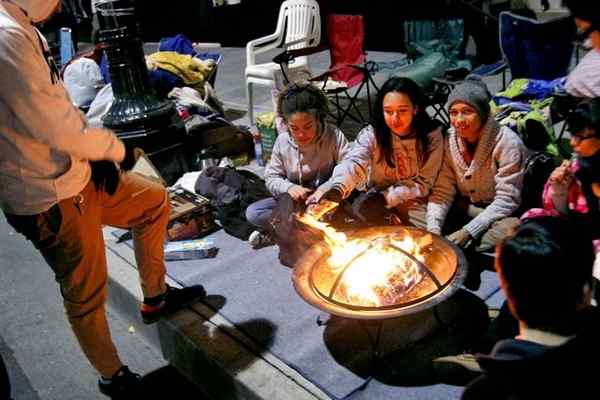
The temperature overnight in Pasadena is expected to dip down to 46° Fahrenheit (that’s 8° Celsius). When Martine and I were there about an hour ago, it was already near that level. Additionally, there is now a 50% chance of rain before morning.

And what is tomorrow morning? Why, it’s the Tournament of Roses parade, which is how Southern California proselytizes Easterners that we don’t have to shovel ice and snow off our sidewalks, and that it (almost) never rains in L.A.

Colorado Boulevard was so crowded with people camping in the streets in order to get a front seat for the parade that Bill, Kathy, Martine and I had to find a different restaurant: The local Persian restaurant, Heidar Baba, was a total mob scene—both from the point of view of parking and prone bodies to step over. Fortunately we found a place a scant two blocks from the parade route that was almost empty.

I never understood why so many people were interested in the Tournament of Roses Parade. And as for camping in the streets along with all the gang members and drug deals, that was never an option for me and never will be. If I wanted to see the parade (which I don’t), TV is good enough, even with the corny announcers oohing and aahing over the 30 million Himalayan Stinkflowers lining the North Korean Friendship Float.

My guess is that many of the campers are Penn State fans in town for the Rose Bowl confrontation with USC. Many will return to their frozen hells convinced that Southern California is the place to be—not to mention the millions viewing it on television from the Keystone State and adjacent polar regions. We don’t really need or want another influx of people escaping the snows of winter only to find that neither housing nor jobs are easy to find here. Oh, well, so it goes.