I Go on the Gulag Diet

Thanks, But No Thanks!

Thanks, But No Thanks!

Today, the doctor threw the book at me. My pancreas has become less able to process carbohydrates. The result: I will have to take even more insulin—two different types, even! And more seriously, I must root out and avoid carbohydrates to the maximum extent possible. I’ll be the person you see with a sour expression on his face discontentedly picking at a salad, moving the lettuce from side to side until I can stomach raising the fork to my mouth.

Effective today, I must reject all offers of food from friends. I may reach into my pocket and eat two or three peanuts when nobody’s looking my way.

What can I eat on the new Gulag Diet? Boots and belts are generally okay, but I must avoid all the carbs that lurk in the bootlaces and stitching.

Eventually, I will make some accommodation to what my doctor assures me is a dire need; but in the meantime, don’t expect me to jump for joy.


Can This Be Me?

Budé

Guillaume Budé

In 1503 he married the daughter of an ancient Norman house, and it is said that, on his wedding-day, by an exceptional act of self-denial, he limited his time of study to three hours only. In his studies he was aided in every possible way by the devotion of his wife. Once, when he was busy reading in his library, one of the servants suddenly rushed in to inform him that the house was on fire. The scholar, without lifting up his eyes from his book, simply said to his informant:—allez avertir ma femme; vous savez bien que je ne m’occupe pas des affaires du menage! (Translated as: “Go tell my wife. You know I don’t concern myself with household matters.”) His health was seriously impaired by his prodigious industry, and the surgeons of the day vainly endeavoured to cure him of his constant headaches by applying a red-hot iron to the crown of his head. Happily he was enabled to find a safer remedy by taking long walks and by cultivating his garden.—John Edwin Sandys, A History of Classical Scholarship, Vol. II, Entry on “Guillaume Budé”

Iceland 2001: Watch a Whale, Eat a Whale

The Port of Husavík in Northern Iceland

The Port of Husavík in Northern Iceland

There is a controversy still going on in Iceland between fisherman who catch whales for domestic consumption and those who run whale-watching cruises for foreign tourists who are dead set against hunting whales.

Although, in general, I am against hunting whales, I think that a small island that has depended on whale meat for over a thousand years deserves a break. Many of the old Icelandic sagas, such as Grettir’s Saga, feature family feuds that began when one family group cut up a beached whale for itself while another claimed the rights to it.

The whales that Icelanders hunt are Northern or Common Minke Whales (Balaenoptera acutorostrata), which are small and relatively common—by no means the endangered species that American, Russian, and Japanese vessels in the Pacific hunted to the point of no return.

During my 2001 to Iceland, I took a whale-watching cruise out of Husavík, along Iceland’s north coast. We only saw a couple of Minke Whales (I guess it was a bad day), but we had a good time. And the galley prepared delicious hot chocolate and sweet rolls for all the passengers.

There is also a decent-sized whaling museum in Husavík that I visited and enjoyed twelve years ago.

If you want me to translate the sign in the above picture, I believe it goes, “If you can read this, you’re too darn close.”

Oasis

An Oasis of Tranquillity: The SRF’s Lake Shrine in Pacific Palisades

An Oasis of Tranquility: The SRF’s Lake Shrine in Pacific Palisades

Even in hectic Southern California, there are oases of tranquility. One of the most surprising is the Self Realization Fellowship’s Lake Shrine on Sunset Boulevard near where it meets the Pacific Ocean.

The property on which it sits had a rich history. It used to be part of Santa Ynez Canyon, where Producer Thomas H. Ince’s Inceville, the first modern studio, was located. Here William S. Hart made his silent cowboy films beginning in 1915. After Ince died in a suspicious accident aboard William Randolph Hearst’s yacht in 1924, surrounded by early Hollywood luminaries.

Eventually, in 1950, the property was sold to Paramahansa Yogananda, the founder and first leader of the Self Realization Fellowship (SRF). Today it serves as a unique meditation garden with a floral walkway around a central lake, upon which swans, ducks, and turtles abound. Usually, there are also koi, but they seemed to be in hiding today.

Martine has gone through the mill with the onset of her fibromyalgia early this year. Of late, she has been feeling better; and I thought that a visit to a peaceful place like the Lake Shrine would do her good. It did that.


The Ugly Sell

If You’re Ugly, Our Ad Message Is for You!

If You’re Ugly, Our Ad Message Is for You!

The latest trend in Internet website advertising is to use ugly models together with some sort of interactive pitch whereby you provide information to the advertiser. Is it because people are tired of advertising models who are better looking than they are? Goodness knows, there are fireplugs I have seen that beat me all to hell in the looks department. But I’m still not sucker enough to fall for one of these.

Here a couple more horrors:

Hmm, Another Real Estate Ad

Hmm, Another Real Estate Ad

This Poor Women Is All Over the Net

This Poor Woman Is All Over the Net

UglyAd1

Oof! Enough!

Iceland 2001: Surviving the Fierce Winds

In a Land of Fierce Winds, Corrugated Steel Siding is Required

In a Land of Fierce Winds, Corrugated Steel Siding is Required

How windy is it in Iceland? For one thing, there are no tall trees on the island. The joke among the natives is the answer to the riddle, “What do you do if you’re lost in an Icelandic forest?” The answer: “Stand up!”

More of the land used to be forested, but centuries of sheep herding and gathering wood for charcoal and building had depleted the original forests. In the medieval sagas, most of which were written in the thirteenth century, much is made of who has the legal rights to claim driftwood that has washed up on the beach. (Cf. The Saga of Havard of Isafjord.)

One of the things I found most curious when I landed in Reykjavík were all the houses with painted corrugated steel siding. The above house is in Heimaey on the Westman Islands, but the general principle holds: Protect it with steel or the wind will blow your house in, if not away. The same goes for the roofs: A shingle roof would not last a month.

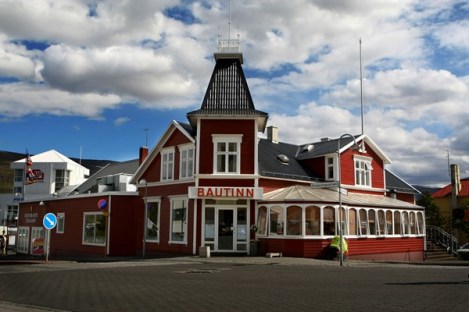
The painted corrugated siding does add quite a bit of color to a land which would otherwise tend toward the grey and gloomy. The following is a photo of the Bautinn, my favorite restaurant in Akureyri:

The Colorful Bautinn Restaurant in Akureyri

The Colorful Bautinn Restaurant in Akureyri

Whole neighborhoods in Reykjavík and other cities feature buildings whose siding has been painted in bright colors.


The Bus and Train Freak

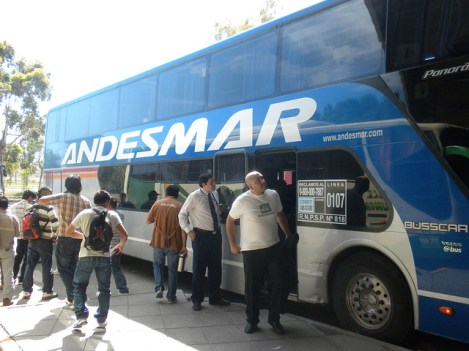
At the Bus Station in Trelew, Argentina

At the Bus Station in Trelew, Argentina

Here in the United States, our intercity ground transportation is the pits. Even Mexico has us beat, with buses they manufacture themselves. Of course, neither the U.S. nor Mexico are any good at railroads, with a few minor exceptions.

One thing about me that you may not know is that I am a transportation freak. I think about public transportation a lot. Two weeks ago, I suddenly woke up in the middle of the night remembering the bus company that took me in 2001 from Reykjavík to Akureyri via the Kjölur route across the desolate plateau that forms the center of the island. The bus I took was labelled Seydisfisbilar Akureyrar. (There may be a few diacritical marks missing: The line doesn’t show up on a present day Google search.).

The funny thing is that I could figure out bus and train schedules almost irrespective of what European language they’re written in. Asking questions and understanding the answers is an entirely different issue.

In Argentina, Martine and I rode long-distance buses between Puerto Madryn, Trelew, and Gaiman—mostly on the 28 de Julio line. They were so far and away better than anything Greyhound has in the field that I blush with shame. Even the verbal interface with the ticket agents in the above cities was relatively easy, until I found out that, on some routes, seating is assigned rather than being asiento libre (“sit where you please”).

When I am in Iceland, if I run into Straeto employees that either do not or will not speak English, I may run into a spot of trouble. But since 95% of Icelanders under the age of 70 speak English, that is pretty much a baroque fear.

As for Icelandic train schedules, there are none, primarily because no one ever built a passenger railroad to serve a sparsely populated island in the Arctic.


The Storyteller

How to Raise a Literate Child

How to Raise a Literate Child

This is my mother within a year or two of my birth. When I see her wave at the camera, I almost feel as if it were a cheery wave at me from another world. There are many things that went into the making of a strange person such as myself. What my mother contributed, other than unstinting love over five decades. were all the stories.

First, as I was a little toddler lying in my crib at 2814 East 120th Street were the stories she made up herself. They were wonderful stories, and they were all in Hungarian. They all took place in a sötét erdö (a dark forest) and featured a tündérlány (fairy princess) who helped a little boy overcome all manner of ogres and other baddies.

When Mom was tired or her inventiveness wasn’t sufficient to satisfy my little inquiring mind, she picked up some children’s books at the library on East 116th Street and read them to me, first translating them into Hungarian. One of the first stories was a book that is still available today: The King’s Stilts by Dr. Seuss. I will never forget the picture of the king’s realm surrounded on all sides by tall levees and the encroaching water. (I still have a copy of the book, which I found on eBay and treasure.)

Then, when I started going to school, and my parents realized that Mrs. Idell and her colleagues had no idea how to teach a little Hungarian boy the English language, my parents decided to buy a house on East 176th Street in the Lee-Harvard area of Cleveland. Also, by that time, I had a little brother; and our apartment on East 120th Street just wasn’t big enough any more.

Sophie Paris was gifted with a fertile imagination. When she wanted to get a job as an Occupational Therapy Assistant (O.T.A.), she had to provide the name of the college she attended. Without any hesitation, she declared herself an alumna of the University of Hakapeszik in Budapest. A rough translation of Hakapeszik would be, “If s/he can get his/her hands on any food, he/she’ll eat.”

You see, Hungarian doesn’t have any gender-specific pronouns. Other than context, there is no way of telling whether he, she, or it is intended.

But that is a story for another day.
Iceland 2001: Jökulsárlón

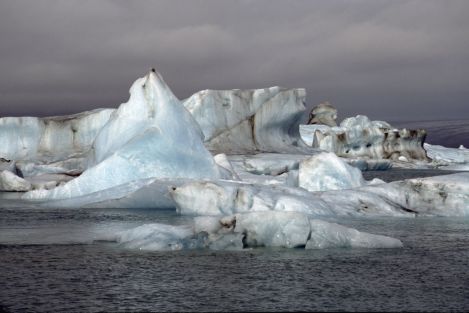
The Glacial River Lagoon of Vatnajökull

The Glacial River Lagoon of Vatnajökull

About a week ago, I found my old Kodachrome slides of my 2001 trip to Iceland. I had them converted by Bel Air Camera in Westwood to JPEG format and copied onto a CD-ROM. Over the next couple of weeks, I will be interspersing my best Iceland 2001 pictures with my regular posts.

The above glacial lagoon is near the Southeast Corner of Iceland, between Höfn and Skaftafell. Iceland is called Iceland because that corner is occupied by Europe’s biggest and most deadly glacier, Vatnajökull. And that glacier is the first part of the island that comes into view when sailing aboard a Viking craft from Europe.

Beneath a heavy layer of glacial ice at Vatnajökull lies the volcano Grimsvötn.

Think of what happens when an active volcano that is covered by a glacier suddenly erupts. You have a phenomenon, unknown in the Continental United States, referred to by Icelanders as a Jökulhlaup, a sudden flood that forms from seemingly nowhere and rushes to the sea, destroying everything in its path. It is because of this phenomenon that Iceland did not have a permanent road connecting the Southeast of Iceland to the Southwest. The picture below shows the wreckage of a steel bridge not far from the lagoon above from the 1996 eruption of Grimsvötn:

Bridge Destroyed by 1996 Eruption of Grimsvötn

Ruins of Bridge Destroyed by 1996 Eruption of Grimsvötn

The lagoon of Jökulsárlón is one of the most popular tourist attractions in the area. The calved pieces of the glacier are all shades of blue and white. It is possible to take an amphibious boat ride among the floating chunks of ice, which I plan to do next month. The bus from Reykjavík to Höfn (and back) stops there for about thirty minutes to let all the shutterbugs have a go at it.