I Am Blown Away

I Thought It Was Curtains for me....

I Thought It Was Curtains for Me….

If you read about the places to visit in Iceland, you will hear about the bird cliffs at Látrabjarg, the westernmost point in Europe (if you except some of the lesser-populated Azores Islands far to the south). Some nine miles in length, the cliffs average over 1,300 feet in height.

It was not easy to get to Látrabjarg using public transportation. Three times a week, a Sterna bus left Isafjördur at 9 a.m., returning twelve hours later. More than half the trip was over bumpy volcanic cinder roads between Þhingeyri and Brianslækur and between Patreksfjördur and Látrabjarg. Along the way, it stopped twice for the arriving Baldur ferry from Stykkisholmur and Flatey. I knew it would be a bear, but I took the bus a week ago today.

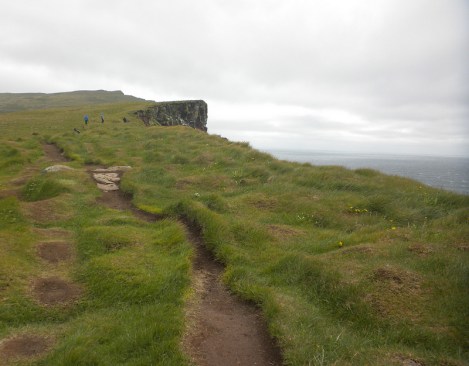
Some days in Iceland are beautiful and clear. Last Saturday was not. As the bus parked at the foot of the cliffs, we all learned we had a mile to hike to the top. A gale-force wind was blowing with light rain, from east to west. As I climbed the trail to the top, I felt the wind tugging me toward the edge.

Twice, I was blown down by strong gusts—each time distressingly close to a plunge to my death over the cliffs. (It happened once last year to a German backpacker.) To protect myself, I dropped down, being unable to make any forward motion in the wind.

Eventually, I made my way back to the bus. The Icelandic driver obligingly let me in an hour before the rendezvous time and informed me that it was like this about half the time. Other times, it was beautiful; and the cliffs abounded with puffins and razorbills. Today, the birds knew better than to try to fly into the teeth of the wind.

Do I regret the trip? Was it a wasted day? By no means: I saw parts of the West Fjords that—in an entirely different sense of the word—took my breath away. And I got to see the wedding-cake-like Dynjandi Falls twice. Just for the record, here is my best photograph of it:

Dynjandi Falls in the West Fjords

Dynjandi Falls in the West Fjords

In all, I saw the falls three times. It was worth it. Sure I got tired out. When we rolled back into Isafjördur around 9 p.m., I stumbled into the nearby N1 Gas Station and ordered a pylsur (that’s hot dog to you) and skyr. Then I somehow tottered over to the Gamla Hostel across the street and fell into a deep sleep.

 

Girls Who Say “Yow”

Icelandic Cannery Workers in Keflavik, Circa 1930s

Icelandic Cannery Workers in Keflavik, Circa 1930s

Actually, all Icelandic women say “Yow,” but only when they’re being positive. It happens that the word for “Yes” in Icelandic is , which is pronounced Yow. I repeatedly cracked up hearing conversations among women in which they kept Yowing back and forth to one another.

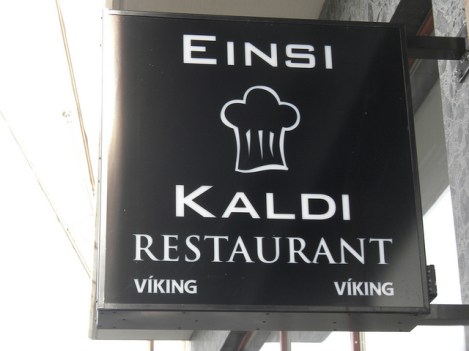
One day, while I was eating dinner at the Hotel Vestmannaeyjar’s Einsi Kaldi Restaurant in Heimaey, the Icelandic girls’ soccer team walked in, still wearing their field uniforms. (There had been a national soccer tournament in Heimaey, which complicated my getting a hotel booking in town.)  After swooning at the impact of the beauty of so many Viking princesses at one time, I was amused by all the Yowing that went on as they described the game just completed.

Where I Encountered the Icelandic Girls’ Soccer Team

Where I Encountered the Icelandic Girls’ Soccer Team

Ever since Quentin Tarantino made a famous comment about young Icelandic women in a Conan O’Brien appearance about “supermodels working at McDonald’s,” stories and myths have abounded about the legendary beauty of Reykjavík girls. (BTW, McDonald’s pulled out of the country because they couldn’t compete with the local hamburger restaurants, which are pretty good.) Much of what he said is about the party scene in Reykjavík—which can get extreme with young women becoming seriously drunk and (presumably) available—is uncomplimentary and not a little insulting.

With my advanced age and scruffy looks, I did not presume to partake in any party scenes. Instead, I dealt with numerous Icelandic women throughout the island and found them to have a great sense of fun.

When I was in Isafjörður, I met a young guide named Thelma (pronounced “Talma”) from West Tours, with whom I took a trip to Vigur Island (about which more at another time). All the time I was there, I kept running into her at various places—it was a village of only 2,000 or so—and she remembered me each time and stopped to chat with me.

Okay, so maybe they saw “Yow” a lot, but Icelandic women are all right in my book.

A Flatey State of Mind

Church and Tiny Library on the Island of Flatey

Church and Tiny Library on the Island of Flatey

In the twelfth century, there was a famous monastery on this tiny little island among many on Breiðafjörður in Northwest Iceland. It was at this monastery that the famous Flateyjarbók with its many sagas was written. Among these sagas are the ones dealing with the Icelandic discoveries of Greenland and North America, as well as many of the tales of Norwegian royalty that make up Snorri Sturluson’s Heimskringla saga.

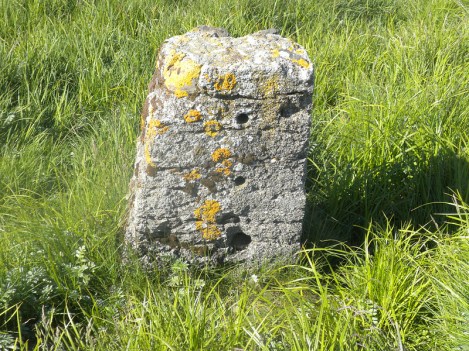
What’s left today of that monastery? Nothing, except a single stone, which I was unable to find. I would like to think, however, that it was this stone:

Could This Be All That Remains of  the Great Monastery at Flatey?

Could This Be All That Remains of the Great Monastery at Flatey?

Centuries later, long after the monastery stones were carted off to form shielings for the local sheep farmers, Flatey was a prosperous town with a large and active fishing fleet.

And today? Flatey has only four year-round inhabitants, though Icelanders from Reykjavík and the northwest of the country like to summer there. I spent the night in the old Hotel Flatey, the only one remaining, with a decided feel of the nineteenth century. (The restaurant, however, was quite excellent and up to date, with its delicious fish specials.)

After dinner, I took a walk on the tiny island in a vain attempt to look for puffins. As I left the “village,” I was immediately attacked by arctic terns for daring to venture near their nesting grounds. Terns are not particularly large, but they are aggressive and can cause painful beak punctures in the head. I had heard about them,  but did not know they were nesting on Flatey. It was only later that a hotel employee told me I should have taken a stick from a box near the entrance: Arctic terns tend to attack the tallest point of an invading person’s body, and they cannot discern the difference between a head and an upraised stick. It was an interesting experience, and a little scarey.

Overall, however, I felt a great sense of peace on this little island that once was the scene of great intellectual, religious, and commercial accomplishments—but now is just a peaceful place (except for the terns) where can stare across the fjörd at the countless uninhabited islands.

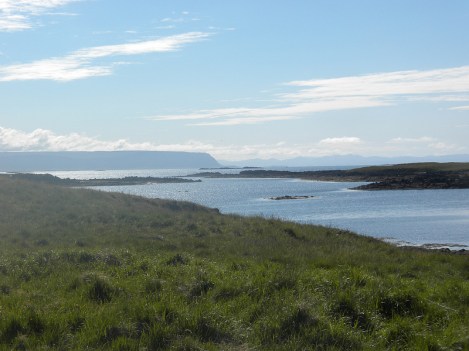
Some of the Thousands of Islets of Breiðafjöður seen from Flatey

Some of the Thousands of Islets of Breiðafjörður Around Flatey

Although I had to be on the 10 a.m. ferry from the dock on Flatey, I enjoyed my evening and morning in this place that once was a bustling center and is now only a place of isolation and tranquillity.

Why I Went to Iceland

The Geyser Strokkur at—Where Else?—Geysir in Iceland

The Geyser “Strokkur” at—Where Else?—Geysir in Iceland

My friend Catina Martinez wrote, “I’ve had lots of friends and family traveling to Iceland lately. I hope you’ll blog about how you chose Iceland. Sounds lovely.” Well, now that I’m back, I thought I’d start with a summary of why I went and answer Catina’s request.

I suspect my reasons will seem strange to many people, but then I am a strange person. It all started with my reading of the medieval Icelandic sagas, beginning with the Njals Saga and going on to the other four principal works: Grettir’s Saga, Laxdaela Saga, The Eyrbyggja Saga, and Egils Saga. At the time they were written in the 13th and 14th centuries, they were the best literature that was written anywhere at the time in Europe.

Now how could that be? The Icelanders were, after all, Vikings. Didn’t they wear helmets with bulls’ horns on them and inspire the other Europeans with fear? Wasn’t a standard prayer of the time “From the fury of the Norsemen, good Lord, deliver us”? And yet they also created a great literature.

Oh, and along the way, they discovered and settled America. (And also Greenland, along the way.)

Of course, their settlement didn’t last; but the Icelanders were definitely there: At L’Anse aux Meadows in Newfoundland, archeologists have discovered artifacts proving they had been there for a time.

Evidently, there’s something going on in that little island whose total population is less than that of a one-mile radius around my apartment in West Los Angeles. It is the most literate country in the world (100%), and I have heard a strange statistic that even I cannot believe: Namely, that 10% of adult Icelanders have written and published books.

At the same time, Iceland is a country of stark and eldritch beauty. Mostly volcanic in origin, some 18 volcanoes have erupted—some multiple times—since the island was settled by Norwegians late in the 8th century A.D. Some of them, especially Laki in 1783-84 were severe enough to have killed off a quarter of the population and imperiled agriculture throughout the island. The eruption of Eyjafjallajökull (bet you couldn’t say that ten times) in 2010 led to massive disruption of air navigation throughout Europe for months. And during the Middle Ages, Hekla was thought to be the gate of Hell.

The geysers at Geysir, the active volcanoes, the glaciers, the thousands of waterfalls everywhere, and the lovely green valleys of the south of the country make it a land of startling contrasts.

And so it was for me. The place takes my breath away.

In the weeks to come, I will keep coming back to these subjects, with supporting photographs I have taken during the last three weeks, such as the one above.