Welcome to the Weimar Republic of America

We’re Bringing Back Those Cheery Days of Yesteryear

We’re Bringing Back Those Cheery Days of Yesteryear

Last month’s midterm election has soured me on American politics.What with the growing inequality between the rich and … everybody else; with the increasing police violence and “open carry” of firearms; with the growing respectability of organizations such as the NRA and the Ku Klux Klan—with all this and more I think we as a nation are transitioning toward a really, really bad time that is just now waiting in the wings, waiting for the Confederate battle flag to be hoisted on the Capitol Building in Washington, perhaps?

I’m not so simplistic as to think that a Hitler-like dictator is next. But with such a small number of Americans exercising their right to vote, maybe we’re just not that interested any more. We have our own cabaret: We take it with us on our smart phones and MP3 players. Maybe we won’t replicate German history of 75 years ago, but we may come close. As long as Taylor Swift is cooing in our ears, we just don’t give a rat’s patoot about anything else.

Look Familiar to You?

Look Familiar to You?

We call the ultra-wealthy the 1%, and they’re much like the mustachioed tycoon in George Grosz’s illustration above. Note that the poor man on the left is getting the boot. Today’s styles might be different, but the direction is substantially the same.

I will of course resist. I vote in every election, even when I don’t detect a clear demarcation between the varying candidates. We live in the world described by William Butler Yeats in his poem “The Second Coming”:

Turning and turning in the widening gyre
The falcon cannot hear the falconer;
Things fall apart; the centre cannot hold;
Mere anarchy is loosed upon the world,
The blood-dimmed tide is loosed, and everywhere
The ceremony of innocence is drowned;
The best lack all conviction, while the worst
Are full of passionate intensity.


“Angels We Have Heard on High…”

Christmas Angel at Grier Musser Museum

Christmas Angel at the Grier Musser Museum

Martine and I don’t go in for celebrating Christmas in a big way, but we like to visit the holiday show at the Grier Musser Museum and look at all the decorations, some dating back to Victorian times, some as new as yesterday. Susan and Ray Tejada have accomplished no less than providing a popular history of Yule memorabilia. Most of the displays did not cost much at the time they were printed or manufactured, but they are the type of “stuff” that people fill impelled to discard because it tends to fill all the available space.

I have always loved the three candle-holding angels (the leftmost one is in the above photo). They appear with a wide selection of greeting cards, pop-up books, commemorative dishes, figurines, paintings, “Depression glass,” music boxes, and other memorabilia relating to the season.

After we did the tour of the house, Susan took us downstairs to see the two television shows that the late Huell Howser did featuring the Grier Musser Museum. It is unfortunate that Huell, who taught us how to appreciate so much of California, is no longer with us. But it was his influence that led Martine and I to begin visiting the museum, which has become one of our own holiday traditions.

Serendipity: Ishmael and Queequeg

The “Cannibal” Queequeg

The “Cannibal” Queequeg

Today, I found myself waiting in the library of Loyola Marymount University for several hours while Martine did her errands. So I went over to the bookstore and bought the Norton Critical Edition of Herman Melville’s Moby-Dick and began my third reading of the classic. To my surprise, it didn’t take long into the book before I found the perfect paradigm of the United States in dealing with the rest of the world.

At the Spouter Inn in New Bedford, Massachusetts, Ishmael can have a place to sleep only if he shares a bed with the harpooner who rents the room. According to the landlord, he is out trying to “sell his head.” Ishmael tries sleeping on a downstairs bench that is too narrow and too short, but finally decides to take a chance. His awakening when the harpooner stumbles in in the middle of the night is a classic:

Lord save me, thinks I, that must be the harpooneer, the infernal head-peddler. But I lay perfectly still, and resolved not to say a word till spoken to. Holding a light in one hand, and that identical New Zealand head in the other, the stranger entered the room, and without looking towards the bed, placed his candle a good way off from me on the floor in one corner, and then began working away at the knotted cords of the large bag I before spoke of as being in the room. I was all eagerness to see his face, but he kept it averted for some time while employed in unlacing the bag’s mouth. This accomplished, however, he turned round—when, good heavens! what a sight! Such a face! It was of a dark, purplish, yellow colour, here and there stuck over with large blackish looking squares. Yes, it’s just as I thought, he’s a terrible bedfellow; he’s been in a fight, got dreadfully cut, and here he is, just from the surgeon. But at that moment he chanced to turn his face so towards the light, that I plainly saw they could not be sticking-plasters at all, those black squares on his cheeks. They were stains of some sort or other. At first I knew not what to make of this; but soon an inkling of the truth occurred to me. I remembered a story of a white man—a whaleman too—who, falling among the cannibals, had been tattooed by them. I concluded that this harpooneer, in the course of his distant voyages, must have met with a similar adventure. And what is it, thought I, after all! It’s only his outside; a man can be honest in any sort of skin. [Italics mine] But then, what to make of his unearthly complexion, that part of it, I mean, lying round about, and completely independent of the squares of tattooing. To be sure, it might be nothing but a good coat of tropical tanning; but I never heard of a hot sun’s tanning a white man into a purplish yellow one. However, I had never been in the South Seas; and perhaps the sun there produced these extraordinary effects upon the skin. Now, while all these ideas were passing through me like lightning, this harpooneer never noticed me at all. But, after some difficulty having opened his bag, he commenced fumbling in it, and presently pulled out a sort of tomahawk, and a seal-skin wallet with the hair on. Placing these on the old chest in the middle of the room, he then took the New Zealand [shrunken] head—a ghastly thing enough—and crammed it down into the bag. He now took off his hat—a new beaver hat—when I came nigh singing out with fresh surprise. There was no hair on his head—none to speak of at least—nothing but a small scalp-knot twisted up on his forehead. His bald purplish head now looked for all the world like a mildewed skull. Had not the stranger stood between me and the door, I would have bolted out of it quicker than ever I bolted a dinner.

Little by little, Ishmael and Queequeg (for such is his name) warm up to each other. Returning from the famous sermon in the Whaleman’s Chapel, Ishmael encounters Queequeg again at the Spouter Inn:

With much interest I sat watching him. Savage though he was, and hideously marred about the face—at least to my taste—his countenance yet had a something in it which was by no means disagreeable. You cannot hide the soul. [Italics mine] Through all his unearthly tattooings, I thought I saw the traces of a simple honest heart; and in his large, deep eyes, fiery black and bold, there seemed tokens of a spirit that would dare a thousand devils. And besides all this, there was a certain lofty bearing about the Pagan, which even his uncouthness could not altogether maim. He looked like a man who had never cringed and never had had a creditor. Whether it was, too, that his head being shaved, his forehead was drawn out in freer and brighter relief, and looked more expansive than it otherwise would, this I will not venture to decide; but certain it was his head was phrenologically an excellent one. It may seem ridiculous, but it reminded me of General Washington’s head, as seen in the popular busts of him. It had the same long regularly graded retreating slope from above the brows, which were likewise very projecting, like two long promontories thickly wooded on top. Queequeg was George Washington cannibalistically developed.

As I read this, I thought that Melville was a man who was comfortable in his own skin and who understood the world—understood it far better than those police in Missouri and New York who killed out of fear, understood it far better than George Zimmerman who “stood his ground” because of his fear.

Fear is not only a mind killer, it is also a killer of otherwise innocent black people who are confronted with very limited white people who don’t know how to take them.


My Years with Gabo

The Mayan Ruins at Chichén Itzá

The Mayan Ruins at Chichén Itzá

It was November 1975. For the first time in my life, I was outside the United States on my own. I always thought it was somehow significant that my first bid for freedom from those endless bad weather trips back and forth to Cleveland to see my parents was a two week vacation in Yucatán. When visiting the ruins at Chichén Itzá, I stayed at the old Hacienda Chichén, which contained the cottages used by earlier archaeologists. I was within walking distance of the ruins.

Back then, a road cut through the ruins. On one side was the Castillo and the structures best known to visitors; on the other, there was Old Chichén. By the side of the road, there was an open-air souvenir stand with thatched roof that sold the usual tourist junk. On the side, there was a book rack that happened to have a Penguin paperback edition of Gabriel García Márquez’s One Hundred Years of Solitude (1967). I had heard of the author before and was just beginning to wake up to that breakout generation of Latin American writers that included Borges, Cortázar, Vargas Llosa, and García Márquez. Here in front of me was a grey-covered Penguin (“This edition not for sale in the United States”) that looked like an interesting read.

How could I not read a book that opened this way:

Many years later, as he faced the firing squad, Colonel Aureliano Buendía was to remember that distant afternoon when his father took him to discover ice. At that time Macondo was a village of twenty adobe houses, built on the bank of a river of clear water that ran along a bed of polished stones, which were white and enormous, like prehistoric eggs. The world was so recent that many things lacked names, and in order to indicate them it was necessary to point.

That was my first acquaintance with the Colombian writer whose work was to become a lifelong pursuit with me. Ever since, I have rationed the books I read by him so that I didn’t run out too soon. Yesterday, I re-read Chronicle of a Death Foretold, which I last read thirty years ago in a magazine that had an illustration by Fernando Botero. (I forget which magazine it was.)

Since my first acquaintance with Colonel Buendía in 1975, I have gone on to read:

  • Leaf Storm (1955)
  • No One Writes to the Colonel (1961)
  • In Evil Hour (1962)
  • The Story of a Shipwrecked Sailor (1970)
  • The Incredible and Sad Tale of Innocent Erendira and Her Heartless Grandmother (1978)
  • Chronicle of a Death Foretold (1981)
  • Love in the Time of Cholera (1985)
  • The General in His Labyrinth (1989)

Then, too, there were numerous short stories, which I will re-read in as many years as are left to me. Although we lost García Márquez in April of this year, his work will live forever.


In Search of the Next Superfood

Is It Chinese Goji Berries?

So Is It Now Chinese Goji Berries?

This is a kind of continuation of yesterday’s post about Clickbait. I get this picture that everything the news or the Internet says about health and nutrition is about 90% wrong. Every week, there’s a new cure for cancer; or a new superfood is discovered that is the holy grail to health, longevity, and a clear brain. It seems that, earlier this year, the superfood of choice was kale, at which I poked fun in a post last May. Before long, there were kale chips, kale jerky, kale pizza, and even 5,000 mg kale capsules suitable for horses.

As for myself, I don’t much care about this sterile quest. I’ve always believed that it is best to eat a varied diet rich in fruits and vegetables. There is no single food that I rely on to supply the majority of my nutritional needs. I have this friend whom I shall call Nelson, who discovers a new superfood every six months and tells me all about the benefits of eating lots of it. It has changed his life … until the next superfood comes along and takes its place.

There is a PBS channel in Orange County that Martine watches from time to time. A parade of health and nutrition gurus is paraded before the viewers with packaged books, DVDs, pills, and exercise programs. They will prevent cancer, keep your mind clear through your declining years, and make you look like twenty even when you’re on Medicare. I see the audiences who are lapping up every word these gurus say. These people want to be saved. They will send in their checks and get the package and perhaps follow the program for a week or two. In a couple months, you’ll see hem in another studio audience listening to a different guru with yet another program.

I am reminded of the Chinese search for the Pill of Immortality. It was a very powerful pill because, although it didn’t exist, it almost brought down one of the world’s great religions—Taoism. I’m waiting to see this pill on offer through a clickbait ad on the Internet.


Don’t Become Clickbait

If This Is You, You’re in Big Trouble

If This Is You, You’re in Big Trouble

Clickbait is a relatively new word in the English language. According to Wikipedia:

Clickbait is a pejorative term describing web content that is aimed at generating online advertising revenue, especially at the expense of quality or accuracy, relying on sensationalist headlines to attract click-throughs and to encourage forwarding of the material over online social networks. Clickbait headlines typically aim to exploit the “curiosity gap,” providing just enough information to make the reader curious, but not enough to satisfy their [sic] curiosity without clicking through to the linked content.

The very existence of the concept shows that there are enough dimwitted Internet users without any capability to think critically to support a whole industry. Even standard news sites like the HuffPost and CNN are riddled with these attempts to grab the attention of readers and bog them down in an ultimately unsatisfying quest containing numerous listicles. You know, of course, what listicles are. Here are a few examples:

  • The ten most perverted actors in Hollywood
  • Five ways you can lower your taxes by as much as 20%
  • The seven most eye-opening celebrity costumes

You get the picture. And if you haven’t seen several hundred of these in “eye-grabbers” in the last week, you’re not half-trying.

Beware of These Come-Ons

Beware of These Come-Ons

Clickbaiting has gotten so bad that even Facebook was moved to intervene, and there is a hilarious take-off called ClickHole created by the folks who brought you The Onion.

What bothers me is that even supposedly legitimate news stories on the Internet and in newspapers are creating Clickbait-type headlines for stories that are just as unsatisfying as most clickthroughs. One finds these proliferating in articles about nutrition (“lose that ugly belly fat”), national and international news (“five things you must know about ISIS”—a typical listicle), exercise (”this simple exercise will guarantee weight loss”), and just about any other subject.

It is a constant temptation to indulge in this ignis fatuus (“swamp gas”) in a vain attempt to get better informed. The best course is to disbelieve anything that sounds too good to be true. And this relates to everything both on and outside of the Internet.


Policia

Assault Police Guarding the Palacio de Gobierno

Assault Police Guarding the Palacio de Gobierno

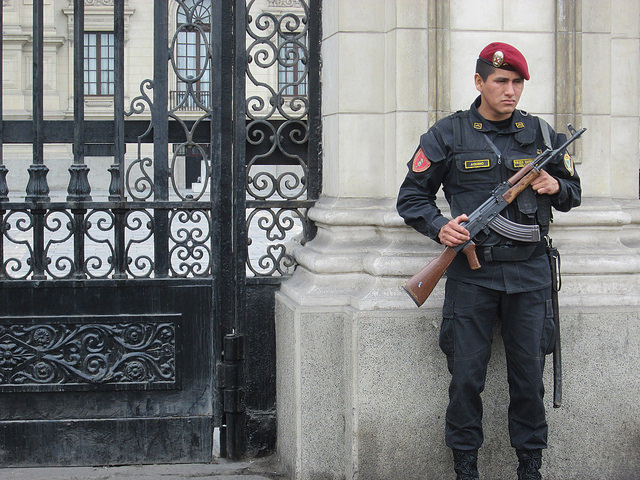
You may recall the news flap that occurred a couple months ago when someone scaled the White House fence and penetrated all the way to the East Room before he was snared. This would not be quite so likely in Lima, where asalto (assault) police with automatic weapons guard the Palacio de Gobierno along with badged security personnel in suits.

The first time I was in Lima, there was a demonstration expected. Just to make sure that it wouldn’t spill over into any sensitive areas, large groups of riot police with shields were stationed all around the Plaza de Armas.

Riot Police with Shields Stationed by the Main Plaza

Riot Police with Shields Stationed by the Main Plaza

South America has had a history of violence against government forces, culminating in the hanging of President Gualberto Villaroel, who in July 1946 was dragged from the presidential palace in La Paz, Bolivia, and hanged from a lamppost on the main square—which is still there and which is grimly shown to tourists.

Did I feel safe in Lima? Yes, as long as I followed the orders of the police about standing too close to the main gate.


Black Friday, Cyber Monday, GACK!!

That’s Right: Shop Till You Drop

That’s Right: Shop Till You Drop!

It’s your duty as an American to shop until the moths in your wallet starve. Show up at your local mall on Black Friday, exercise those debit and credit cards, and help contribute to the financial well-being of Belorussian and Transdniestrian teenage hackers. And if you were remiss about that—you bad peoples you!—there’s always today: Cyber Monday! Go to Amazon, eBay, the websites of department and electronics stores, and spend yourself into a dither, or oblivion, whichever comes faster.

Since it is HallowThanksMas season, it is incumbent upon you to indulge in the Great Holiday Potlatch activity of buying stuff people don’t need or want, and then either discarding or returning it, preferably in the same container in which it was originally wrapped. (Children, of course, always know what they want—until about fifteen minutes after they get it.) Remember to buy extra batteries of all sizes, even if you don’t need them for anything other than to recharge your sagging spirits.

You are drawn in by the thought of a 10% or 20% discount off some mythical retail price, which is as you know is whatever the retailer wants to set it at. Note that if you don’t buy that widget, you are saving a good deal more than 10% or 20%, but you are officially in violation of the Patriot Act; and I will be forced to turn you in. And then you’re off to a fun-filled beach holiday at Guantanamo.

If your credit card overheats, let it rest for a few hours in the freezer before returning to the fray. You might want to join it!


Rainy Day Museum

Alfred George Stevens’s “Portrait of Sarah Bernhardt” (1885)

Alfred Stevens’s “Portrait of Sarah Bernhardt” (1885)

We typically scoff when the weather forecasters tell us that rain is on the way. Well, today it finally happened. Not that the heavens opened up, but my windshield did get a bit dirty. So Martine and I decided to visit the Hammer Museum in Westwood, which is located only a few hundred paces from where I work. I knew from passing it many times that the focus was on modern art, but there are two galleries with European art from the 19th century and earlier.

The painting which most caught my eye was by the Belgian painter Alfred Émile Léopold Stevens (1823-1906). It was an 1885 portrait of actress Sarah Bernhardt (1844-1923). I was particularly impressed with the theatrical-style lighting from the left, including a striking glint around the model’s right eye. At the height of her career, Bernhardt looks like a commanding figure, even with the frilly ribbon around her neck. Her lips are pursed as if determined to get her way, yet she is delightfully feminine at the same time.

Also impressive was a Titian entitled “Portrait of a Man in Armor” and Rembrandt’s “Portrait of a Man Wearing a Black Hat” (both below).

Rembrandt’s “Portrait of a Man Holding a Black Hat”

Rembrandt’s “Portrait of a Man Holding a Black Hat”

Titian’s “Portrait of a Man in Armor”

Titian’s “Portrait of a Man in Armor”

It’s not that the museum’s holdings were all portraits: It’s just that it was the portraits that most held my attention.

What did not hold my attention was the museum’s substantial holdings of contemporary art. Call me a Philistine if you will, or even a Visigoth, but I prefer art that holds my attention. Stevens’s portrait of Bernhardt had me coming back several times. I did not even feel like entering the contemporary galleries after even the most cursory glances of their contents.

The Etruscan Smile

A Smile That Shines Across Millennia

A Smile That Shines Across Millennia

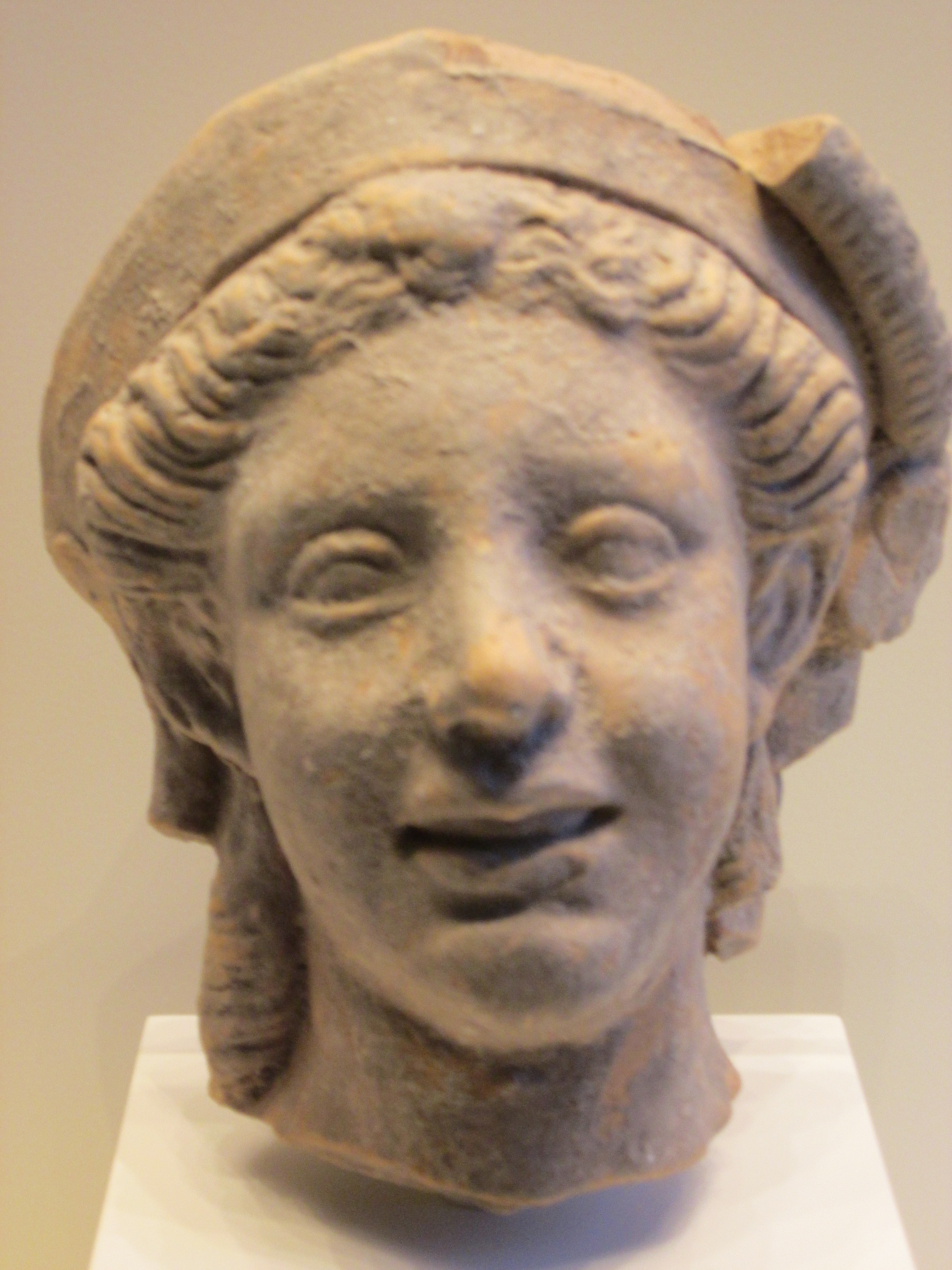
The whole world of the smiling girl in he above photo is long gone, but her smile still speaks to us. It tells us that, even in Ancient Rome, there was something to laugh about. When I took the picture on Friday, I did not note the provenance of the figurine, but I wonder if it was Etruscan. This ancient people is the only one that has allowed itself to be depicted as wreathed in smiles—very contrary to the picture we have of the dour Romans.

Below is a hollow cinerary urn from the Banditaccia Necropolis showing a married couple, whose ashes are presumably intermingled therein:

Hi, We’re Dead. Why Don’t You Come and Join Us?

Hi, We’re Dead. Why Don’t You Come and Join Us?

I guess my little figurine is not Etruscan.Their images always show them as having sharp features and almond eyes. The girl above is definitely Roman.

Not to change the subject, but it reminds me somewhat of the following poem by Robert Browning:

My Last Duchess

That’s my last Duchess painted on the wall,
Looking as if she were alive. I call
That piece a wonder, now: Frà Pandolf’s hands
Worked busily a day, and there she stands.
Will ‘t please you sit and look at her? I said
‘Frà Pandolf’ by design, for never read
Strangers like you that pictured countenance,
The depth and passion of its earnest glance,
But to myself they turned (since none puts by
The curtain I have drawn for you, but I)
And seemed as they would ask me, if they durst,
How such a glance came there; so, not the first
Are you to turn and ask thus. Sir, ‘t was not
Her husband’s presence only, called that spot
Of joy into the Duchess’ cheek: perhaps
Frà Pandolf chanced to say, ‘Her mantle laps
Over my lady’s wrist too much,’ or ‘Paint
Must never hope to reproduce the faint
Half-flush that dies along her throat:’ such stuff
Was courtesy, she thought, and cause enough
For calling up that spot of joy. She had
A heart—how shall I say?—too soon made glad,
Too easily impressed; she liked whate’er
She looked on, and her looks went everywhere.
Sir, ‘t was all one! My favour at her breast,
The dropping of the daylight in the West,
The bough of cherries some officious fool
Broke in the orchard for her, the white mule
She rode with round the terrace—all and each
Would draw from her alike the approving speech,
Or blush, at least. She thanked men,—good! but thanked
Somehow—I know not how—as if she ranked
My gift of a nine-hundred-years-old name
With anybody’s gift. Who’d stoop to blame
This sort of trifling? Even had you skill
In speech—(which I have not)—to make your will
Quite clear to such an one, and say, ‘Just this
Or that in you disgusts me; here you miss,
Or there exceed the mark’—and if she let
Herself be lessened so, nor plainly set
Her wits to yours, forsooth, and made excuse,
—E’en then would be some stooping; and I choose
Never to stoop. Oh, sir, she smiled, no doubt,
Whene’er I passed her; but who passed without
Much the same smile? This grew; I gave commands;
Then all smiles stopped together. There she stands
As if alive. Will ‘t please you rise? We’ll meet
The company below then. I repeat,
The Count your master’s known munificence
Is ample warrant that no just pretence
Of mine for dowry will be disallowed;
Though his fair daughter’s self, as I avowed
At starting, is my object. Nay, we’ll go
Together down, sir. Notice Neptune, though,
Taming a sea-horse, thought a rarity,
Which Claus of Innsbruck cast in bronze for me!

That line about “all smiles stopped together” is grimly humorous.