With the Terries and the Firmies

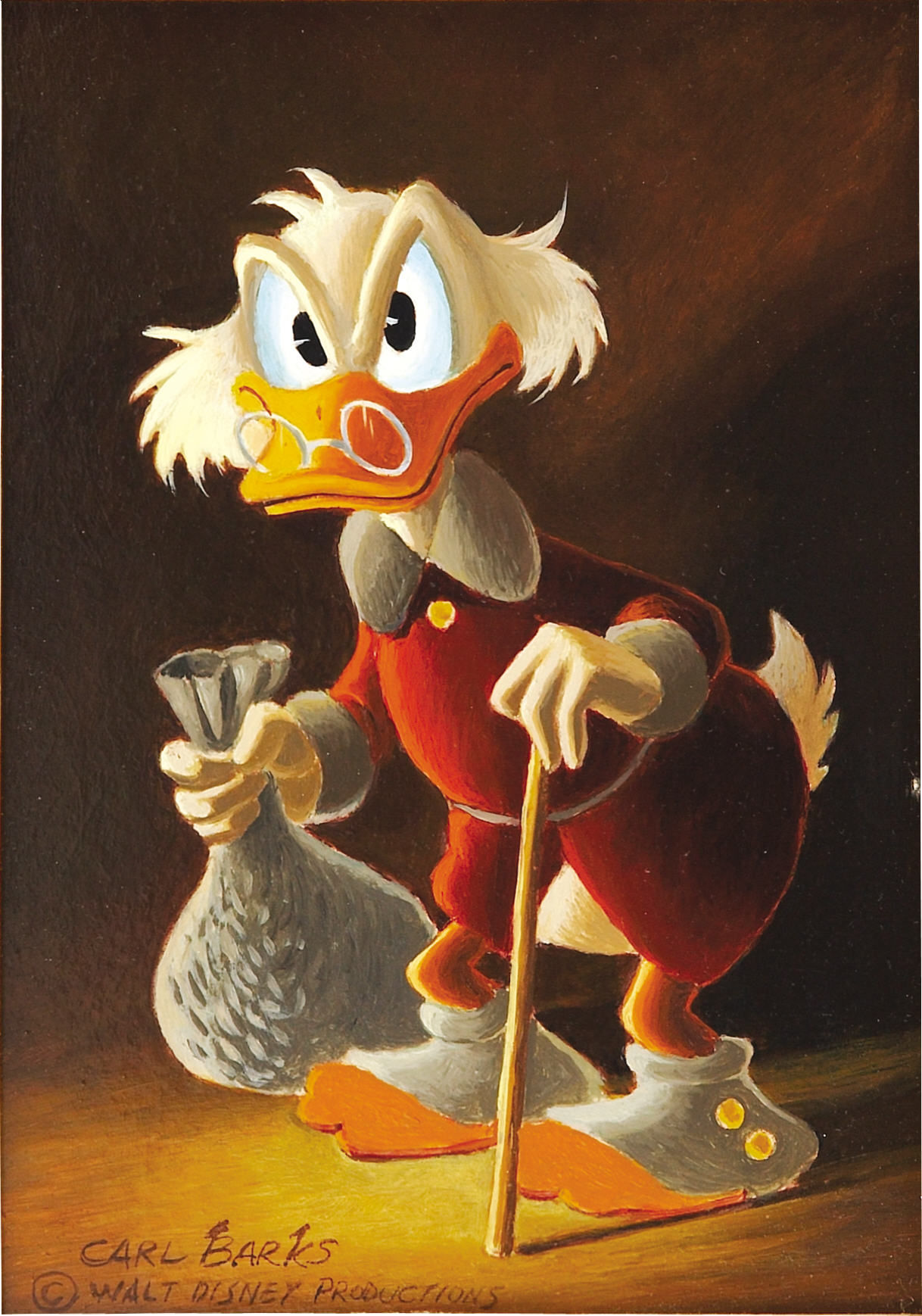
Carl Barks Painting of Uncle Scrooge

Carl Barks Painting of Uncle Scrooge

As a kid who loved to read, where do you suppose I found my most interesting stories? The answer is simple: I was a devout reader of Walt Disney’s Uncle Scrooge Comics, created by the redoubtable artist Carl Barks who created the character and illustrated so many great Scrooge and Donald Duck cartoons.

Another big fan of Barks’s work was George Lucas, who frequently borrowed incidents from the Scrooge archive, such as the rolling rock in Indiana Jones and the Raiders of the Lost Ark. And it is said that the musical Mackenna’s Gold was largely based on the “Seven Cities of Gold” episode.

Perhaps my favorite of them all was Barks’s explanation of how earthquakes happen. One day, when all the money from Uncle Scrooge’s huge money vault disappears underground (a plot device he used often), the tycoon travels with Donald and his three nephews, Huey, Dewey, and Louie, to discover the cause.

The Boys Discover What Really Causes Earthquakes

The Boys Discover What Really Causes Earthquakes

The episode entitled “The Land Beneath the Ground” speculates that under the earth are two types of apodal (legless) creatures that, together, cause the shaking and rolling characteristics of temblors. They are called “Terries” and “Firmies” respectively. Fortunately, Huey, Dewey, and Louie find the answers to all their problems in their voluminous Junior Woodchucks Handbook and save the day, and their uncle’s treasure.

I should get a copy of that for my library!

On Being Young and Entitled

Barbie Doll Strikes Back

Malicious Barbie Doll Strikes Back

I don’t suppose it’s worth wasting much bandwidth on the subject, but I was disgusted by ESPN Announcer Britt McHenry’s tirade against some poor clerk when she came to pick up her towed car. If you’ve spent the last week in a Siberian yurt, you may have missed this wretched display available on YouTube.

What struck me is that this bottle-blonde popsie felt so superior to some poor overweight woman with bad teeth who was collecting the tow charge from her. She keeps referring to her own college education, but behaves as if she had never finished grade school.

What type of massive intellect does it require to read the news from a telepromper in front of a TV camera? And it’s just sports news at that. This woman probably has an intellect not much higher than a puppy’s, and if she gets paid well, it’s just because she is eye candy and doesn’t stumble too much over the words she has to read.

If she had her just deserts, she would be spending time in a jail cell with a Leona Helmsley or a young Conrad Hilton.

Getting overpaid for looking like Barbie doesn’t give you special privileges.


Ghosts on the Pampas

Mapuche Indian Women

Mapuche Indian Women

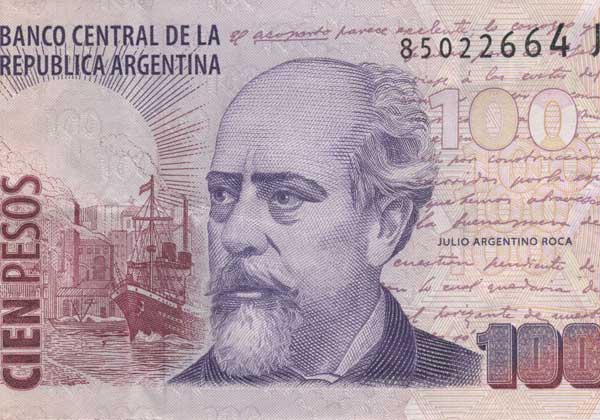
One doesn’t hear much about the aboriginal population of Argentina. That is because, for the most part, the Indians of Argentina were done away with. Those who didn’t die of the white man’s diseases were rounded up and either executed or imprisoned during the 1870s under the “Conquest of the Desert” fomented by President Julio Argentino Roca (pictured below on the Argentinian 100 peso note).

Two Argentinian writers, however, did a fair job resuscitating the original peoples of the land. In The Witness, Juan José Saer writes of the fictional Colastiné who inhabited La Litoral along the Rio Paraná. A Spanish cabin boy is one of several prisoners from his 16th century landing party. His mates are all cooked and eaten in a cannibal feast. Yet there is a strange beauty to them:

For the Indians everything seems and nothing is. And the appearance of things is situated above all in the field of non-existence. The open beach, the transparent day, the cool green of the trees in spring, the otters with their smooth, rippling skin, the yellow sand, the golden-scaled fish, the moon, the sun, the air and the stars, the tools they skilfully and patiently fashioned from recalcitrant materials, in short everything that presented itself clearly to the senses was for them formless, and had a vague and sticky underside against which the darkness beat.

Saer’s Colastiné are true primitives, whereas César Aira’s Mapuche in The Hare are subtly ironic. Fortunately for them, the Mapuche survive today on the Chilean side of the Andes. (Unlike the Argentineans, the Chileans frequently intermarried with their tribal peoples.)

Argentine 100-Peso Note

Argentine 100-Peso Note

In The Hare, the narrator, Clarke, is an Englishman in search of the legendary Legibrerian Hare, which can not only run and leap, but fly when necessary. The Mapuche chief Calfucurá tells Clarke:

We have a word for “government” which signifies, in addition to a whole range of other things, a “path,” but not just an ordinary path—the path that certain animals take when they leap in a zigzag fashion, if you follow me; although at the same time we ignore their deviations to the right and left, which due to a secondary effect of the trajectory end up of course not being deviations at all, but a particular kind of straight line.

Both Saer and Aira are superb writers, and both capture in their own ways the peoples who came before them.

“Here Is Man Brief”

Scene from the Bayeux Tapestry

Scene from the Bayeux Tapestry

This was a world that almost seemed to know it wasn’t going to be around long. Anglo-Saxon poetry is not plentiful, but what exists has a sadness that is touching. The following is an excerpt from “The Wanderer” as translated by Clifford Truesdell IV:

Where went the rider? Where went the giver of treasure? Where went the high seats? Where are the halls of feasting? Alas for the bright cup! Alas for the mailed warrior! Alas for the prince’s glory! How time vanishes, darkens under night’s helmet as if it never were. Stands now where stood beloved companions a wall, wondrous high, snake-like mottled. Spears’ might took off the warriors, slaughter-greedy weapons, notorious fate; and storms smite these stone walls; snow falling binds the earth, winter’s tumult. When dark comes night’s shadow deepens, sends from north fierce hail-fall, to harrow men. All is hardship in earth realm, Fate’s course undoes world under heaven. Here are goods brief, here is friend brief, here is man brief, here is kin brief.

Virtually all known Anglo-Saxon poems and fragments can fit into a slim paperback edition. I myself own two such collections, and find myself coming back again and again.

Tarnmoor’s ABCs: UCLA

Royce Hall on the Campus of the University of California at Los Angeles

Royce Hall on the Campus of the University of California at Los Angeles

All the blog posts in this series are based on Czeslaw Milosz’s book Milosz’s ABC’s. There, in the form of a brief and alphabetically-ordered personal encyclopedia, was the story of the life of a Nobel Prize winning poet, of the people, places, and things that meant the most to him.

My own ABCs consist of places I have loved (Iceland, Patagonia, Quebec, Scotland), things I feared (Earthquakes), writers I have admired (Chesterton, Balzac, Proust, and Borges); locales associated with my past life (Cleveland and Dartmouth College), people who have influenced me (John F. Kennedy), foods I love (Olives and Tea), and things I love to do (Automobiles and Books). This blog entry is my own humble attempt to imitate a writer whom I have read on and off for thirty years without having sated my curiosity. Consequently, over the weeks to come, you will see a number of postings under the heading “Tarnmoor’s ABCs” that will attempt to do for my life what Milosz accomplished for his. To see my other entries under this category, hit the tag below marked “ABCs”. I don’t guarantee that I will use up all 26 letters of the alphabet, but I’ll do my best. The fact that I made it as far as the letter  “U” is a major surprise to me.

I came out to California at the tail end of December 1966 to attend graduate school at UCLA. My original intention was to become a Professor of Film History and Criticism. Well, I didn’t. Instead I ran into dirty politics as personified by one Professor Howard Suber who waged a kind of dirty war on those of his students who loved film. Out of an inborn cussedness, he made it difficult to sign up for classes; and he appointed himself chairman of my thesis committee over my personal choice of the late Bob Epstein. I knew at once that my chances of a Masters degree based on a study of the Westerns of John Ford was a goner.

It was around this time that Governor Ronald Reagan began making deep cuts in the budget of California’s universities. Seeing the handwriting on the wall, I made a sidestep into computer programming at System Development Corporation in Santa Monica, which led, by a commodius vicus of recirculation, into my present profession in accounting.

My quandary was that I loved film, but was not willing to immolate myself for he sake of principle. I kept my hand in film, writing articles and chapters of books even after I was out of the program. I even wrote a humorous article for the UCLA Daily Bruin entitled “Confessions of an Ex-Filmfreak: Or, Slow Death 24 Times a Second.”

My apartment is a scant three miles from the UCLA campus, which I still visit from time to time for various cultural events. It’s always interesting to look back at the decisions that led me to where I am today.

Do I have any regrets? Not really.


“History Never Really Says Goodbye”

We Lost Another Great One Today

We Lost Another Great One Today

There are many great writers who have written powerfully about Mexico, Argentina, Colombia, Chile, and Brazil—but only one who saw Latin America as a whole, saw to the core of its myriad tragedies, and wrote a great body of work analyzing it. That was Eduardo Galeano, who died today in Montevideo, Uruguay, at the age of 74.

I loved what he wrote in Children of the Days: “History never really says goodbye. History says ‘See you later!’”

My favorite of his works is the trilogy Memory of Fire (1982-1986), an anecdotal history of Latin America from before 1492 to the present day, liberally interlarded with quotations and observations. Perhaps, however, he is most famous for The Open Veins of Latin America: Five Centuries of the Pillage of a Continent (1971).

As you may know, I have had a love affair with Latin America since my first visit to Mexico in 1975. In addition to Mexico, I have also visited Peru, Argentina, and Uruguay. And as long as the blood is flowing in my veins, I am planning yet more trips.

In The Open Veins of Latin America, Galeano wrote:

The division of labor among nations is that some specialize in winning and others in losing. Our part of the world, known today as Latin America, was precocious: it has specialized in losing ever since those remote times when Renaissance Europeans ventured across the ocean and buried their teeth in the throats of the Indian civilizations. Centuries passed, and Latin America perfected its role. We are no longer in the era of marvels when face surpassed fable and imagination was shamed by the trophies of conquest— the lodes of gold, the mountains of silver…. Our defeat was always implicit in the victory of others; our wealth has always generated our poverty by nourishing the prosperity of others.

Galeano’s life has been a stressful one. Always a lover of liberty, he fled Uruguay for Argentina in 1973 when a military coup took over his country. Three years later, when the rightist generals rose to power in Argentina, he was off to Spain, from whence he did not return until 1985, when Uruguay restored civilian rule.

At a speech he delivered at the University of Wisconsin, he said, “I tried, I try, to be stubborn enough to go on believing, in spite of all evidences that we humans are badly built, but we are still unfinished.”

The question is: Will we as a species be undone before we are ever finished? If so, we need more writers like Galeano.


Petroleuses and Communards

Nope, Not the French Revolution—Eighty Years Later

Nope, Not the French Revolution—Eighty Years Later

Most Americans know little about French history, particularly in the years after the French Revolution and Napoleon. I mean, aren’t they “surrender monkeys”?

Not quite. In 1870-1871, Germany invaded France and crushed the French forces at Sedan, as described by Émile Zola in his novel Le Débacle (The Débacle). The Emperor Napoleon III hurriedly decamped; and the Third Republic under Adolphe Thiers, headquartered at Versailles, took over and continued the war. The problem was the city of Paris. The lightly armed National Guard wanted no truck with either Thiers or the Prussians, whereupon the forces of both laid siege to Paris.

This is when the Paris Commune was formed, which ran the besieged city from March to May of 1871. There were stories (probably mythical) of Parisiennes called petroleuses (illustrated above) armed with bottles of inflammable fluids roving the streets, setting fire to buildings. Admittedly, Napoleon III’s Tuileries Palace was torched; but most of the fires were attributable to French and Prussian cannon fire. Still, women found hurrying home with bottles of cooking oil were frequently executed on the spot.

Altogether, the casualties of the siege were about ten times larger than the entire Reign of Terror under Robespierre: The invading forces usually did not take prisoners and instead went in for an early version of ethnic cleansing, targeting mainly the working poor.

It was during this siege that the Parisians first developed a taste for horsemeat, which they were forced into eating along with dogs, cats, and various vermin when food supplies became scarce.

When I was in Paris, I visited the Communards’ Wall at Père Lachaise cemetery, where several hundred men, women, and children were captured, lined up against the wall, shot by firing squads, and buried in a mass grave.

Not too many years later, Vladimir Lenin carefully studied the lessons of the Paris Commune and adopted them in the Bolshevik Revolution, which was much less bloody than the events of Paris in May 1871.

Nattering Nabobs of Negativism

It Seems That Most Politics Is Driven by Hate

It Seems That Most Politics Is Driven by Hate

The phrase is from the late Vice President Spiro T. Agnew, referring to the news media. I think, however, in today’s poisonous climate, it refers to most populist politics. According to an article in the current edition of The New Scientist entitled “We Are What We Vote,” we find the following paragraph:

Research in the past few years using information on brain structure and function from MRI scans, psychological responses, eye-trackers and behavioural genetics, shows that individual political orientations are deeply connected to biological forces that are usually beyond personal control…. Despite initial incredulity—people like to believe political opinions are rational responses to salient events—the evidence that political preferences are linked to systems that often involve subconscious is growing. An admittedly simplistic but useful summary of this research is that human emotions are grounded in biology, and politics is grounded in emotions.

If you are left-leaning, a look at Raw Story or Salon.Com will send your blood boiling based on what such fear totems as Ted Cruz, Sarah Palin, and Rush Limbaugh are saying. If, on the other hand, your news source of preference is The Drudge Report or RedState.Com, you will find articles bemoaning attacks on liberty, gun ownership, and fundamentalist religion. The intention is generally to make you feel outrage and hatred.

For each article by a reasonable commentator, there are typically half a dozen or more pieces excoriating “the enemy.” If it is hard to get away from knee-jerk reactions, it is partly because, amid all the clickbaiting, there are all too many examples in the mainstream media.

There is even an entire news network dedicated to fear and outrage. Do I have to name it, or can you guess?

Emeric Toth and the City

Emeric Toth Is My Alter Egp

First Impressions of a Megalopolis

This posting is reprinted from Yahoo! 360 from February 2009, when I wrote some quasi-fictional pieces starring my alter ego, one Emeric Toth.

What was there to love about this city? Ten million plus people living their lives on a series of shelves between the mountains and the sea. Most of the time, the sun beat down relentlessly on the people, the buildings, and the gigantic road network that radiated like octopus appendages out from the center. When he first arrived there over forty years ago, Emeric Toth heard Los Angeles described as seventy-five towns in search of a city. He remembered the confusion on the ride to his first apartment from Union Station. He started downtown, went some five miles and—bam!—there was another downtown by Hollywood. A few miles further and—bam!—another downtown by a new place called Century City.

He had heard about the strangeness of the place and its inhabitants, who lived in metastasizing suburbs that stretched out for miles in every direction but one: The sea was an effective barrier.

The new state governor was an actor named Ronald Reagan, whom Toth had seen co-starring with a chimpanzee in Bedtime for Bonzo (1939). The whole hippie thing was just beginning, which he traced with some amusement in the weekly newspaper called the Los Angeles Free Press, or Freep for short. The Vietnam war was just beginning to arouse massive resentment: In just two short years, Johnson would refuse to run for a second term because he felt tainted by the war. That’s when presidents cared what people thought.

So many things have changed, most notably Emeric Toth himself. The city was still recognizably the same, grimier in some instances, and new and shiny in others. He sat at a local café slowly savoring a small pot of Darjeeling tea as he watched the young people chattering away at adjacent tables. In another forty years, those kids would still be there, drinking whatever the beverage of choice would be, but he himself would not be. But some part of himself would be still be attenuated and distributed across the hundreds of square miles of buildings and freeways and occasional green spaces and towering peaks (if they’ll be able to see them then) and above all that dark green and black ocean whose waves break endlessly on the shore of Santa Monica Bay.

In Search of the Deskable

My Adventures with E-Books

My Adventures with E-Books

About a third of the books I read are on one of my two Kindles—especially if I am traveling where a bag full of books would limit my range. Most of the time, the experience is pleasant, especially when the e-book I purchase is from a reputable publisher such as Penguin. Sometimes, however, you get an otherwise worthy book that is marred by the bane of e-publishing: namely, Optical Character Recognition, or OCR.

I have just finished reading C.S. Lewis’s superb autobiography, Surprised by Joy: The Shape of My Early Life. In between passages of great beauty, I would find sentences such as: “…but the real Deskable would have evaded one, the real Deske would have been left saying, ‘What is this to me?’”

Deskable? Deske?

The publisher of this e-book decided to forego human proofreading in favor of OCR software. Unfortunately, the software used rendered Desire as Deske and Desirable as Deskable.

At one point, I recognized the word “horkon” as the computer’s reading of “horizon.” The first person singular pronoun was frequently rendered by the decimal digit 1.

Fortunately, the work was good enough for me to persist to the end; but, many a time, usually when dealing with cheapster editions, I have given up in disgust.