The Stale Language of Protest

This Is What It’s Usually About

This Is What It’s Usually About

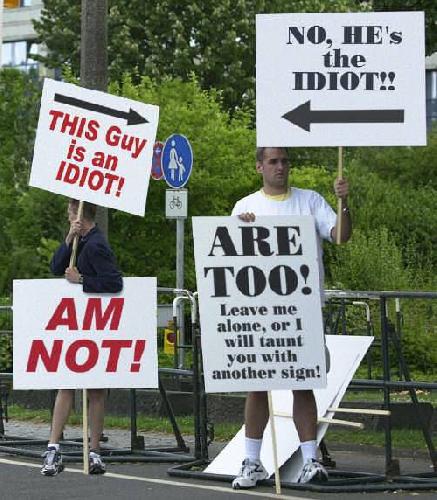
Every so often, I feel that a particular mode of behavior has run its course. I think it’s time for a paradigm shift (perhaps that expression has run its course as well) in the art of protest. Turn on any news program, and you are sure to see a group of people carrying placards and usually moving around in a circle chanting very stale slogans. Typically, a newsman will hold a microphone and camera up to one of the most inarticulate of the protesters and ask them why he or she is picketing. After a few hems and haws, the protester will say that so and so is unfair or unjust or dangerous or just irksome as all get-out.

Now it is possible that all ten people who think like the protester are with him marching around and chanting. It is indeed probable that the viewpoint being expressed is not only in the minority, but a statistically insignificant sliver of the total population. In our era of “fair and balanced” news reporting, we are eager to seek out these minority viewpoints and make as much hay with them as possible. Think of these boring protests as a boon to news organizations, particularly on a slow news day.

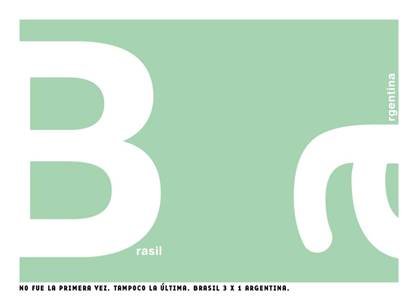
I am always for more ingenuity. If one’s point of view is to be effectively conveyed, I say do something that people will remember. Let me cite a classic example. An Argentinian condom manufacturer who was also a big soccer fan published the following graphic before a match with Brazil:

PICBA1

I will not try to explain exactly what is happening here because—well, if you don’t know, you probably haven’t reached the age of puberty yet. Needless to say, the B stands for Brazil and the A for Argentina. This did not sit well with the Brazilian soccer fans. When their team pasted the Argentinians, they rubbed it in by publishing an even funnier graphic:
PICBA2

I will always remember this as perhaps the most inventive act of protest I have ever seen.

The next time you feel like taking to the streets with your message, try something different. Think of the streets as a form of theater. And start from there.

(This is a re-posting of one of my 2009 entries from Blog.Com.)

A Bird with a Broken Wing

I’m Healing, but Slowly

I’m Healing, but Slowly

Today marks the third week since I fell in the street opposite my house and broke my left shoulder. The fracture is healing nicely, but ever so slowly.

The worst of it is at night when I am in bed. The joint throbs in pain all night, with my arm frequently falling asleep. Last night, I slept all of three hours; and I was unable to nap this afternoon. During the day, I get along all right and do not have to wear my sling. (I wear it on the bus, however, to warn other passengers to steer clear of my shoulder.)

On Thursday, the orthopedic surgeon seemed pleased with my recovery. He hinted that there would be a breakthrough in the next few days. I’m still waiting for it. In the meantime, I’m taking Advil for the pain, which seems no worse than the Hydrocodone I had been taking, and is probably a good deal safer.

This fracture has been far worse than the one I had in 2006 on my right shoulder: That one entailed a slightly cracked humerus. This one is fractured along several planes.

Eventually, this, too, shall pass. In the meantime I wish all of you a Happy Easter!

Laki and Tambora

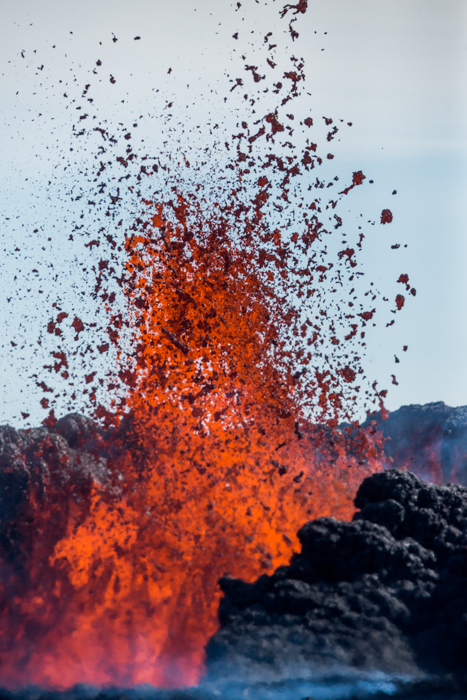
Volcanic Eruption at Holuhraun in Iceland

Volcanic Eruption at Holuhraun in Iceland

After all these billions of years, it never fails to amaze me that, beneath the crust of the earth, there are superhot gases that could, at a moment’s notice, change all our lives. Since our country was founded, there have been two volcanic mega-events that caused widespread death, destruction, and—surprisingly—temporary global cooling.

In answer to a question from an American reader, ESA, one of the staff writers of The Iceland Review wrote the following about Laki:

The Laki eruption (aka Skaftáreldar) took place over an eight-month period between June 8, 1783, and February 7, 1784. The eruption occurred in the Lakagígar craters in fissures on either side of Laki mountain between Mýrdalsjökull and Vatnajökull in the southern highlands and the adjoining Grímsvötn volcano in Vatnajökull….

The eruption began as a fissure with 130 craters opened with phreatomagmatic explosions. This event is rated as 6 on the Volcanic Explosivity Index (VEI). The scale is open-ended with the largest volcanoes in history given magnitude 8. For comparison, the 2010 Eyjafjallajökull eruption is rated as magnitude 3 on VEI.

The Laki eruption produced an estimated 14 km3 (3.4 cubic miles) of lava, and the total volume of tephra emitted was 0.91 km3 (0.2 cubic miles). Lava fountains were estimated to have reached heights of 800 to 1,400 meters (2,600 to 4,600 feet).

The gases emitted, including an estimated 8 million tons of hydrogen fluoride and 120 million tons of sulfur dioxide (SO2), caused the death of over 50 percent of Iceland’s livestock, leading to a famine killing approximately 25 percent of the country’s inhabitants.

The Laki eruption and its aftermath caused a drop in global temperatures, as SO2 was spewed into the Northern Hemisphere. This caused crop failures in Europe and may have caused droughts in Asia. The eruption has been estimated to have killed over six million people worldwide, making it the deadliest in historical times.

Not too long after, in 1816, there was another mega volcanic event. Bill McGuire, in The New Scientist (28 March 2015), wrote:

Two hundred years ago, a simmering tropical volcano tore itself apart in spectacular fashion. Mount Tambora, on the Indonesian island of Sumbawa, erupted in a colossal blast that led to the deaths of more than 70,000 people in the region. So large was the explosion that its reach extended far beyond South-East Asia, loading the stratosphere with 200 million tonnes of sulphate particles that dimmed the sun and brought about a dramatic cooling with widespread ramifications half a world away.

The extended climate disruption saw 1816 dubbed “the year without a summer.” There was a wholesale failure of harvests in eastern North America and across Europe, contributing to what economic host John Post has called “the last great subsistence crisis in the western world.” Famine, bread riots, insurrection and disease stalked many nations, while governments sought to cope with the consequences of a distant geophysical phenomenon they didn’t understand.

It can happen again at any time somewhere along the Ring of Fire that encircles the earth. Pray that it doesn’t happen in our lifetime.

Gone Forever: The Cafe Richmond

One of the World’s Great Literary Cafés

One of the World’s Great Literary Cafés

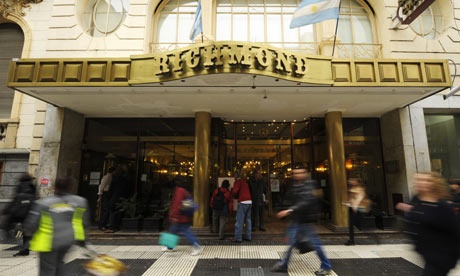
Just before Martine and I flew to Buenos Aires in 2011, one of the world’s greatest literary cafés was turned overnight into a Nike sportswear shop. Where once Jorge Luis Borges sat and wrote his stories, and where Graham Greene hung out (and commemorated) while he was writing The Honorary Consul, and where Antoine de Saint-Exupéry ate near his “charming little apartment” on Calle Florida, you can now buy shoes and other clothing items that are also available in a thousand other nearby outlets.

If I make it to Argentina later this year, I plan to photograph the damage, while urging you to boycott Nike. As far as I’m concerned, they can go and swoosh themselves into oblivion.

There is a charming article in the Argentina Independent about Calle Florida, where the Richmond was located at #468 (near the intersection with Lavalle). You can read more about the Cafe Richmond in The Guardian and The Independent.

Fortunately, Buenos Aires is a city with many great cafés; but, sometimes, when a great one closes, the ripples are felt around the world.

Gabriela Kogan has written a great little book which Martine and I used called The Authentic Bars, Cafés, and Restaurants of Buenos Aires which is available from The Little Bookroom.