A Murky Business

Argentine Special Prosecutor Alberto Nisman

Argentine Special Prosecutor Alberto Nisman

It all started on the morning of July 18, 1994. A Renault utility truck packed with explosives blew sky high in front of Buenos Aires’s Asociación Mutual Israelita Argentina (AMIA) killing 85 Jews and injuring 300 more. This set off an investigation that involved three Argentinian presidents (Carlos Menem, Néstor Kirchner, and Cristina Fernández de Kirchner), Hezbollah (who claimed to have set off the bomb), Iran (who sponsors Hezbollah), and several other countries besides (including Venezuela and the United States). During most of the last 21 years, Alberto Nisman was involved in the investigation as a prosecutor and was intent on skewering Iran.

Until 2013, the Argentine government was behind him. Then it changed sides and decided to not pursue the case. That left the outraged Nisman determined to go after the government. He promised to have a big show and tell on Monday, January 18, of this year before the Congress. Sometime that night, however, he was killed with a rickety old 22 caliber pistol lent to Nisman by his computer technician, Diego Lagomarsino.

At first, it was suspected that it was death by suicide, though there were no gunpowder on his hands. Eventually, President Cristina Fernández de Kirchner decided it was murder. The question was: Who killed him? Was it the nefarious Secretaría de Inteligencia de Estado (SIDE), which has been suspected of numerous crimes under the Videla dictatorship? Was it Iran and Hezbollah, which had tired of Nisman’s relentless charges over two decades? Was it Diego Lagomarsino, whose gun it was? At this point, it’s difficult to exonerate anyone.

Nisman himself was a bit strange. According to an article entitled “Death of a Prosecutor” by Dexter Filkins in the July 20 issue of The New Yorker:

In the years that Nisman presided over the AMIA investigation, he became a famous man. Separated from his wife, he was a fixture at Buenos Aires’ night clubs and sometimes appeared in gossip magazines with various girlfriends. He relished his image as a lone prosecutor going after terrorists in the Middle East. With a large staff and a big budget, he cultivated relationships with American intelligence analysts, conservative think-tank experts, and the staff of Senator Marco Rubio, who kept track of his work. He rented a luxury apartment in the chic neighborhood of Puerto Madero and indulged a passion for windsurfing.

Since January, Nisman’s death has been page one news in a country whose judicial system reminds one of Kafka’s The Trial. Even in today’s issue of the Buenos Aires Herald, there’s a story about ex-President Carlos Menem offering more information about the AMIA bombing.




Serendipity: “Nothing Perishes”

C. K. Scott Moncrieff, Translator

C. K. Scott Moncrieff, Translator (Painting by Edward Stanley Mercer)

This is a translation of a passage by the Roman poet Ovid from The Metamorphoses. The remarkable thing is that is was made by a thirteen-year-old boy who later grew up to translate Marcel Proust’s multi-volume masterwork, In Search of Lost Time:

Everything is changed but nothing perishes. The spirit wanders, going hence, thither, coming thence, hither and takes possession of any limbs it pleases. With equal ease it goes from beasts into human bodies and from us into beasts, nor in any length of time does it fail. And as wax is easily moulded in new shapes, nor remains as it had been before, nor keeps the same form, but is yet itself the same; so do I teach that the soul is ever the same, but migrates into different shapes.

Although many think that Scott Moncrieff’s translations are growing a little long in the tooth, there is no doubt of their excellence. As Walter Kaiser wrote in The New York Review of Books (June 4, 2015):  “Not surprisingly, Scott Moncrieff’s translations from Latin and Greek in the examination that year [1903] were awarded higher scores than anyone else’s, for it turns out that the astutely ingenious, poetic use of language for which he is celebrated in his great translation of Proust was his from an early age.”


Ilex paraguariensis

Traditional Yerba Mate Tea Popular in South America

Traditional Yerba Mate Tea Popular in South America

When cooler weather returns to Southern California, in about twenty years or so, I will resume my habit of drinking yerba mate tea. In the meantime, I will enjoy Robert Southey’s poem “Introductory to South America Yerba Mate.” I was pleasantly surprised to see a 19th century British poet conversant with the Ilex paraguariensis, or yerba mate.

Introductory to South America
Yerba Mate
Robert Southey (1774–1843)

(From A Tale of Paraguay)

AMID those marshy woodlands far and wide
Which spread beyond the soaring vulture’s eye,
There grew on Empalado’s southern side
Groves of that tree whose leaves adust supply     [scorched
The Spaniards with their daily luxury;
A beverage whose salubrious use obtains
Through many a land of mines and slavery,
Even over all La Plata’s sea-like plains,
And Chili’s mountain realm, and proud Peru’s domains.

But better for the injured Indian race
Had woods of manchineel the land o’erspread:
Yea, in that tree so blest by Nature’s grace
A direr curse had they inherited,
Than if the Upas there had reared its head
And sent its baleful scions all around,
Blasting where’er its effluent force was shed,
In air and water, and the infected ground,
All things wherein the breath or sap of life is found.

The poor Guaranies dreamt of no such ill,    [Paraguayan natives
When for themselves in miserable hour,
The virtues of that leaf, with pure good-will,
They taught their unsuspected visitor,
New in the land as yet. They learnt his power
Too soon, which law nor conscience could restrain,
A fearless but inhuman conqueror,
Heart-hardened by the accursed lust of gain,
O fatal thirst of gold! O foul reproach for Spain!

For gold and silver had the Spaniards sought,
Exploring Paraguay with desperate pains,
Their way through forests axe in hand they wrought;
Drenched from above by unremitting rains
They waded over inundated plains,
Forward by hope of plunder still allured;
So they might one day count their golden gains,
They cared not at what cost of sin procured,
All dangers they defied, all sufferings they endured.

Barren alike of glory and of gold
That region proved to them; nor would the soil
Unto their unindustrious hands unfold
Harvests, the fruit of peace,—and wine and oil,
The treasures that repay contented toil
With health and weal; treasures that with them bring
No guilt for priest and penance to assoil,
Nor with their venom arm the awakened sting
Of conscience at that hour when life is vanishing.

But keen of eye in their pursuit of gain
The conquerors looked for lucre in this tree:
An annual harvest there might they attain,
Without the cost of annual industry.
’T was but to gather in what there grew free
And share Potosi’s wealth. Nor thence alone.
But gold in glad exchange they soon should see
From all that once the Incas called their own,
Or where the Zippa’s power or Zaque’s laws were known.

For this, in fact though not in name a slave,
The Indian from his family was torn;
And droves on droves were sent to find a grave
In woods and swamps, by toil severe outworn,
No friend at hand to succor or to mourn,
In death unpitied, as in life unblest.
O miserable race, to slavery born!
Yet when we look beyond this world’s unrest,
More miserable then the oppressors than the opprest.

Fire and Water

Well, Which Is It To Be?

Well, Which Is It To Be?

As I sit here writing this, I hake my head in total perplexity. On one hand, today was so hot that I felt my face burning off. On the other, a mega El Niño event is predicted for later this year and possibly lasting through next spring. Of course, predictors hasten to add that it wouldn’t put an end to California’s historic drought. (Sounds like nothing would, short of another Noah’s Ark flood.)

The way it looks, I will be burned by searing heat, and then drowning in an incredible flood. Will there be any transition between the two? Will there be a day with not a cloud in the sky and 120 degree heat, followed immediately by waves of heavy rain fronts? Or will it be a slow transition?

In the end, the only person who, to my mind, has ever shed light on what El Niño means is the late Chris Farley, in this video clip on YouTube.


Summer in Balbec

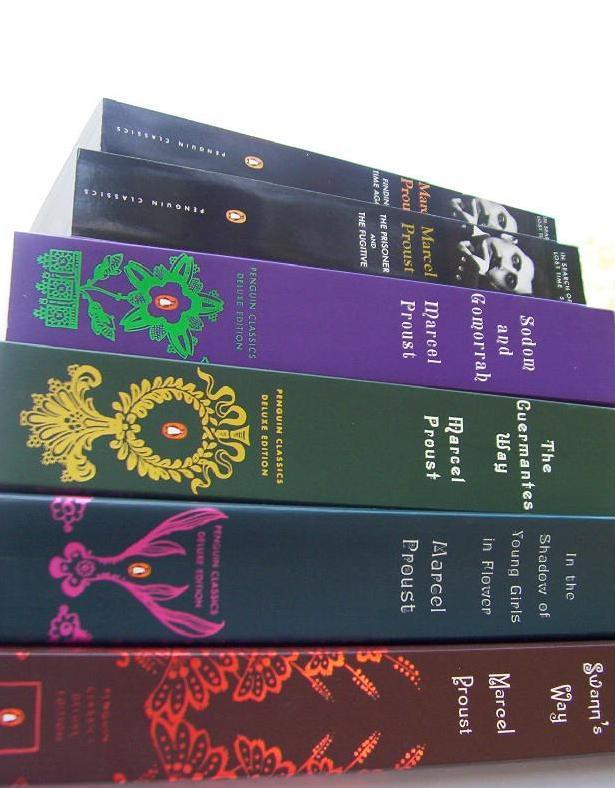
The Viking Penguin Edition of Proust Edited by Christopher Prendergast

The Viking Penguin Edition of Proust Edited by Christopher Prendergast

It has been beastly hot in Southern California, but I have been diverted from mere animal sweating by reading Marcel Proust’s In the Shadow of Young Girls in Flower as translated by James Grieve. Although his translation is considered the bastard orphan of the series as pictured above, I still loved it—after reading the authoritative C. K. Scott-Moncrieff translation twice.

Generally, it takes me a whole decade to go through the entire In Search of Lost Time, but it’s time well spent. I hope to tackle The Guermantes Way (again, for the third time) after my vacation; and I hope to live long enough for at least one or two more complete re-readings.

Many who have tackled Swann’s Way have been put off by its opening, in which young Marcel schemes for about fifty pages to have his mother come in to his bedroom and kiss him goodnight despite his father’s general disapproval of the practice. Then there are those long sentences that seem to go on forever—but which carry a significant amount of meaning in the process. Once you get over those two hurdles, the rewards come fast and furious.

Chief among those rewards is being in the mind of Marcel, the narrator. (He never gives his last name.) His hopes and desires are sketched with such intensity that few have experienced in this life. These relate to his family, his acquaintances, his heroes, his reading, his knowledge of art (just tracking the paintings he mentions is a full-time job), and his loves.

In the Shadow of Young Girls in Flower is mostly about his two main loves, Gilberte Swann and Albertine Simonet. In the first volume of the book, he reluctantly gives up on Gilberte, who has on occasion treated him contemptuously. Still, he hangs out with her parents hoping to demonstrate to the daughter that he is worthy of her attention.

In the second volume, Marcel is with his grandmother at the seaside resort of Balbec. There, he meets Robert de Saint-Loup, who becomes his friend, and the “little gang” of girls that become his obsession. Of the latter, Marcel toys with Andree, Rosemonde, and Gisele, but his real obsession is for Albertine. The book just stops short of the relationship with her actually commencing. (That, and Marcel’s anxieties about Albertine, are for the later volumes.)

Reading Proust takes a long time: I devoted two weeks to this book, but I loved every minute of it.

Laki

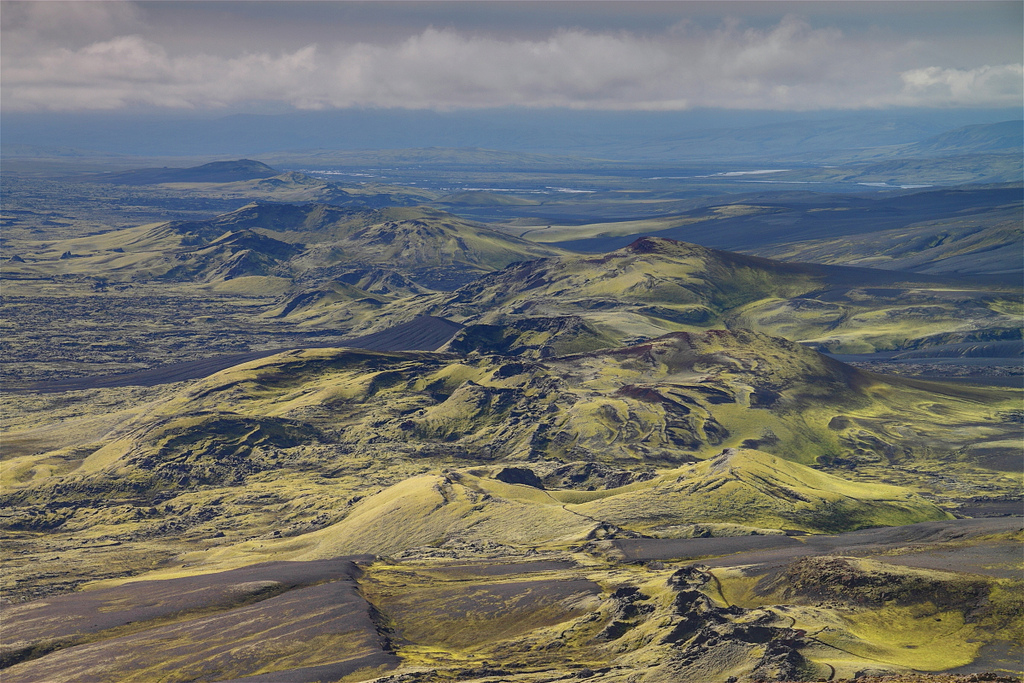
Looks Peaceful, Doesn’t It?

Looks Peaceful Today, Doesn’t It?

It was during the American Revolution that one of the world’s great climatic disasters occurred. It happened at Lakagigar—“The Craters of Laki”—where a volcanic fissure opened up during an eight-month period between 1783 and 1784 near the village of Kirkjubæjarklaustur in South Iceland. Before it had finished, it had pumped 3.4 cubic miles (14 cubic km) of basaltic lava, hydrofluoric acid, and sulfur dioxide that killed 50% of Iceland’s livestock and, after the ensuing famine, 25% of Iceland’s population.

The effluents from the eruption caused a drop in temperature that caused massive crop failures in Europe and a drought in India. According to Wikipedia, in the end as many as six million deaths were attributed the after-effects of Laki. That would make it the most deadly eruption in modern times.

Today, the moss-covered mountains are crowded with European tourists visiting Vatnajökull National Park, of which Laki is now a part. In her column in the Iceland Review, writer Zoë Robert complains of the tourists’ heedlessness:

While chatting to the park ranger the next day, I expressed my shock at the recent incident at Þingvellir National Park where several campers ripped up large amounts of moss in order to insulate their tents, causing many open scars in the land. While the ranger too indicated her dissatisfaction, she pointed out that large moss areas, like those which exist in Iceland, are rare in other countries and that some people may not realize their true value. This I understand, but I still find it difficult to accept that people can willingly uproot large areas of vegetation, especially in or near a national park, and think that is admissible.

Hunting for Wales in Argentina

Flag of Argentina with Welsh Dragon

Flag of Argentina with a Welsh Dragon

It was almost exactly one hundred fifty years ago that a large group of Welsh colonists arrived at Puerto Madryn and proceeded to settle in the State of Chubut. Today, the Welsh speaking members of Y Wladfa Gymreig  (the Welsh Colony) number somewhere between 1,500 and 5,000. They are centered in the towns of Gaiman, Trelew, and, farther inland, Trevelin.

In 2011, Martine and I visited Gaiman with our guide (shown below), Rogelio Rhys. We had a fantastic Welsh Tea at the Ty Gwyn and, on a subsequent visit, saw a number of the historical sights of the colony. I had a read a book by Rogelio’s grandfather William Casnodyn Rhys entitled A Welsh Song in Patagonia: Memories of the Welsh Colonization.  Our guide was astonished that I was familiar with the book.

Rogelio Rhys in Gaiman

Rogelio Rhys in Gaiman

Shown below is a typical Welsh Tea at the Ty Gwyn. It is heavy in carbohydrates, but I threw all caution to the winds and determined to make up for it in the days to come.

A Welsh Tea at the Ty Gwyn Teahouse in Gaiman

A Welsh Tea at the Ty Gwyn Teahouse in Gaiman

So, if you should find yourself in Patagonia, don’t forget to visit the Welsh heart of the State of Chubut. In addition to the Welsh Colony, you will find the best place in the Americas to see whales (Peninsula Valdez) and penguins (Punta Tombo). And don’t forget to sit down and have some tea. It’s really great.

“Epitaph on a Tyrant”

Robert A. Buhler’s W. H. Auden (1907-1973)

Robert A. Buhler’s W. H. Auden (1907-1973)

The above painting hangs at Oxford’s Christ Church College, where Poet W. H. Auden attended college. The following poem is a short one, but eloquent. It is called “Epitaph on a Tyrant”:

Perfection, of a kind, was what he was after,
And the poetry he invented was easy to understand;
He knew human folly like the back of his hand,
And was greatly interested in armies and fleets;
When he laughed, respectable senators burst with laughter,
And when he cried the little children died in the streets.

One Word Makes a Difference

Argentinian Writer Jorges Luis Borges (1899-1986)

Argentinian Writer Jorge Luis Borges (1899-1986)

There is a wonderful novel by José Saramago called The History of the Siege of Lisbon (1989) in which a historian introduces a single word—“not”—to indicate that Crusaders failed to help lift the Portuguese king lift the siege of the city of Lisbon from the attacking Moors. The other day, I saw an article in the I Love Chile News in which the word “not” was inadvertently omitted, changing the whole sense of the passage.

In an interview with Maria Kodama, Borges’s widow, the I Love Chile News said that the Nobel Prize Committee actually wanted Borges to accept an honor from dictator Augusto Pinochet. It is generally thought that the Committee refused to give the Nobel Prize for Literature to Borges because he was hobnobbing with rightist dictator. Following is the text of the story as it was printed:

According to an interview with the Spanish newspaper El País, before traveling to Chile in 1976 to receive an honorary award of the Faculty of Philosophy and Humanities of the University of Chile, the author received a call from Stockholm.

He was awarded the Nobel Prize and they warned him that he should [here’s where the “not” belongs] go forward with his visit to the South American country.

According to Kodama, Borges told the Nobel Foundation member: “Look, gentleman: I am grateful for your kindness, but after what you just told me my duty is to go to Chile. There are two things that a man can not allow: bribe or be bribed. Thank you very much, good morning.”

Historical Background

Borges arrived in Chile in mid-September, in the same days in which the socialistic ex-chancellor Orlando Letelier was murdered in Washington.

A few months earlier, Borges had already received the Order of Bernardo O’Higgins from the Chilean embassy in Buenos Aires. It was the highest honor you could receive from the military dictatorship as a foreigner at the time.

In his acceptance speech in Santiago, Borges paid tribute to the repression by saying that “in this era of anarchy in here, between the mountains and the sea, there is a strong country. (The Argentine poet Leopoldo) Lugones preached strong homeland when he spoke of the time of the sword. I declare to prefer the sword, the clear sword, to the furtive dynamite,” he said, quoting a verse.

“And I say this knowing very clearly, very precisely, what I say. Well, my country is emerging from the swamp, I think, with happiness. I think we deserve to go out of the morass in which we were. We are already going through the work of swords, exactly. And here they have already emerged from the swamp. And here we are: Chile, the region, the country, which is both a long country and an honorable sword,” said Borges.

At the time Argentina was under the dictatorship of General Jorge Videla, who according to official figures killed thousands of people during the repression.

The next day, Borges also met Pinochet and said “he is an excellent person, his warmth, his goodness … I’m very satisfied … The fact that here, also in my country, and in Uruguay, the freedom and the order is saved, especially in an anarchy continent, a continent undermined by communism. I expressed my satisfaction, as an Argentine, of which we should have here nearby a country of order and peace.”

There are several things questionable about the story. I doubt that the Nobel Prize Committee would have been so overt about dangling the award in front of Borges. It may well be true that kowtowing to Pinochet cost Borges his Nobel, but Ms. Kodama has been known to embroider the facts on occasion.

My Final Word on the Subject

As Usual, Bill the Cat is Eloquence Personified

As Usual, Bill the Cat is Eloquence Personified

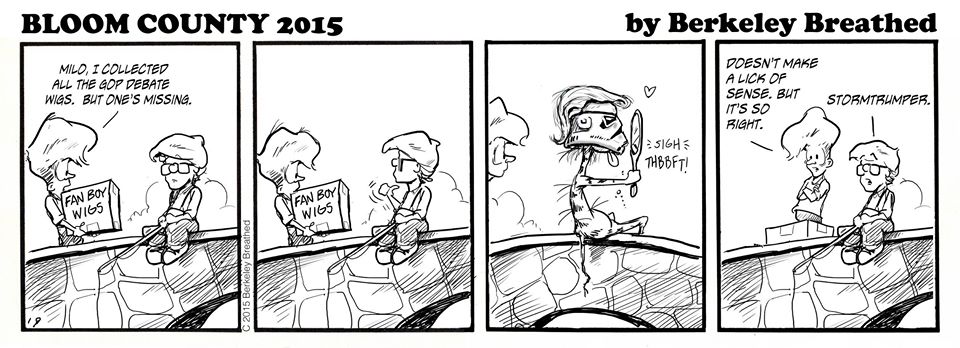
Donald Trump has brought joy to comics—though not to me—and even inspired Berkeley Breathed to start up his Bloom County comic once again after a thirty plus year absence. If, as most of my friends think, Trump will self-destruct long before November 2016, all well and good. But, if not, look for another Reichstag fire, concentration camps for Mexicans and women, and perhaps another land invasion of Russia.

It Kind of Says It All, Doesn’t It?

It Kind of Says It All, Doesn’t It?

You see, I have lost my faith in the American voter. Trump’s rising popularity in the face of the most asinine political behavior imaginable leads to to expect that the mofo might possibly win. And, if that happens, say goodbye to the U. S. of A.