“A Dream Within a Dream”

Is all that we see or seem But a dream within a dream?

Is all that we see or seem
But a dream within a dream?

We tend to undervalue the poems, stories, and essays of Edgar Allan Poe. Currently, I am reading a slim volume of his complete poem; and I am amazed at what simple means he uses to achieve such strong and vivid effects. Take this one, for example:

A Dream Within a Dream
By Edgar Allan Poe

Take this kiss upon the brow!
And, in parting from you now,
Thus much let me avow —
You are not wrong, who deem
That my days have been a dream;
Yet if hope has flown away
In a night, or in a day,
In a vision, or in none,
Is it therefore the less gone?
All that we see or seem
Is but a dream within a dream.

I stand amid the roar
Of a surf-tormented shore,
And I hold within my hand
Grains of the golden sand —
How few! yet how they creep
Through my fingers to the deep,
While I weep — while I weep!
O God! Can I not grasp
Them with a tighter clasp?
O God! can I not save
One from the pitiless wave?
Is all that we see or seem
But a dream within a dream?

This is a poem even a child can understand. Yet few adults, however brilliant, could put it so well.

Move Aside, Men!

Best in the World

Best in the World

Something happened quite suddenly in he last ten or twenty years: American women athletes have proven themselves time and again to be world class contenders. Today, the U.S. Women’s Team beat Japan 5-2 for the 2015 World Cup in soccer.

Although I was not able to watch the game, I am delighted to hear that our women won, and convincingly, too.

I would like to see soccer football replace the so-called American football with its armored players pawing the dirt with their feet during the innumerable time-outs that were no doubt created solely for the convenience of advertisers. Soccer football is the real deal: It goes back and forth in waves until a sudden break-out results in a goal.

Americans will always have problem with the concept of a tied game, especially when the result is a 0-0 tie. But even some of those games are exciting.

Way to go, Ladies!


Mexican Bus Ride

Model of an ADO Bus With 1980s Logo

Model of an ADO Bus With 1980s Logo

It was in the 1970s and 1980s that I first fell in love with Latin America. Unfortunately, at that time, many of the countries that I wished to visit such as Guatemala, Chile, Argentina, Peru, and Uruguay were ruled by dictators and—in the case of Peru—marked by a violent Maoist insurgency (the Sendero Luminoso). But Mexico was okay at the time. Now there are parts of Mexico I would fear to visit because of violent narcotraficante gangs. And Central and South America are generally safer.

I remember traveling thousands of miles by bus—all on buses built in Mexico by such companies as Masa, Sultana, and Dina. I remember one Cristóbal Colón bus between Mazatlán and Durango that crossed the Sierra Madre Occidental and forded several (then) unbridged rivers on roads that would have left a GM bus in pieces.

In central Mexico, I fell in love with the Flecha Amarilla (Yellow Arrow) line of clean second class buses one could board within minutes to destinations such as Guanajuato, San Miguel Allende, Querétaro, Pátzcuaro, and Mexico City. Along the Gulf, there were the buses of ADO (Autobuses de Oriente) that went clear to Yucatán. Only in Yucatán itself were the intercity buses broken-down wrecks, especially the ones operated by Union de Camioneros de Yucatán. (This may no longer be the case, but it was when I traveled there.)

All through my travels, I kept thinking of a Luis Buñuel film entitled (in the U.S.) Mexican Bus Ride (1952), although the original title is Subida al Cielo (“Ascent to Heaven”). Most of the story takes place during a long bus ride from a coastal fishing village over the mountains to the interior. During the film, there is a death, a birth, a seduction—in other words, just about all of life. It is probably one of Buñuel’s best films, and certainly his best production made in Mexico.


In Amongst the Enemy

The Tomb of President Ronald Reagan

The Tomb of President Ronald Reagan

Today I was surrounded by hundreds of Republicans as I visited the library of their sanctified hero, Ronald Wilson Reagan, 40th President of the United States.

While he was Governor of California and President of the United States, I hated him with a white-hot heat. With hundreds of fellow UCLA students, I jeered him at an illegal screening of Bedtime for Bonzo (1951), in which the widely disliked Governor of California was paired with a chimpanzee.

But times have changed. Although I disagreed with him on a number of counts, especially the Iran-Contra affair and the sending of U.S. troops to be blown up by one of the first suicide bombers in Lebanon. And yet, I would prefer him to any of the Klown Kar GOP candidates for 2016. There was a certain intelligence and sincerity to him that I would now find refreshing. He could also whip them all in a debate with his hand (and tongue) tied behind his back.

The words on his tomb (above) read: “I know in my heart that man is good, that what is right will always eventually triumph, and there is purpose and worth to each and every life.” That’s not a bad line to be remembered by.

Curiously, Martine and I showed up at the Reagan Library on June 5, 2004, the day Mr. Reagan died. We were interviewed by the Press (though I never saw my interview on TV). At that time, I said I thought that, although I did not agree with many of his policies, I thought he was a superb communicator. I still stand by that opinion.


He Couldn’t Breathe

Eric Gardner Died of a Police Chokehold in 2014

Eric Gardner Died of a Police Chokehold in 2014

One could complain forever about brutality of life in America, especially when one doesn’t have white skin. Instead, I wanted to present this little poem by Ross Gay, a teacher and gardener living in Bloomington, Indiana. I would rather celebrate Eric Garner’s life, as this poem does. The title is the same as the first line: “A Small Needful Fact.”

A small needful fact
Is that Eric Garner worked
for some time for the Parks and Rec.
Horticultural Department, which means,
perhaps, that with his very large hands,
perhaps, in all likelihood,
he put gently into the earth
some plants which, most likely,
some of them, in all likelihood,
continue to grow, continue
to do what such plants do, like house
and feed small and necessary creatures,
like being pleasant to touch and smell,
like converting sunlight
into food, like making it easier
for us to breathe.

Garner’s widow, Esaw, pictured above with a beautiful smile, said to the press, “My husband was not a violent man. We don’’t want violence connected to his name.”

This poem was reprinted by Truthdig.Com, for which I thank them.

“The Whole Country Is One Vast Forest”

Deep Forest

A French Visitor Describes a Very Different America

Among foreign visitors to the young United States around 1800 was one Constantin Volney, who was lucky to escape the Reign of Terror and the guillotine in his native France. His The Ruin was one of some seventy volumes of travels in the New World by French visitors during that time.

“Compared with France,” wrote Volney, “we may say that the entire country is one vast forest.” In the year 1796, he had traveled from Pennsylvania through Virginia and Kentucky to Detroit and back by way of Albany. During his travels, he wrote, “I scarce traveled three miles together on open and cleared land.”

This was at a time when Philadelphia was the largest city in the United States, with a population of some 70,000 inhabitants, followed by New York, with 60,000; Boston, with 25,000; and Baltimore, with 13,000. In 1800, these were the only American cities with more than 10,000 population.

I got these facts from Van Wyck Brooks’s The World of Washington Irving, which is showing me a far different picture of my country some two hundred years ago.


In Remembrance of Amusements Past

The Abandoned Amusement Park of My Youth

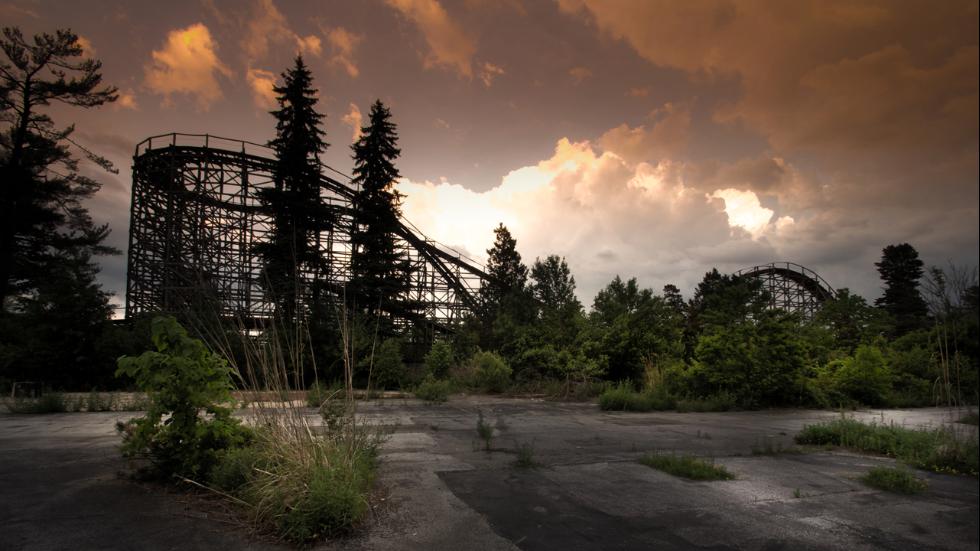
Geauga Lake: The Abandoned Amusement Park of My Youth

There are few things so pathetic as an abandoned amusement park. When I was a kid in Cleveland, I remember going at least once every summer to Geauga (pronounced JAW-gah) Lake in Aurora, Ohio. My father’s union, MESA Local 17, frequently held its summer picnics there. My brother and I always had a ball.

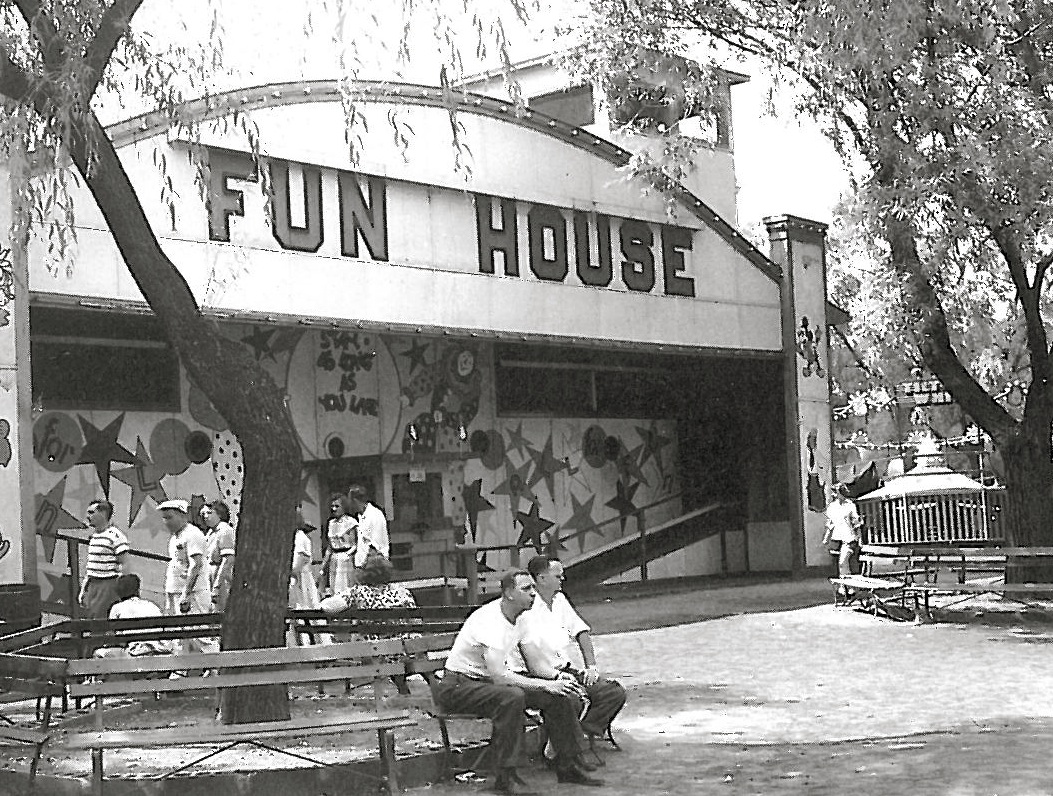
The park had a great fun house, complete with naughty mechanical peep shows that had nekkid ladies for a penny, and you could crank the cards to turn over at whatever speed. By the entrance, one had to maneuver a tricky labyrinth. There was a carney employee stationed by a button that released a jet of air to blow women’s dresses up above their heads. (I guess that wouldn’t go over too well now.) Also there was a giant rolling wooden barrel that one tried to traverse without falling on one’s heinie.

The Fun House at Geauga Lake

The Fun House at Geauga Lake

What my parents liked was the big open launch that circled the lake, creating a breeze that refreshed the passengers in the humid Ohio air. There was a roller coaster and a lot of fast rides that I was too chicken to try. (It was enough just to battle the car sickness en route.)  No, I mostly hung out at the fun house, or I would pick a nice shady spot to read—ever the bookworm. I even remember one summer in high school reading J. E. Neale’s Queen Elizabeth I to pass the time after I became sated with my crude fun house pleasures. I still have the volume on my shelf.

As I grow older, I see parts of my past being annihilated by the passage of time. Geauga Lake was founded in 1887 and finally closed down in 2007. I guess 120 years was not a bad run. Hell, I wish I could last as long!


Far from Invincible

Eat Up, Uighurs!

Eat Up, Uighurs!

Whereas others seem to think that China is invincible, I keep seeing them make mistakes of the facepalm variety. The latest is a move by the Communist Party leadership to forbid the Muslims of the western state of Xinjiang from observing their Ramadan fast. Typically, they must eat nothing from dawn to dusk from now until Friday, July 17, waiting until the sun goes down before dining. In addition, they are forbidden in indulge in “vigils or other religious activities” during the month.

Do you suppose that Beijing wants to see how far they could push the 20-odd million Muslims in their country without experiencing the kind of terrorism that is becoming a feature in much of the rest of the world?

Although there is widespread anger among East Asian countries about China’s grab of small islands in the South Pacific. Many of them would be inundated by a major tsunami—and guess where most major tsunamis originate!

It’s nice to know we’re not the only country that makes such policy howlers.


“The Absence of Life”

The Beast in the Jungle?

The Beast in the Jungle?

In his An Introduction to American Literature, Jorge-Luis Borges wrote of Henry James, “Despite the scruples and delicate complexities of James his work suffers from a major defect: the absence of life.” Borges got Henry James wrong, just as he got William Faulkner wrong. I can understand, because I thought the same about James—up until the time I actually started reading him.

Granted he can appear to be insufferably bland and insufferably gentlemanly. At the same time, he knew what he was about; and he had a moral sense that was more finely wrought than almost all other writers. In his story “Maud-Evelyn,” he writes about a middle-aged couple called the Dedricks:

“Whom do they know?”

“No one but me. There are people in London like that.”

“Why know no one but you?”

“No—I mean no one at all.  There are extraordinary people in London, and awfully nice. You haven’t an idea. You people don’t know every one. They lead their lives—they go their way. One finds—what do you call it?—refinement, books, cleverness, don’t you know, and music, and pictures, and religion, and an excellent table—all sorts of pleasant things. You only come across them by chance; but it’s all perpetually going on.”

Sounds rather boring, doesn’t it?—until, that is, you find out what the Dedricks are up to with their dear-departed daughter. With James, it’s all too easy to get stuck on this surface frou-frou.

Henry James

Henry James

If you read James’s best story, “The Beast in the Jungle,” you will have the pleasure of seeing James write about himself under the name of John Marcher. Our Mr. Marcher feels that he is being reserved for an unknown and dire fate. His woman friend May Bartram puts it this way: “You said you had from your earliest time, as the deepest thing within you, the sense of being kept for something rare and strange, possibly prodigious and terrible, that was sooner or later to happen to you, that you had in your bones the foreboding and the conviction of, and that would perhaps overwhelm you.”

We spend about forty pages then trying to find out the nature of this curse. In the meantime, John Marcher does not fall in love, though he has a sort of Darby-and-Joan relationship with May Bartram. One pictures him sitting by, his shoulders hunched against the threat of what he calls “the beast in the jungle” that is waiting around some dark corner to pounce on him. In the meantime, May sickens and dies, but not before suspecting the nature of Marcher’s curse.

Eventually Marcher, too, finds out, as he watches a grieving mourner at the cemetery near May’s grave. And the nature of the beast?

The fate he had been marked for he had met with a vengeance—he had emptied the cup to the lees; he had been the man of his time, the man, to whom nothing on earth was to have happened. That was the rare stroke—that was his visitation…. The Beast had lurked indeed, and the Beast, at its hour, had sprung.

Think of Henry James as a John Marcher: He never gets married or falls in love. He exchanges social amenities with all the best people. But he uniquely knows that his very bloodlessness chills many readers to the bone.

The truth is an elusive quantity. Sometimes it comes best expressed by a writer whom one chronically underestimates because of his style of life.


At the Hotel in the Desert

It Was Another of My Strange Dreams

It Was Another of My Strange Dreams

Don’t expect this to make any sense: It was another of my strange dreams. I was trudging with a friend across the sands of a desert when we came up on a hotel surrounded on all sides by sand dunes.

Naturally, the first thing we looked for was the check-in counter, but we couldn’t seem to find it. There were rooms, restaurants, pools, and lounges scattered almost randomly. We wandered down endless corridors, passing restaurants with sumptuous-looking fare. But we felt we had to check in first.

Like almost all of my dreams, it was well short of being a nightmare because of the dreamlike acquiescence with which we accepted the illogical design of the hotel. At any time, we could have asked someone where the front desk was located, but that possibility didn’t enter our heads.

As I write this, it strikes me that our wanderings through this hotel are a lot like life. We have to check out before we ever figure out where to check in.