The Dance Goes On

Little Girls in Greek Costumes

Little Girls in Greek Costume

Yesterday afternoon, Martine and i went to the Valley Greek Festival at St. Nicholas in North Hills. It was a cool overcast day, but people came from all over the Valley to party. Unfortunately, there were some signs of increased organization and decreased quality, especially in the food service area. But it’s still fun, what with all the music and Greek dancing. (No, I didn’t dance: I was not born with the ability to move in time to music without causing pain to my dancing partners’ feet.)

We took our usual tour of the church. Greek Orthodox churches can be pretty spectacular, and St. Nicholas is one of them. In case you were wondering, yes, it’s Saint Nick, Santa Claus, after whom the church is named. For some reason, this year there was no Question and Answer session with one of the parish priests, which I rather miss. Although I was raised a Catholic, I have a lingering admiration for Orthodoxy.

Doctrinally, the major difference between Catholicism and Orthodoxy is a single word—filioque—in the Nicene Creed. Also, their priests can be married; whereas Roman Catholic clergy must remain celibate. Curiously, there are several different rites of he Catholic Church, under Papal jurisdiction, in which marriage is also permitted.


All-American Glop

Burger Heaven, American Style

Burger Heaven, American Style

One of the advantages of my having a Hungarian upbringing is that it allows me to cast a critical eye on what most Americans would consider good eating. Take, for example, the hamburger. One starts with a plain piece of ground meat, chars it, and adds an inch or two of cheese, lettuce, tomatoes, onions (either raw or caramelized), mayonnaise, ketchup, mushrooms, and God knows what. The result is a concoction that will likely contribute more to staining your shirtfront than satisfying your hunger.

Hungarians prefer to season the meat itself rather than topping it off with a salad. My mother used to mince (not chop!) onions, garlic, and parsley and work it gently in with the ground beef (which itself could be mixed with bits of ground pork or veal). Take a look, for example, at this recipe for fasirt, a kind of Magyar fried hamburger. Whether fried or charbroiled, the Hungarian hamburger would usually be served between two pieces of rye bread, cheese optional. It had flavor. And if we wanted vegetables, they would be there on the plate, fresh from our garden, rather than piled high over the meat patty.

The same goes for meatballs. If you get matballs and spaghetti in an Italian-American restaurant, the meatballs will usually be plain meat. Our late landlady made her meatballs the Old Country way, buy adding seasonings to the meat before cooking it.

It’s a simple technique, perhaps a little time-consuming, but it tastes ever so much better than the plain unadorned ground meat.


The Blue House on Galos

I’m Starting to Book My Vacation...

I’m Starting to Book My Vacation…

I’ve already begun booking my vacation, even though it is still months in the future. There are still a few question marks. Now that Calbuco has gone to orange alert, I suspect I won’t have any major volcano troubles.The biggest question right now is how I will get a reservation on the November 13 Tren Patagonico between Viedma and San Carlos Bariloche. I suspect what I’ll do is contact an English-speaking tour agency in Buenos Aires, one like Say Hueque, which is geared to more independent travelers like me.

According to the international rail travel website The Man in Seat 61:

Viedma is across the river by small ferry from Carmen de Patagones, but no same day connection is possible so you need a night in a hotel. The Trén Patagonico from Viedma to C. de Bariloche is tremendous fun and thoroughly recommended!  Comfy secure sleeping cars (solo travellers are given a compartment to themselves and a key to lock it), excellent dining car serves steaks and wine, good company and wonderful Patagonian scenery in the morning. Excellent value, and you can buy the tickets in advance in Buenos Aires at Gallerias Rio Negro on Reconquista.

I’m afraid that by the time I get to Gallerias Rio Negro on November 4, the train will be all sold out.

In the meantime, I booked a ideally situated hotel overlooking the Recoleta Cemetery on Azcuénaga in Buenos Aires, and a nice boutique hotel near the river in Puerto Iguazu. For Valparaíso, I’ll be at the La Nona B&B on Galos (Wales) Street atop Cerro Alegre. It’s in the blue building on the left in the above photo.

Yes, it’s beginning to take shape!

This Morning’s Harvest

Go On, Believe It! Be Stupid!

Go On, Believe It! Be Stupid!

It appears that one of my e-mail addresses has made the Numero Uno suckerbait list. Here’s a selection of just some of the garbage offers that ended up in my mailbox:

  • Interest too high? Find the perfect card—from “Zero Interest Cards.” Yeah, well, did you ever hear of fees?
  • Uncover your ancestors and your family tree. Try it – 14 days no/cost. Give us your e-mail address so we can send you even more clickbait.
  • Most Wanted summer-slim-down – ready for delivery!  You, too, can experiment with your health by using expensive and untested meds.
  • Final Notice: Your gift card is about to expire.  Why would Chilis Bar & Grill, which I’ve never heard of, send me a gift card?
  • 10-second trick makes Diabetes go away. This is from Harvard Research Dept (whatever that is), so it must be true.
  • Do you want to Improvement your hearing in 1-7 days? No, but I’d love to Improvement your English!
  • Cover all of your Appliances with Choice Home Warranty. Whaddaya mean you won’t reimburse me $1,000 for my bum toaster?
  • You have been selected for inclusion. This is from Eddie Lopez, who sent the same e-mail twice, so he must want me real bad.
  • Fabulous and wonderful in your kitchen. Why thank you: I didn’t think you knew!
  • Avoid the Hassles of Home Repair. Get Your First Month Free! It’s those Choice Home Warranty (CHW) people again. In essence: Pay us and say goodbye to your money.
  • When you lose something finding it fast with this! What about that quarter that fell through a hole in my pocket in 1956?
  • (Wow!) Satellite photos make amazing discovery. That’s nice….

This is just a small selection of what parades through my mailbox every day, sometimes as many as several hundred in one twenty-four hour period.


Bad Day at La Bombonera

Fans Climbing Over High Security Barriers

Fans Climbing Over High Security Barriers

Among the lowest of the low among the male animal is the rabid sports fan. I keep thinking of one San Francisco Giants fan, Bryan Stow, who was beaten within an inch of his life by Dodgers fans while attending a game here in Los Angeles.

No one beats soccer fans, however, for grotesque violence, of which the Brits are among the worst—to the extent of being banned from some international events. There was even a war caused by dissatisfied fans when the results of a Honduras-El Salvador match did not go according to their desires. (Polish journalist Ryszard Kapuscinski wrote an excellent book on the subject called The Soccer War.)

As much as I like Argentina, I find the recent violence between Boca Juniors fans and Rio Plate players to be truly despicable. After a timeout in a 0-0 tie, Rio Plate players were shot in the eyes with a homemade pepper spray that disabled them. The Argentinean sports federation called the game and endangered Boca’s chances in league play. According to an article in the Toronto Sun:

The rivalry between the two Buenos Aires sides is one of the most heated in the world. It pits Boca, a traditionally working class side from the port area of the city against their more up-town rivals known as the “Millionaires.”

Boca’s Bombonera stadium was a cauldron of drums and the chants of the club’s passionate supporters, who sat just inches from the touchline separated by high wire fences. Few players relish the visit with away supporters barred from attending Argentine matches in a bid to curb violence.

I have been by La Bombonera, “The Chocolate Box,” as Estadio Alberto J. Armando is known, on my last visit to Argentina. Martine and I could have toured the museum, but we knew in advance that La Bombonera is in a tough neighborhood. There is one main tourist street than runs diagonally to the Riachuelo called El Caminito. Every step away from the Caminito raises your chances of being mugged; and the street itself has a huge police presence.

Perhaps rabid attention to sports is something to live for when you have nothing else to live for. But that doesn’t mean I would ever like to attend a major soccer football match anywhere in the world.

Hua Hum? Ho Hum!

One of the Border Crossings from Argentina into Chile That I Was Researching

One of the Border Crossings from Argentina into Chile That I Was Researching

As of yesterday, the 20 km danger zone around the Chilean volcano Calbuco has been lifted, restoring normal traffic between San Carlos Bariloche and Puerto Varas. Although the volcano is still listed as red for a potential eruption, in terms of actual danger, it has been downgraded to orange.

In a way, I am disappointed. I had been researching the other crossings over the Andes and discovered a little-known one at Paso Hua Hum near San Martin de los Andes. By way of a lake crossing, it takes me to Puerto Fuy, from which I can go to Valparaíso by way of Temuco or Valdivia. From pictures I’ve seen, it is every bit as scenic as the famous Lakes Crossing from Bariloche; and it is well off the normal tourist circuit.

This kind of research is part of the fun connected with my vacations. There is always a “problem” to be solved. For Eastern Canada, it was how to find a place to sleep close to Québec City while avoiding the traffic problems. For Iceland, it was how to see the bird cliffs at Latrabjárg in the Westfjords. For Peru, it was how to avoid coming down with acute mountain sickness. All these problems were successfully solved, which made for no small part of the satisfaction I felt from the vacation as a whole.

Down On His Luck

From a New Book on LA Crime Scene Photos from 1953

From a New Book on LA Crime Scene Photos from 1953

Crime writer James Ellroy has come out with a new book of crime scene photos from 1953. The book is called, simply, LAPD ’53. The victim is one Jésus Fernández Muñoz, who, according to Ellroy’s description, was “a good guy down on his luck. The coroner’s register one-sheet is perfunctory. It’s an accidental death. He was walking on or sleeping on a concrete beam below the Aliso Street bridge.” He suddenly dropped 50 feet to the hard surface of the L.A. River, which in that area is a concrete flood channel.

I always loved Ellroy’s L.A. detective novels, especially the so-called L.A. Quartet, consisting of:

  • The Black Dahlia (1987)
  • The Big Nowhere (1988)
  • L.A. Confidential (1990)
  • White Jazz (1992)

I’ve read a few others, but need to read more, as I think he is one of the best working today. And his picture of Southern California is right on the money. I understand he is working on a new series set in L.A.


Don’t Cry for Me, Argentina!

Evita Perón Speaking into a Microphone

Evita Perón Speaking into a Microphone

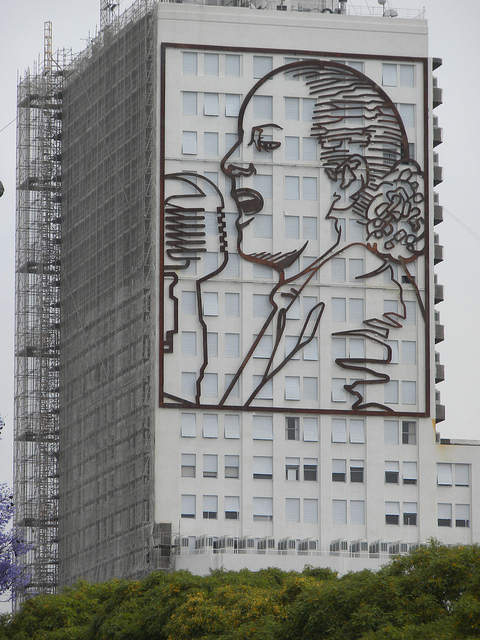
When I first saw the above building in 2011, I thought it was decorated with Evita’s image while her widowed husband Juan was still alive. I was surprised to find that Cristina Fernández Kirchner, the current president of Argentina, put it up on the side of the Ministry of Health headquarters around the time of my visit. The building is on Avenida 9 de Julio, the giant fourteen-lane highway that runs north/south from Retiro to Constitucion Station.

As President Kirchner said when she unveiled the image: “She was the most hated but the most loved, the most offended, insulted and discounted but the most venerated – the most humiliated but today eternally victorious…. She taught us that to confront the powerful carries a high price.”

By the time I find myself in Argentina next, Kirchner will have been termed out of office. I wonder how she will be seen by future generations. Evita’s reputation is safe: she died of cancer at the age of 33 at the height of her popularity. She was just about to request sharing power with her husband when the illness struck. Cristina, on the other hand, has ruled Argentina alone, and with her late husband Nestor, since 2003.


Short Line

Our Train Pulling Up to the Gate

Our Train Pulling Up to the Gate

In Ventura County’s Santa Clara River Valley, there is a railroad line that runs roughly between Piru and Santa Paula, with Fillmore as its base. Most trains run on Saturdays and some Sundays, with most trains running from Fillmore to Santa Paula, stopping for sufficient time for passengers to see the Santa Paula Agricultural Museum or the California Oil Museum. On the way back, there is a stop at the Loose Caboose, where one can buy locally grown fruit, olives, and honey as well as see cockatiels, parakeets, peacocks, koi, and goats.

We got an acceptable lunch on the Powhatan Dining Car on the train, and sat back as we rolled past hundreds of fruit orchards. (Santa Paula considers itself the citrus capital of the United States.)

The Fillmore & Western Railway is essentially a fun enterprise. If you’re expecting 100% authenticity or haute luxury, you will be disappointed. Your four-hour journey will be restful and low-key. Many of our fellow passengers seemed to be retired farmers, who had interesting things to say about the farmland through which we passed.

Fillmore and Santa Paula are only about a dozen miles apart, but Martine and I had a good time and would consider coming back.

Tarnmoor’s ABCs: Venice

A Million Miles from St. Mark’s

A Million Miles from the Adriatic

All the blog posts in this series are based on Czeslaw Milosz’s book Milosz’s ABC’s. There, in the form of a brief and alphabetically-ordered personal encyclopedia, was the story of the life of a Nobel Prize winning poet, of the people, places, and things that meant the most to him.

My own ABCs consist of places I have loved (Iceland, Patagonia, Quebec, Scotland), things I feared (Earthquakes), writers I have admired (Chesterton, Balzac, Proust, and Borges); locales associated with my past life (Cleveland, Dartmouth College, and UCLA), people who have influenced me (John F. Kennedy), foods I love (Olives and Tea), and things I love to do (Automobiles and Books). This blog entry is my own humble attempt to imitate a writer whom I have read on and off for thirty years without having sated my curiosity. Consequently, over the weeks to come, you will see a number of postings under the heading “Tarnmoor’s ABCs” that will attempt to do for my life what Milosz accomplished for his. To see my other entries under this category, hit the tag below marked “ABCs”. I don’t guarantee that I will use up all 26 letters of the alphabet, but I’ll do my best. The fact that I made it as far as the letter “V” makes me wonder sometimes.

Los Angeles has been described as a varying number (depending on who’s doing the quoting) of suburbs in search of a city. After all, what is the real difference between Sherman Oaks and Encino, Mar Vista and Palms, or Rancho Park and West L.A.? Some of the communities in the county are distinctive because of their ethnicity, such as Monterey Park (Chinese), East L.A. (Mexican), Gardena (Japanese), Pico-Union (Central American), and Glendale (Armenian).

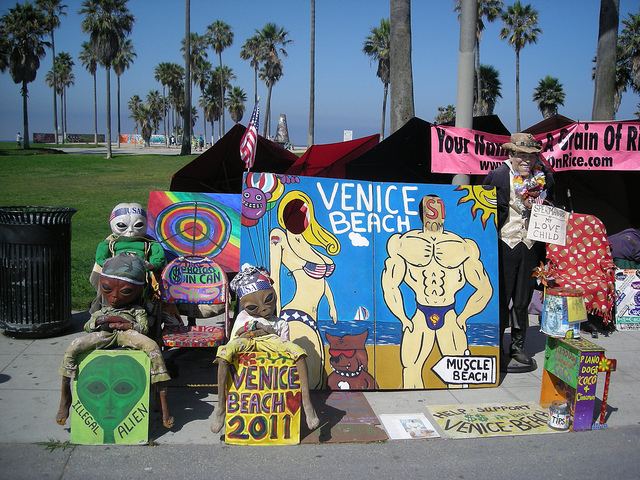
One neighborhood that is known more for its culture than its ethnicity is Venice. When Abbot Kinney first thought of the idea of artificial canals in a community bordering the ocean in 1905, naturally, the name “Venice” popped into his head. In the 1960s, the area was known as Los Angeles’s answer to Haight-Ashbury. Charles Manson and his gang hung around the area. Jim Morrison and the Doors advertised itself at first as a Venice band.

At the same time that the Hippies became the predominant population, some prominent artists also set up shop in the area, such as Charles and Ray Eames. Others associated with Venice included Charles Arnoldi, Jean-Michel Basquiat, John Baldessari, Larry Bell, Dennis Hopper, and Ed Ruscha. Abbot Kinney Boulevard is dotted with art galleries.

You can get your name on a grain of rice, buy any number of T-shirts with funny sayings, eat funnel cakes (whatever those are), or order sausages from Jody Maroni’s Sausage Kingdom.

I frequently walk along the Boardwalk where it begins just south of Venice Boulevard to Small World Books, one of the best remaining independent bookstores in Southern California. Frankly, I enjoy the sleaziness of the area—perhaps not enough to hang out there after the sun sets.