Tarnmoor’s ABCs: Quebec

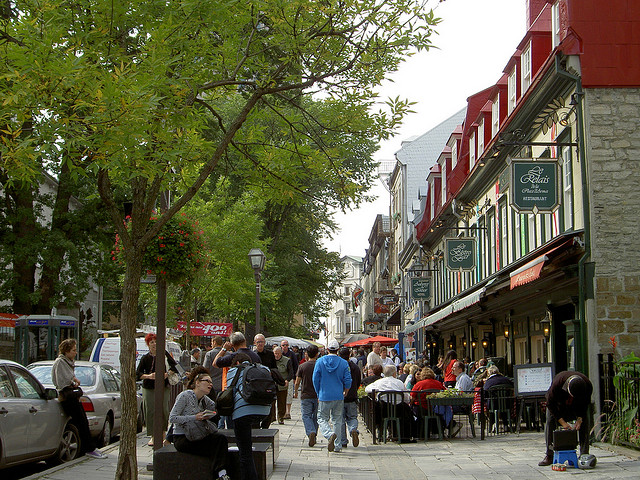
Central Quebec City

Central Quebec City: The Haute Ville

I was so very impressed by Czeslaw Milosz’s book Milosz’s ABC’s. There, in the form of a brief and alphabetically-ordered personal encyclopedia, was the story of the life of a Nobel Prize winning poet, of the people, places, and things that meant the most to him. Because his origins were so far away (Lithuania and Poland) and so long ago (1920s and 1930s), there were relatively few entries that resonated personally with me. Except it was sad to see so many fascinating people who, unknown today, died during the war under unknown circumstances.

My own ABCs consist of places I have loved (Iceland), things I feared (Earthquakes), writers I have admired (Chesterton, Balzac, Proust, and Borges); things associated with my past life (Cleveland and Dartmouth College), people who have influenced me (John F. Kennedy), foods I love (Olives), and things I love to do (Automobiles and Books). This blog entry is my own humble attempt to imitate a writer whom I have read on and off for thirty years without having sated my curiosity. Consequently, over the months to come, you will see a number of postings under the heading “Tarnmoor’s ABCs” that will attempt to do for my life what Milosz accomplished for his. To see my other entries under this category, hit the tag below marked “ABCs”. I don’t guarantee that I will use up all 26 letters of the alphabet, but I’ll do my best. Today the letter is “Q” for Quebec.

If you want to see France, but can’t quite afford it, you can always go to Quebec City. While it’s not exactly Paris, it is not quite Anglo Canada either. There will be times you have to dredge up your High School French to make yourself understood. As in France, people understand more English than they let on: They just want to see if you’re willing to go halfway.

Just a short stroll along the cliffs over the St. Lawrence, and you arrive at the Plains of Abraham, where the French were decisively defeated, despite the death of both generals, Wolfe and Montcalm. The English may have won, but the Quebecois will tell you, “Je me souviens”—“I remember.” And they do, to the extent that at several times in recent history, they have threatened to declare their independence. (For the historical background, I recommend you read Francis Parkman’s 19th Century classic, Montcalm and Wolfe.)

The cuisine in Quebec is an intriguing mixture of old country French with such local touches as maple syrup. Probably your best bet is to dine at Aux Anciens Canadiens in the old town. It is probably one of the five best restaurants I have ever visited.

Everywhere you turn in Quebec, you will be reminded of France. See the Musée des Ursulines on rue Donnacona for a tribute to the nuns who played such a major role in French Quebec. Walk along Dufferin Terrace past the Hotel Château Frontenac to see the St. Lawrence from atop the cliffs that once protected the city.

I have visited Quebec City twice and hope to go again.

Back to Argentina?

Third Time’s a Charm!

Third Time’s a Charm!

As tax season pressures come to bear on me once again, I look frantically for some escape. As Martine is still unable to travel with any degree of comfort, I will travel alone for the third year in a row. And I’ve decided that I am far from finished with Argentina. When I traveled there in 2006 and 2011, it was the country of Jorge Luis Borges, of his “Funes the Memorious” and “Death and the Compass.” It still is, but new names have been added, particularly César Aira and Juan José Saer, from Coronel Pringles and Santa Fé respectively.

And there are places I have always wanted to see: San Carlos de Bariloche in the Patagonian Andes and Iguazu Falls where Argentina, Brazil, and Paraguay meet. Also I want to spend more time in Buenos Aires—a city that I love. In 2006, I stayed in the Microcentro; in 2011, Martine and I stayed in Palermo; this time, I think I’ll stay either in Recoleta (not the cemetery, pictured above) or Barrio Norte.

Because I will be traveling alone, I will probably take more long-distance buses, especially as Aerolíneas Argentinas is so dismal. To get to Argentina, by preference I will fly on LAN, probably by way of Lima, perhaps even stopping for a few days in Lima.

I wish Martine could come with me, but with her aches and pains, she would turn into a zombie from lack of sleep—which is in effect what happened during our Cabo San Lucas trip last month, which was a test of sorts.

The Coldest and Windiest Place in the Lower 48

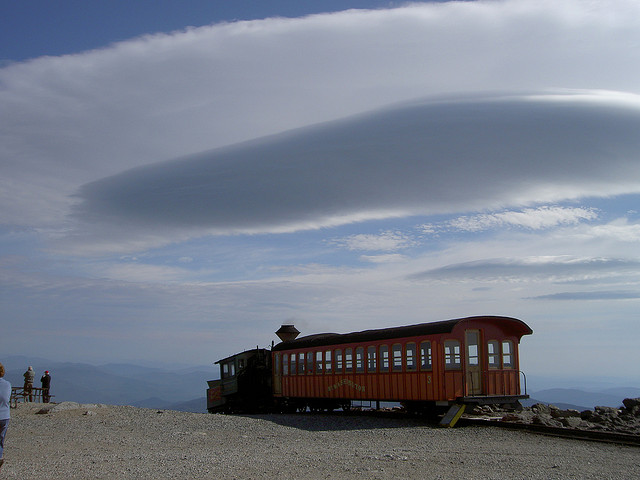
Atop Mount Washington in New Hampshire

Atop Mount Washington in New Hampshire in 2005

Mount Washington in the White Mountains of New Hampshire has recorded the coldest temperatures in the contiguous 48 states and the highest surface wind measurement. On January 22, 1885, the lowest official temperature reached -50º Fahrenheit (-46º Centigrade). Only Cyclone Olivia in the South Pacific reached higher recorded surface wind speeds than the 231 mph (372 km/hour), which occurred there on April 12, 1934.

As extreme as the temperature gets, you can easily travel up to the top using the historic cog railway (built in 1869). If you go, be sure to bundle up, else you will turn into an icicle.

The reason why Mount Washington has such extreme temperatures is explained as follows by Wikipedia:

The weather of Mount Washington is notoriously erratic. This is partly due to the convergence of several storm tracks, mainly from the Atlantic to the south, the Gulf region and Pacific Northwest. The vertical rise of the Presidential Range, combined with its north-south orientation, makes it a significant barrier to westerly winds. Low-pressure systems are more favorable to develop along the coastline in the winter months due to the relative temperature differences between the Northeast and the Atlantic Ocean. With these factors combined, hurricane force wind gusts are observed from the summit of the mountain on average of 110 days per year.

Suffice it to say, the cog railway does not run when the climactic conditions are unfavorable. The folks there don’t want their tourists blown to Oz and beyond.

Ghost Duds

If They’re Spirits, Why Do Ghosts Wear Clothes?

If They’re Spirits, Why Do Ghosts Wear Clothes? (If Not Shoes)

I don’t often do this, but the subject whetted my appetite. The following comes verbatim from a November 24, 2013 posting on Futility Closet. Do visitors from the spirit realms have an innate sense of modesty? Do they not want to arouse our lubricity or disgust? Or do they not want to leave their clothing in—of all places—the Futility Closet? Come to think of it, the one ghost I saw—that of my Great Grandmother Lydia—was fully clothed in her normal everyday wear. Anyhow here goes:

Why do ghosts wear clothes? If a ghost is the spirit of a living creature, how can it carry its inanimate garments into the afterlife?

“How do you account for the ghosts’ clothes — are they ghosts, too?” asked the Saturday Review in 1856. “What an idea, indeed! All the socks that never came home from the wash, all the boots and shoes which we left behind us worn out at watering-places, all the old hats which we gave to crossing-sweepers … What a notion of heaven — an illimitable old clothes-shop, peopled by bores, and not a little infested with knaves!”

In 1906 psychic researcher Andrew Lang argued that, far from confusing the notion of an afterlife, ghosts’ clothing might even help to corroborate its existence. “A pretty instance occurs, I think, in a biography of Warren Hastings. The anecdote, as I remember it, avers that at a meeting of the Council of the East India Company in Calcutta one of the members (I think several shared the experience) saw his own father, wearing a hat of a peculiar shape, hitherto strange to the observers. In due time came a ship from London bearing news of the father’s death, and a large and well-selected assortment of the new hat fashionable in England. It was the hat worn by the paternal appearance! If the circumstances are recorded in the minutes of the proceedings of the Council, which I have not consulted, then the hat of that spook becomes important as evidence.”

Even if we grant that a dead person can convey his most personal belongings into the afterlife, how are we to account for phantom ships, coaches, and railway trains? In his 1879 book The Spirit World, American spiritualist Eugene Crowell decided that, rather than being the spirits of “dead” earthly conveyances, these are constructed in the afterlife by the ghosts of mariners and railwaymen who want to ply their trades again. Spectral ships “glide over the waves without sinking,” Crowell explained, “and earthly winds propel them at rates of speed which our ships cannot attain.” If that’s true, then perhaps some ghostly tailor is simply manufacturing clothes for the naked spirits of the newly dead. Decent of him.

Stopping Autoplay Videos in I.E.

You Can Also Stop Autoplay Videos in I.E.

You Can Also Stop Autoplay Videos in I.E.

Here, from the February 2015 issue of PC World, are Lincoln Spector’s instructions for suppressing autoplay videos in Internet Explorer:

  1. From the menus at the top of the window, select: Tools>Manage add-ons.
  2. In the resulting Manage Add-ons dialog box, make sure that Toolbars and Extensions is selected on the left. Wait for the list to appear.
  3. Find and double-click Shockwave Flash Object on the right. (It’s listed under Adobe and will likely be near or at the top.)
  4. In the resulting More Information dialog box, click the Remove all sites button. Then close the dialog boxes.

According to Spector, the Flash windows may not appear at all, or they may appear blank. A bar at the bottom of the window will offer options to allow Flash to play. Click the x on the right to indicate No.

How to Stop Autoplay Videos

Yes, You Can Retain Control Over Videos

Yes, You Can Retain Control Over Videos

Last summer, I wrote a blog posting entitled Streaming Agony in which I bewailed the tendency of websites to push streaming videos in your face when you open websites—particularly prevalent among news websites. Most of these streaming videos are controlled by Adobe Shockwave. Using your Internet browser, you could request that the video be grayed out, as in the three examples in the above screen shot from the Buenos Aires Herald, and activated only when you specifically request it. By clicking on “Activate Adobe Flash,” you can see the video once, or grant blanket permission to the website.

Because I use Mozilla Firefox as my browser, I will reprint the instructions by Lincoln Spector from the February 2015 issue of PC World on “How to Stop Autoplay Videos” using this browser. If you should be a user of Google Chrome or Internet Explorer, reply at the bottom of this post and I will post the equivalent instructions for your browser. If you use Safari, you are out of luck.

Here are the instructions for suppressing autoplay videos on Firefox:

  1. Press Ctrl-L to go to the address bar and type in the local URL field: about:addons.
  2. Click Plugins in the left pane.
  3. Find Shockwave Flash in the list of plug-ins.
  4. Click the Always Activate pop-up menu on the right, and select Ask to Activate.

The article in PC World continues:

When you visit a page with an embedded Flash video, the video window will be in a box, but this time it will be white with Adobe’s Flash logo (a stylized letter ‘f’ in the center). A gray bar at the top of the page will give you options to continue blocking or allow the flash.

If you click Allow, you’ll get options to Allow Now or Allow and Remember. If you want to allow it at all, I recommend Allow Now.

Hopefully this will protect you from loud NSFW (Not Safe for Work) loud ads and most autoplay videos.


Dragged Kicking and Screaming into the 21st Century

A Brave New World

A Brave New World

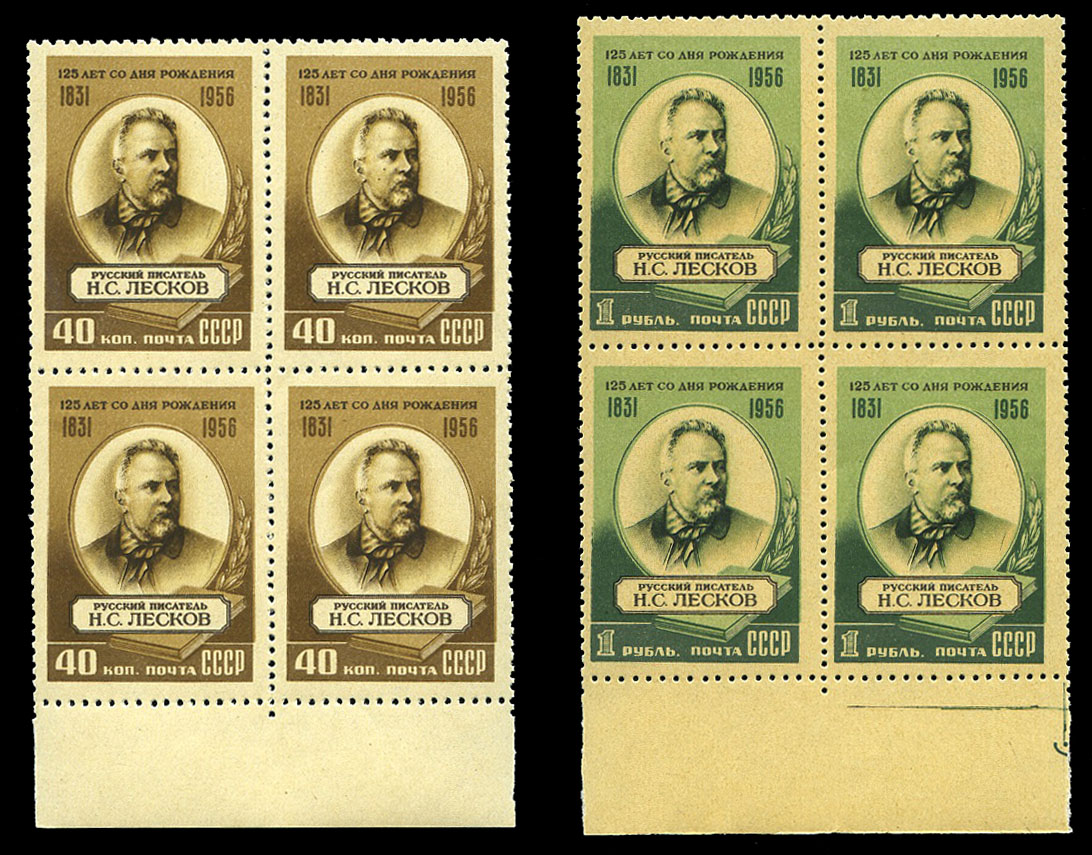
It used to be that, in fiction, the story was king—partly, I think, because God was in His Heaven and all was right with the world. A few things have happened since then: two World Wars, terrorism on a global scale, Charles Darwin, contraception, quantum mechanics, the Internet, and the Atomic Bomb. Mind you, I still love the great storytellers, men like Isaac Bashevis Singer, Nikolai Leskov (see illustration below), Charles Dickens, J.R.R. Tolkien, the authors of the Icelandic sagas, and John Steinbeck. But the world has changed, or at least is in the process of changing, and the only people who still stick with the fundamentalist view of society are the United States (particularly in the Bible Belt) and the Middle East (with the Jihadists).

Slowly, I have been dragged kicking and screaming into the postmodernist 21st century. In 1999, Martine and I walked right by the Picasso Museum in Paris without expressing any interest in its contents. I still actively dislike Mark Rothko, Jackson Pollock, Willem de Kooning, and most abstract expressionists. As for much of current architecture, I curl my lips in disgust. As for music, I tend to be pretty conservative, especially as I listen to most music while reading. Perhaps, for the time being, I am interested only in the literary impact of postmodernism. As for the other art forms, perhaps later….

Russian Stamps Honoring Nikolai Leskov, One of the Great Storytellers

Russian Stamps Honoring Nikolai Leskov, One of the Great Storytellers

What started me down this path is my clear enjoyment at reading such authors as César Aira, Geoff Dyer, Juan José Saer, and Samuel Beckett. Christopher L.C.E. Witcombe has attempted to define the postmodern artist:

The post-modern artist is reflective in that he/she is self-aware and consciously involved in a process of thinking about him/herself and society in a deconstructive manner, “damasking” [i.e., weaving with elaborate design] pretentions [sic], becoming aware of his/her cultural self in history, and accelerating the process of self-consciousness.

In an interesting Chinese blog by Xiaoqing Liu, two characteristics of postmodernism include “a tendency in contemporary culture characterized by the problem of objective truth and inherent suspicion towards global cultural narrative or meta-narrative” and the principle that “the perceiving subject cannot be taken out of the equation.”

One result is that postmodern literature can be painfully difficult to read. There is little respect for straight chronology. Sometimes, as in Geoff Dyer’s The Search, surrealism suddenly intrudes and plays havoc with the susceptibilities of more traditionally-oriented readers.

Still, there are rewards. The Godlike narrator is gone, and time and place are twisted out of shape. One interesting result is that reading becomes an activity similar to crime detection; and that’s partly why postmodernism has certain affinities with the mystery genre.

The painting at the top is by the British postmodern painter Francis Berry and is entitled “Tonic Moment: Search.”


Of Mustard and Hot Dogs

This Won a Rebuke for Me from the Hot Dog Vendor

This Won a Rebuke for Me from the Hot Dog Vendor

When I was a grade school student at Saint Henry in Cleveland, I started getting straight A’s after fourth grade. At that time, the Cleveland Press had a program to reward kids like me by giving straight A students seven pairs of baseball tickets for Indians games during the summer. Most of them were for weekday daytime games, so I usually wound up going by myself or with one of my friends.

I remember the first time I ordered a hot dog at Cleveland Municipal Stadium. The vendor immediately smeared the dog with mustard, and I blanched. “Could I have one without mustard, please?” I begged. The vendor was plainly irritated. “Kid,” he told me. “There must’ve been something wrong about the way you was raised.”

Well, I certainly had a weak stomach; and, for some reason, I had a particular antipathy to mustard.

Around then, I made an abortive attempt to get into the Boy Scouts. I say abortive because I knew I could never advance to First Class because (1) I did not know how to swim at that time and (2) I had problems memorizing the Morse Code. But I did spend a weekend at Hiram House Camp with the Scouts.

It was not one of the high points of my youth. The weather was cold, so we had the fireplace going all night; and no one knew how to operate the flue. Consequently, we were gagging from the smoke all night. Then—horrors—the next day at lunchtime I had to help wash the dishes, which were liberally slathered with mustard.

Shortly after then, I dropped out of scouting.


“A Web of Cigarette Smoke and Revery”

This Could Have Been the Place

Could This Have Been “Hotel Insomnia”?

I have just finished reading a strange surrealistic novel—one which made me want to find a poem to match. Here it is: “Hotel Insomnia” by Serbian-American poet Charles Simic.

Hotel Insomnia by Charles Simic

I liked my little hole,
Its window facing a brick wall.
Next door there was a piano.
A few evenings a month
a crippled old man came to play
“My Blue Heaven.”

Mostly, though, it was quiet.
Each room with its spider in heavy overcoat
Catching his fly with a web
Of cigarette smoke and revery.
So dark,
I could not see my face in the shaving mirror.

At 5 A.M. the sound of bare feet upstairs.
The “Gypsy” fortuneteller,
Whose storefront is on the corner,
Going to pee after a night of love.
Once, too, the sound of a child sobbing.
So near it was, I thought
For a moment, I was sobbing myself.

He received a Pulitzer Prize in 1990; and, in 2007, he was appointed Poet Laureate Consultant in Poetry to the Library of Congress.

The Melancholy of Departure (and Arrival)

Giorgio di Chirco’s “Gare Montparnasse: The Melancholy of Departure”

Giorgio di Chirco’s “Gare Montparnasse: The Melancholy of Departure”

I usually do not write about a book until I have finished reading it, but I decided that I had to post this while the ideas were still fresh in my mind. Geoff Dyer’s novel The Search (1993) started out as a genre mystery/detection novel, but has transformed into a Giorgio di Chirico painting.

We are in a non-specific country in an area known as The Bay. A man named Walker (no first name given) winds up at a party with his brother and meets an alluring woman known as Rachel Malory and asks him to track down er ex-husband in order to get some papers signed. Walker finds Rachel seductive, but she does not allow herself to be seduced, which only spurs Walker on. Although he does it ostensibly for money, it is really she who is the goal of his endeavors.

So far, so good. But it is not long before strange things begin to happen. First of all, he meets a man named Carver who wants badly to compare notes with him about Malory. When he refuses, Carver threatens to kill him. So while he is chasing Mallory, he is being chased by Carver. Then even stranger things begin to happen:

There was something strange about the city but he was unable to work out what. Then it came to him. There were no trees or pigeons or gardens. Yet all around were the sounds of leaves rustling and the beating of wings, the cooing of departed birds. He was so shocked that he stood at a street corner, listening.

Then there was a closed bridge that was actually vibrating like a plate of Jello in the wind. Walker goes through a series of tatty cities in this strange nondescript landscape. In one, there are no people; and he is able to get a suit and a car without paying for them. In another, there doesn’t seem to be much of a city, but whatever there is is surrounded by a network of wide freeways on which all the motorists are speeding furiously.

There don’t seem to be any clues about Malory, but Carver or some unknown assailant is still chasing him through a series of random cities.

“Enigma of a Day”

“Enigma of a Day”

That’s when I thought of di Chirico, that painter of mysteriously nonspecific cities. Cities like Meridian, Port Ascension, Eagle City, Usfret, Kingston, Monroe, Durban, Iberia, Friendship—the list stretches on. Each town is different from the other, in a sort of alternate United States with black and Latino ghettos. In one unnamed city, he even finds what looks to be a picture of Malory with Rachel.

As the surrealism grows, I almost want to ration the rest of the book so that I don’t finish it too soon.