“This Hint of an Unhappy Ending”

Serbian-American Poet Charles Simic

Serbian-American Poet Charles Simic

Born in Belgrade, Serbia, Душан “Чарлс” Симић (better known today as Charles Simic) is probably one of our best poets. There is a simplicity and strength in his lines, which are usually blank verse. He received the Pulitzer Prize for poetry in 1990 for his collection The World Doesn’t End, and was a finalist in both 1983 and 1986. In 2007, he was appointed Poet Laureate.

Below is his poem entitled “Clouds Gathering,” which takes a romantic setting and sees beyond it the threats to happiness that all men face:

It seemed the kind of life we wanted.
Wild strawberries and cream in the morning.
Sunlight in every room.
The two of us walking by the sea naked.

Some evenings, however, we found ourselves
Unsure of what comes next.
Like tragic actors in a theater on fire,
With birds circling over our heads,
The dark pines strangely still,
Each rock we stepped on bloodied by the sunset.

We were back on our terrace sipping wine.
Why always this hint of an unhappy ending?
Clouds of almost human appearance
Gathering on the horizon, but the rest lovely
With the air so mild and the sea untroubled.

The night suddenly upon us, a starless night.
You lighting a candle, carrying it naked
Into our bedroom and blowing it out quickly.
The dark pines and grasses strangely still.

I love the last line, which reminds me of Thomas Hardy’s poem “The Subalterns,” in which nature apologetically admits to its unfortunate role as contributing to man’s suffering.
Favorite Films: Rififi (1955)

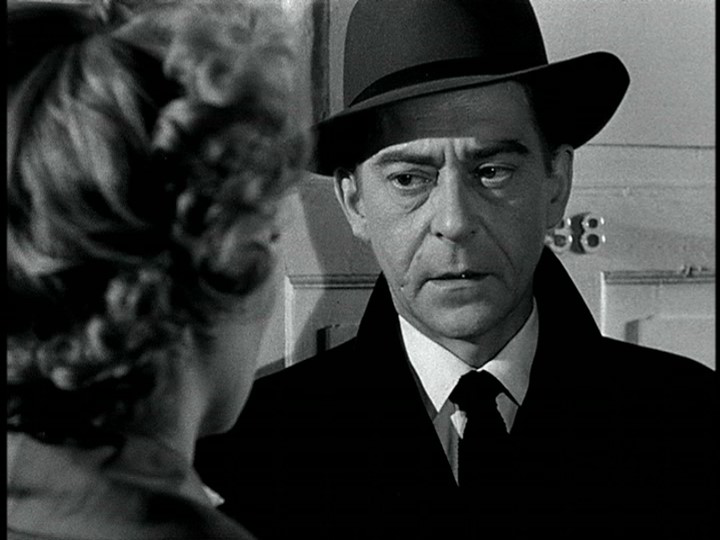
Jean Servais in Rififi

Jean Servais in Rififi

It was another blast furnace day in Los Angeles (after numerous mendacious weather forecasts predicting a cool-down). So Martine and I decided to take in a movie. The one we picked was a Jules Dassin classic called Rififi (Du rififi chez les hommes). According to the lyrics of a song in the film sung by a torch singer, the term rififi means “rough and tumble,” which is a pretty good description of the film’s action.

The cast is relatively little known, with the brilliant Jean Servais in the lead role of Tony, a sickly ex-con with puffy eyes that look as if they were stuffed full of coffee grounds. All the characters in the film are hoods, and it is as if we were watching a Greek tragedy enacted before our eyes. One of the four jewel thieves, the safe cracker, is played by Dassin himself.

After first refusing to join in the heist of a luxe Paris jewelry, Tony changes his mind and takes over the planning of the job. All goes well, until a ring from the job is found on the finger of a dancer working for a rival mob. From this point on, the plot works itself out, with bodies strewn all over Paris.

Dassin was an American director working in France to escape the Blacklist. In the United States, he is responsible for such films as Naked City (1948), Never on Sunday (1960), and Topkapi (1964).

The print we saw look as fresh and new as if we were watching its first run some sixty years ago.

Under Four Flags

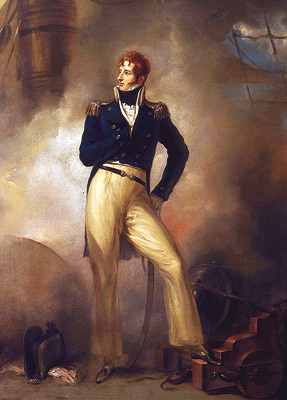
Lord Thomas Cochrane (1775-1860)

Lord Thomas Cochrane (1775-1860)

He must have been an amazing sight to his enemies, towering over six feet with red hair. Lord Thomas Cochrane, 10th Earl of Dundonald, was an impoverished Scot of noble birth who was a brilliant attacking sea captain. Because of various circumstances, mostly relating to his problems with authority, he was perhaps the most brilliant naval strategist who did not actually command a fleet. Had the Admiralty not been so venal and corrupt, he could have shortened the Napoleonic Wars by incursions against the mainland of France, forcing Napoleon back from Russia ahead of schedule. But that was not to be.

Some people are not meant to get along well with politicians. (I am one such myself, though not with one thousandth the talent of the Scotsman.) Cochrane developed a whole slew of enemies, hobnobbing as he did with Radicals as William Cobbett and Sir Francis Burdett. He even spent time at King’s Bench Prison for stock fraud—a mostly bogus charge cobbled together by his enemies with a complaisant and corrupt judge on the bench.

Stripped of his Order of the Bath and drummed out of the Navy, Cochrane accepted an offer the command the navy of the emerging Republic of Chile. He fought a number of sharp naval actions until the Spanish Pacific Fleet was driven off. Then he assisted Dom Pedro I of Brazil fight for that country’s independence from Brazil.

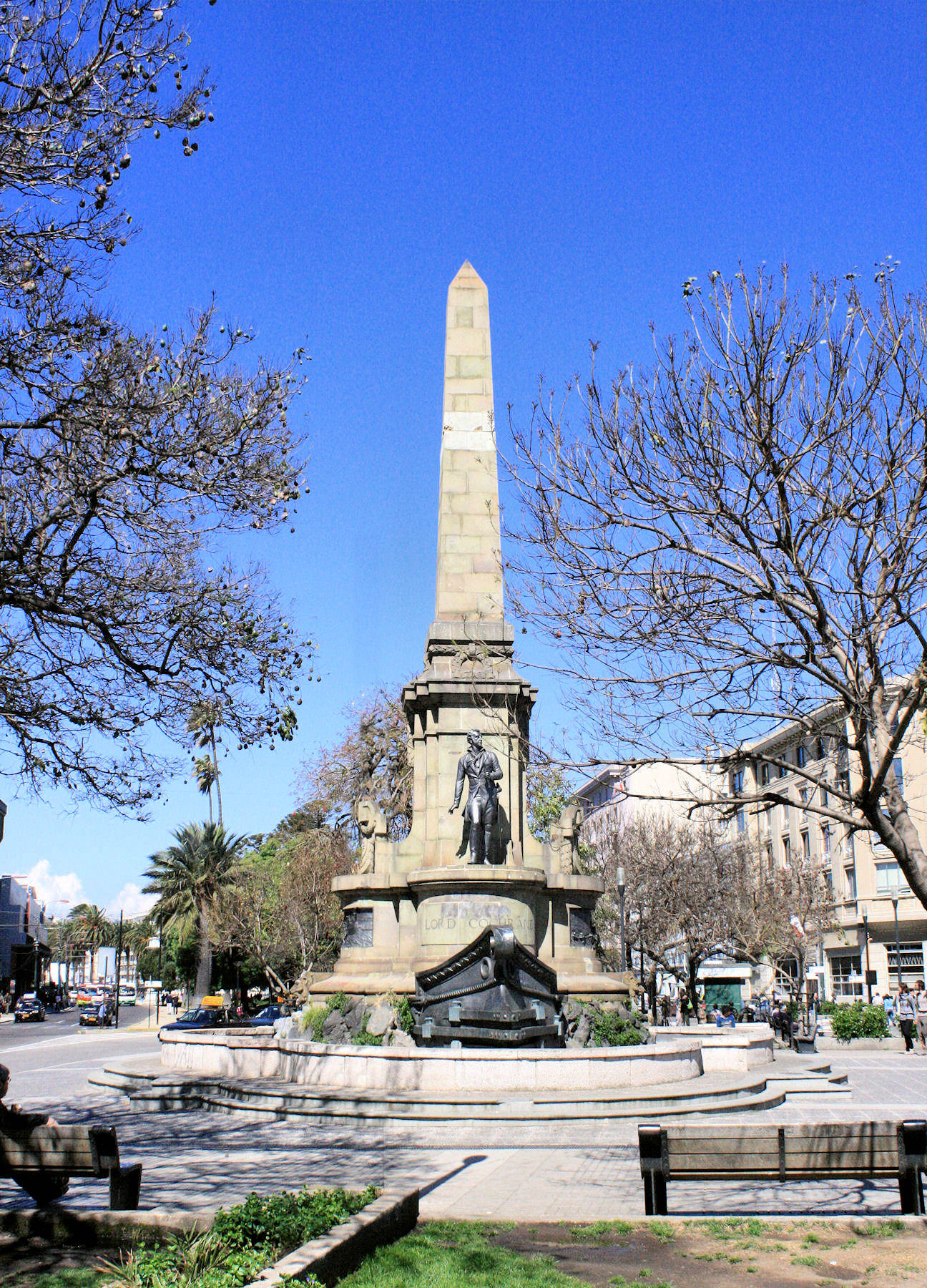
Memorial to Cochrane in Valparaiso, Chile

Memorial to Cochrane in Valparaiso, Chile

Finally, he ended up commanding the fleet of the Greeks who were then fighting to free themselves from the Ottomans. Here he was least effective, largely because of the rampant factionalism of the Greeks. According to Donald Thomas in his excellent biography Cochrane, “he wrote to the Chevalier Eynard of the Philhellenic Committee in Paris, describing the government of Greece as depending on ‘bands of undisciplined, ignorant, and lawless savages.’” This was a far cry from the well-trained British and Chilean sailors he had commanded.

Eventually, Greece won her independence, but only after the British, Russians, and French combined to dictate terms against the Turks.

Cochrane reminds me of General George Patton, another brilliant military leader who paid a heavy price for refusing to kiss the butts of military administrators.

I Am Attacked by the British

All I Did Was Express an Opinion

All I Did Was Express an Opinion

Yesterday, I posted a blog about the Falklands War of 1982 and ran into a hailstorm of British patriotism, challenging me to provide reasons. Very well, I am prepared to do so.

I prefer Argentina’s claims to Britain’s because … well … the Argentinians have better food. (The British cheeses, however, are vastly superior—especially Stilton.) I cannot help but think the poor mutton-eating settlers of the Falklands do not appreciate the extent to which they have been deprived.

Am I anti-British? By no means. On the other hand, I was never a supporter of Margaret Thatcher. But then, General Galtieri and his Junta win no awards either.

Let’s just call it an unsupported opinion by an obviously prejudiced observer.


Islas Malvinas

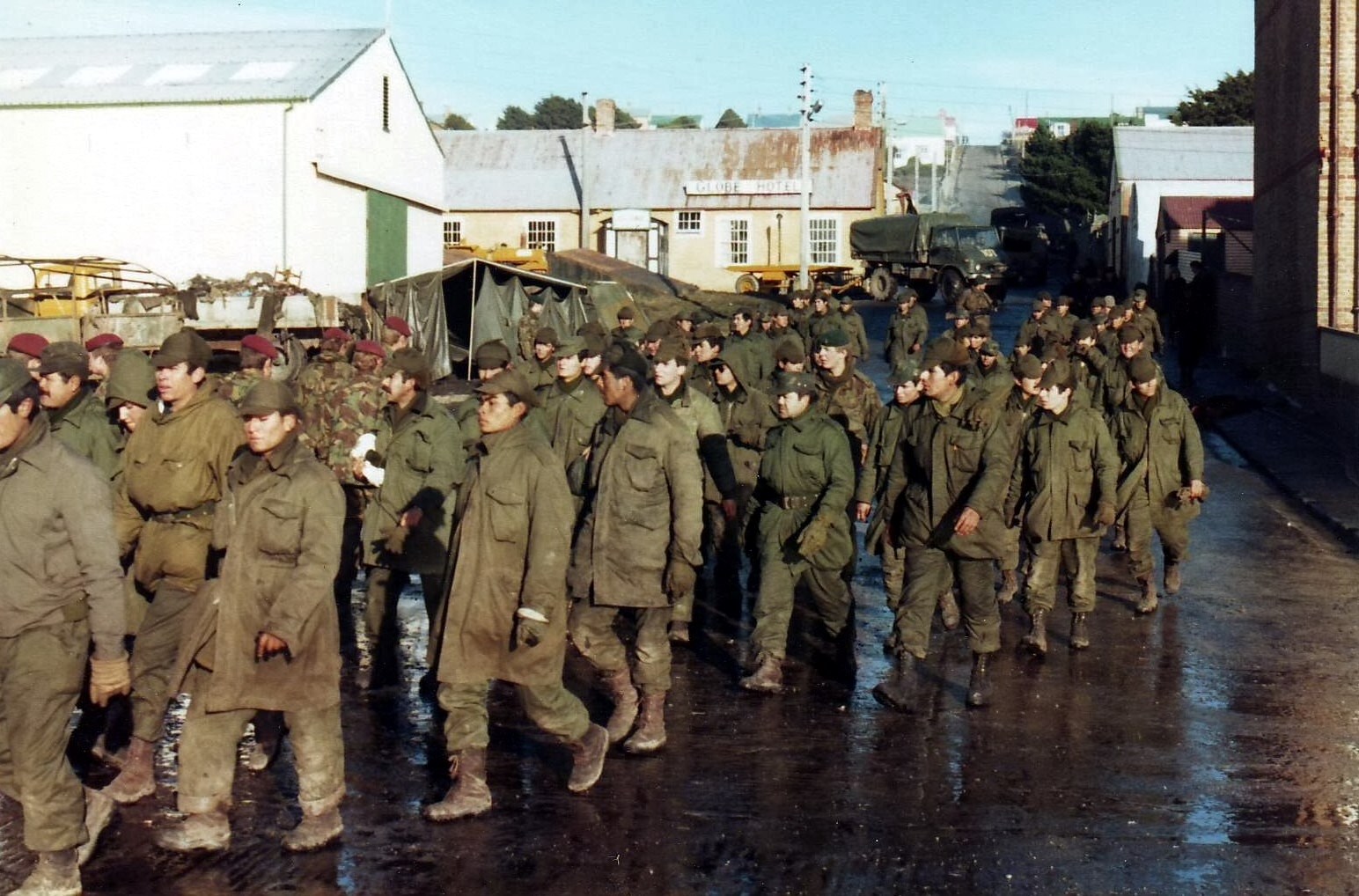
Argentine Prisoners of War in Port Stanley, 1982

Argentine Prisoners of War in Port Stanley, 1982

In 1982, Argentina invaded the Falkland Islands, which it had claimed ever since independence from Spain in 1810. However, England and France had also settled the archipelago, though France eventually abandoned their claims to Spain. Argentina could very well have won, except for one thing: Iron Lady Margaret Thatcher was in charge, and she was having none of it. A short but bloody conflict ensued, with the Brits coming out on top. The Argentine junta of General Galtieri promptly collapsed and was replaced by free elections.

To whom do the Falklands rightly belong? A British sea captain  named John Strong discovered the islands in 1690, and Louis Antoine de Bougainville started a French settlement in 1764. There were English, French, Spanish, and Argentinean gaucho settlers in the Falklands; but England decided to lay claim to the whole shooting match in 1833.

That has never sat well with Argentina, which calls the archipelago the Islas Malvinas. The airport in Tierra del Fuego’s Ushuaia is called Malvinas Argentinas International Airport. Streets throughout the Republic bear the name Malvinas. And now the new 50-peso note reiterates the Argentine claim. The country is full of monuments to the war dead, and woe betide any tourist who utters the name “Falklands.”

... for Now Anyhow

… for Now Anyhow

My friend Peter did some filming in the Falklands before the 1982 war, mostly of old sailing ship wrecks which had run aground there after Cape Horn storms. He told me that, although the Falklands are in some of the richest fishing waters on earth, the local English residents all prefer to eat mutton.

Who is right? England or Argentina? My preference goes to the Argeninians, though I doubt that the British would ever step down, especially as there is considerable oil exploration taking place.


The Dinosaur and the Flickers

Changing Tastes Affect Whole Media

Changing Tastes Affect Whole Media

Yesterday at Cinecon 51, I had an interesting discussion with a film memorabilia vendor from Philadelphia about the changing tastes of the film audience. Both of us noted that there was a remarkable lack of younger filmgoers—anything under age forty—attending the recently restored films from former decades. In fact, most of the attendees were in their seventies or above.

That set me to thinking: I am happy that I did not achieve my educational goal of becoming a professor of motion picture history and criticism. If I had, I would have had to face the fact that my chosen field was, essentially, ultimately doomed for lack of interest. How many younger people would be interested in silent films, or early talkies in black and white, or even anything that had a more complicated story line. Who would even be able to sit still for The Seven Samurai or Doctor Zhivago or Rules of the Game?

People are clearly becoming more distracted as time goes on. Movie screens have gotten smaller, and home TV screens have grown larger. They haven’t quite met yet, though the tendency continues. One does not need to watch a television with rapt attention, not while one is texting, reading one’s e-mails, or watching YouTube on a smart phone.

So, if I were a professor of film history, I would feel as if I were ramming films down the throats of a younger generation that thought the subject matter was irrelevant.  Who cares about the films of F. W. Murnau, Josef von Sternberg, or even Alfred Hitchcock?  (I can just imagine trying to explain Hitch’s Vertigo or Shadow of a Doubt to a restive crowd who were itching to jump onto their smart phones.)

As far as my own tastes are concerned, I will follow them through à l’outrance, to the bitter end. The films I love, I will always love and continue to study, even though it separates me from the following generations. Does that make me a dinosaur? So be it!

The Stairs of Silverlake

One of the Stairs of Silverlake

One of the Stairs of Silverlake

This being Labor Day Weekend, Martine and I attended the Cinecon film restoration show in Hollywood. To me, the highlight of this show was how three comics of the 1930s and 1940s used the stairs of Silverlake, a hilly area just west of today’s Dodger Stadium. The stairways still exist, and I would not be surprised  if hundreds of student films took advantage of their cinematic qualities.

The three films in the so-called “Silverlake Steps Trilogy” were:

  • The Music Box (1932). The best of the three, starring the inimitable Laurel & Hardy, who try to wrestle a player piano up the steps. (See illustration below.)
  • An Ache in Every Stake (1941), with the Three Stooges. Larry, Curly and Moe try to deliver ice blocks on a super-hot day up the steps, only to have them turn into cubes once they get up top. The film ends with the three acting as chefs at a birthday party at the house where they deliver the ice.
  • It’s Your Move (1945), with Edgar Kennedy hefting a wash machine up the steps.
Billy Gilbert with Laurel and Hardy in “The Music Box”

Billy Gilbert with Laurel and Hardy in “The Music Box”

The above films are not only in chronological order, but also in descending order of quality. By the time It’s Your Move was released, the big studios were less interested in short programs, especially as television was looming over the horizon.


A Brummagem Martyrdom

Kim Davis, Going for the Brass Ring

Kim Davis, County Clerk, Going for the Brass Ring

It’s not often that I have occasion to quote Oprah Winfrey, but this time it fits: “If you come to fame not understanding who you are, it will define who you are.” The clerk of Rowan County, Kentucky—Kim Davis—is making her run for fame as it is understood in the Tea Party and Evangelical Christian worlds. By refusing a Supreme Court order to allow for same-sex marriages, irrespective of her religious beliefs, she is seeking a brummagem martyrdom which will enable her to cash in by appealing to her ever-outraged fellow religious and political cohorts. At the same time, she will find herself swirling in clouds of infamy which will probably sink her little boat.

Gay Activist Dan Savage has the lady all figured out:

I think Kim Davis is waiting to cash in. I predicted from the beginning that she would defy all the court orders, defy the Supreme Court, she would ultimately be held in contempt of court, lose her job, perhaps go to prison for a short amount of time. And then she will have written for her, ghost written books. She will go on the right-wing lecture circuit and she’ll never have to do an honest day’s work ever again in her life.

If Kim Davis aims to be the champion of heterosexual marriage, she has certainly enough experience, having been wed four times and borne children out of wedlock. By gum, it’s great to be born again: It wipes the slate clean and allows one to commit fresh infamies without being called to account.

I think she is following the example of the twenty-odd Republican presidential candidates, most of whom don’t stand a ghost of a chance (Thank God!) running this country … into the ground. As long as American political conservatism is going through this vampire phase, people like Rick Santorum, Ted Cruz, and Mike Huckabee will be able to make a living by lining their wallets with cash from the voters in the Bible States who persist in being ignorant, outraged, and relatively well off. Look at Sarah Palin: Why should she have to work at being Governor of Alaska when she get get people to pay to listen to her?


The Modesty of the Ancients

An Unedited Face from 2,300 Years Ago

An Unedited Face from 2,300 Years Ago

Going to a great art museum always makes me think. Although my two most recent posts regarding my visit to the Getty Center on Saturday are (partly) repeats, there is one thing that hit me between the eyes: In the exhibit entitled “Power and Pathos: Bronze Sculpture of the Hellenistic World ,” I saw that in the ancient world, verisimilitude took precedence over vanity. In the bust of Seuthes III (above), a Thracian monarch, for example, we have a face that does not attempt to prettify its subject. If the face on the statue was not considered to be recognizable to viewers, it was a failure. Unlike today, there was no equivalent to “Photoshopping.”

The same goes for Roman coins. Consider the following examples:

The Emperor Nero

The Emperor Nero

With that massive bull neck, the Emperor Nero was no beauty, yet all representations of him from his day do not hesitate to show his bad features, of which there were many.

The same goes for the Emperor Nerva:

The Emperor Nerva with Massive Schnozz

The Emperor Nerva with Massive Schnozz

Now here is a case of a look that a good plastic surgeon could do something about with a rhinoplasty. Nerva reminds me of that exchange in W.C. Fields’s The Bank Dick (1940):

Boy in Bank: Mommy, doesn’t that man have a funny nose?
Mother in Bank: You mustn’t make fun of the gentleman, Clifford. You’d like to have a nose like that full of nickels, wouldn’t you?


Where It All Began

Where Star Trek and Alien Began

Where Star Trek and Alien Began

Lest we think of ourselves as too sophisticated and pooh-pooh out of hand some old (1950) science fiction with a somewhat clunky name, perhaps we should reconsider. A. E. Van Vogt’s The Voyage of the Space Beagle is a collection of four short stories cobbled together. From this unlikely source came the idea for Gene Roddenberry’s Star Trek and all its spin-offs and movies. From the third story came the idea for the movie Alien.

You remember the words that started the show: “Space, the final frontier. These are the voyages of the Starship Enterprise. Its five-year mission: to explore strange new worlds, to seek out new life and new civilizations, to boldly go where no man has gone before.” Van Vogt got his idea from Charles Darwin’s The Voyage of the Beagle, which, curiously, lasted five years. While the five years did not figure in Van Vogt’s book, it assumed new importance when Roddenberry lifted the general idea. And he never paid a penny to Van Vogt nor credited him with the idea for the series.

This Scene in Alien Did Not Come from Van Vogt

This Scene in Alien Did Not Come from Van Vogt

The producers of the film Alien did not get off so easily. Van Vogt sued the producers and came to an arrangement with them that was monetarily satisfactory to both sides. Needless to say, the character of Ripley, played by Sigourney Weaver (above), was not part of The Voyage of the Space Beagle, as all its crew were chemically castrated males.

There are many treasures from the Golden Age of Science Fiction (mostly the 1950s) that are worth re-examining. I would submit that the works of A. E. Van Vogt deserve a closer look. I have re-read three of his books recently and found them well worth the effort.