Poor Cleveland

I Have Many Happy Memories of the Place

I Have Many Happy Memories of the Place

No, this is not about the Oompa-Loompa coronation ceremony taking place in my old home town, nor of GOP dumpster fire that threatens to engulf the United States. This is about my happy memories of Cleveland going back to my childhood.

No one outside the Chamber of Commerce would think of Cleveland has a happening sort of place. But I did when, as a student at Saint Henry School on the East Side. Back then, the metro area was the seventh largest in the nation, with a population of approximately 900,000. There were huge auto plants, and the city was a major machine tool building center. That’s the industry my Dad worked in, building giant gear-hobbing machines for Lees-Bradner. My Uncle Emil ran a small factory in the Flats of the Cuyahoga River.

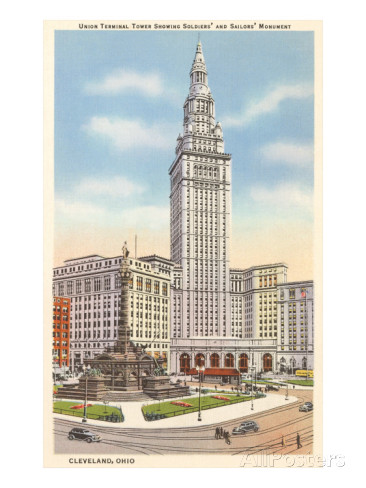
The symbol of Cleveland was the Terminal Tower—oh, how unfortunately symbolic!—on downtown’s Public Square. (You can catch glimpses of it in the movie A Christmas Story (1983), many of whose exteriors were shot in the area.) It was during those school years the largest building in the country outside of New York.  Underneath was a large concourse and the main rail passenger terminal for Northeastern Ohio.

When I graduated from high school in 1962, I marveled that so many of my classmates were leaving town. And, it turned out, never to return. By then blight had set in, the auto industry was beginning to tank, and many machine-related industries were moving to Asia. Worst of all, people were starting to laugh at Cleveland. The Cuyahoga River caught fire from the pollutants flowing downstream from the factories in the Flats, and one mayor—Ralph Locher—was photographed with his hair on fire when he refused to wear a hard hat when visiting a steel mill. Worst of all was Maynard G. Krebs (Bob Denver) on the “Dobie Gillis” show always going to see a film called The Monster That Devoured Cleveland.

Until the Cavs won the NBA championship this year, the records of local sports teams have been dismal. For a while, we even lost the Cleveland Browns NFL franchise, until they re-formed in 1999.

I wish Cleveland well, and I hope they survive this week’s political onslaught.


Serendipity: The Solitary Traveler

London’s Vauxhall Gardens in the 18th Century

London’s Vauxhall Gardens in the 18th Century

Here, straight from the 17th Century, is what I feel like during my travel. The source is Sir Richard Steele’s essay “A Ramble from Richmond to London”:

It is an inexpressible pleasure to know a little of the world and be of no character or significance in it.

To be ever unconcerned, and ever looking on new objects with an endless curiosity, is a delight known only to those who are turned for speculation: nay, they who enjoy it must value things only as they are the objects of speculation, without drawing any worldly advantage to themselves from them, but just as they are what contribute to their amusement, or the improvement of the mind.

In Praise of Old Cars

Cadillac El Dorado Dashboard

Cadillac El Dorado Dashboard

Martine and I drove to Oxnard today to pay a return visit to the Murphy Auto Museum. We began our trip with a big surprise. When we were there in April, Martine had left her Magellan cane seat in the rest room. After three months’ absence, a volunteer went into the back room, fetched it in a few seconds, and handed it over to Martine. We were both bowled over. That put our visit on a good footing from the word go.

Unlike the two major auto museums in L.A., the Murphy concentrates on American cars, many only 10 or 20 years old, that are beautifully restored and cared for, such as the metallic blue El Dorado from the above photo (I forget the model year) .

There was a special exhibit of vintage trailers, including a large Airstream and a small teardrop. It led me to dreaming about getting a small camper van for visiting desert campgrounds. (If only I had the money!) A number of the trailers were custom-made and manufactured from a variety of materials with varying degrees of professionalism.


Oh, No, Not Again!

Any Sort of Tragedy Brings These Termites Out of the Woodwork

Any Sort of Tragedy Brings These Termites Out of the Woodwork

Maybe it’s because I was raised a Catholic, but most public displays of prayer leave me cold. What is this thing about holding your arms out while emoting excessively? Is it to prove conclusively to God and to your fellow man that you do not have round-the-clock protection? And what’s all this mummery with candles and flowers and cutesy stuffed animals?

Perhaps I am disturbed by the similarity of that holding-out-one’s-arms prayer gesture to a fervent “Heil Hitler!”

Am I knocking prayer? Not at all. I believe in God, though in a somewhat heterodox manner; and I have even been known to pray. But my prayer is a private matter between the Creator and myself. I eschew all mummery, and I have no desire to prove myself holier than anyone else. (Which I certainly am not.)  Demonstrative public prayer is just … well … a form of showboating.

Whenever there is a terrorist act or a mass shooting or some horrendous accident, you will see them making some sort of pseudo-Evangelical religious demonstration. Our awful news media even likes to interview them—even though they have never had anything to say. It’s kind of like hiring an official mourner to keen for your loved ones. Can you wonder why I can’t stand to see how television reports “tragedies.”

“That Came to Pass This Also May”

Anglo-Saxon Court

Anglo-Saxon Court

This blog posting consists of three views of an Anglo-Saxon poem called “Deor.” First I suggest you click here to see the poem being recited aloud in the original language.

Next, here is Seamus Heaney’s translation of the poem in modern English:

Welund himself knew misery by worms.
The brave man knew hardship,
had to himself for company sorrow and longing,
winter-cold misery; He often found woe,
since Nithhad by force laid a thin sinew-bond onto the better man.

That came to pass, this also may!

Beadohilde was not as sorrowful from her brothers’ death
as from her own thing,
that she certainly understood that she was pregnant;
She was never able to think confidently,
about what she should do.

That came to pass, this also may!

We found out that for Maethhilde,
many became the bottomless embraces of the Geat,
that the sorrowful love deprived her of all sleep.

That came to pass, this also may!

Theodric possessed for thirty winters the city of Maeringa;
That was known to many.

That came to pass, this also may!

We discovered the wolfen thought of Ermanaricus;
He occupied widely the people of the kingdom of the Goths.
That was a harsh king.
Many a man lived bound to sorrows,
woe in expectation,
often wishing that this kingdom was overcome.

That came to pass, this also may!

He lived sorrowful, deprived of joy,
he grew dark in his spirit,
it seemed to him that the troubles would be endless.
I might then think that throughout this world the wise Lord changes enough,
shows honour to many a man, true splendor,
a portion of woes to some.

That I by myself wish to tell,
that I once was a scop of the Heodenings,
dear Lord.

The name ‘Deor’ was mine.

I had for many winters a good fellowship, a loyal lord,
until now Heorrenda, a man skilled in poetry,
received a privilege that the protecting lord once gave to me.

That came to pass, this also may!

Finally, here is the written poem in the original Anglo-Saxon:

Welund him be wurman    wræces cunnade.
Anhydig eorl    earfoþa dreag,
hæfde him to gesiþþe    sorge ond longaþ,
wintercealde wræce,    wean oft onfond,
siþþan hine Niðhad on    nede legde
swoncre seonobende    on syllan monn.
Þæs ofereode,    þisses swa mæg!
Beadohilde ne wæs    hyre broþra deaþ
on sefan swa sar    swa hyre sylfre þing:
þæt heo gearolice    ongieten hæfde
þæt heo eacen wæs—    æfre ne meahte
þriste geþencan,    hu ymb þæt sceolde.
Þæs ofereode,    þisses swa mæg!
We þæt Mæðhilde    monge gefrugnon
wurdon grundlease    Geates frige,
þæt hi seo sorglufu    slæp ealle binom.
Þæs ofereode,    þisses swa mæg!
Ðeodric ahte    þritig wintra
Mæringa burg—    þæt wæs monegum cuþ.
Þæs ofereode,    þisses swa mæg!
We geascodan    Eormanrices
wylfenne geþoht;    ahte wide folc
Gotena rices.    Þæt wæs grim cyning.
Sæt secg monig    sorgum gebunden,
wean on wenan,    wyscte geneahhe
þæt þæs cynerice    ofercumen wære.
Þæs ofereode,    þisses swa mæg!
Siteð sorgcearig    sælum bidæled,
on sefan sweorceð,    sylfum þinceð
þæt sy endeleas    earfoða dæl.
Mæg þonne geþencan    þæt geond þas woruld
witig dryhten    wendeþ geneahhe,
eorle monegum    are gesceawað,
wislicne blæd,    sumum weana dæl.
Þæt ic bi me sylfum    secgan wille,
þæt ic hwile wæs    Heodeninga scop,
dryhtne dyre.    Me wæs Deor noma.
Ahte ic fela wintra    folgað tilne,
holdne hlaford,    oþþæt Heorrenda nu,
leoðcræftig monn    londryht geþah,
þæt me eorla hleo    ær gesealde.
Þæs ofereode,    þisses swa mæg!

There are only two letters of the alphabet that are unfamiliar to most of us. There is the thorn (Þ), which is pronounced like the soft th in thick. Next is the edh (ð), pronounced like the hard th in then.

Notice how the poetic line is broken into two fragments, with the additional space indicating a pause.

After a while, the recurring refrain Þæs ofereode,    þisses swa mæg!—“That came to pass, this also may”stands out like the heart of Anglo-Saxon philosophy. The gentle fatalism of that refrain is one of the things we lost when Harold Godwinsson died at Hastings in 1066 with a Norman arrow in his eye.

I now know why Jorge Luis Borges was so intent on learning Anglo-Saxon towards the end of his life. It is a beautiful language and lends itself well to poetry.

Groovin’ at CAAM

Detail from Faith Ringgold’s Groovin’

Detail from Faith Ringgold’s “Groovin’”

The opening of the Expo Line from Santa Monica to Downtown Los Angeles has opened up a whole new world for me. Once or twice a week, I take the train downtown and explore the ethnic richness of the city center. Today, I went to the California African American Museum (CAAM) in Exposition Park.

I have always felt that African Americans have made an outsize contribution to our culture, especially in music, entertainment, and literature. CAAM gave me the opportunity to see a number of highly original artworks that are not “normally” seen by white people.

There are four galleries at CAAM, two large ones for the permanent collection and two smaller ones for rotating exhibits.

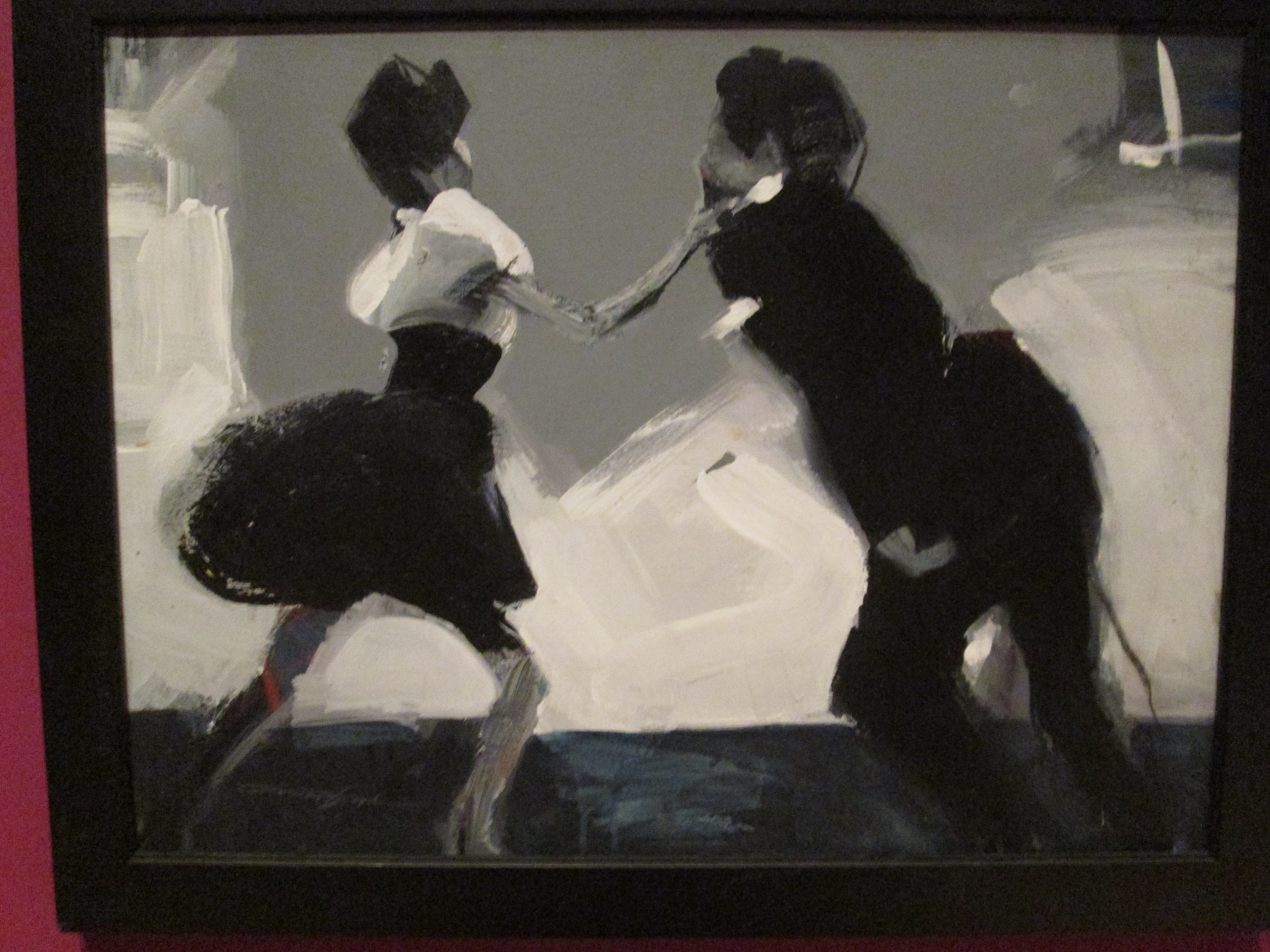
Dancers by Overton Loyd

Dancers by Overton Loyd

The rotating exhibits on view at present in the two smaller galleries are a retrospective of the works of Overton Loyd and an exhibition of hip hop photography by various artists.

Why did I choose two works showing dancers? It’s not that the exhibit was slanted toward them, but that I was drawn to them. Both paintings are intense, with the Ringgold’s slow rhythms and the abstract dynamism of the Loyd.

Although I profess not to live most modern art, there is something about the black artists who have struggled in obscurity to create beauty and meaning that appeals to me. I hope to check in at CAAM every once in a while to see what’s on exhibit.

(Not) In Praise of Education

My Classes Were Better Managed Than This

My Classes Were Better Managed Than This

From today’s Futility Closet posting comes this attack on education in the form of four quotes, three from England and one from Poland. I mention this because nothing I experienced was anywhere near as negative, despite the fact that I began my schooling speaking only Hungarian. Of course, everything I’ve read about an English Public School (really, Private School) education sounded rather like Dotheboys Hall in Dickens’s Nicholas Nickleby, with the possible addition of homosexual rape.

Anyway, here are the quotes:

“There is, on the whole, nothing on earth intended for innocent people so horrible as a school.” — George Bernard Shaw

“I sometimes think it would be better to drown children than to lock them up in present-day schools.” — Marie Curie

“Nearly 12 years of school … form not only the least agreeable, but the only barren and unhappy period of my life. … It was an unending spell of worries that did not then seem petty, of toil uncheered by fruition; a time of discomfort, restriction and purposeless monotony. … I would far rather have been apprenticed as a bricklayer’s mate, or run errands as a messenger boy, or helped my father to dress the front windows of a grocer’s shop. It would have been real; it would have been natural; it would have taught me more; and I should have done it much better.” — Winston Churchill

“Not one of you sitting round this table could run a fish-and-chip shop.” — Howard Florey, 1945 Nobel laureate in medicine, to the governing body of Queen’s College, Oxford, of which he was provost

The West Cork Flying Column

Military Re-Enactors at Old Fort MacArthur

Military Re-Enactors at Old Fort MacArthur

This year marks the 100th anniversary of the start of the Irish War of Independence. In April 1916 a group of volunteers took over the Dublin Post Office, were captured and executed by the British. Yesterday, I went by myself (Martine not feeling well) to the Old Fort MacArthur days in San Pedro.

Present was a group of military re-enactors modeled on the West Cork Flying Column commanded by Thomas Barry (as described in his excellent Guerilla Days in Ireland: A Personal Account of the Anglo-Irish War). I have run across this group before and admire their knowledge of their country’s history and their adherence to verisimilitude. Also, they have the best music by far of any group at the show.

The Irish War of Independence went on until December 1921 when the signing of the Anglo-Irish Treaty created the Irish Free State.

Serendipity: “Drowned Untimely”

Virginia Woolf (1882-1941)

Virginia Woolf (1882-1941)

I am currently reading (among other things) Virginia Woolf’s The Death of the Moth and Other Essays. In particular, I was drawn to the essay entitled “Street Haunting,” which contains a sustained reverie about Woolf’s walking the streets of London on a winter evening in search of a lead pencil. Following are a couple of paragraph’s about her visit to a second-hand bookstore, with its prophetic phrase about a poet “drowned untimely,” as the author was herself when, depressed by the onset of the Second World War, she filled her pockets with heavy stones and committed suicide by walking into the River Ouse near her home:

But here, none too soon, are the second-hand bookshops. Here we find anchorage in these thwarting currents of being; here we balance ourselves after the splendours and miseries of the streets. The very sight of the bookseller’s wife with her foot on the fender, sitting beside a good coal fire, screened from the door, is sobering and cheerful. She is never reading, or only the newspaper; her talk, when it leaves bookselling, which it does so gladly, is about hats; she likes a hat to be practical, she says, as well as pretty. 0 no, they don’t live at the shop; they live in Brixton; she must have a bit of green to look at. In summer a jar of flowers grown in her own garden is stood on the top of some dusty pile to enliven the shop. Books are everywhere; and always the same sense of adventure fills us. Second-hand books are wild books, homeless books; they have come together in vast flocks of variegated feather, and have a charm which the domesticated volumes of the library lack. Besides, in this random miscellaneous company we may rub against some complete stranger who will, with luck, turn into the best friend we have in the world. There is always a hope, as we reach down some grayish-white book from an upper shelf, directed by its air of shabbiness and desertion, of meeting here with a man who set out on horseback over a hundred years ago to explore the woollen market in the Midlands and Wales; an unknown traveller, who stayed at inns, drank his pint, noted pretty girls and serious customs, wrote it all down stiffly, laboriously for sheer love of it (the book was published at his own expense); was infinitely prosy, busy, and matter-of-fact, and so let flow in without his knowing it the very scent of hollyhocks and the hay together with such a portrait of himself as gives him forever a seat in the warm corner of the mind’s inglenook. One may buy him for eighteen pence now. He is marked three and sixpence, but the bookseller’s wife, seeing how shabby the covers are and how long the book has stood there since it was bought at some sale of a gentleman’s library in Suffolk, will let it go at that.

Thus, glancing round the bookshop, we make other such sudden capricious friendships with the unknown and the vanished whose only record is, for example, this little book of poems, so fairly printed, so finely engraved, too, with a portrait of the author. For he was a poet and drowned untimely, and his verse, mild as it is and formal and sententious, sends forth still a frail fluty sound like that of a piano organ played in some back street resignedly by an old Italian organ-grinder in a corduroy jacket. There are travellers, too, row upon row of them, still testifying, indomitable spinsters that they were, to the discomforts that they endured and the sunsets they admired in Greece when Queen Victoria was a girl. A tour in Cornwall with a visit to the tin mines was thought worthy of voluminous record. People went slowly up the Rhine and did portraits of each other in Indian ink, sitting reading on deck beside a coil of rope; they measured the pyramids; were lost to civilization for years; converted negroes in pestilential swamps. This packing up and going off, exploring deserts and catching fevers, settling in India for a lifetime, penetrating even to China and then returning to lead a parochial life at Edmonton, tumbles and tosses upon the dusty floor like an uneasy sea, so restless the English are, with the waves at their very door. The waters of travel and adventure seem to break upon little islands of serious effort and lifelong industry stood in jagged column upon the floor. In these piles of puce-bound volumes with gilt monograms on the back, thoughtful clergymen expound the gospels; scholars are to be heard with their hammers and their chisels chipping clear the ancient texts of Euripides and Aeschylus. Thinking, annotating, expounding goes on at a prodigious rate all around us and over everything, like a punctual, everlasting tide, washes the ancient sea of fiction. Innumerable volumes tell how Arthur loved Laura and they were separated and they were unhappy and then they met and they were happy ever after, as was the way when Victoria ruled these islands.

On Re-Reading

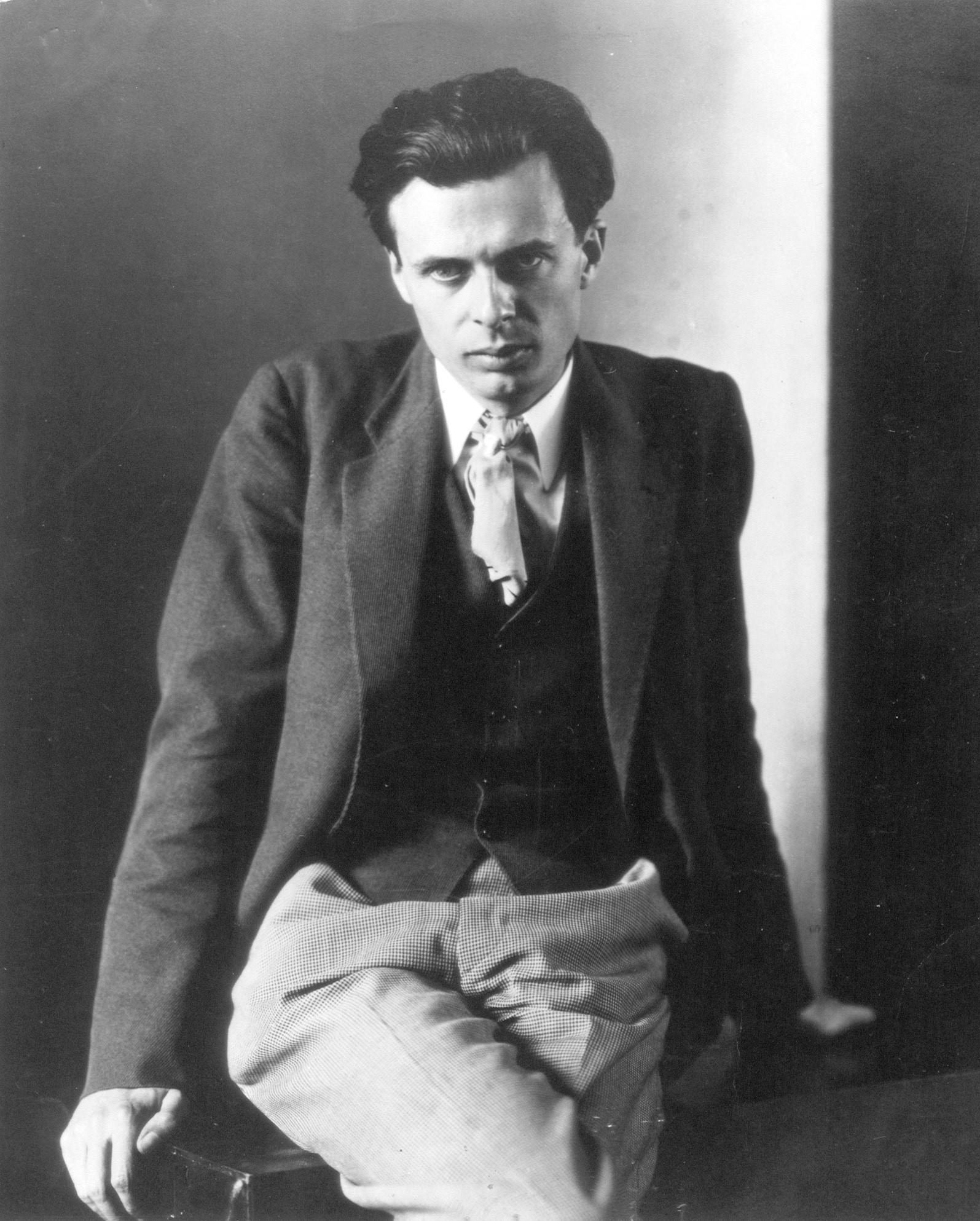
Aldous Huxley (1894-1963)

Aldous Huxley (1894-1963)

As Juan Vidal wrote for National Public Radio:

The best books are the ones that open further as time passes. But remember, it’s not because they changed. Every letter and punctuation mark is exactly where it always has been, and where it will remain forever. It’s you who are different; it’s you who’s been affected by the depth of your experience. And it’s you that has to grow and read and reread in order to better understand your friends.

I have just finished re-reading Aldous Huxley’s first novel, Crome Yellow, written in 1921 at the beginning of his career. In 1975, I was abashed by the romantic failures of Dennis Stone, the book’s narrator, with whom I identified because of my own experiences at that time. Now I see that Huxley not only was living through his own callow youth, but very neatly encapsulated for all time that obsessiveness with our own tactical failures can result in even more serious strategic failures in this life. Dennis fails with Anne Winbush, but his consciousness of failure prevents him from seeing Mary Bracegirdle, who is interested in him.

There are some books I re-read on a regular basis. Most notably: Marcel Proust’s In Search of Lost Time. I am now in my third reading of the seven-volume novel, and ready to start re-reading the third volume, The Guermantes Way. Then there are works like The Iliad and The Odyssey, Don Quixote, Dante’s Divine Comedy, Balzac’s Comédie Humaine, and any number of great books that I want to re-investigate because I have changed. To re-read is to measure that change.

When I was in my thirties, I loved Aldous Huxley and read many of his works. Now I think I’m about to check out his novels, stories, and essays again. The years have sped on, and we are all a work in progress.