The Venice Canals

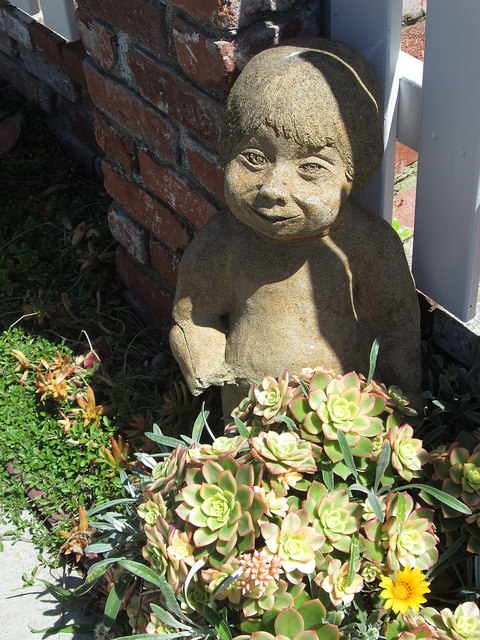
Garden Statue with Cacti

It being another beautiful day, Martine and I took a walk along the Venice Canals. The six remaining canals are what remains of Abbot Kinney’s original 1905 plan for the area. In addition to the vertical Grand Canal and the Eastern Canal, there are four horizontal canals that link them. To remember them, I use the mnemonic ScHLoCk—for Sherman, Howland, Linnie, and Carroll.

In the past, we would visit the area only around the holidays, especially Halloween and Christmas, to see the decorations. But suddenly, one year, the decorations all but disappeared. The area is interesting, nonetheless, because of the residents’ attempts to create gemlike little gardens and house fronts. There were more than a few vacancies and notices portending structural modifications. There are numerous types of succulents and flowering plants on display, and not a few architectural monstrosities, especially of the modern variety.

I have a feeling that the neighborhood can go either way at this point, either becoming a slightly disreputable slum or a major tourist draw. Most of the other walkers were speaking French and other foreign languages, so it is obviously hitting the European and Asian guidebooks. In any case, it’s a pleasant walk.

The Dominguez Rancho Adobe

The Main Building of the Dominguez Rancho Adobe

The same Spanish names are dotted all over the map of California, namely of the Spanish and Mexican land grants that were made before the United States occupied the state during the Mexican-American War. The oldest of these land grants was the Rancho San Pedro, granted to a retired Spanish soldier named Juan José Dominguez by Pedro Fages, Lieutenant Governor of California, in 1784.

When the armed forces of the United States occupied the state beginning in 1846, Rancho San Pedro was the scene of a battle between Californios loyal to Mexico and a poorly led American naval force under Captain William Mervine. The Americans were attempting to relieve the siege of Los Angeles by another Californio force and were driven back in disarray. The conflict is also known as the Battle of the Old Woman’s Gun.

The next time the Adobe enters history was in 1910, when the Rancho was the scene of the first national aviation meet in the United States. According to Wikipedia:

It is estimated that over a half-million passengers traveled by train to see this historic event. An open grandstand was erected that was more than six hundred feet in length. Use of the field was provided without rental charge by the Dominguez family, though the family asked to have front row seats for the entire event. Many of the early aviation pioneers were present, including the Wright brothers, Curtiss, Martin, Paulhan, and Willard. Roy Knabenshue flew in one of the very first blimps. The aviation meet lasted for 10 days, establishing the first speed and endurance records.

The first time Martine and I saw the Dominguez Rancho Adobe was in June 2010 at a celebration honoring the 100th anniversary of the the 1910 event.

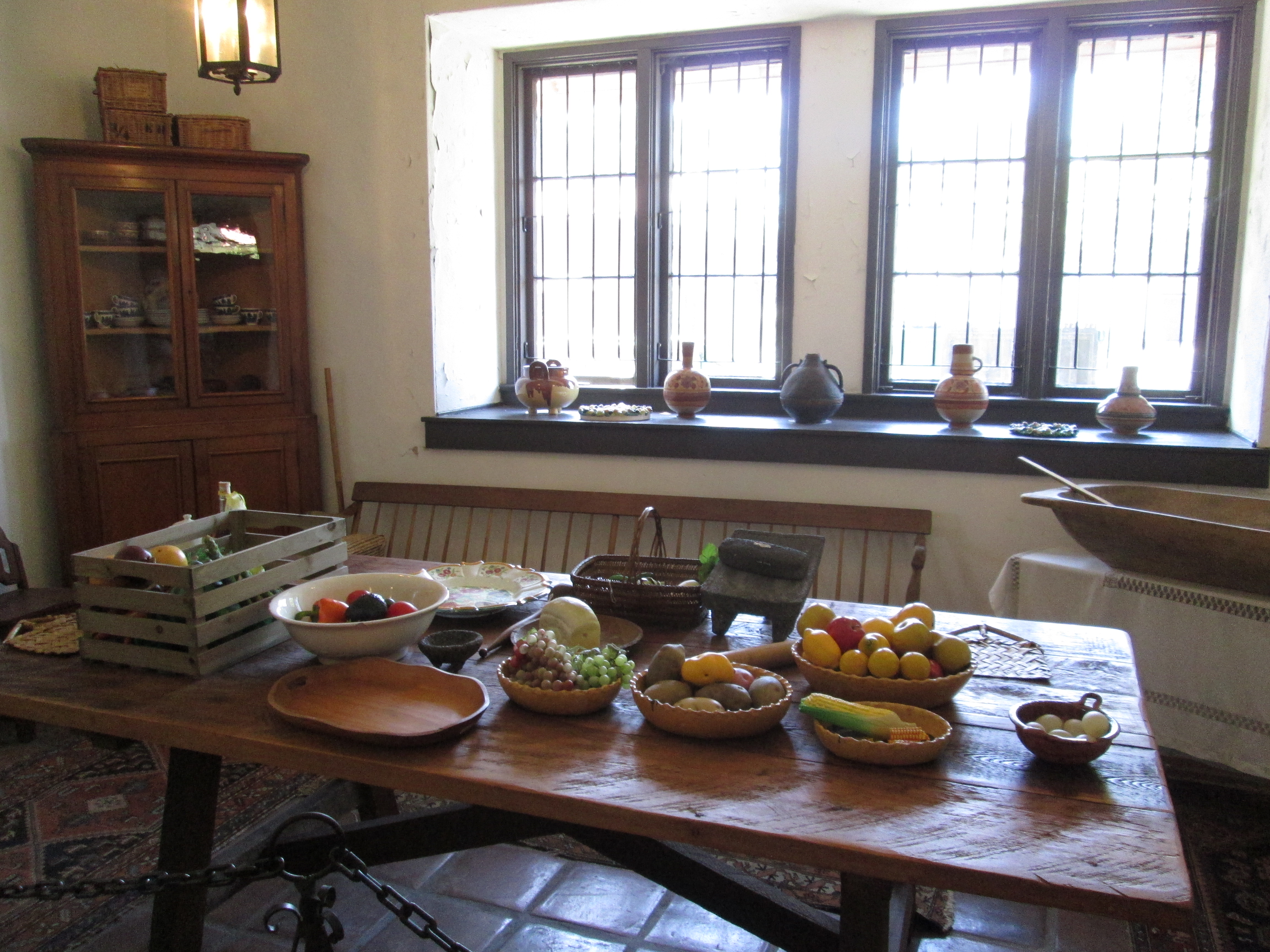
Today, the adobe was much more quiet. We were given an excellent tour by a docent. Many of the furnishings of the adobe building belonged to original members of the Dominguez family. When Manuel Dominguez, Juan José’s only surviving male heir, fathered six daughters, the names of Carson, Del Amo, and Watson, many of whose descendants are still extant.

The Adobe Kitchen

To perpetuate the Dominguez name, Manuel’s daughters in 1922 donated land to the Claretian Missionaries. Today, there is a two-story retirement home for Claretians on the premises. They are partly responsible for the attractive rose and cactus gardens on the premises. In the cactus garden, I even saw a cacao tree which was bearing fruit, similar to the ones my brother and I saw in Mindo, Ecuador in October 2016.

El Ombú

The Ombú Outside the La Biela Café in Buenos Aires’s Plaza Francia

One of the most spectacular trees to be encountered in Argentina is the Ombú. The one in the above picture is in front of my favorite Buenos Aires café, La Biela, where Jorge Luis Borges frequently dined with Adolfo Bioy-Casares. Also, it reminds me of the tree described by W. H. Hudson in his first story in Tales of the Pampas (1916):

IN ALL THIS DISTRICT, though you should go twenty leagues to this way and that, you will not find a tree as big as this ombú, standing solitary, where there is no house; therefore it is known to all as “the ombú,” as if but one existed; and the name of all this estate, which is now ownerless and ruined, is El Ombú. From one of the higher branches, if you can climb, you will see the lake of Chascomus, two thirds of a league away, from shore to shore, and the village on its banks. Even smaller things will you see on a clear day; perhaps a red line moving across the water—a flock of flamingos flying in their usual way. A great tree standing alone, with no house near it; only the old brick foundations of a house, so overgrown with grass and weeds that you have to look closely to find them. When I am out with my flock in the summer time, I often come here to sit in the shade. It is near the main road; travellers, droves of cattle, the diligence, and bullock-carts pass in sight. Sometimes, at noon, I find a traveller resting in the shade, and if he is not sleeping we talk and he tells me the news of that great world my eyes have never seen.

They say that sorrow and at last ruin comes upon the house on whose roof the shadow of the ombú tree falls; and on that house which now is not, the shadow of this tree came every summer day when the sun was low. They say, too, that those who sit much in the ombú shade become crazed. Perhaps, sir, the bone of my skull is thicker than in most men, since I have been accustomed to sit here all my life, and though now an old man I have not yet lost my reason. It is true that evil fortune came to the old house in the end; but into every door sorrow must enter—sorrow and death that comes to all men; and every house must fall at last.

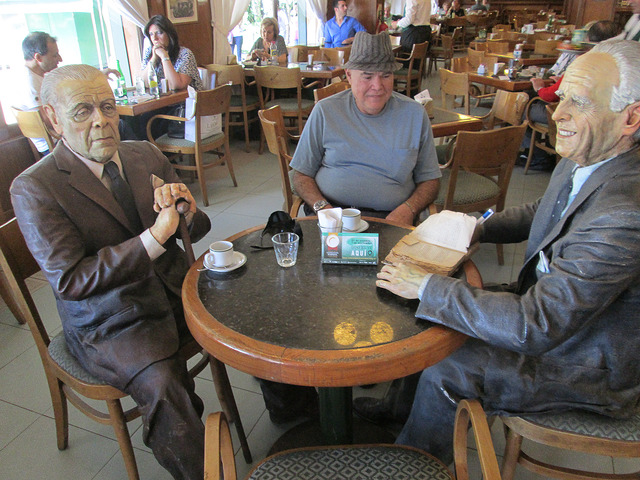
But my memories of this Ombú are all happy ones. I have eaten at the café there twice, both times having excellent meals. The first time was with Martine in 2011. In 2015, I met with my friend David Benesty there. Below is a picture of David sitting between Borges and Bioy-Casares at what was once their favorite table:

Jore Luis Borges, David Benesty, and Adolfo Bioy-Casares


I would love to go to La Biela again and have a cool bottle of Imperial beer on a hot Buenos Aires afternoon.


Handicap

Originally a Good Idea, Until the Abuses Started

I am writing this blog post at Martine’s behest. She frequently takes walks around the neighborhood and is disgusted by the large numbers of cars indicating a handicap driver, where neither the driver nor the passengers are in fact disabled. One of the problems of living in West Los Angeles or neighboring communities filled with people who feel themselves entitled to free parking. On some of her walks, up to 75% of the parked cars sport handicap placards. Only twice in the last few days has she actually seen disabled people emerge from those vehicles, one with a walker and the other with a cane.

There is something wrong with people who assume they are entitled to free parking because, well, they are special. It is easy to convince a physician to write a note giving them the right to purchase such a placard. From that point on, until the placard expires, they can park without paying for the privilege.

These same drivers frequently cut me off in traffic, whether I am driving or am a pedestrian. They frequently drive expensive cars such as Porsches, BMWs, Mercedes-Benzes, or—worst of all—Range Rovers.

If there is any single symbol of inequality in our society, it is a luxury car with a handicap placard when there is no disability involved. And yet there are whole parts of Southern California where many or most of the luxury cars sport the blue placard. Everlasting shame to them!

When I had severe osteoarthritis sixteen years or more ago, my orthopedist suggested that I get one. I refused, telling him that my habitual practice was to park far and walk, even though I was in excruciating pain. But then, even then, I walked several miles every weekend with Martine and my friends.

As actress Teri Garr once said: “When you hear the word ‘disabled,’ people immediately think about people who can’t walk or talk or do everything that people take for granted. Now, I take nothing for granted. But I find the real disability is people who can’t find joy in life and are bitter.” To which I add people who assume they are entitled to do whatever they want.

The Founding Fathers Weigh In

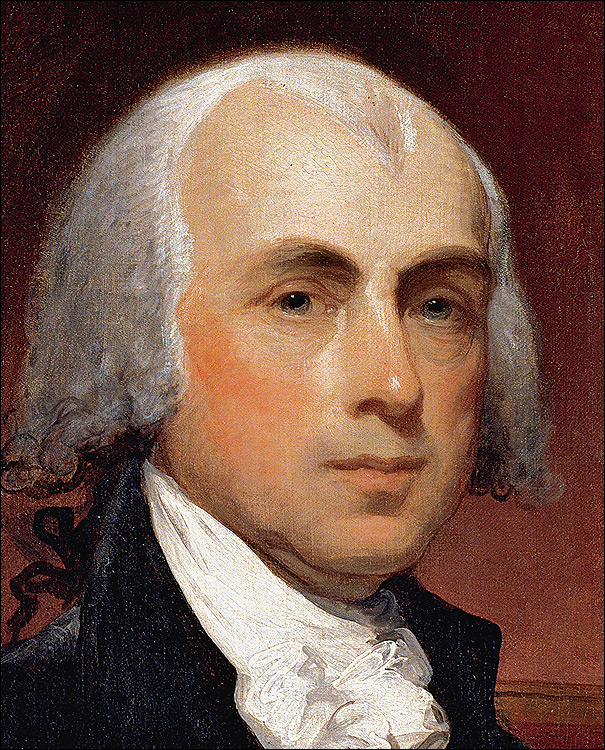
James Madison, Author of Federalist #10

I for one do not credit the Founding Fathers of this country with any supernatural intelligence or moral sense, but they have a way of surprising me from time to time. The following comes from #10 of the Federalist Papers, entitled “The Utility of the Union as a Safeguard Against Domestic Faction and Insurrection,” written by James Madison:

The latent causes of faction are thus sown in the nature of man; and we see them everywhere brought into different degrees of activity, according to the different circumstances of civil society. A zeal for different opinions concerning religion, concerning government, and many other points, as well of speculation as of practice; an attachment to different leaders ambitiously contending for pre-eminence and power; or to persons of other descriptions whose fortunes have been interesting to the human passions, have, in turn, divided mankind into parties, inflamed them with mutual animosity, and rendered them much more disposed to vex and oppress each other than to co-operate for their common good. So strong is this propensity of mankind to fall into mutual animosities, that where no substantial occasion presents itself, the most frivolous and fanciful distinctions have been sufficient to kindle their unfriendly passions and excite their most violent conflicts.

Further on, he continues:

If a faction consists of less than a majority, relief is supplied by the republican principle, which enables the majority to defeat its sinister views by regular vote. It may clog the administration, it may convulse the society; but it will be unable to execute and mask its violence under the forms of the Constitution. When a majority is included in a faction, the form of popular government, on the other hand, enables it to sacrifice to its ruling passion or interest both the public good and the rights of other citizens. To secure the public good and private rights against the danger of such a faction, and at the same time to preserve the spirit and the form of popular government, is then the great object to which our inquiries are directed. Let me add that it is the great desideratum by which this form of government can be rescued from the opprobrium under which it has so long labored, and be recommended to the esteem and adoption of mankind.

I am still uncertain whether our Republic can somehow purge the nefarious effects of a Trumpf administration with its lies, its prejudice against helping the majority of its citizens, and its flagrant self-aggrandizement and treason.

With luck, we will survive the current infestation. But only by the skin of our teeth.


The Fashion Police

In Quito, There Are Many Types of Police

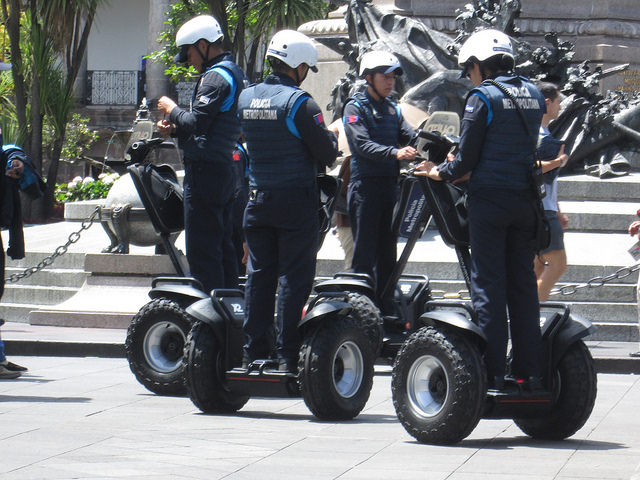
One thing that my brother and I noticed when we were in Quito, Ecuador, last October was that there are many different types of police. We sat in the central Plaza de Independencia for upwards of two hours, watching the different types of police congregate and go their separate ways, only to be replaced by policia with different uniforms and different means of locomotion. We were particular amused by the Segway patrol that mostly wheeled around chatting with one another.

At one point, as we were going by in a taxi, we noticed a number of heavily armed military escorting several male and female officers into the Municipal Palace. They seem to have arrived there without any major mishaps, like having a Segway run over their feet.

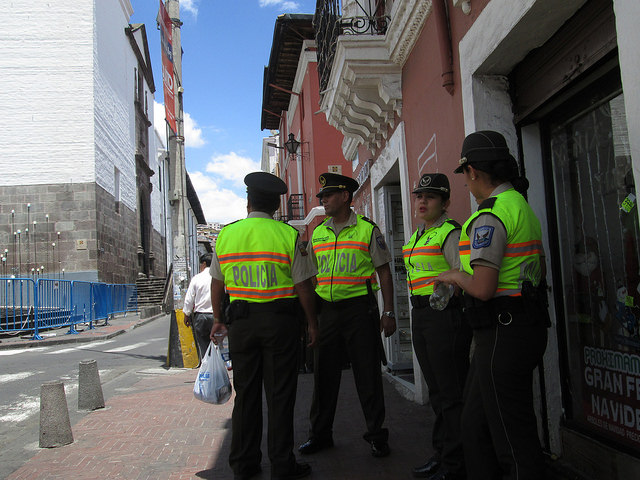
Just a few blocks away, there were four cops with bright yellow vests.

These Police Seemed to Be Guarding a Church (Rear Left)

All I could guess is that the creation of different government security forces was a form of mitigating the unemployment problem that seems to be endemic throughout South America.

Several times, we asked the police for directions. They were always very polite, even if they didn’t understand us. Fortunately, we didn’t look like bad guys; else, we would have been mobbed by policia wearing a variety of different uniforms. (It would have given them something to do for a change.)

A Shakespearean Tragedy

The House in Which Richard M. Nixon Was Born

Today Martine and I visited the Richard M. Nixon Library and Birthplace in Yorba Linda. It is a humble house that was built from a kit by Nixon’s father in 1912. Most of the furniture is original, including the bed in which Hannah Nixon gave birth to the 37th President of the United States. In keeping with that humility, within a few feet of the house’s rear entrance are the graves of Richard and Pat Nixon, who died within a year of each other.

There is no doubt that Nixon was a flawed man. Yet—at the same time—his list of accomplishments in office is impressive. He ended the unpopular war in Viet Nam. He ended the military draft. He was a staunch supporter of civil rights. His Title IX legislation made women’s sports at the collegiate level a major success. He courageously took it upon himself to re-open China to the West. He founded the Environmental Protection Agency (EPA). The list goes on and on.

Yet, despite his smashing victory over George McGovern in the 1972 election, he saw his opponents as a personal threat to him and initiated a burglary of the weakened Democratic National Committee in the Watergate Building. Like our current President, who also maintains an enemies list, Nixon was also a public servant who was intelligent and hard-working on behalf of the American People—which our current President is decidedly not.

The Grave Site of Richard M. Nixon

During the Sixties and Seventies, I was a determined enemy of Nixon. Now I am not so sure I feel that way. There was something about the man which could have made him our greatest political leader of this century. But he was all too human, and his life is like a Shakespearean tragedy of overwhelming promise and ambition brought down by an all-too-human flaw.

What Ever Became of Them?

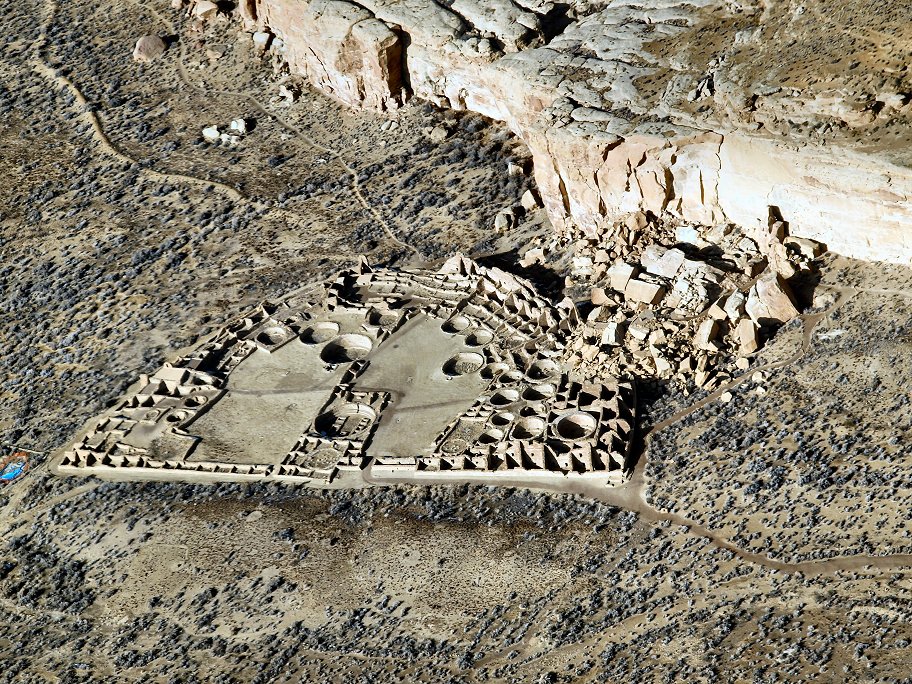
The Anasazi Ruins of Pueblo Bonito at Chaco Canyon

You’re familiar with the patter: These ancient people had an advanced civilization, and they suddenly disappeared. What ever happened to them? Actually, they didn’t go very far: You can find their descendants among the Hopi and the twenty-three tribes of Pueblo Indians in New Mexico, ranging from Taos to Acoma to Zuñi. What made them move from Chaco Canyon and the other Anasazi communities of the Four Corners, such as the ones at Mesa Verde, Betatakin, Chimney Rock, and Keet Seel? Some time around the 13th century, many of the local rivers dried up; and the Anasazi were forced to move.

I ran into the same type of “mystery journalism” in Mexico. What ever happened to the Mayans? These brilliant peoples inherited all those wonderful ruins such as the ones at Chichén Itzá and Uxmal—and now they’re all gone, or are they? All I know is that there are millions of Maya still inhabiting Yucatán, Chiapas, and much of Central America—and many of them still speak Mayan.

One of the reasons I want to go to New Mexico is to see Anasazi ruins. The best site is Chaco Canyon, of course, but I’ll be traveling this time with Martine, who doesn’t like long washboarded dirt roads and sleeping in campgrounds. So I will try to see some of the more peripheral Anasazi cities such as Chimney Rock, Salmon, or Aztec. (No, they are not related to the Aztecs of Mexico.)

No doubt I will be seeing thousands of Anasazi, or at least their descendants.


In the Right Place at the Right Time

This Overpass on SR 14 Collapsed in Both 1971 and 1994

Assembling California is the fourth volume of John McPhee’s geology tetralogy, the other volumes of which are Basin and Range, In Suspect Terrain, and Rising from the Plains. I delayed finishing the quartet because, as a California resident, I relished the enjoyment I would get from reading Assembling California. My only disappointment is that, being an Easterner, McPhee was mostly enthralled by Northern California, especially the area around I-80. Oh, well, it happens.

Assembling California is all about a fact that the geology, in its own way, replicates how the people of California came together from everywhere. So, too, did the pieces of rock that form the state migrate from all over the world and stick together—a process which will continue over millions of years to take the start apart just as it put it all together. Geologist Eldridge Moores writes:

People look upon the natural world as if all motions of the past had set the stage for us and were now frozen. They look out at a scene like this and think, It was all made for us—even if the San Andreas Fault is at their feet. To imagine that turmoil is in the past and somehow we are now in a more stable time seems to be a psychological need. Leonardo Seebler, of Lamont-Doherty, referred to it as the principle of least astonishment. As we have seen this fall, the time we’re in is just as active as the past. The time between events is long only with respect to a human lifetime.

I, for one, have been through two major quakes—the Sylmar Quake of 1971 and the North Hills Quake of 1994.

There are times when I stop and listen, waiting for the earth to rise up again and send me into paroxysms of terror. Whether I live or die will depend if “I am in the right place at the right time.” I can pretend that I will never experience another earthquake, but the chances are good that I will.

“Things Are Getting Dangerously Nutty!”

Berkeley Breathed Knows All About It!

There are a lot of ways at looking at America’s seemingly insoluble split down the middle between the Trumpites/Tea Partiers and the Liberals. Probably the healthiest approach is to take Opus’s point of view. It was that split that brought Berkeley Breathed, the creator of Bloom County, out of retirement. Today, his Facebook page is one of the sanest places on the Internet.

Does anyone knew where I can yet yellow and green briefs with smiley faces printed on them?