The Past Recaptured?

Hungarian Stuffed Cabbage with Rye Bread and Sour Cream

I do not have anything to say about Proust in this posting. Maybe I should have called it “You Can’t Go Home Again” or some such title. My earliest memories are about being raised in a Hungarian household in Cleveland by loving parents. I could not, would not ever repudiate that part of me; and I keep going in search of experiences that, like Proust’s madeleine bring back the happy memories of my childhood.

There used to be some good Hungarian restaurants in Los Angeles; but, as big a city as this is, there do not appear to be any at this time. So Martine and I show up at the local Hungarian Reformed Churches for their festivals. I go to recover my memories, and Martine goes because (although she is French) she loves Hungarian food more than any other.

Despite a rare May rain shower, we went to the Majális festival at the Grace Hungarian Reformed Church in Reseda. We have been going here for almost ten years. Even within that short time, we have seen the parishioner base age as the old Hungarians die off and the younger ones spread out to the four winds. Still, the food is excellent. Their stuffed cabbage is superb, and their baked goods are world class.
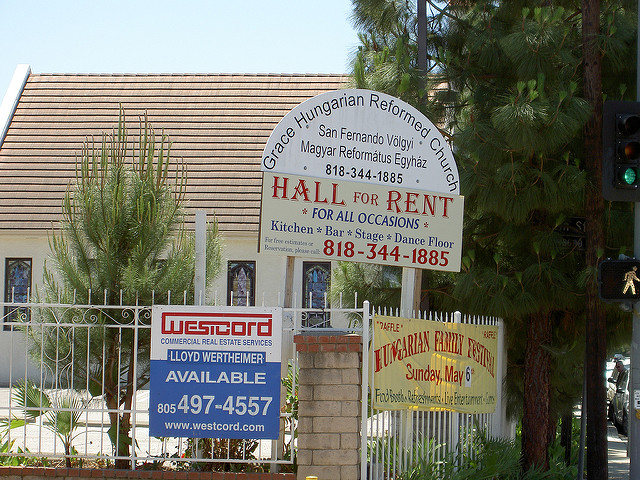
The Grace Hungarian Reformed Church as It Looked Several Years Ago

Their pastor is still Zsolt Jakabffy, who keeps soldiering away at maintaining a parish amid the rapidly changing demographics of the San Fernando Valley.

Wait a minute! What’s a Catholic boy like me doing hanging out at a Protestant church? It all goes back to when my Catholic father and my Protestant Reformatus mother made before their children were born. Any boys would be brought up as Catholic; any girls, as Protestant. Just my mother’s luck that she gave birth to two sons.

So, yes, I have no compunction looking for God wherever He is invoked.


Seen From Above

Poet and Naturalist Loren Eiseley (1907-1977)

It is a well-known fact that there are probably half a dozen writers that you have been urging your friends to read … with no success. My own personal failure in this regard is with the works of Loren Eiseley. Perhaps as a scientist, he is a little too out of date; but the fact that he is also a poet makes everything I have read by him almost numinous. Here, for example, is a poem called “The Condor”:

The Condor

The great bird moves its feathers on the air
like fingers playing on an instrument,
the instrument of wind; it climbs and scarcely moves
while steady thermals push
its giant wings still higher till it soars
beyond my sight completely, though it peers
through strange red eyes
upon my face below.
Its kind is dying from the earth; its wings
create a foolish envy among men.
Its shadow knew the mammoth and he passed,
floated above the sabertooth, now gone,
saw the first spearmen on the bison’s track,
banked sharply, went its way alone.
Its eyes are larger than its searching brain;
the creature sees like a satellite,
but exists within
an ice-world now dead. This bird cannot
understand rifles, multiply its eggs,
one hidden on a cliff face all it has.
Its shadow is now passing from the earth
just as the mammoth’s shadow at high noon.
Something has gone with each of them, the sky
is out of balance with the tipping poles.
No huge, tusked beast is marching with the ice,
no aerial shadow tracks the passing years.
Only below the haze grows deeper still,
only the buildings edge up through the murk.
Planes fly, and sometimes crash, but no black wing will write
the end of man, as man’s end should be written
by all the condor wings beneath high heaven.

I have seen Andean condors in Peru at Colca Canyon. They were rising and falling in the thermals hundreds of feet at a time.

Unutterably Alien

Arkady (1925-1991) and Boris (1933-2012) Strugatsky, the World’s Greatest Sci-Fi Writers

There is something about these two Russian brothers: They wrote the simply most incredible science fiction novels. I am thinking particularly of Roadside Picnic (Пикник на обочине), writen in 1972. At some time in the past, parts of Earth were visited by one or more bands of interstellar travelers. They left their mark on the places they have stayed—in strange, unaccountable ways. Nowhere is there a description of the visitors: no one alive has ever seen them. But the laws of matter and energy don’t seem to work there any more.

The novel was turned into a film by fellow Russian Andrei Tarkovsky in 1979. The film was called Stalker, and it was one of the greatest films produced anywhere in that decade. The film so influenced Geoff Dyer that he wrote a book in 2012 called Zona about his memories of the movie.

Scene from Tarkovsky’s Stalker

This is some powerful stuff. Those two brothers had some freaky visions that could so influence so many follow-on works. I am currently reading one of their earlier works, Space Apprentice (Стажеры) (1962). It’s not quite the level of Roadside Picnic, but it is fascinating.

While we’re on the subject of Eastern European sci-fi writers, I thought I’d put in a word for Poland’s Stanisław Lem , author of Eden (1959). In that novel, the earthling explorers go to a strange new world, where they are ignored. The protagonists can make nothing whatsoever of the local inhabitants.

Walking Into History

The Original House of the Seven Gables

I have been looking back at some of my older digital pictures. The first vacation I took with a digital camera was to Massachusetts, New Hampshire, Vermont, and a little piece of Maine in the fall of 2005. Although I had been there before, none of my destinations struck me the way Salem did. Not only for its history of witchcraft, though there was plenty there. Not only for its literary history, what with Nathaniel Hawthorne’s Customs House and the actual House of the Seven Gables. And not only for its Federalist architecture, what with whole streets with houses built before 1800. Probably what struck me about Salem was the density of its historical sights, almost as if I were in parts of London or Paris.

There was no doubt about it: Salem, Massachusetts, played an outsize role in American history.  Its ships ranged the seas to China, as shown in the Peabody Essex Museum. In fact, I found it to be better than Boston for its highly concentrated slice of early American history.

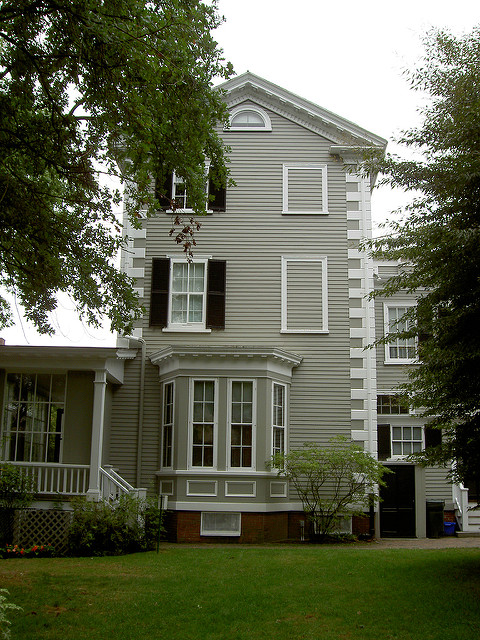
Federalist Era House in Salem

Only a short train ride from Boston, I found Salem to be a better place to base oneself than Boston. And a whole lot less crowded! There seems to be several hundred colleges in the Boston area, and the students always seemed to be using the same public transit that Martine and I were.

The Original Farmer’s Market

Mickey Jacobs of The Bread Bin (Closed in 2008)

Today, I went to the original Farmer’s Market at 3rd and Fairfax with my 88-year-old neighbor Luis. We had lunch at Moishe’s, which has delicious lamb shish-kabobs. I could not help remembering that some of my first digital pictures were taken at the Market with my old Kodak in July 2006. Hunting up my photo library on Flickr, I saw the above picture of Mickey Jacobs, proprietor of the Bread Bin. This was Martine’s favorite stop the times we went there: She loved to see me talk in Hungarian to Mickey, who had some delicious pastries. Unfortunately, Mickey sold his business two years later; and his replacement was not quite up to snuff.

Still, the original Farmer’s Market is a great place to go. Even on a Wednesday, it was full of tourists, looking for good food, fresh meats and produce, and souvenirs. They also used to have a bookstore and even antiques, but they are no more. What there are are a lot of good places to eat and relatively few vacancies. With all that foot traffic, if you open a decent place, you are bound to have a successful business.

Cherries at the Farmer’s Market

It’s still too early for cherries by a few weeks, but it won’t be long now. The above picture was taken in July 2008, at the height of their season.

I plan to visit the Farmer’s Market as much as once a week to have a good lunch and to hole up with a good book for a few hours. I know a place on the second floor where I can eat and read without getting trampled by all the foot traffic.

My Los Angeles

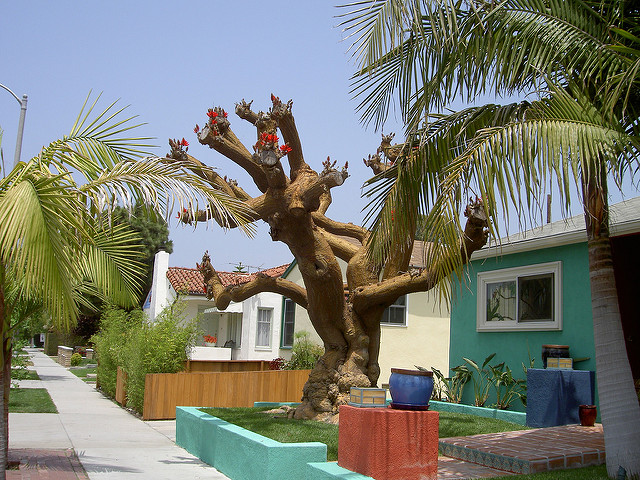
Tree on Ocean Avenue in Venice

I guess that by now I’m officially an Angeleno. It was late in December 1966 that I took a train to arrive at L.A.’s Union Station and was met by former neighbors from Cleveland, Ohio. It was the first time I had ever been west of Chicago, so all I saw was new to me. All that pastel stucco instead of the sooty red brick of Northeastern Ohio. The plants were all different. The climate was strange. Even the people were somewhat odd. Fortunately, I was rooming on Sunset Boulevard with a friend from Dartmouth College days, with whom I am still a close friend.

Mind you, I did not take to the place at once. For years, I thought of myself as an Easterner. It was only by slow degrees that the light of Southern California, with those beautiful sunsets over the Pacific, started to work a sea change in me. There were some things that repulsed me. Numero Uno: Earthquakes. The Sylmar quake of 1971 hurled me out of my bed and scared the stuffing out of me. Last night, while I was recording a Max Ophüls film—The Earrings of Madame de … (1953)—on videotape, I felt a sharp jolt. Even after all these years, I felt a moment of terror. Should I run for the bedroom hallway, where I would be safe from falling building parts? Should I just shrug my shoulders? I opted to go to bed.

Martine is even more nonchalant about temblors than I am—probably because she never felt one of the big ones, such as the ones in 1971 and 1994. Ah, well, she’ll learn!

I still don’t think much of L.A. drivers. They tend to be lazy about following the law, such as signalling lane changes and crashing red lights and stop signs. But then, it could be that way in most other big cities, too. I seem to remember not liking to drive in Miami, Calgary or Las Vegas either.

Some things I really like about Los Angeles are:

  • The food. California looks South (Latin America) and West (Asia) for its cuisine.
  • The politics. As a determined Trumpf-hater I feel in good company in this very Blue State.
  • The mountains. There are some mountains in Los Angeles County that are 10,000 feet high, a far cry flat flat Ohio.
  • The deserts. So we don’t get much rain, but the deserts of the Southwest are beautiful, so long as you don’t make the mistake of visiting them at the wrong time.
  • The coast. Driving along the Pacific can be gorgeous, especially in the early morning before the Beemer bozos get out of bed.

You’ll notice that I didn’t mention the weather. I’ve never liked really hot weather: And every year we get about 20 days of horrendously torrid weather. Fortunately, Martine and I live only two miles inland from the coast, so we can usually catch a few breezes, but not always.

Betty, Veronica, and Racism in America

One Can Learn a Lot from These Two Young Women

Both Women Were Equally AttractiveI came back to my apartment early this afternoon while Martine was watching The Courtship of Eddie’s Father (1963) on TCM starring Glenn Ford, Dina Merrill, and Stella Stevens. The two latter stars are in competition with each other to marry Glenn, who is the father of Eddie (played by Ron Howard), his son from an earlier marriage. It is Stella, the blonde, who wins, while the raven-haired Dina ends up sucking a mop in left field.

The film made me think of the Archie comic books I used to read in my youth. In these comics, the blonde Betty is pitted against the dark-haired Veronica for Archie’s affections and, not coincidentally, ours. I seem to remember that my sympathies were with Betty, and probably intended by the cartoonist to be so. There is something of the Dragon Lady about Veronica.

Both Women Were Equally Attractive

I grew up thinking that blondes were more beautiful. After all, there were Marilyn Monroe, Scarlett Johansson, Dominique Sanda, Brigitte Bardot, Uma Thurman, Grace Kelly, and Catherine Deneuve—not to mention several hundred others. It was only later that I fell for brunettes like Nastassja Kinski and Natalia Tolokonnikova of the Russian rock group Pussy Riot.

But for the longest time, I was in love with golden-haired beauties. I cannot help but wonder whether it was a subtle form of racism implicit in the dichotomy between Betty and Veronica. Thank God, now I think all kinds of women are beautiful, even the green ones shown on the old Star Trek show. Fortunately, I have not become fixated exclusively on the green ones, because else I would be desperately lonely.

Green Women Can Be Nice…