Chinatown

Exterior of Chinatown’s Hong Kong BBQ at Night

This being Thursday, I visited the Central Library at 5th and Flower Streets, then took the Dash B bus to Chinatown. The last several times I’ve been downtown, I headed to Chinatown and dined at the Hong Kong BBQ Restaurant. Their Spicy Fish Filet with Black Bean Sauce and their Spicy Eggplant with Fish Fillet make for a great lunch. So great that I wasn’t able to finish my dinner.

L.A.’s Chinatown actually shares billing with Vietnamese and Thai restaurants. I always look for the little old lady sitting on the sidewalk who sells a bag of fresh limes for a dollar. There are numerous shops selling Chinese lacquerware, statuary, jewelry, clothing, and other goods.

I used to cook Chinese more frequently than I do now. It’s not great to eat white rice on a regular basis if one is diabetic. So I splurge occasionally and hope the damage is minimal. Maybe the fish fillet makes up for the carbs in the rice.

Things have not always run smoothly with the Chinese population in L.A. In 1871, there was a race riot directed at the Chinese in which about twenty Chinese were hanged from lampposts by a mob of some 500 Angelenos. Not one of the members of the mob lost their lives or served time for their misdeeds. It was probably the ugliest race incident in Southern California’s history, except, of course, what we did to the Indians.


French Noir? Obscurité Française?

Still from Jean-Pierre Melville’s Le Samouraï (1967)

It sounds a bit odd to talk about French noir literature and films, mainly because noir is a French word. Perhaps I should be talking about Obscurité Française. This afternoon, I watched a work of that master of French noir, Jean-Pierre Melville. His film Le Samouraï is a masterpiece, both in its spare visual style and its typical noir attributes. Alain Delon as Jef Costello, the hit man, is a pleasure to watch, as is François Périer, the police superintendent, who goes all out to arrest Jef based on his belief that his alibi would not hold up.

Melville has made other excellent noir films as well, including Bob le Flambeur (1956) and Le Doulos (1963). But Le Samouraï is his best by far.

In addition to noir films, the French are no strangers to noir fiction. Yesterday, I read Three to Kill (1976) by the late Jean-Patrick Manchette (1942-1995), who also wrote Fatale (1977) and Ivory Pearl (1996), the latter of which was unfinished. I am also interested in reading works by Boris Vian (1920-1959), author of I Spit On Your Graves (1946).

The United States has an embarrassment of riches in the genre, starting with Raymond Chandler and Dashiell Hammett, and continuing with David Goodis, Cornell Woolrich, James M. Cain, Mickey Spillane, Charles Willeford, Jim Thompson, Dorothy B. Hughes, Kenneth Fearing, W. R. Burnett, and a host of others. They are one of the joys of recent American literature which I have been taking advantage of during this long, hot summer.


The Deserts of This Earth

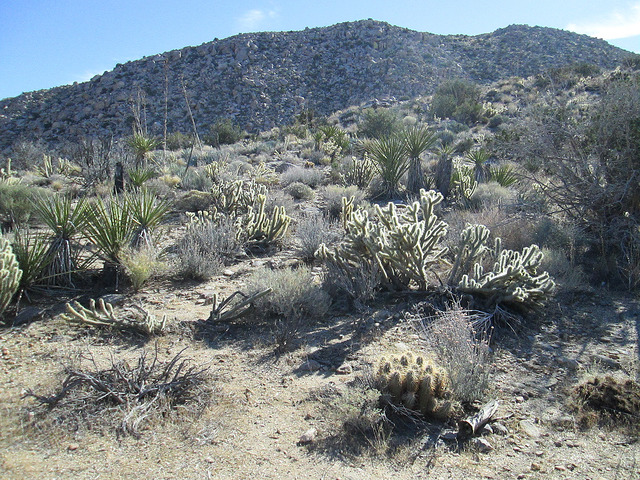
Hillside with Cholla Cactus in the Anza-Borrego Desert

California has a number of distinct desert zones, ranging from Death Valley in Inyo County to the Mohave Desert around I-15 and I-40 along the route to Las Vegas and Northern Arizona to the Anza-Borrego Desert east of San Diego. My friend Bill also tells me about the Carrizo Plain National Monument, which also seems to be a desert, one which I have not yet visited. And undoubtedly there are several I am not taking into account.

One thing they all have in common: Don’t go there in the summer if you don’t want to die of discomfort and have your car stranded on some obscure untraveled highway. In the winter, on the other hand, the desert is lovely and beguiling. Do you see those cholla cactuses in the center of the above photo? When the sun shines through their barbed needles, they look positively huggable. But don’t even try! If you brush against cholla spines, they will stick to your skin and your clothing, and you will have the devil’s own time disposing of them.

During the spring, you are likely to see that every inch of the rough desert surface seems to be covered with tiny wildflowers. The efflorescence lasts only a few weeks, and you have to time your visit carefully and call locals to see if it’s happened yet. And it generally happens only after a wet rainy season. We haven’t had many of those lately.

Because California is on the ring of fire, you can occasionally find natural hot springs in which you can bathe. There is one such in Anza-Borrego on County Road S-2 south of Scissors Crossing. To get there, one passes by the old Butterfield Stage Route; and you can even stop at one of the Butterfield Stage stations which has been restored to its 19th century glory.

When it’s too cold to go the beach, consider the desert.


La Politique des Auteurs

Cahiers du Cinema: The French Film Journal That Started It All

I find now that yesterday’s post took a lot for granted. One can’t just float a concept like the auteur theory and expect to be understood. When I first got into films at Dartmouth College, I was influenced by a French monthly called Cahiers du Cinema, and by the work of an American film critic writing for the Village Voice named Andrew Sarris, who tried to translate the French critics’ ideas into the American idiom. For Film Culture magazine (Winter 1962/1963), he wrote a long article entitled “Notes on the Auteur Theory in 1962.” I photocopied his article and kept it with me for years, until he turned it into a book in 1968 entitled The American Cinema: Directors and Directions 1929-1968.

The whole issue of the auteur theory is simple: If the cinema is an art form, then who is the artist in the cinema? Is it the producer? No, he’s mostly just a money man. Is it the film studio? Again, their major concern is money. Is it the writer, the actors, the director of photography, the editor? No times four. They just do what they’re told to do. The auteur theory elevated the director to the role of the artist. When the director is a studio hack, the result can be entertaining, but is rarely great. Yesterday, I wrote:

Why did I not go to the movies this year? Simply put, I remain an auteurist; and there were few films this year made by the directors whose work I follow. I am not interested in the films of William Seiter, Norman Panama, Archie Mayo, George Archainbaud, Alan Crosland, Alfred L. Werker, and any number of studio hacks who never signed their names to a great film. They were for the most part competent film makers whose work was light and entertaining; but I was after bigger game.

Now thye French considered Jerry Lewis to be an auteur, a true film artist. His films after he parted with Dean Martin are usually directed by him in a consistent and very competent way. You may not think that Jerry Lewis is a film artist, but he fits the idea the French have of the immature American male—like it or not.
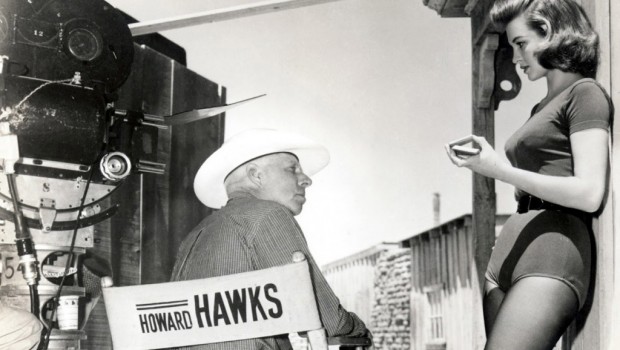
Director Howard Hawks with Angie Dickinson on the Set of Rio Bravo (1958)

So who are the great film auteurs? There are almost as many lists as there are film critics. I remembered long discussions with my fellow film freaks in the late 1960s as to who was great and who wasn’t: I called the activity “trading bubble gum cards.”

Here is Andrew Sarris’s auteur pantheon:

  • Charles Chaplin
  • Robert Flaherty (he wouldn’t make my list)
  • John Ford
  • D. W. Griffith
  • Howard Hawks
  • Alfred Hitchcock
  • Buster Keaton (though he didn’t sign his name as director)
  • Fritz Lang
  • Ernst Lubitsch
  • F. W. Murnau
  • Max Ophüls
  • Jean Renoir
  • Josef von Sternberg
  • Orson Welles

A few of the names are predominantly European directors who also made several films in America (like Murnau, Ophüls, and Renoir).

Everything Changes

Try to Get Your Kids Interested in This!

This year for the first time in many years I have not attended the films at Cinecon. I did, however, go with Martine to the memorabilia dealers’ rooms. In the past, when my friend Norman Witty was alive, Martine enjoyed acting as his assistant; and she made a number of friendships with the other dealers. So while she chatted with her old friends and acquaintances, I found a comfortable chair and read a book. Also I devoted some time to thinking about what was happening to the dealers and members of Cinecon.

In short, they were getting older and passing on. I saw few people under the age of sixty at the dealers’ tables.

Why did I not go to the movies this year? Simply put, I remain an auteurist; and there were few films this year made by the directors whose work I follow. I am not interested in the films of William Seiter, Norman Panama, Archie Mayo, George Archainbaud, Alan Crosland, Alfred L. Werker, and any number of studio hacks who never signed their names to a great film. They were for the most part competent film makers whose work was light and entertaining; but I was after bigger game.

Then I thought,“Wait a sec! How many auteurists are around these days?” The answer is: damned few, and fewer every year. Instead people go to see superhero films intended for very young males, starring powerful guys and gals who like to wear their Underoos over their street clothes. Then there are the numerous independent productions, about the problems of young people who are altogether too full of themselves. What do I care about Hipster man with his man-bun and immaculately trimmed beard and all his digital toys?

Many of my posts have not been kind to the younger generation—mostly because the things they value are nothing to me, and the things I value, nothing to them. For how long will Cinecon be around to commemorate films of the 1920s and 1930s? I mean, people, we are talking about films that are not even in color!

After my generation leaves the scene, many whole worlds will disappear as if in a puff of cosmic dust.