Don’t Forget to Vote!

Fill Those Booths Tomorrow! No Excuses!

If you fail to vote tomorrow, I hope it’s because you are a Trump supporter. For anyone else—and that includes the majority of Americans—the man and his minions are a stench in the nostrils. If you fail to vote because you were (a) hung over, (b) busy playing computer games, (c) studying for an exam, or (d) turned off by politics … then you have no cause … ever again … for complaint. You have failed in your primary duty as a citizen. Your very right to vote is in question, as witness the Republican anti-democratic voter suppression in Kansas and Georgia.

I know you have heard a lot about this election, and you’ve probably been turned off by everything you’ve heard. So what! I’m the guy who ends calls from political volunteers with a few choice swear words and hangs up. I do not care to discuss my political choices with what might turn out to be corporate shills hired by the Koch brothers or other disruptive forces.

This “Prickly City” Cartoon by Scott Stantis Appeared in Today’s L.A. Times

Although I suspect he might be a Republican, I feel that cartoonist Scott Stantis is a Republican of the non-#$&!!@# variety. I have seen his thought evolve over the years to the extent that I cannot pass a day without reading his cartoons. Even if the characters in the above cartoon are right, and I suspect they are, there is too much of a danger of electing the Wrong nincompoops, like those Tea Party jerks who have caused so much damage to the country that I still love for all its wrong turns.

Vote. Be in charge. Stay in charge. And make the effort to stay in charge!


Outliers: James Castle of Idaho

Outlier Artist James Castle (1899-1977)

When I look at the recent history of art in, say, the last hundred years, I see a host of reputations I would like to see toppled. Enough of the Mondrians, the de Koonings, the Pollockses, the Rothkos, and their ilk! That’s why I am interested in exploring the outliers, who explored the boundaries of art without trapping themselves in some movemen such as abstract expressionism.

Today, I look at James Charles Castle of Garden Valley, Idaho. According to the Wikipedia entry on him:

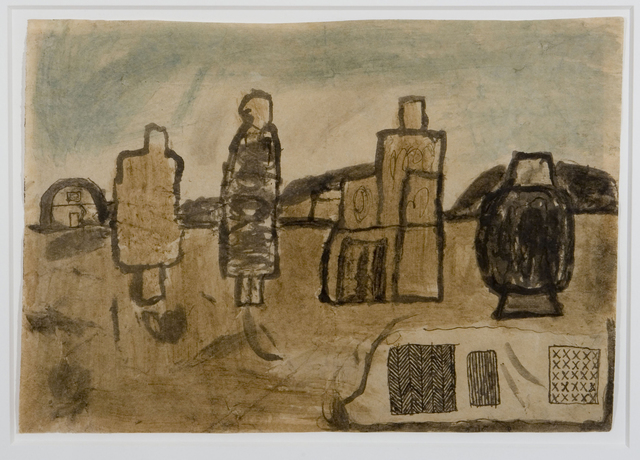
Castle was a self-taught artist who created drawings, assemblage and books throughout his lifetime. Castle was born profoundly deaf and for at least some time attended the Gooding School for the Deaf and the Blind in Gooding, Idaho, but it is not known to what extent he could read, write, or use sign language. Castle’s artworks were created almost exclusively with found materials such as papers salvaged from common packaging and mail, in addition to food containers of all types. Castle mixed ink using soot from the woodstove and saliva and applied it with tools of his own making, including sharpened sticks, and other found objects. His drawings sensitively depict interiors, buildings, animals, landscapes and people based on his family’s rural Garden Valley homestead as well as the architecture and landscapes of the places he lived and visited.

Homestead

Like many of Castle’s works, the above obviously used a folded sheet of paper that had come his way with a tear toward the lower right corner. Created as it is of spit, soot, and found paper, it beautifully balances shapes and tones.

Artsy

Even when his own work approaches the abstract, Castle manages to make the viewer stop and think. What is this? A tree, a person, a skyscraper, a computer printer—all drawn at the same scale? And what of those geometric designs in the lower right corner? And the picture is in the form, basically, of a horizontal landscape.


100 Years Old Today

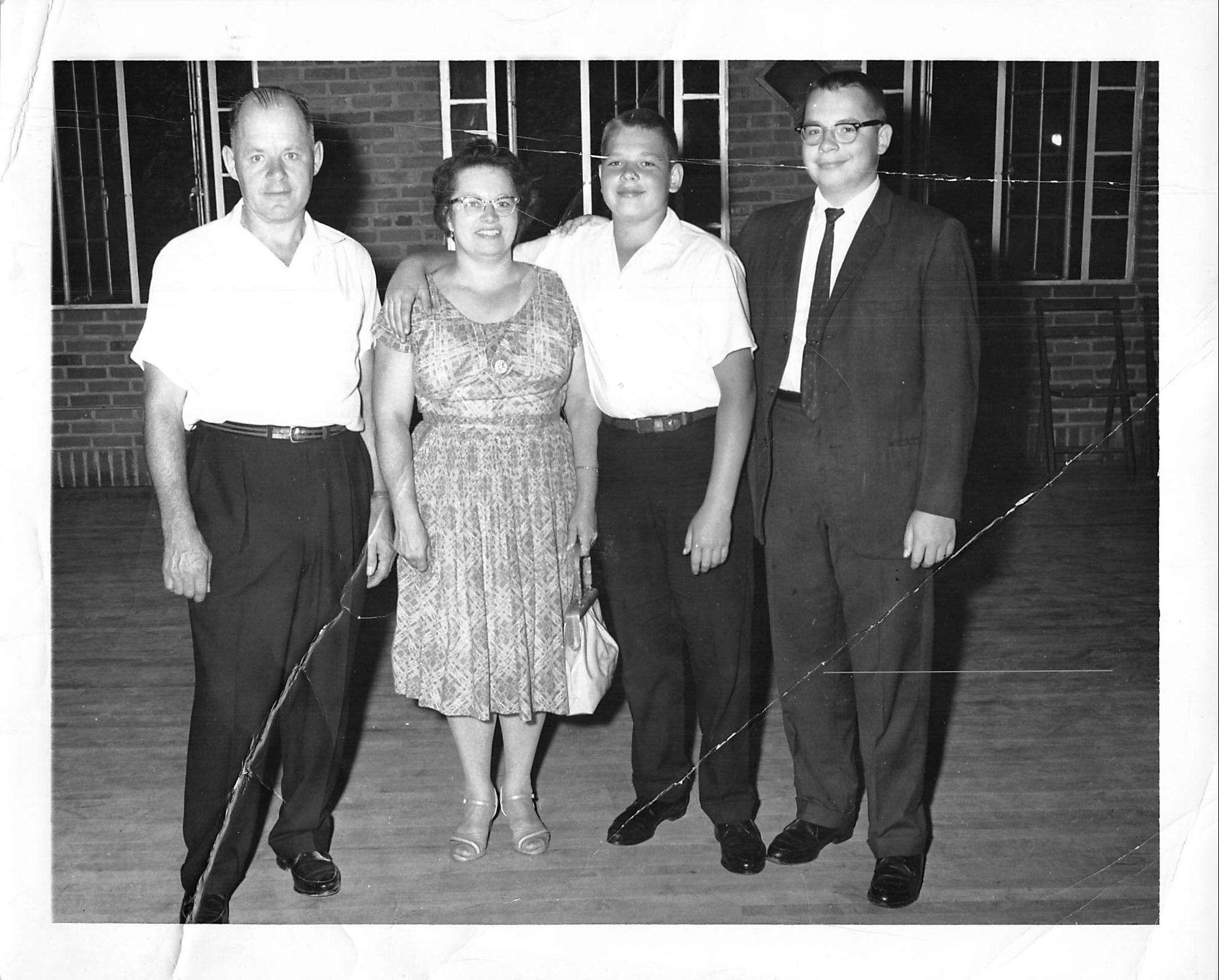
The Paris Family in the Early 1960s

If my mother were alive, today would be her 100th birthday. Unfortunately, she didn’t make it to her 80th birthday. In August 1998, shortly after she hung up after my usual Saturday morning call to her, she pitched forward upon getting up from her phoneside chair, hemorrhaged, and died immediately. Within a couple of hours, my brother and I both knew what had happened. Dan was living only a few miles west of Kings Beach, CA on the north shore of Lake Tahoe at the time. She didn’t answer the phone when he called her, so he sent a neighbor to investigate, and he found her body.

Sophie (or Zsófi) Paris born in Cleveland, Ohio and raised by her grandparents, Daniel and Lidia Toth, who gave up on the United States and took her back to their farm in Felcsut, Hungary. But when the specter of Hitler was beginning to loom, they returned to Cleveland in 1937 on the Queen Mary. There, she met my father, Alex (or Elek) around 1943. Despite the opposition of her grandparents, she married him in 1944 and became pregnant with me. My brother Dan came along in April 1951.

My mother wise incredibly street savvy. She applied for jobs for which she was not qualified, stating on the applications that she was a graduate of the University of Hakapeszik in Budapest, Hungary. Now “Hakapeszik” is another way of saying “The School of Hard Knocks,” or “If one gets his hands on some food, one eats” in literal translation.

She worked as a supermarket checker, a woolen mill, a manufacturer of earphones for pilots (the Rola Company), and eventually an assistant occupational therapist working in a hospital for the terminally ill. She was a wonderful cook and a good-hearted person. She did, however, break a number of wooden spoons on my recalcitrant butt when necessary. At the same time, she was incredibly kind and made friends easily. She was also wise. To this day, I consult her usual practice before making any big decisions. If Sophie wouldn’t have gone for it, neither would I.


Dia de los Muertos

Dia de Los Muertos Celebrants at Cabot’s Museum in Desert Hot Springs

In the Catholic liturgy, today is All Souls’ Day, which the Mexican culture has enriched with its Dia de los Muertos, the Day of the Dead. The Mexican feast day is much healthier than our own Halloween: Families go to the cemeteries with a picnic lunch, which they eat by the grave of their loved ones. Years ago, I was on a bus between Mazatlán and Durango on November 2 with a number of villagers headed to celebrate. The bus was full, so I helped a young mother hold her baby from time to time as she tended to her other children.

We see death as an embarrassment, some kind of failure. Too bad, because we all die; and that death is part and parcel of our lives. We deny it at our own risk, because when we least expect it, to springs out like a jack-in-the-box and catches us all unawares. One of the strengths of Mexican culture—and I believe there are many—is that people do not try to sweep the inevitable under the rug.

The Tzompantli, or Skull Rack, at Chichen Itza

The Aztecs and Maya used to fight wars among themselves and their neighbors for the sole purpose of capturing prisoners who were sacrificed to the gods. At Chichen Itza, there was a large platform called the Tzompantli, or Skull Rack, to hold a pyramid of skulls of these sacrificial victims. There were a number of grisly rituals connected with these sacrifices, such as cutting out the heart of victims with an obsidian knife and kicking the body down the pyramid steps, skinning the victims and having the priests wear the skins. There was even some cannibalism. Eventually, with the Spanish invasion, these rituals were suppressed; but the celebration of life’s fragility became a part of the culture.

Maybe this is what Trumpf is afraid of by these “invasions” from Latin America. He’s afraid for his own head, perhaps. They can have it.


Why New Cars Tend to Look Alike

Maybe You Can Personalize Your License Plate

When my cousin Ilona visited me from Communist Hungary in 1974, she marveled at how our car models were so differentiated from one another. There was even more variation in color. The Ladas, Skodas, Zhigulis, Tatras, and Trabants of her own country struck her as comparatively grim.

Well, times have changed. Now most new cars from Japan, Europe, and the United States resemble one another more than they differ. There even seem to be fewer colors. Even my 2018 Subaru Forester, which I love, has a hard time competing with my old 1994 Nissan Pathfinder in terms of styling.

You can see this video from CNET on the top five reasons why new cars look alike. (It blames most of the changes on the survival of pedestrians who are hit head on.) Writing for the Mother Nature Network, Jim Motavalli adduces several other reasons as well. These are, in no particular order:

  • Government requirements relating to fuel economy mean that all cars try to wring every bit of aerodynamic efficiency possible
  • This means very uniform front ends ending in what CNET calls a “Mrs. Doubtfire” boxy butt
  • Big door pillars protect drivers and passengers when the car rolls
  • In most cars, you feel as if you were sitting in a bunker due to higher door sills and smaller windows, especially along the sides
  • It is possible that, in future, aerodynamic efficiency will involve the loss of outside rear-view mirrors (I certainly hope not)

Cars do seem safer today, and I am rather fond of having 100% all-wheel drive on my Subaru.