California Dreaming

Condos Reflected on Venice’s Grand Canal

Today, as I was driving to a history discussion group, I saw huge crowds of tourists lurking around Beverly Hills and perched on countless tourist buses. It is interesting to see that so many young people from elsewhere are interested in Los Angeles. Even if what they are interested in is mostly garbage: The shops on Rodeo Drive and the Hollywood Walk of Fame.

But there is something about this place. Believe it or not, it’s the light. But you have to be receptive to visual nuances, something not quite as crass as a Gucci Bag or a star honoring the career of Rod La Rocque. And you have to be up early in the morning, or be around at dusk. Noon is just plain achingly bright.

The funny thing is that you don’t see much of what L.A. is about by visiting Universal City or Disneyland or even the La Brea Tar Pits. You can get something of a feel for it when you see the Getty Center or the Arboretum or Descanso Gardens or the Huntington Gardens and Art Museum. But you have to be still and let the light play over you. The more frenzied your touring is, the less you’ll get out of it.

Hell, it took me years before I could even see this place as it should be seen.


Among the Ruins of Christianity

A Room in the Archbishop’s Palace in Lima, Peru

I started my travels in 1975 with an interest in ancient civilizations. Then, I found myself also visiting the ruins of a much more recent civilization—our own. It reached its apogee in Peru. I was definitely interested in the Inca, but I found the remnants of Christianity in Peru to be even more interesting. Lima in particular was a treasure house of ecclesiastical art, not only in the cathedral and the main churches, but also in the archbishop’s palace, which is just as interesting.

For some reason, I was particularly interested in the depiction of angels in the New World. These were not the hermaphroditic or epicene angels of the mother country, but images of masculine strength that obviously owed something to the images of supernatural beings among the Incas.

Image of Angel in Lima’s Cathedral

The angel in the above picture appears to be driving a spear into some unformed material, like clay. There is a look of determination on the angel’s face as well as a feeling of strength. Most of the statuary and art in the churches were actually done by Peruvians, and not transshipped from Europe.

Statue of Angel in the Museo de Las Conceptas in Cuenca, Ecuador

I saw the above statue in the Museo de Las Conceptas in a former convent in Cuenca. He is another one of those militant angels of South America, and one who is in the middle of overcoming a demon. Cuenca has two religious museums. One is the former cathedral on the main square, and the other is in the former convent.

If you find yourself visiting Latin America, you will find some interesting bits of our own history as it has been adapted and modified by the converted natives. Perhaps the most extreme example of this is among the highland Mayans of Chiapas. I don’t have any pictures for you, because I was warned against even taking my camera to Chamula. Some European tourists were killed by the Chamulas by taking photos in the church. My brother and I did see the church. There were statues of Christ, the Virgin, and various saints, but they were covered with stalks of corn. In place of pews, there was a large open space, where the Chamulas lie face down on the floor with arms outstretched, surrounded by lit candles.

As you can see, going to church is a part of my visits to Latin America.


Die, Hipster! Die!

E-Scooters Are Almost a Necessary Condition

Every generation has its own prototypical brand of foolishness. When I was in my twenties, the hippies were in fashion. Unkempt beards. Long scraggly hair. Tie-died T-shirts. Passing joints back and forth.

Was I ever a hippie? Not on your life. My hair was a little longer and less white than it is now, but I haven’t changed much.

Next came the Gen-Xers and the Yuppies. I never was one of those either. After all, my goal in life was not to become a pathetic meme of some sort.

Now the hipsters are in bloom. They are everywhere. Beards are back, but now they are compulsively neat, possibly accompanied by a man-bun. In my part of L.A., they tend toward black T-shirts and pants, with neon-colored Smurf shoes. And there are those damnable e-scooters. As we may remember, the one thing people in their twenties know is that it will be many decades before they have to think about their demise. And, naturally, they do everything they can to bring about that demise by riding at fifteen miles an hour without a helmet, riding on streets, bike paths, sidewalks, wherever they damned well please.

Martine has been close to being run down by hipsters riding their silent electric-powered scooters on the sidewalk and not warning pedestrians of their presence. In general, about half the population are dead-set against these scooting hipsters. Check out the Bird Graveyard @ Instagram for pictures and videos of people—most of them young people—destroying the Bird and Lime scooters that infest West Los Angeles. Several of the videos show nasty falls injuring the riders.

Many cities have taken to banning the devices, or at the very least studying the legal implications of allowing them to take over the streets and sidewalks.


TBR

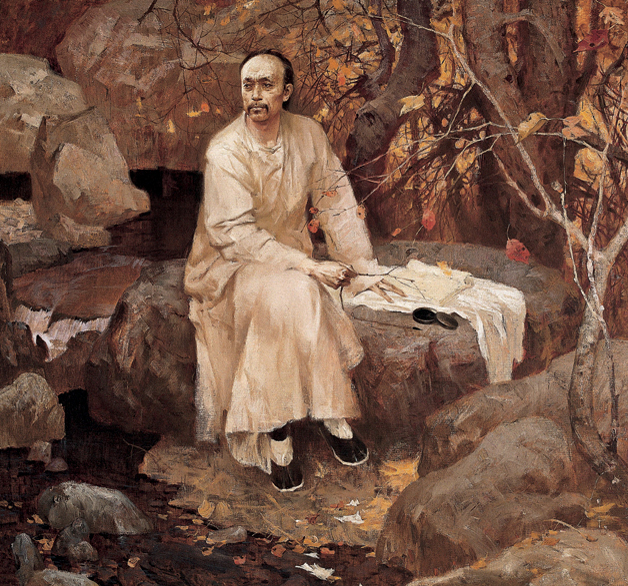
Chinese Author Cao Xueqin (1715-1763)

TBR is a real bookworm’s term: It’s an acronym for To Be Read. We all have our TBR piles. Here is a look at mine, consisting mostly of Asian classics (some of which are multi-volume) and various Medieval and Ancient Greek and Roman classics. Here are some 22 classics which I will attempt, in my own desultory fashion, to read while I am able:

  • Anonymous, The Mahabharata (India)
  • Giovanni Boccaccio, The Decameron (Italy)
  • Hermann Broch, The Sleepwalkers (Austria)
  • Cao Xueqin, The Dream of the Red Chamber (aka The Story of the Stone) (China)
  • Geoffrey Chaucer, The Canterbury Tales (England)
  • Fyodor Dostoyevsky, A Raw Youth (aka The Adolescent) (Russia)
  • Ralph Ellison, The Invisible Man (USA)
  • William Faulkner, A Fable (USA)
  • Gunter Grass, The Tin Drum (Germany)
  • João Guimarães Rosa, The Devil to Pay in the Backlands (Brazil)
  • Henry James, The Bostonians (USA)
  • Kalidasa, The Shakuntala (India)
  • Yasunari Kawabata, The Sound of the Mountain (Japan)
  • Lucretius, On the Nature of Things (Ancient Rome)
  • Michel Eyquem de Montaigne, Complete Essays (France)
  • Shikibu Murasaki, The Tale of Genji (Japan)
  • Robert Musil, The Man Without Qualities (Germany)
  • Ovid, Metamorphoses (Ancient Rome)
  • Plato, The Republic (Ancient Greece)
  • Alexander Pushkin, Eugene Onegin (Russia)
  • Salman Rushdie, Midnight’s Children (India)
  • Valmiki, Ramayana (India)

Some of the above works are major; others are relatively minor. The Faulkner and Dostoyevsky, for instance, are there only because they are the only novels by the two authors I have not read. I have already picked up a copy of Henry James’s The Bostonians to read next month.


Flying in the Andes

Actually, It’s Anything But Tame

I have flown over the Andes on several airlines: LAN, Avianca, Star Peru, Copa, and TAME. Because we don’t often think about South America, we don’t realize that the Andes are every bit as high, in general, as the Himalayas. I say “in general” because our method of measuring altitude is in flux, largely because the ocean level is in flux due to global warming. If we measure a mountain’s altitude from a point at the center of the earth, the highest mountain on the planet is Chimborazo in Ecuador. That is due primarily to a bulge in the earth around the equator which in effect elevates mountains atop that bulge.

In the past, I used to be disturbed by air turbulence. Now, with all the vacations in South America, I see turbulence as a sign that I am nearing my destination. Virtually all flights from Los Angeles to Lima, Quito, Santiago, or Buenos Aires involve a diagonal path over a chunk of the Andes. This usually takes place in the middle of the night, so I don’t get a chance to see the snowcapped peaks over which we are flying.

That plane in the picture was the plane I flew from Cuenca in the south of Ecuador to Quito. My brother had left a week or so earlier (also on a TAME prop plane), so we had returned the rental car to the Cuenca office of the rental company. I explored a bit on my own, taking a bus to Alausi to take a fascinating train ride; and I also visited a whole lot of museums in Cuenca. There are a zillion museums in Latin America, and most of them are fun even when there are no signs in English.

For my next trip to South America, I hope to fly to Bolivia and return via Buenos Aires. There’s a lot to see in between, even if I have to take a connecting flight part of the way.


American Cuisine? No Thanks!

Burger and Fries … and Fries and Burgers

As I grow older, I realize more and more how different I am from most Americans. Politically, I have re-defined myself as independent of the two major political parties, and totally uninterested in the minor ones. Racially, I no longer consider myself to be white—ever since I have become so disgusted with misbehaving whites in the Trumpf era. (As a Hungarian, I consider myself to be of Other Race, namely Finno-Ugric, the language family to which the Hungarian language belongs, originating in the borderlands between Europe and Asia.) Now I find myself disliking most American food. At those times I am forced to eat at an American restaurant, I am usually lucky if I can finish 30% of my meal.

I make an exception in the case of the foods of the American South and Southwest. And I like Italian, Latin American, Asian, African, and Middle Eastern foods. And I still love Hungarian food, if I can find any! But don’t offer me a burger and fries. Been there. Done that. Am finished with it once and for all.

That has led to some problems with Martine. Most of the time, she likes to eat stuff I don’t like, such as burgers, pot roast, fried chicken, and mashed potatoes. I will indulge her on weekends when we go out to eat, but I don’t make much of a dent in what is served to me. And no Cokes or Pepsis, please, just iced black tea without chemical additives. In the end, I make sure she gets what she wants, but she is frightened that I am becoming a vegetarian of the Indian Subcontinent variety.

During the last six weeks, Martine has had major digestive issues, so that I have concentrated on improving my vegetarian curries. And I have done so substantially, to an extent that alarms my little French girl. I suspect that we shall come to some sort of agreement in the end, even if I have to cook some foods I am not interested in tasting.

Outliers: Rick Bartow, Mad River Wiyot

Deer Spirit by Rick Bartow (1946-2016)

Today, Martine and I visited the Autry National Center, which was putting on a show of the late American Indian painter and sculptor, Rick Bartow, entitled “Things You Know But Cannot Explain.” I was enthralled by Bartow’s vision of people and the wild animals whose spirits have invaded them. A member of the Mad River Band of Wiyot Indians, Bartow  lived much of his life around Newport, Oregon.

The deer spirit illustrated above is typical of Bartow’s depiction of human verging on totemic animal. Another is the drawing that gave its name to the show:

“Things You Know But Cannot Explain”

Note the face seeming to emerge from the upper right behind the foreground figure, who appears to be paralyzed with fright. Much more traditional is the drawing of three hawks below.

“Three Hawks”

I may not have a drop of Native American blood in me, but I am always delighted to see creative depictions of animals I consider to be my own personal totems, among whom I include the coyote, the raven, and the bear. Because I live at the edge of the desert and Bartow lived in the wet forests of the north, he did not depict my other totems, the frog and the turtle, both of whom I associate with life-giving rain.

Some of Bartow’s most impressive works are his sculptures. Perhaps I will do another posting on those later on. They are usually formed of wood, nails, and various found objects.

At a time when much of the art work is ruled by abstract expressionist garbage, I find Rick Bartow to be rooted in an ancient tradition that manages to speak to me today.


The Old Man of the Mountain

Max and Dave Fleischer Were the Opposite of Disney

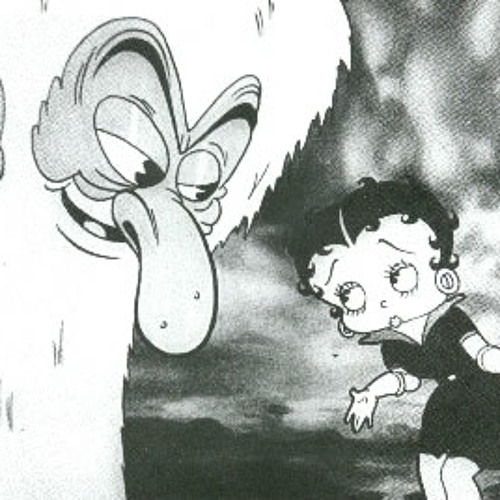
Walt Disney was good at what he tried to do, but he was not really for adults. At the same time that Disney was animating his Mickey Mouse cartoons, Max and Dave Fleischer presented a much more adult vision of life in their Betty Boop cartoons. These were done before the Hays Office descended on Hollywood with their black pall of censorship. Yesterday, I watched their “The Old Man of the Mountain” on YouTube. It is about a luscious young thing who goes up against the Old Man of the Mountain (sung by Cab Calloway and His Orchestra) and starts getting chased by him. At one point, he rips off her dress, though all we see of Betty is the lower edge of her frilly panties as she hides behind a tree. (Holy Miscegenation!)

Watch the cartoon for yourself:

In another Boop mcartoon, Betty attempts to perform a tooth extraction on Koko the Clown. By accident, she winds up infecting the whole town with Laughing Gas. The cartoon, entitled “Ha! Ha! Ha!” was banned in Britain because of its casualness about drugs. In another cartoon, “Betty Boop’s Big Boss,” Betty appears to endorse the mauling of secretaries as sexual provender by big fat bosses. You can see these cartoons for free any time by Googling their titles, as in “YouTube Ha! Ha! Ha! Betty Boop.”

I actually like Walt Disney’s work, but I think Betty Boop is pretty hot stuff. At one point in “The Old Man of the Mountain,” a cripple on crutches espies Betty’s curvaceous legs, gives them a thorough viewing, and then leaves without his crutches, which go off by themselves.

“Dinosauria, We”

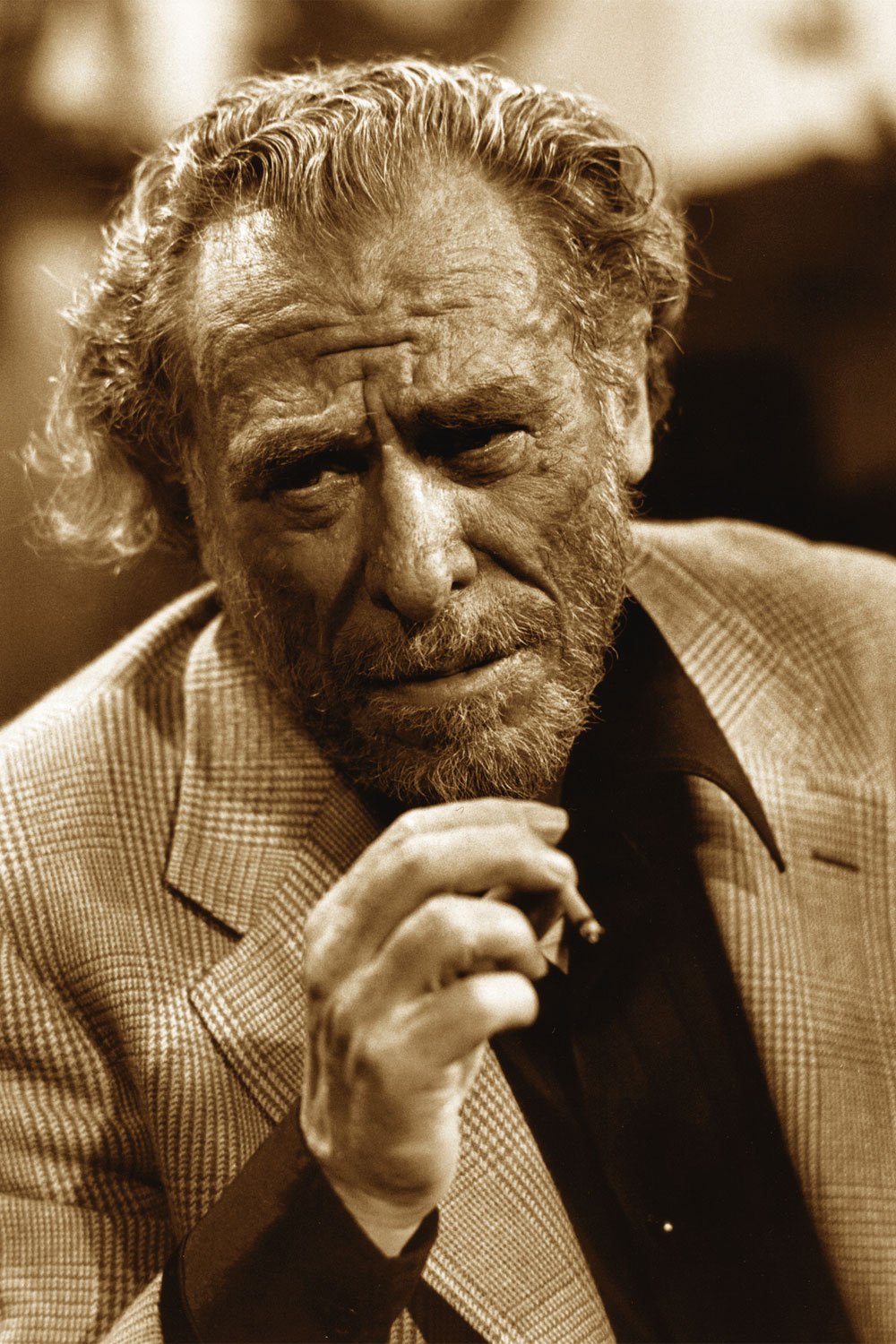
L.A. Poet Charles Bukowski (1920-1994)

Today I watched a DVD about the life and career of Charles Bukowski, the greatest poet to come from Los Angeles (though by way of Andernach, Germany). The more I read Bukowski, the more I think he is the true successor to Walt Whitman. He may not be a great stylist, but his poems cut to the quick. By the way, the film is called Bukowski: Born Into This (2003), and that’s where I got the idea to present that poem here. The name of the poem is “Dinosauria, We”:

Dinosauria, We

Born like this
Into this
As the chalk faces smile
As Mrs. Death laughs
As the elevators break
As political landscapes dissolve
As the supermarket bag boy holds a college degree
As the oily fish spit out their oily prey
As the sun is masked
We are
Born like this
Into this
Into these carefully mad wars
Into the sight of broken factory windows of emptiness
Into bars where people no longer speak to each other
Into fist fights that end as shootings and knifings
Born into this
Into hospitals which are so expensive that it’s cheaper to die
Into lawyers who charge so much it’s cheaper to plead guilty
Into a country where the jails are full and the madhouses closed
Into a place where the masses elevate fools into rich heroes
Born into this
Walking and living through this
Dying because of this
Muted because of this
Castrated
Debauched
Disinherited
Because of this
Fooled by this
Used by this
Pissed on by this
Made crazy and sick by this
Made violent
Made inhuman
By this
The heart is blackened
The fingers reach for the throat
The gun
The knife
The bomb
The fingers reach toward an unresponsive god
The fingers reach for the bottle
The pill
The powder
We are born into this sorrowful deadliness
We are born into a government 60 years in debt
That soon will be unable to even pay the interest on that debt
And the banks will burn
Money will be useless
There will be open and unpunished murder in the streets
It will be guns and roving mobs
Land will be useless
Food will become a diminishing return
Nuclear power will be taken over by the many
Explosions will continually shake the earth
Radiated robot men will stalk each other
The rich and the chosen will watch from space platforms
Dante’s Inferno will be made to look like a children’s playground
The sun will not be seen and it will always be night
Trees will die
All vegetation will die
Radiated men will eat the flesh of radiated men
The sea will be poisoned
The lakes and rivers will vanish
Rain will be the new gold
The rotting bodies of men and animals will stink in the dark wind
The last few survivors will be overtaken by new and hideous diseases
And the space platforms will be destroyed by attrition
The petering out of supplies
The natural effect of general decay
And there will be the most beautiful silence never heard
Born out of that.
The sun still hidden there
Awaiting the next chapter.

La Guerra de la Sed

Translation: “The War of Thirst”

Paraguay has given the world two horrendous wars over the last two centuries. Yesterday, I posted about the War of the Triple Alliance. Today, we will see one of the most horrendous wars of the Twentieth Century: The Chaco War of 1932-1935 between Paraguay and Bolivia. The Grand Chaco is a desert area comprising most of Paraguay’s territory (in an area the size of Poland) but with only 3% of the population. In its earlier war, Paraguay lost big. The Chaco War was actually fought to a draw, with heavy casualties on both sides.

The Bolivians were hampered by the fact that their supply line was so much longer, and most of their troops were from the altiplano and were not used to lowland deserts, especially truly horrible ones like the Chaco. Here there were few water holes, cockroaches that ate human hair, poisonous snakes, jaguars, giant lizards, vampire bats, and a wilderness of thorns and sharp spines. Also, Paraguayans could intercept messages in Spanish meant for the Bolivians, while the Paraguayans communicated over radio lines in Guaraní, the other official language of the country.

In his book At the Tomb of the Inflatable Pig: Travels Through Paraguay, John Gimlette wrote:

A pattern emerged. The Bolivians would be separated from their water and then the Guaranís would cut round the back to offer them dehydration or surrender. Behind these moves was a man with chilly blue eyes who played the war like chess, not theatre. General Estigarribia is often credit with genius, and later he would stand for [the] presidency. Had his propeller not come off over Altos, he might have spared Paraguay the Stronato [the nickname for the long presidency of dictator General Alfredo Stroessner] and the uncomfortable years ahead….

Bolivian morale slithered. The myth of Paraguayan invincibility took shape: the Guaranís lived on palm hearts and thin air, fought like wilcats and were everywhere.

PARAGUAY: a Stamp Printed in Paraguay shows Heroes of the Chaco War


When the war was over, the general thinking was that the war was fought for oil instead of a useless chunk of desert. In fact, there was no oil in the Chaco. The war was fought over a desolate area of no major import to either of the war’s participants.